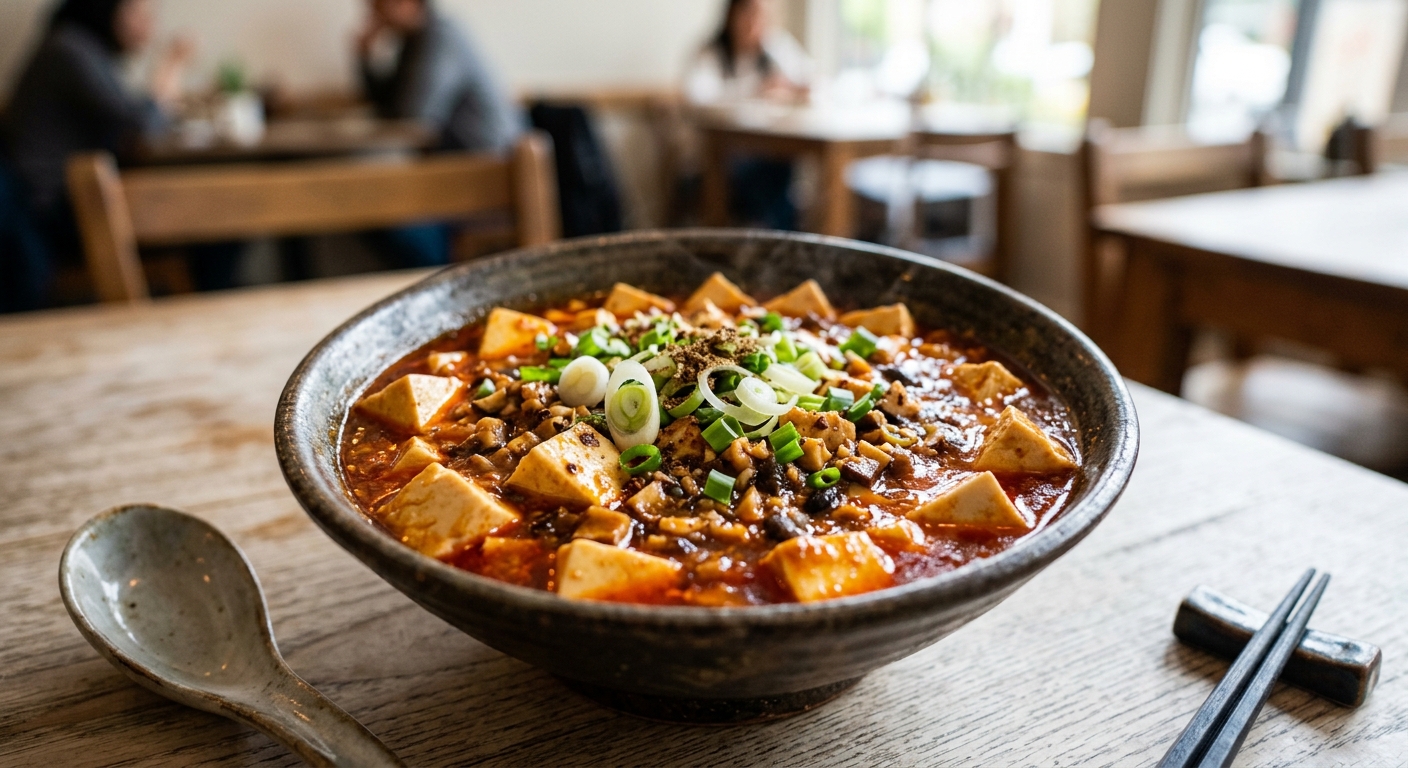
Mapo tofu is one of the great dishes of Sichuan cuisine, a centuries-old preparation that transforms humble tofu into something genuinely thrilling. This version leans fully plant-based, swapping traditional ground pork for umami-rich shiitake mushrooms and fermented black bean paste, while doubling down on the dish’s most nutritionally powerful ingredient: tofu. By using both firm tofu in the sauce base and silken tofu as the finishing element, we capture dramatically different textures while stacking calcium, protein, and bone-supporting minerals into a single bowl.
From a bone health perspective, this dish is a genuine powerhouse. Calcium-set firm tofu and silken tofu together provide over 400mg of calcium per serving, largely from the calcium sulfate coagulant used in their production. That calcium comes packaged alongside magnesium and phosphorus, the two co-factors your body needs to actually incorporate calcium into bone matrix. The dish also supplies meaningful amounts of manganese and vitamin K2 precursors from the fermented bean pastes, both of which activate osteocalcin, the protein that anchors calcium to bone tissue.
Do not let the ingredient list intimidate you. The doubanjiang (fermented chili bean paste) and fermented black beans are available at any Asian grocery store or online, and they are the non-negotiable flavor pillars that no substitution can truly replicate. Once those are in your pantry, this recipe comes together in under 40 minutes on the stovetop. We have also developed genuinely distinct slow cooker and pressure cooker adaptations, each with technique notes specific to how silken tofu behaves under those very different heat environments.
4
servings
Ingredients
- 600 gsilken tofu, cut into 2cm cubes
- 400 gfirm calcium-set tofu, cut into 1.5cm cubes
- 3 tbspdoubanjiang (Sichuan fermented chili bean paste)
- 2 tbspfermented black beans (douchi), rinsed and roughly chopped
- 200 gshiitake mushrooms, stems removed and finely diced
- 4 clovesgarlic, minced
- 1 tbspfresh ginger, finely grated
- 3 stalksgreen onions, white and green parts separated, thinly sliced
- 2 tbspAvocado Oil100% Pure Avocado Oil (such as avocado or rice bran oil)
- 1 tspSichuan peppercorns, toasted and ground
- 1 tspdark soy sauce
- 1 tsplight soy sauce
- 1 tsptoasted sesame oil
- 1 tspsugar
- 480 mllow-sodium vegetable stock
- 2 tbspcornstarch mixed with 3 tbsp cold water (slurry)
- —Colima Sea SaltMicroplastic Free Salt to taste
- —Steamed jasmine or short-grain rice, to serve
- —Extra ground Sichuan peppercorn and sliced green onion tops, to garnish
Instructions
Click on an item below to shop for the recommended items for this recipe on Amazon.
As an Amazon Associate, we earn from qualifying purchases.
- Bring a medium saucepan of lightly salted water to a gentle simmer over medium heat. Carefully lower the silken tofu cubes into the water and poach for 3 minutes. This firms the surface proteins just enough to prevent total collapse during finishing. Lift out with a slotted spoon onto a plate lined with a clean kitchen towel and set aside. Discard the water.
- Heat a wok or large flat-bottomed skillet over high heat until a drop of water instantly evaporates. Add the neutral oil and swirl to coat. Add the doubanjiang and fermented black beans and fry, stirring constantly, for 90 seconds until deeply fragrant and the oil has turned a vivid brick red. This step is called ‘hong you’ and is the flavor foundation of the entire dish.
- Reduce heat to medium-high. Add the diced shiitake mushrooms and stir-fry for 3 to 4 minutes until they release their moisture and begin to brown at the edges. Add the garlic, ginger, and white parts of the green onions and cook for a further 60 seconds, stirring constantly to prevent the garlic from scorching.
- Pour in the vegetable stock, dark soy sauce, light soy sauce, and sugar. Stir to combine and bring to a rolling boil. Carefully add the firm tofu cubes in a single layer and reduce to a vigorous simmer. Cook uncovered for 6 to 8 minutes, gently rocking the pan rather than stirring, to allow the firm tofu to absorb the sauce without breaking apart.
- Give the cornstarch slurry a quick stir, then pour it slowly into the simmering sauce while gently tilting the pan to incorporate. The sauce should thicken to a glossy, lightly viscous consistency within 60 seconds. If it thickens too fast, add a splash of stock.
- Reduce heat to low. Gently nestle the poached silken tofu cubes into the surface of the sauce, spooning a little sauce over each piece. Cover and cook for 2 minutes just to heat through. Do not stir. Drizzle with sesame oil, scatter the green parts of the green onions over the top, and finish with the ground Sichuan peppercorn. Serve immediately over steamed rice.
- Before anything goes into the slow cooker, you must bloom the doubanjiang. Heat the neutral oil in a small skillet over medium heat. Add the doubanjiang and fermented black beans and fry for 90 seconds, stirring constantly, until the oil turns red and the paste smells deeply savory. Scrape the entire contents of the skillet, oil and all, into the slow cooker insert. This step cannot be skipped as the slow cooker cannot reach the temperature needed to properly fry the paste.
- Add the diced shiitake mushrooms, garlic, ginger, white parts of the green onions, firm tofu cubes, vegetable stock, dark soy sauce, light soy sauce, and sugar to the slow cooker. Stir gently to combine everything with the bloomed paste, being careful not to break up the firm tofu. Place the lid on and cook on Low for 2 hours and 30 minutes.
- At the 2 hour 30 minute mark, stir the cornstarch slurry well and pour it into the slow cooker, gently tilting and swirling the insert to distribute it rather than stirring vigorously. Replace the lid and cook for a further 20 minutes on Low, allowing the starch to activate and the sauce to thicken.
- Meanwhile, bring a small saucepan of lightly salted water to a gentle simmer on the stovetop. Poach the silken tofu cubes for 3 minutes to firm them slightly. Lift out carefully with a slotted spoon and set aside.
- Open the slow cooker and gently lay the poached silken tofu cubes across the surface of the thickened sauce. Replace the lid and cook for a final 10 minutes on Low, just enough to heat the silken tofu through without it disintegrating. Drizzle with sesame oil, top with ground Sichuan peppercorn and green onion tops, and serve directly from the insert over steamed rice.
- Set the Instant Pot or electric pressure cooker to Saute mode on High. Add the neutral oil and heat for 1 minute. Add the doubanjiang and fermented black beans and fry, stirring constantly with a heat-safe spatula, for 2 minutes until the oil is deeply red and the paste is fragrant. Add the garlic, ginger, and white parts of the green onions and saute for a further 60 seconds.
- Add the diced shiitake mushrooms and saute for 2 minutes until softened. Pour in the vegetable stock and deglaze the bottom of the pot thoroughly, scraping up any stuck paste with the spatula. This is critical: any residue on the bottom will trigger the burn sensor and prevent pressurization. Add the dark soy sauce, light soy sauce, and sugar and stir to combine.
- Add the firm tofu cubes gently, distributing them evenly in the liquid. Do not add silken tofu at this stage. Cancel the Saute mode, secure the lid, and set the pressure valve to Sealing. Cook on Manual High Pressure for 5 minutes.
- When the cook time ends, perform a quick pressure release by carefully moving the valve to Venting. Once all steam has escaped and the float valve drops, open the lid. The sauce will look thin at this stage, which is expected.
- Switch back to Saute mode on Normal. Stir the cornstarch slurry well and pour it into the pot while stirring gently. Allow the sauce to simmer for 2 to 3 minutes, stirring occasionally, until it thickens to a glossy coating consistency. Cancel Saute mode.
- While the sauce is thickening, poach the silken tofu in a separate small saucepan of gently simmering salted water for 3 minutes to firm the exterior. Carefully transfer the silken tofu cubes into the thickened sauce in the Instant Pot using a slotted spoon. Spoon sauce gently over the top. Let rest for 2 minutes before finishing with sesame oil, ground Sichuan peppercorn, and green onion tops. Serve immediately over rice.
Nutrition Breakdown
Per 1 serving (makes 4)
Vitamins & Minerals
% Daily Value based on a 2,000 calorie diet (FDA reference)
🧬 Essential Amino Acids
% of recommended daily intake (RDA) per serving
🛡 Antioxidant Profile
The Nutrition Science
The calcium story in this dish begins with how tofu is made. Both the firm and silken tofus specified in this recipe use calcium sulfate (gypsum) as a coagulant, a practice dating back over a thousand years in East Asian food culture. Calcium sulfate directly mineralizes the tofu curds during setting, meaning the calcium in tofu is structurally bound within the protein matrix rather than simply dissolved in liquid. This results in a bioavailability rate estimated at 31 to 37 percent, comparable to that of dairy milk and significantly higher than the calcium in many plant foods that are bound by oxalates. The 1kg combined weight of both tofu varieties in this recipe delivers approximately 2,000mg of raw calcium before portioning.
Bone health is rarely about calcium alone. The supporting cast in this dish is equally important. Manganese, supplied primarily by the firm tofu and shiitake mushrooms, is a required cofactor for the enzyme manganese superoxide dismutase (MnSOD), which protects osteoblasts from oxidative stress during the bone remodeling cycle. Phosphorus works in a precise 1:1 to 1:2 molar ratio with calcium in hydroxyapatite crystal formation, the mineral lattice that gives bone its compressive strength. Magnesium converts vitamin D into its active form (calcitriol), which in turn governs calcium absorption at the intestinal wall. When magnesium is deficient, even high dietary calcium intake cannot normalize bone mineral density.
The fermented elements of this dish, the doubanjiang and fermented black beans, contribute beyond flavor. Fermentation increases the bioavailability of zinc and iron by partially breaking down phytic acid, the chelating compound that otherwise binds these minerals in legume-based foods. Research from the Journal of Food Science has demonstrated that lactic acid fermentation of soybean products can reduce phytate content by 30 to 60 percent, meaningfully increasing the fraction of zinc and iron that reaches systemic circulation. Combined with the non-heme iron from both tofu and shiitake mushrooms, this dish provides over 20 percent of the daily iron RDA per serving, supporting the oxygen transport that skeletal muscle and connective tissue require for repair and regeneration.
Pro Tips
- The single most important technique in this recipe is properly blooming the doubanjiang in hot oil before any liquid is added. Frying it in oil for 90 seconds releases fat-soluble flavor compounds, including capsaicin esters and Maillard-reaction byproducts, that do not develop when the paste is simply simmered in water-based liquid. Do not abbreviate this step.
- To cut silken tofu without it crumbling, open the package and drain it, then slide the block onto a cutting board without lifting it directly. Use a sharp knife and a single clean press-cut motion rather than a sawing action. Alternatively, use a bench scraper for perfectly uniform cubes.
- If you cannot find calcium-set tofu (look for ‘calcium sulfate’ in the ingredient list on the package), nigari-set tofu (magnesium chloride coagulant) is the second choice. Avoid tofu coagulated with glucono-delta-lactone only, as it tends to be more acidic, softer, and provides less calcium per gram.
This looks incredible, and I’m so glad someone is highlighting tofu’s calcium content because so many people overlook it. My question is about the choline content here, since silken tofu is great but firmer varieties pack more of it, and I’m always thinking about brain development for my baby. Did you calculate the choline in your two-tofu combo? Also, this screams postpartum recovery meal to me, and I’m genuinely wondering if you’ve tested it as a galactagogue friendly dinner, since the savory umami and the calcium would be amazing for both milk supply and bone recovery after birth.
What a beautiful dish, and I love that you’re shining a light on tofu’s bioavailability of calcium. I’m curious about the spice profile of your mapo sauce, though, because I always think about how Sichuan peppercorns and ginger work together to support digestion and nutrient absorption from plant foods. If you’re using any warming spices like ginger or black pepper in there, that could be amplifying the calcium uptake even further from an Ayurvedic perspective, since those spices kindle agni, our digestive fire. Have you experimented with adding either to your sauce?
Hey Laurie, great question on the choline angle. I’m curious how you’re thinking about choline timing relative to your training, since I’ve been experimenting with it during my recovery windows and noticed some interesting effects on power output metrics the following session. That said, I wonder if the recipe’s two-tofu combo actually hedges that bet well, mixing the silken form for bioavailable calcium with potentially a firmer variety for choline density, though I’d need to see the exact gram amounts to run the numbers on whether it hits optimal ratios for endurance athletes.