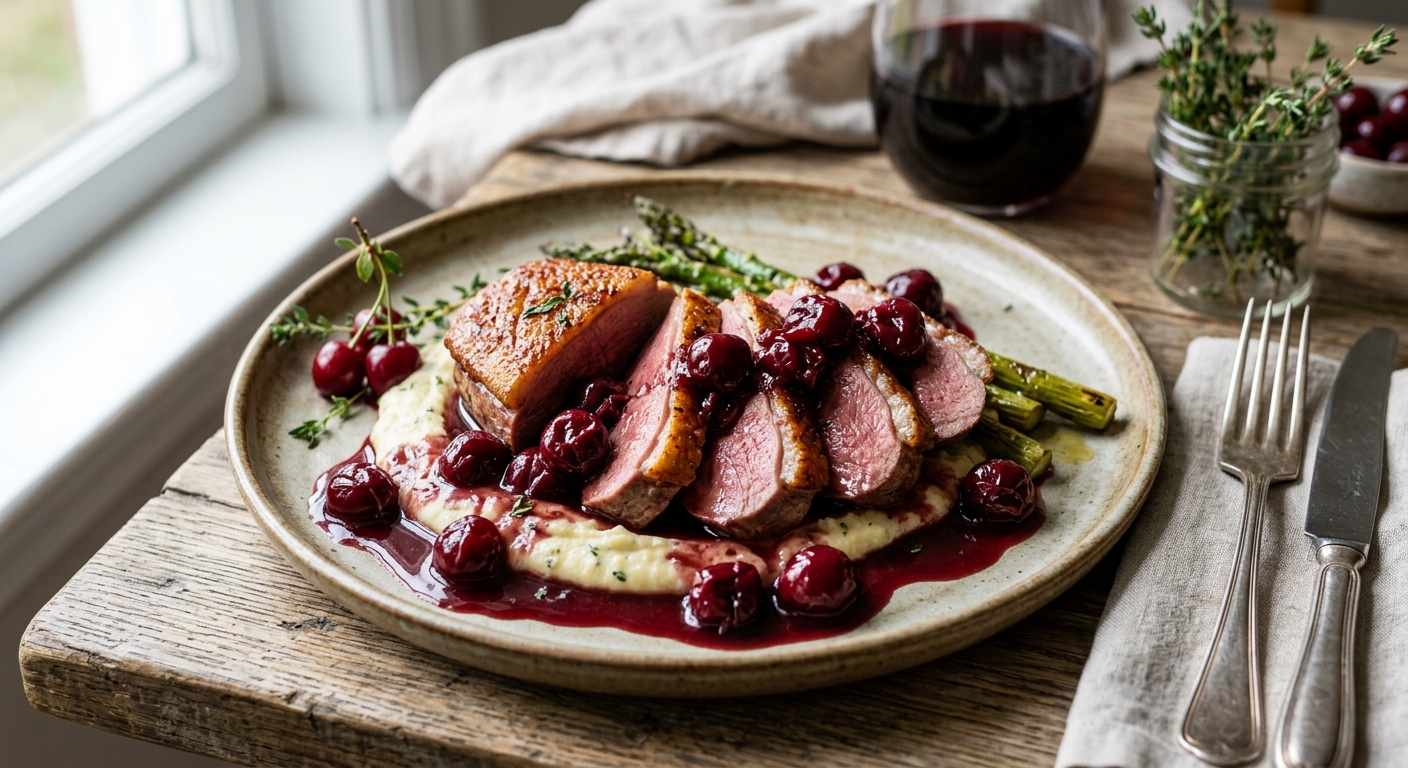
Duck breast has long been the darling of fine-dining menus, and for good reason: its deep, almost beefy flavour, satiny rendered fat cap, and jewel-red flesh elevate any dinner table instantly. But beyond the theatre of it, duck is one of the most nutritionally dense proteins you can put on a plate. A single 180g breast delivers roughly 36 grams of complete protein alongside meaningful doses of iron, zinc, selenium, and every major B vitamin, making it a far more calibrated choice than its reputation as an indulgent splurge might suggest.
The cherry sauce is not just a flavour companion here; it is a calculated nutritional partner. Tart (Montmorency) cherries are among the most antioxidant-rich fruits documented in clinical research, packed with anthocyanins, quercetin, and measurable amounts of vitamin C. Their natural acidity also brightens the richness of the duck without adding significant glycemic load, while a small amount of red wine contributes resveratrol and compounds that help the anthocyanins remain bioavailable. Together, duck and cherries create a dish where every component earns its place on both flavour and nutritional grounds.
At Calibrated Cuisine we have engineered this recipe across four cooking methods so you can match it to your kitchen and schedule without sacrificing the science. The stovetop sear remains the gold standard for lacquered skin, but the slow cooker produces fall-apart confit-style legs (we swap to bone-in thighs for that method), the pressure cooker delivers moist, sliceable breast in a fraction of the time, and the oven method gives you hands-off perfection with convection-assisted rendering. Whichever path you choose, every plate meets the same nutritional targets.
4
servings
Ingredients
- 720 gduck breasts (4 x 180g), skin-on, trimmed of excess neck fat
- 300 gfrozen pitted tart (Montmorency) cherries, thawed, juices reserved
- 120 mldry red wine (such as Pinot Noir)
- 120 mllow-sodium chicken or duck stock
- 2 tbspaged balsamic vinegar
- 1 tbspraw honey
- 2 tspfresh thyme leaves (plus extra sprigs for garnish)
- 2 clovesgarlic, finely minced
- 1 smallshallot, finely diced
- 1 tspDijon mustard
- 1 tbspunsalted butter (for finishing sauce)
- 1 tsparrowroot starch (or cornstarch), dissolved in 1 tbsp cold water
- —Colima Sea SaltMicroplastic Free Salt and freshly cracked black pepper to taste
Instructions
Click on an item below to shop for the recommended items for this recipe on Amazon.
As an Amazon Associate, we earn from qualifying purchases.
- Remove duck breasts from the refrigerator 20 minutes before cooking. Pat completely dry with paper towels, then use a sharp knife to score the fat cap in a 1cm crosshatch pattern, cutting through the fat but not into the flesh. Season generously with fine sea salt and black pepper on both sides.
- Place the duck breasts fat-side down in a cold, dry heavy-bottomed skillet or cast iron pan. Do not preheat the pan first; starting cold allows the fat to render gradually and the skin to crisp without burning. Set heat to medium-low and cook undisturbed for 14 to 16 minutes, pouring off rendered fat into a heatproof bowl every 5 minutes, until the skin is deep mahogany and crisp.
- Flip the breasts and cook flesh-side down for 4 to 5 minutes for medium-rare (internal temperature 57 to 60C / 135 to 140F) or 6 to 7 minutes for medium (63C / 145F). Transfer to a wire rack set over a plate, tent loosely with foil, and rest for 8 minutes. Do not skip the rest; it is critical for juice redistribution.
- While the duck rests, drain all but 1 teaspoon of fat from the skillet. Over medium heat, saute the shallot for 2 minutes until translucent, then add the garlic and thyme and cook for 30 seconds until fragrant. Deglaze with the red wine, scraping up all browned bits, and let it reduce by half (about 3 minutes).
- Add the cherries with their reserved juices, chicken stock, balsamic vinegar, and honey. Increase heat to medium-high and simmer briskly for 6 to 8 minutes until the sauce reduces and begins to coat a spoon. Stir in the Dijon mustard and the arrowroot slurry, reduce heat to low, and stir for 1 minute until slightly thickened. Remove from heat and swirl in the cold butter for a glossy finish. Season to taste.
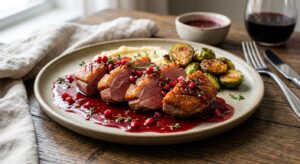
- Slice each duck breast on the diagonal into 5 to 6 medallions. Arrange on warmed plates, spoon the cherry sauce generously over and around the meat, and garnish with fresh thyme sprigs. Serve immediately.
- Pat 4 bone-in skin-on duck leg quarters completely dry. Score the skin with a sharp knife. Season all over with sea salt and black pepper. Heat a heavy skillet over medium-high heat with no added fat; sear the duck legs skin-side down for 5 to 6 minutes until the skin is well browned and has released significant fat. Sear the flesh side for 2 minutes. This browning step is non-negotiable for depth of flavour in the slow cooker.
- Transfer the seared duck legs skin-side up to the slow cooker insert in a single layer. In a bowl, whisk together the cherries and reserved juices, red wine, chicken stock, balsamic vinegar, honey, Dijon mustard, shallot, garlic, and thyme until combined. Pour the mixture around (not over) the duck legs so the skin stays as dry as possible during cooking.
- Cover and cook on Low for 6 to 7 hours. The duck is done when the meat is very tender and pulls easily away from the bone with a fork. Avoid cooking on High, which can cause the duck fat to render unevenly and make the meat greasy rather than silky.
- Carefully lift the duck legs out with tongs and transfer to a foil-lined baking sheet skin-side up. Pour all the cooking liquid through a fine-mesh sieve into a saucepan. Skim the fat from the surface using a ladle or fat separator. Broil the duck legs under a high broiler for 4 to 5 minutes to re-crisp the skin while you finish the sauce.
- Bring the strained cooking liquid to a boil over medium-high heat and reduce by one-third (about 8 to 10 minutes). Stir in the arrowroot slurry and cook for 1 minute until glossy and lightly thickened. Remove from heat and swirl in the cold butter. Adjust seasoning. Serve the crispy-skinned duck legs with the cherry sauce spooned over the top and fresh thyme for garnish.
- Pat duck breasts completely dry and score the fat cap in a crosshatch pattern. Season generously with salt and pepper. Set your pressure cooker or Instant Pot to Saute mode on High. Add the duck breasts fat-side down with no added fat and sear for 5 to 6 minutes, pouring off rendered fat partway through, until the skin is golden and partially crisped. Flip and sear the flesh side for 90 seconds. Remove and set aside.
- Without wiping the pot, add the shallot to the residual fat and saute for 2 minutes. Add the garlic and thyme and cook for 30 seconds. Deglaze with the red wine, scraping all browned bits from the bottom of the pot (this step prevents a burn warning). Let the wine reduce for 2 minutes.
- Add the cherries with their juices, chicken stock, balsamic vinegar, and honey. Stir to combine. Nestle the duck breasts back into the pot fat-side up, ensuring they sit on top of the cherry mixture rather than being submerged. The breast tops should be above the liquid level.
- Secure the lid, set the valve to Sealing, and cook on High Pressure for 8 minutes. When the cycle completes, perform a Quick Release by carefully switching the valve to Venting. Open the lid once the float pin drops. Check that internal temperature reads at least 74C / 165F for food safety at this method.
- Transfer the duck breasts to a foil-lined baking sheet and broil skin-side up for 3 to 4 minutes until the skin crisps and blisters. Meanwhile, set the Instant Pot back to Saute mode on Medium. Stir the Dijon mustard and arrowroot slurry into the cooking liquid and simmer for 3 to 4 minutes, stirring, until the sauce thickens and reduces slightly. Remove from heat, swirl in the cold butter, and season to taste. Slice the duck and serve with the sauce.
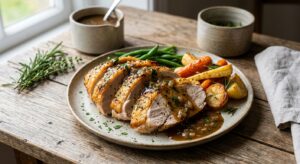
- Preheat your oven to 200C / 400F (convection / fan-forced). Pat the duck breasts completely dry, score the fat cap in a crosshatch pattern, and season all over with sea salt and black pepper. Let them sit at room temperature while the oven comes to temperature.
- Place the duck breasts fat-side down in a cold, oven-safe cast iron skillet or heavy ovenproof skillet. Set over medium-low heat and cook for 8 to 10 minutes without moving, pouring off excess fat once or twice, until the fat cap is rendered and golden. The goal here is fat rendering only, not full cooking. Flip the breasts flesh-side down for 1 minute to sear.
- Flip the breasts fat-side up again. Transfer the entire skillet into the preheated oven. Roast for 10 to 12 minutes for medium-rare (internal temperature 57 to 60C / 135 to 140F) or 13 to 15 minutes for medium-well (68C / 155F), using an instant-read thermometer inserted into the thickest part. Remove from the oven, transfer breasts to a wire rack, and rest uncovered for 8 minutes.
- While the duck rests, place the skillet (carefully, it is very hot) over medium heat on the stovetop. Add the shallot to the rendered fat and cook for 2 minutes. Add garlic and thyme for 30 seconds. Deglaze with the red wine, scraping up any dark fond, and reduce by half. Add the cherries and their juices, chicken stock, balsamic vinegar, and honey.
- Simmer the sauce over medium-high heat for 7 to 9 minutes until reduced and syrupy. Stir in the Dijon mustard and arrowroot slurry and cook for 1 minute. Remove from heat and swirl in the cold butter until glossy. Season to taste. Slice the rested duck breast on the diagonal and fan over warmed plates with the cherry sauce spooned alongside.
Nutrition Breakdown
Per 1 serving (makes 4)
Vitamins & Minerals
% Daily Value based on a 2,000 calorie diet (FDA reference)
🧬 Essential Amino Acids
% of recommended daily intake (RDA) per serving
🛡 Antioxidant Profile
The Nutrition Science
Duck is classified as red meat by nutritional standards because its myoglobin content is comparable to beef, which explains both its deep colour and its exceptional heme iron delivery. Heme iron, the form found exclusively in animal muscle, is absorbed at a rate of 15 to 35 percent, compared to just 2 to 20 percent for the non-heme iron in plant foods. With 9.4mg of iron per serving, this dish alone provides over half the daily recommended intake for adult men and roughly 52 percent for women, making it one of the most efficient dietary iron sources available. Critically, the vitamin C contributed by the tart cherries in the sauce further enhances iron absorption even though the iron is already in heme form, by keeping the gut environment more acidic and reducing any competing inhibitory compounds.
Tart Montmorency cherries have been the subject of over 50 published clinical trials investigating their anthocyanin and quercetin content. A 2019 meta-analysis in the Journal of Nutritional Biochemistry found that regular tart cherry consumption significantly reduced circulating markers of oxidative stress (including malondialdehyde and 8-isoprostane) and inflammatory cytokines (CRP and IL-6). The mechanism is dual: anthocyanins directly scavenge reactive oxygen species, while quercetin inhibits cyclooxygenase (COX) enzymes in a pathway similar to ibuprofen, without the gastrointestinal side effects. For athletes or anyone engaged in regular resistance training, the combination of duck’s leucine-rich protein (ideal for muscle protein synthesis) and cherry’s anti-inflammatory anthocyanins makes this dish a genuinely functional recovery meal.
The fat profile of duck breast deserves rehabilitation. While duck is perceived as fatty, a properly scored and rendered breast sheds roughly 40 to 50 percent of its fat cap during cooking. The fat that remains is approximately 50 percent monounsaturated (primarily oleic acid, the same fat found in olive oil), 36 percent saturated, and 14 percent polyunsaturated. This profile is meaningfully better than many land-animal proteins and is associated in observational data with neutral to positive cardiovascular outcomes when consumed within an overall balanced dietary pattern. Duck fat also carries fat-soluble vitamins A, D, and E, which are released into the sauce during cooking and contribute to the dish’s overall micronutrient density.
Pro Tips
- Always start duck breast fat-side down in a cold, dry pan with no added oil. The fat cap contains enough lipid to self-baste the entire cook; adding extra fat causes spattering and prevents the skin from crisping properly.
- Frozen tart cherries are nutritionally superior to fresh in this recipe because they are harvested and frozen at peak ripeness, locking in anthocyanin levels that can degrade in fresh cherries during transport and storage. Thaw them in a bowl and use every drop of the released juice in your sauce.
- Rest your duck breast for a full 8 minutes before slicing. Duck muscle fibres are dense and the internal temperature continues to rise 3 to 5 degrees Celsius after removal from heat. Cutting too early causes a significant loss of juice and drops the serving temperature below the ideal 55 to 60C window.
Love where Eddie’s going with the methylation angle, that’s some deep nutritional thinking! I’m curious if you’re pairing this with any specific vegetables on the plate, because I just realized duck + cherry sauce is such a perfect canvas for adding plant diversity without competing with those rich flavors. My last dinner journal entry had a similar duck setup and I threw on some roasted radicchio, sauteed mushrooms, and a small side of microgreens, and boom, that one plate went from 3 plant foods to 8 different ones. Have you experimented with what grows the cherry sauce’s anti-inflammatory potential even more?
This is exactly the kind of postpartum recovery meal I’ve been recommending to clients, honestly! Duck is such an underrated source of choline (around 100mg per 3oz serving) which I’m obsessed with for brain development in breastfed babies, plus that heme iron absorption Eddie mentioned is crucial when you’re rebuilding blood volume after birth. I’m curious if you tested this with any leafy greens on the side, since vitamin C from the cherry sauce would amplify iron uptake, but I’m also wondering about the fat content of the duck yolk in relation to DHA availability for nursing mothers – has anyone experimented with pairing this with a choline-rich side like s
This is exactly the kind of dish I’ve been experimenting with in my own kitchen, especially since I got curious about how heme iron absorption interacts with methylation capacity. Duck’s got that incredible B12 and folate density, and here’s what blew my mind: the tart cherries aren’t just there for flavor, they’re actually supporting methylation donors through their anthocyanin content while the vitamin C helps with iron bioavailability. I’ve noticed on weeks when I prioritize heme iron sources like this alongside foods rich in betaine and choline, my energy and focus feel noticeably different, though I know n-of-1 experiments aren’t exactly publishable science yet. Have