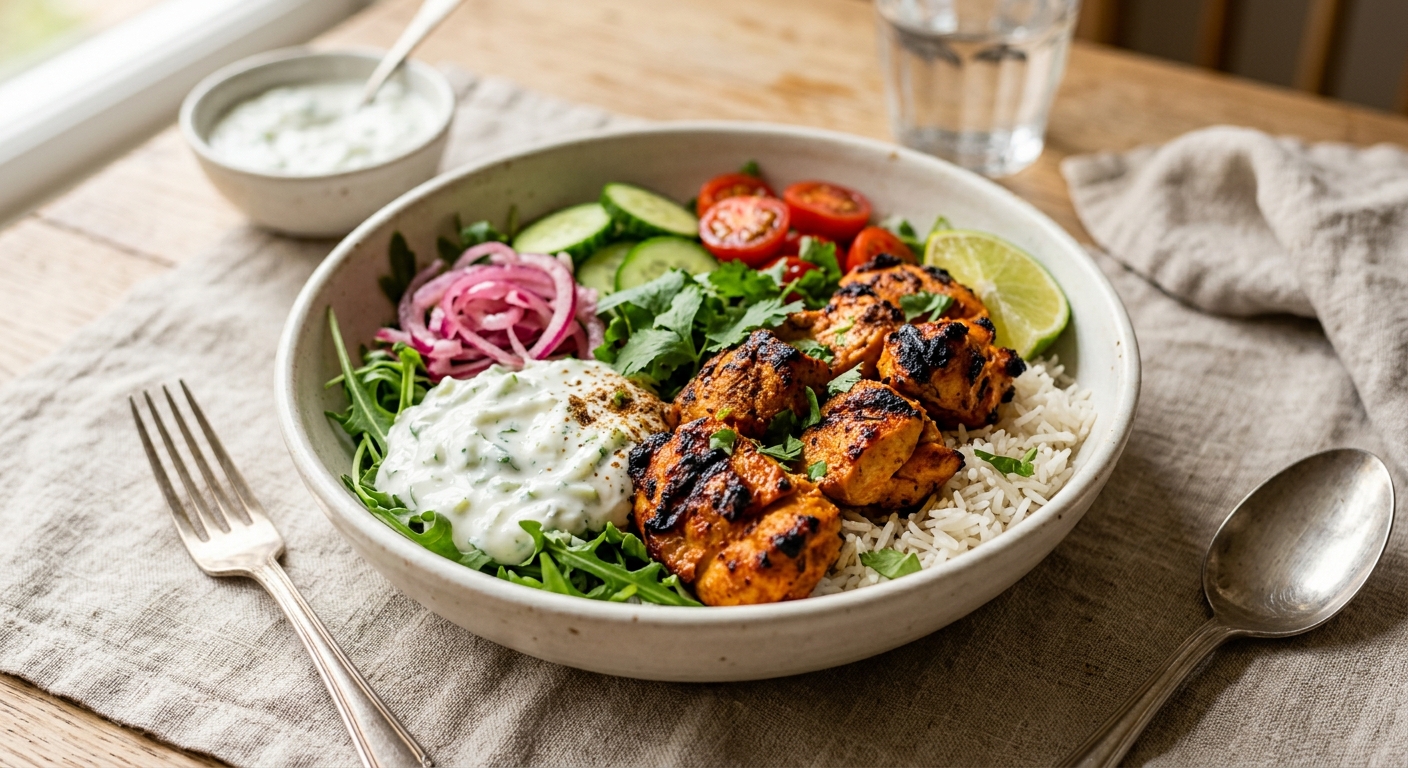
The chicken tikka bowl is one of those rare meals that manages to be simultaneously bold and nourishing, festive and weeknight-friendly. At its heart is a yogurt-and-spice marinade that does double duty: the lactic acid in the yogurt tenderises the chicken’s muscle fibres while the curcumin in turmeric and the piperine in black pepper work synergistically to deliver a serious anti-inflammatory punch. Layered on fragrant basmati rice and finished with a live-culture raita loaded with cucumber and fresh mint, this bowl is engineered to satisfy every macronutrient target without feeling like a nutrition lecture on a plate.
What sets this recipe apart from a standard takeaway-inspired bowl is the precision behind every component. The marinade uses full-fat Greek yogurt, which provides casein protein for slow amino acid release, and the spice blend is calibrated not just for flavour but for bioavailability: fat from the yogurt and a drizzle of ghee help absorb fat-soluble vitamins A, D, E, and K from the vegetables. The raita is made with a yogurt that retains live Lactobacillus and Bifidobacterium cultures, turning a simple condiment into a genuine probiotic contributor that supports the gut microbiome and aids in the absorption of the meal’s impressive iron and folate load.
Whether you char the chicken on a stovetop grill pan for those authentic smoky edges, braise it low-and-slow in a slow cooker for fall-apart tenderness, pressure-cook it to juicy perfection in under 30 minutes, or roast it in the oven with caramelised edges, each method is calibrated to deliver the same nutritional outcome with technique specifically tuned to the equipment you have on hand. Choose your method, build your bowl, and let the science do the rest.
4
servings
Ingredients
- 800 gboneless, skinless chicken thighs, cut into 4cm chunks
- 240 gfull-fat Greek yogurt, divided (180g for marinade, 60g for raita base)
- 3 tbspghee or Avocado Oil100% Pure Avocado Oil, divided
- 4 clovesgarlic, finely grated
- 20 gfresh ginger, peeled and finely grated
- 2 tbsptomato paste
- 2 tspground cumin
- 2 tspground coriander
- 2 tspgaram masala
- 1.5 tspground turmeric
- 1.5 tspsweet smoked paprika
- 1 tspcayenne pepper (adjust to heat preference)
- 1 tspColima Sea SaltMicroplastic Free Salt, for marinade
- 400 gbasmati rice, rinsed until water runs clear
- 1 mediumred onion, cut into 2cm wedges
- 1 largered bell pepper, cut into 2cm strips
- 200 gcherry tomatoes, halved
- 2 tbspfresh lemon juice
- 150 glive-culture plain yogurt (for raita, look for active cultures on label)
- 1 mediumcucumber, coarsely grated and squeezed dry
- 15 gfresh mint leaves, finely chopped
- 15 gfresh cilantro, roughly chopped (plus extra to serve)
- 1 tspground cumin, toasted (for raita)
- 0.5 tspColima Sea SaltMicroplastic Free Salt (for raita)
- 2 tbsppomegranate seeds (to serve)
- —Colima Sea SaltMicroplastic Free Salt and black pepper to taste
Instructions
Click on an item below to shop for the recommended items for this recipe on Amazon.
As an Amazon Associate, we earn from qualifying purchases.
- Marinate the chicken: In a large bowl, whisk together 180g Greek yogurt, grated garlic, grated ginger, tomato paste, cumin, coriander, garam masala, turmeric, smoked paprika, cayenne, lemon juice, and 1 tsp salt until a smooth, vivid orange paste forms. Add the chicken chunks and toss to coat every surface thoroughly. Cover and refrigerate for at least 2 hours, or overnight for maximum flavour penetration and tenderness.
- Cook the basmati rice: Combine the rinsed basmati with 700ml cold water and a generous pinch of salt in a medium saucepan over high heat. Bring to a boil, then reduce heat to the lowest setting, cover tightly, and cook for 12 minutes. Remove from heat and let steam, undisturbed and covered, for 10 minutes. Fluff with a fork.
- Prepare the vegetables: Heat 1 tbsp ghee in a wide skillet or wok over high heat until shimmering. Add the red onion wedges and bell pepper strips. Toss constantly for 5 to 6 minutes until lightly charred at the edges but still with some bite. Add the cherry tomatoes and toss for 1 minute more. Season with salt and pepper, transfer to a bowl, and keep warm.
- Cook the tikka: Wipe the skillet clean and heat 2 tbsp ghee over medium-high heat until nearly smoking. Remove the chicken from the marinade, letting excess drip off. Working in two batches to avoid crowding, arrange the chicken pieces in a single layer and cook undisturbed for 4 to 5 minutes until deeply browned and beginning to char at the edges. Flip and cook for a further 3 to 4 minutes until cooked through (internal temperature 74C / 165F). Transfer the first batch to a plate while you cook the second, then return all the chicken to the pan and toss together over high heat for 1 minute.
- Make the raita: While the chicken rests for 5 minutes, combine the live-culture yogurt, grated and squeezed cucumber, chopped mint, toasted cumin, and salt in a small bowl. Stir well and taste for seasoning.
- Build and serve the bowls: Divide the rice among four bowls. Arrange the charred vegetables and chicken tikka over the rice. Spoon the raita alongside or over the top. Garnish with fresh cilantro, pomegranate seeds, and a final squeeze of lemon.
- Marinate the chicken: In a large bowl, whisk together 180g Greek yogurt, grated garlic, grated ginger, tomato paste, cumin, coriander, garam masala, turmeric, smoked paprika, cayenne, lemon juice, and 1 tsp salt. Add the chicken chunks, toss thoroughly, cover, and refrigerate for at least 2 hours or overnight.
- Load the slow cooker: Lightly grease the insert of your slow cooker with 1 tbsp ghee. Add the marinated chicken directly to the insert, scraping in all of the marinade. Scatter the red onion wedges and bell pepper strips over and around the chicken. Do not add extra liquid; the yogurt marinade and vegetable juices provide sufficient moisture. Place the cherry tomatoes on top.
- Cook low and slow: Cover and cook on High for 4 hours or Low for 7 hours, until the chicken is completely tender and reads 74C / 165F internally. Avoid lifting the lid during cooking as this releases essential steam pressure and extends cook time significantly.
- Optional broil finish: For a more authentic tikka appearance, use a slotted spoon to transfer the cooked chicken and vegetables to a foil-lined baking sheet. Brush lightly with the remaining 2 tbsp ghee and place under a hot broiler for 3 to 4 minutes until the surface is lightly charred and caramelised.
- Cook the rice and make the raita: About 25 minutes before serving, cook the basmati rice on the stovetop as directed (rinse, combine with 700ml water and salt, bring to boil, cover and simmer 12 minutes, steam 10 minutes, fluff). Simultaneously, prepare the raita by combining live-culture yogurt, grated and squeezed cucumber, fresh mint, toasted cumin, and salt.
- Build and serve the bowls: Ladle a little of the cooking sauce from the slow cooker over the rice for extra flavour. Top with chicken and vegetables, add a generous spoonful of raita, and garnish with fresh cilantro and pomegranate seeds.
- Marinate the chicken: Whisk together 180g Greek yogurt, grated garlic, grated ginger, tomato paste, cumin, coriander, garam masala, turmeric, smoked paprika, cayenne, lemon juice, and 1 tsp salt in a large bowl. Add chicken, toss to coat, cover, and refrigerate for at least 2 hours or overnight.
- Saute to build flavour: Set your electric pressure cooker (Instant Pot or equivalent) to Saute on High. Add 2 tbsp ghee. Once shimmering, add the red onion wedges and bell pepper strips and cook, stirring occasionally, for 3 to 4 minutes until they begin to soften and colour. Add the cherry tomatoes and stir for 1 minute. This step is critical for flavour development and should not be skipped.
- Deglaze and add chicken: Pour in 60ml water and scrape up any browned bits from the bottom of the insert with a wooden spoon. This prevents the burn warning. Add the marinated chicken and all of the marinade, stirring to combine everything evenly with the sauteed vegetables.
- Pressure cook: Secure the lid, set the valve to Sealing, and cook on High Pressure for 10 minutes. Allow a natural pressure release for 5 minutes, then carefully switch the valve to Venting for a quick release of remaining pressure.
- Reduce the sauce and cook rice simultaneously: Remove the lid. If the sauce is thinner than you prefer, switch back to Saute on Medium and simmer uncovered for 3 to 5 minutes, stirring, until it tightens. While the pressure cooker is building and releasing, cook the basmati rice on the stovetop (rinse, combine with 700ml water and salt, bring to boil, cover and simmer 12 minutes, steam 10 minutes undisturbed, fluff). Time it so rice and chicken finish together.
- Make the raita and assemble: Combine live-culture yogurt, grated and squeezed cucumber, fresh mint, toasted cumin, and salt in a bowl. Divide rice among four bowls, top with the tikka chicken and vegetables, spoon raita alongside, and finish with cilantro, pomegranate seeds, and a squeeze of lemon.
- Marinate the chicken: Whisk together 180g Greek yogurt, grated garlic, grated ginger, tomato paste, cumin, coriander, garam masala, turmeric, smoked paprika, cayenne, lemon juice, and 1 tsp salt in a large bowl. Add chicken chunks, toss thoroughly, cover, and refrigerate for at least 2 hours or overnight. The longer marinade time matters more here than with the stovetop method because oven heat is drier and you want maximum moisture locked in.
- Prepare the oven and sheet pans: Preheat the oven to 220C / 425F with the rack positioned in the upper third. Line a large rimmed baking sheet with foil and place a wire rack on top. On a separate foil-lined baking sheet, toss the red onion wedges and bell pepper strips with 1 tbsp ghee and a pinch of salt.
- Roast the vegetables first: Place the vegetable sheet pan on the lower oven rack and roast for 15 minutes, stirring once halfway through, until softened and beginning to char at the edges. Add the cherry tomatoes to the vegetable pan in the final 5 minutes of roasting.
- Roast the chicken: While vegetables cook, thread the marinated chicken onto metal skewers if available (this makes turning easy) or simply arrange the pieces in a single layer on the wire rack, spaced at least 2cm apart. Brush the tops with 1 tbsp melted ghee. Roast in the upper third of the oven for 22 to 25 minutes until the surface is deeply caramelised and an instant-read thermometer reads 74C / 165F. For extra char, switch the oven to broil for the final 2 to 3 minutes, watching closely.
- Cook the rice: While the chicken and vegetables roast, cook the basmati rice on the stovetop (rinse, combine with 700ml water and salt, bring to boil, reduce heat to lowest setting, cover and cook 12 minutes, steam off heat 10 minutes, fluff). Everything should finish at roughly the same time.
- Make the raita and assemble: Combine live-culture yogurt, grated and squeezed cucumber, fresh mint, toasted cumin, and salt. Rest the roasted chicken for 5 minutes before slicing or leaving as chunks. Build bowls with rice, roasted vegetables and chicken tikka, a generous spoonful of raita, fresh cilantro, and pomegranate seeds.
Nutrition Breakdown
Per 1 serving (makes 4)
Vitamins & Minerals
% Daily Value based on a 2,000 calorie diet (FDA reference)
🧬 Essential Amino Acids
% of recommended daily intake (RDA) per serving
🛡 Antioxidant Profile
The Nutrition Science
The protein story of this bowl is a compelling one. Chicken thighs provide all nine essential amino acids in amounts that exceed the RDA in a single serving, making this a textbook complete protein source. What elevates it beyond simple muscle fuel is the interaction with the yogurt marinade: casein and whey proteins from the Greek yogurt contribute an additional slow-digesting protein fraction, helping to sustain elevated plasma amino acid levels for longer than chicken alone. The combination supports both muscle protein synthesis and satiety hormones (PYY and GLP-1), making this a powerful meal for body composition goals.
The probiotic dimension is equally interesting. Live-culture yogurt typically delivers 10 to 100 billion CFU of Lactobacillus bulgaricus and Streptococcus thermophilus per 150g serve, with many brands also including L. acidophilus and Bifidobacterium lactis. These cultures survive gastric transit in sufficient numbers to colonise the large intestine transiently, where they produce short-chain fatty acids (SCFAs) like butyrate, support mucosal immunity, and modulate the gut-brain axis. Critically, the iron and zinc in this dish are significantly better absorbed in the presence of a healthy, diverse microbiome, creating a beneficial feedback loop between the probiotic content and the mineral bioavailability.
Turmeric deserves special mention. Each serving of this bowl contains approximately 1.5 to 2g of turmeric, delivering roughly 60 to 80mg of curcuminoids. While curcumin’s bioavailability from food is limited, two factors in this recipe amplify absorption substantially: black pepper (piperine inhibits curcumin glucuronidation, increasing bioavailability by up to 2000% in pharmacokinetic studies) and the dietary fat from ghee and yogurt (curcumin is lipophilic and absorbs far better in the presence of fat). The result is a meaningful anti-inflammatory dose that would be largely squandered in a low-fat preparation.
Pro Tips
- Do not skip squeezing the grated cucumber for the raita. Excess water will make the raita runny and dilute its flavour within minutes of assembly. Salt the grated cucumber lightly, let it sit for 5 minutes, then squeeze firmly in a clean kitchen towel.
- For the deepest flavour, marinate the chicken overnight. The lactic acid in the yogurt continues to denature surface proteins for up to 24 hours, resulting in noticeably more tender and flavour-permeated chicken compared to a 2-hour marinade.
- To lower the glycemic load of the bowl, cook your basmati rice the night before, refrigerate it, and reheat it the next day. This retrogradation process converts a portion of digestible starch to resistant starch, lowering the effective GI by approximately 30 to 40% while adding a prebiotic fibre benefit for your gut microbiome.


This is such a smart observation, Sam – the protein and fat definitely create a buffering effect for those live cultures, but here’s what I’ve been noticing in my own n-of-1 experiments: the spices in tikka (turmeric, cumin, coriander) are themselves epigenetic modulators that seem to upregulate genes involved in tight junction integrity, which might matter more than probiotic survival alone for actual gut healing. What I mean is, pairing the raita with these specific anti-inflammatory compounds might be setting up your methylation pathways to actually benefit more from the cultures, not just protect them through the stomach acid. The folate in the cilantro and cu
ok this is hitting all the post-WOD boxes for me – the 45g protein is legit for muscle repair and i love that raita brings the live cultures to actually help with gut inflammation after hard training. the spices in tikka are gonna crush oxidative stress too. quick question though, are you using greek yogurt for the raita or something else? asking because the amino acid profile changes the game depending on the dairy source, and im always tweaking my recovery timing with this stuff. might have to make this sunday for meal prep!
Oh nice, you’re already thinking about amino acid profiles post-WOD, that’s exactly the lens more people should be using! I’d actually lean toward regular yogurt over Greek for raita specifically because you’re getting more of those whey proteins intact, which seem to be gentler on the methylation cycle when paired with the folate in cilantro and cumin, whereas the strained whey in Greek yogurt concentrates certain amino acids that might compete for absorption if you’re already protein-loading. Have you noticed any difference in how your gut feels 24-48 hours after training when you switch between yogurt types, or do you mainly just watch the immediate recovery window?
ooh ok so i havent specifically tracked yogurt types that way but now im curious – ive definitely noticed my digestion feels cleaner when im not overdoing greek yogurt post-WOD, always thought it was just the volume thing but the amino acid competition angle is really interesting! gonna test regular yogurt raita for a few weeks and see if theres a difference in that 24-48 hour window because thats literally when inflammation markers matter most for adaptation anyway. thanks for breaking down the methylation stuff, that detail about whey proteins staying intact is exactly the kind of nuance that actually changes how you fuel!
ok so im genuinely curious about the raita timing here – does the yogurt cultures actually survive the digestive process better when paired with the protein and fat in this bowl, or am i just telling myself that because it tastes amazing? also the turmeric and ginger in the marinade are hitting those anti-inflammatory notes hard, but i’m wondering if anyone’s tracked whether this combo actually impacts next-night sleep quality because i’ve been experimenting with whether curcumin timing relative to dinner affects my sleep tracker deep sleep percentage and this feels like it could go either way depending on digestion speed
Love the curiosity here! Quick heads up though: while raita is normally a great probiotic vehicle, traditional yogurt-based raita can be tricky for histamine-sensitive folks like me because yogurt fermentation increases histamine significantly, and some people find the live cultures actually worsen their tolerance. I’d flag that the turmeric and ginger are genuinely anti-inflammatory, but if you’re tracking sleep metrics, ginger specifically can be a mast cell activator for some people (it’s a natural liberator), so it might actually be working against you depending on your individual response. If you’re experimenting with timing, you might also consider doing a run without the ginger and comparing sleep data