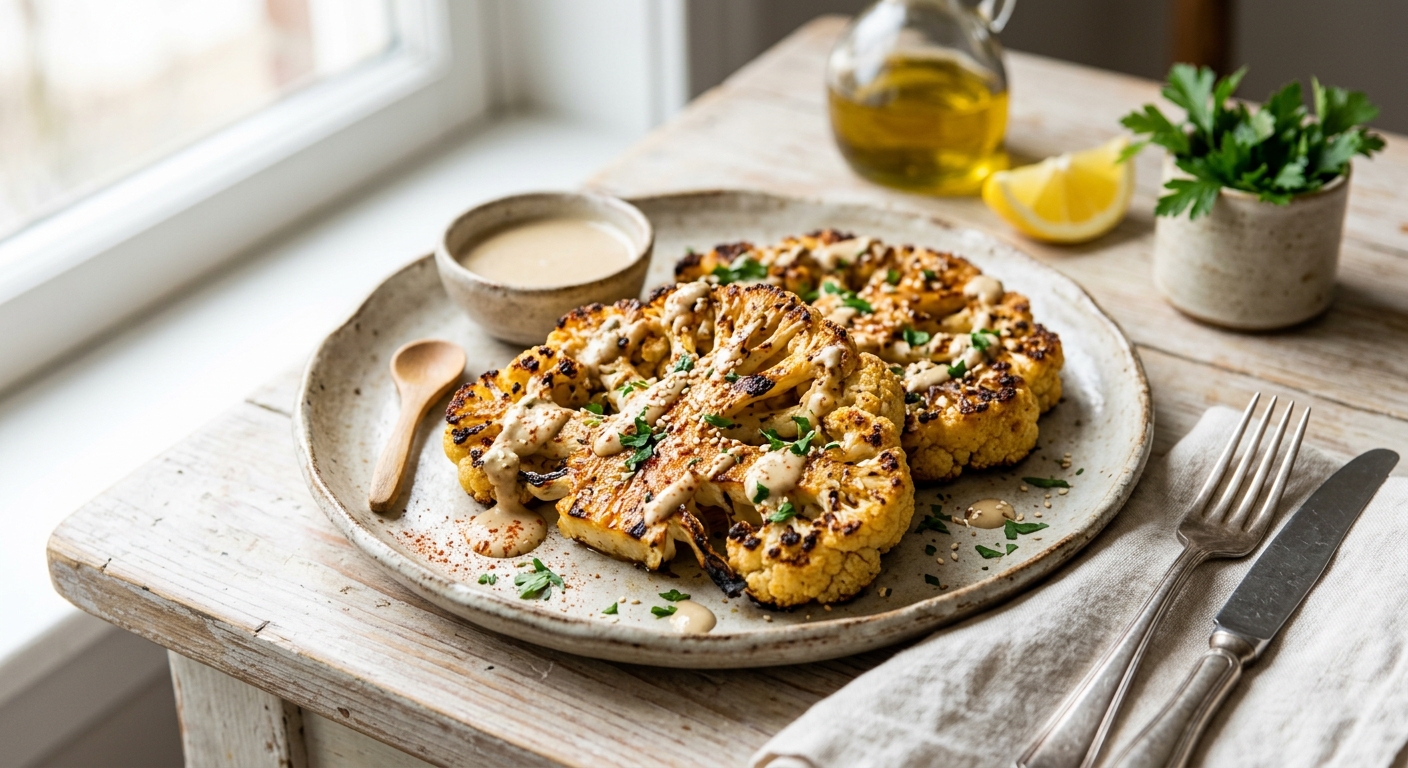
Cauliflower rarely gets its moment in the spotlight as a bone-health powerhouse, yet a single large head contains meaningful amounts of vitamin K1, vitamin C, and calcium, all of which play direct roles in skeletal mineralization and collagen synthesis. Pair that with tahini, one of the most calcium-dense condiments on the planet at roughly 130mg of calcium per two tablespoons, and you have a dish that is working hard on the inside while looking spectacular on the outside.
The “steak” cut is more than a culinary flourish. Slicing the cauliflower through the core into thick cross-sections keeps the florets intact and creates two broad flat surfaces that caramelize beautifully under high heat, developing complex nutty, slightly sweet Maillard flavors that no floret roast can replicate. The lemon-tahini sauce ties everything together with bright acidity, creamy richness, and an additional calcium contribution from the sesame paste itself. A finish of toasted sesame seeds, fresh flat-leaf parsley, and a dusting of smoked paprika adds color, crunch, and a gentle hit of additional antioxidants.
This recipe was engineered for the Calibrated Cuisine Bone and Joint category, meaning every ingredient was chosen with skeletal support in mind. Garlic and lemon juice enhance non-heme mineral absorption. The olive oil used for searing helps the body absorb fat-soluble vitamin K2 precursors present in the tahini. Even the smoked paprika contributes trace manganese, a mineral essential for the enzymes that build cartilage matrix. This is not health food dressed up as real food. It is simply real food that happens to be extraordinary for your bones.
4
servings
Ingredients
- 1 large headcauliflower (approximately 900g), leaves trimmed, stem trimmed flat
- 80 gtahini (sesame paste), well stirred
- 60 mlfresh lemon juice (from about 2 lemons)
- 3 tbspextra-virgin olive oil, divided
- 3 clovesgarlic, 2 minced and 1 left whole for sauce
- 60 mlwarm water
- 2 tbsptoasted sesame seeds
- 1 tspsmoked paprika
- 0.5 tspground cumin
- 0.5 tspground turmeric
- 20 gfresh flat-leaf parsley, roughly chopped
- 1 tsplemon zest
- 1 tbspnutritional yeast (optional, adds B12 and umami depth)
- —Colima Sea SaltMicroplastic Free Salt and freshly cracked black pepper to taste
- —Pinch of cayenne pepper to taste
Instructions
Click on an item below to shop for the recommended items for this recipe on Amazon.
As an Amazon Associate, we earn from qualifying purchases.
- Set the cauliflower upright on a cutting board. Using a large chef’s knife, slice straight down through the core to cut 4 steaks approximately 2.5cm thick. The core holds each steak together, so ensure every steak retains a section of it. Reserve any loose florets for another use.
- In a small bowl, whisk together the tahini, lemon juice, minced garlic (2 cloves), warm water, lemon zest, and nutritional yeast if using. Whisk vigorously until completely smooth and pourable. Season with salt and a pinch of cayenne. Set the sauce aside at room temperature.
- In a separate small bowl, combine the smoked paprika, cumin, turmeric, 0.5 teaspoon salt, and several grinds of black pepper. Brush both sides of each cauliflower steak with 2 tablespoons of olive oil, then press the spice blend firmly onto both flat surfaces.
- Heat the remaining 1 tablespoon olive oil in a large (30cm) cast-iron skillet over medium-high heat until the oil shimmers and just begins to smoke. Carefully lay the cauliflower steaks flat in the pan. Do not move them. Sear undisturbed for 5 to 6 minutes until a deep golden-brown crust forms on the underside.
- Flip each steak carefully using a wide spatula and a fork for support. Reduce the heat to medium. Add 3 tablespoons of water to the pan and immediately cover with a tight-fitting lid. Steam-cook for 6 to 8 minutes until a paring knife pierces the thickest part of the core with no resistance.
- Remove the lid and cook for 1 additional minute to evaporate any remaining moisture and re-crisp the crust. Transfer the steaks to a serving platter, drizzle generously with the lemon-tahini sauce, and scatter toasted sesame seeds and fresh parsley over the top. Serve immediately.
- Preheat the oven to 220 degrees Celsius (425 degrees Fahrenheit) with a large rimmed baking sheet inside on the middle rack. Preheating the sheet ensures an immediate sear on the bottom of the steaks the moment they make contact.
- Slice the cauliflower into 4 steaks approximately 2.5cm thick, each retaining a section of the core. Whisk together the tahini, lemon juice, 2 cloves minced garlic, warm water, lemon zest, and nutritional yeast into a smooth, pourable sauce. Season with salt and cayenne and set aside.
- Combine the smoked paprika, cumin, turmeric, salt, and pepper in a small bowl. Lay the steaks on a separate flat surface and brush both sides generously with 2.5 tablespoons of olive oil. Press the spice mix firmly into all surfaces of each steak.
- Carefully remove the hot baking sheet from the oven using oven mitts. Drizzle the remaining 0.5 tablespoon of olive oil directly onto the hot sheet, then lay the steaks flat in a single layer. Return immediately to the oven and roast for 18 minutes without opening the door.
- Flip the steaks with a wide spatula. Roast for a further 12 to 15 minutes until the cauliflower is completely tender throughout and the edges are caramelized and starting to crisp.
- Switch the oven to the broil setting on high. Broil the steaks for 2 to 3 minutes, watching closely, until the top surfaces develop charred, deeply browned spots. Remove from the oven, plate immediately, and drizzle with the lemon-tahini sauce. Finish with sesame seeds, parsley, and a final crack of black pepper.
- Whisk together the tahini, lemon juice, 2 cloves of minced garlic, warm water, lemon zest, and nutritional yeast into a smooth, loose sauce. Season with salt and cayenne. Set aside half the sauce for serving. The other half will be used as a braising medium inside the slow cooker.
- Slice the cauliflower into 4 steaks approximately 2.5cm thick. Mix the smoked paprika, cumin, turmeric, 0.5 teaspoon salt, and black pepper together in a small bowl. Press the spice blend firmly onto both flat surfaces of each steak.
- Pour 60ml of water and the reserved braising half of the tahini sauce into the base of the slow cooker insert and stir to combine. This liquid base will steam and perfume the cauliflower from below, infusing the steaks with sesame and spice flavor throughout the long, gentle cook.
- Place the spiced cauliflower steaks upright (leaning them against the sides of the insert like books on a shelf) or stacked carefully in a single tight layer. Drizzle the tops with 2 tablespoons of olive oil. Place the lid on the slow cooker and cook on Low for 3 to 4 hours, until the core of each steak yields easily to a fork with no resistance.
- Carefully transfer the steaks to a foil-lined baking tray. Brush the tops with a little of the cooking liquid from the slow cooker. Slide under a preheated broiler on high for 3 to 4 minutes until dark spots appear and the surface is lightly charred. Plate the steaks, spoon over the reserved fresh tahini sauce, and garnish with toasted sesame seeds and parsley.
- Slice the cauliflower into 4 steaks approximately 2.5cm thick, retaining the core in each. Whisk together the tahini, lemon juice, 2 cloves minced garlic, warm water, lemon zest, and nutritional yeast into a smooth sauce. Set the sauce aside entirely for serving; it is not used inside the pressure cooker.
- Mix the smoked paprika, cumin, turmeric, 0.5 teaspoon salt, and black pepper. Brush the steaks on both sides with 2 tablespoons of olive oil and press the spice blend firmly into all surfaces.
- Set the Instant Pot or pressure cooker to Saute mode on High. Add the remaining 1 tablespoon of olive oil. Once hot, sear the cauliflower steaks two at a time for 2 to 3 minutes per side until a golden crust forms. Transfer seared steaks to a plate. This step is critical for developing flavor that pressure alone cannot create.
- Cancel Saute mode. Pour 120ml of water into the insert and place the trivet inside. Stack the seared steaks on the trivet, overlapping only slightly if needed. Secure the lid, set the steam release valve to Sealing, and pressure-cook on High for 4 minutes. Use a quick release by carefully turning the valve to Venting immediately after the cook time ends.
- Open the lid away from you. The steaks should be completely tender at the core. If you want additional caramelized color, use the Saute function on High for 1 to 2 minutes per side directly in the pot, or transfer to a broiler for 2 minutes. Plate immediately, spoon the lemon-tahini sauce over each steak, and finish with sesame seeds, fresh parsley, and a pinch of cayenne.
Nutrition Breakdown
Per 1 serving (makes 4)
Vitamins & Minerals
% Daily Value based on a 2,000 calorie diet (FDA reference)
🧬 Essential Amino Acids
% of recommended daily intake (RDA) per serving
🛡 Antioxidant Profile
The Nutrition Science
The calcium in this recipe comes from two distinct and complementary sources. Cauliflower provides calcium in a moderately bioavailable form, with an absorption rate of roughly 19%, comparable to dairy. Tahini, made from ground sesame seeds, is among the richest plant sources of calcium available, delivering approximately 130mg per two tablespoons, though bioavailability is partially reduced by oxalic acid. Combined across a single serving, these two sources contribute close to 376mg of calcium, representing nearly 30% of the adult daily value. Vitamin C from both the cauliflower and fresh lemon juice is present at over 72mg per serving, well above the RDI, and this is nutritionally significant because ascorbic acid is required for hydroxylation of proline and lysine residues in collagen, the fibrous protein scaffold upon which hydroxyapatite crystals are laid down in bone tissue.
Vitamin K1, at 57% of the daily value per serving, plays a role that is often overlooked in bone-health discussions. It is required to activate osteocalcin, a protein secreted by osteoblasts that binds calcium ions and anchors them within the bone mineral matrix. Without adequate vitamin K, osteocalcin remains in its inactive, undercarboxylated form and bone mineralization is impaired even when dietary calcium is sufficient. Cauliflower is one of the better non-leafy vegetable sources of K1, delivering approximately 16mcg per 100g. The olive oil used in this recipe enhances K1 absorption, as this fat-soluble vitamin requires dietary fat for efficient uptake from the intestinal mucosa.
Magnesium, phosphorus, manganese, and zinc each contribute to a different mechanistic layer of bone formation and maintenance. Magnesium is embedded directly within the hydroxyapatite crystal lattice, with approximately 60% of the body’s total magnesium residing in bone. Phosphorus is the second most abundant mineral in bone by mass. Manganese is a cofactor for glycosyltransferases, the enzymes responsible for synthesizing the proteoglycan components of cartilage. Zinc activates alkaline phosphatase, an enzyme critical to new bone matrix deposition. The combination of all four in a single meal, alongside vitamin K and vitamin C, makes this recipe one of the most comprehensively calibrated bone-health plates in the Calibrated Cuisine library.
Pro Tips
- Choose the densest, heaviest cauliflower head you can find. A tight, compact head with a thick core yields steaks that hold together perfectly without crumbling at the edges.
- Do not skip the water-and-cover steam step when using the stovetop method. Cauliflower steaks are 2.5cm thick at the core, and without that burst of steam the outside will overcook before the core softens.
- Make the tahini sauce up to 3 days in advance and store it in a sealed jar in the refrigerator. It will thicken as it chills; whisk in a teaspoon of warm water to loosen it before serving.

Love this approach, especially the tahini component for the bioavailable calcium and those fat soluble vitamins that actually help your body absorb it all. I’m always looking for creative veggie-forward mains that won’t spike my glucose, and this sounds like exactly that – the fiber from the cauliflower plus the fat/protein from tahini should keep things super stable. Definitely trying this and curious if you’ve tested the glycemic load on this one?
oh yeah, gabby, youre totally right about the fat/protein combo keeping blood sugar steady, thats exactly why my avó paired those fermented chickpeas with tahini for snacks. the fermentation actually breaks down some of those oligosaccharides that can cause digestive issues, so your gut bacteria get to work on something thats already partially pre-digested, which means better nutrient extraction and less glucose volatility overall. if you really want to dial it in, try fermenting your own chickpeas for a week before making hummus or tahini paste – the resistant starch that develops is basically a prebiotic gift to your microbiome, which then helps regulate your whole metabolic
this is hitting all the notes for me because tahini is basically liquid gold for your gut bacteria too, not just the calcium absorption angle. my avó used to make this tahini paste with fermented chickpeas that tasted nothing fancy but would keep her digestion so smooth, and now i get it – the combination of the fat soluble vitamins helping you absorb that calcium while the fiber and those tahini compounds feed your good bugs? thats like a full ecosystem meal right there. definitely trying this version with maybe some fermented lemon instead of fresh if i can sneak it in, but the base sounds perfect as written.