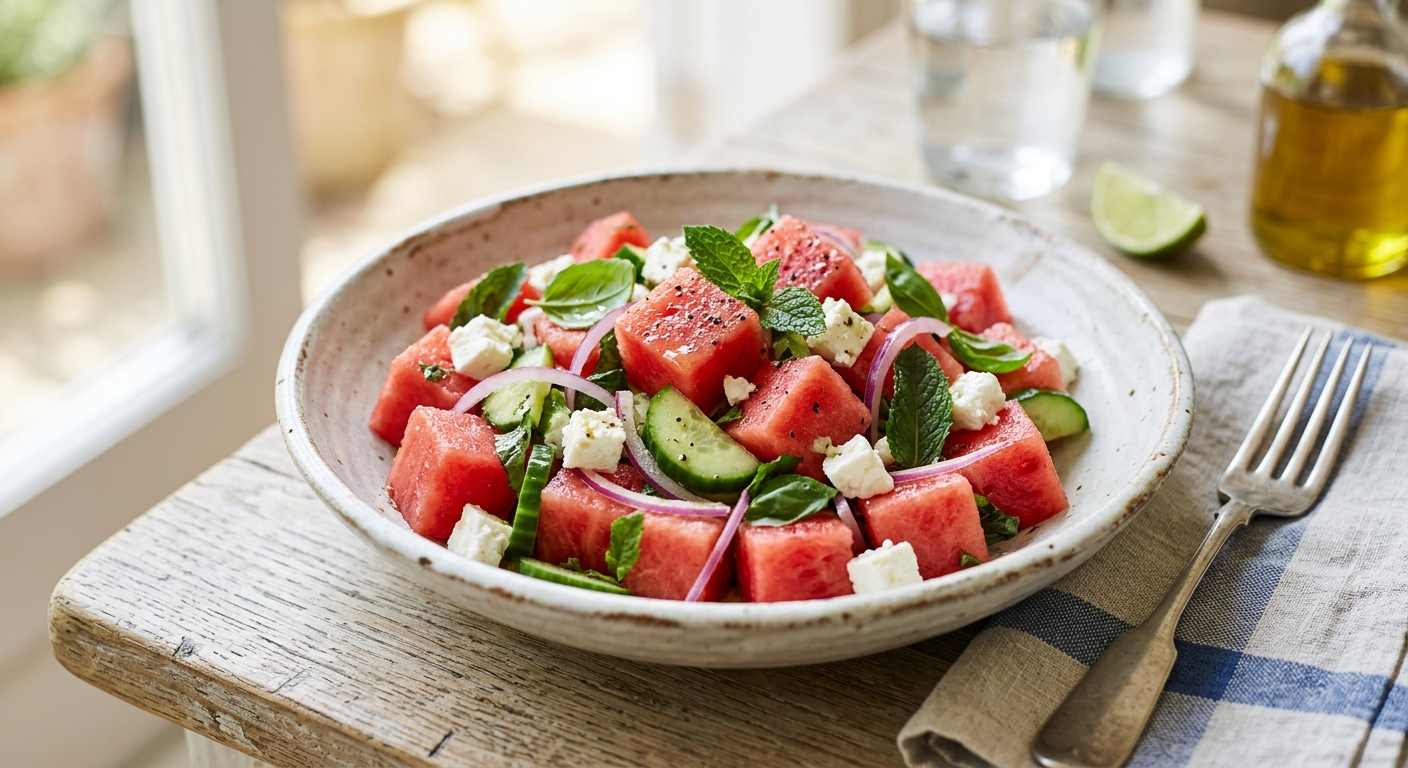
Few dishes capture summer’s essence as completely as a well-made watermelon and feta salad. The contrast of sweet, ice-cold watermelon against salty, crumbling feta is one of those rare flavor pairings that feels instinctively right, and behind that pleasure lies a remarkably dense nutritional profile. Watermelon is one of the richest dietary sources of lycopene, the carotenoid antioxidant most famously associated with tomatoes, yet gram for gram, ripe red watermelon can actually exceed tomato lycopene concentrations. Combined with the calcium and protein from authentic Greek sheep’s-milk feta, fresh mint’s rosmarinic acid, and a drizzle of extra-virgin olive oil that actively enhances carotenoid absorption, this salad punches far above its simple appearance.
At Calibrated Cuisine, we treat this recipe as a genuine anti-inflammatory intervention. Chronic low-grade inflammation is implicated in cardiovascular disease, metabolic syndrome, and cognitive decline, and lycopene has been shown in peer-reviewed trials to reduce circulating markers of oxidative stress including 8-isoprostane and C-reactive protein. The fat from olive oil and feta is not just delicious here; it is scientifically essential, because lycopene is a fat-soluble compound that requires dietary lipids for optimal absorption into the gut epithelium and onward transport in chylomicrons. Every design decision in this recipe is made with that in mind.
We have developed four preparation methods below, starting with the classic no-cook assembly and extending to a warm, lightly roasted version for cooler months. You will also find slow-cooker and pressure-cooker adaptations built around a watermelon-feta warm grain bowl base, which transform the flavor profile entirely while preserving the core nutritional benefits. Whichever path you choose, you are building a meal around one of nature’s most underrated anti-inflammatory ingredients.
4
servings
Ingredients
- 1200 gseedless red watermelon flesh, cut into 3cm cubes (roughly a quarter of a medium melon)
- 200 gauthentic Greek feta cheese, crumbled or cut into 1cm cubes
- 120 gcucumber, halved lengthways and sliced into half-moons
- 80 gred onion, very thinly sliced
- 20 gfresh mint leaves, larger leaves torn, small leaves left whole
- 15 gfresh basil leaves, torn
- 3 tbspextra-virgin olive oil
- 2 tbspfresh lime juice (about 1 large lime)
- 1 tspraw honey or agave syrup
- 1 tspsumac, plus extra for garnish
- 0.5 tspAleppo pepper flakes (or a pinch of standard chili flakes)
- 40 gtoasted pumpkin seeds (pepitas)
- 30 gpitted Kalamata olives, halved
- —Colima Sea SaltMicroplastic Free Salt and freshly cracked black pepper to taste
Instructions
Click on an item below to shop for the recommended items for this recipe on Amazon.
As an Amazon Associate, we earn from qualifying purchases.
- Mellow the onions: Place the thinly sliced red onion in a small bowl, add a generous pinch of flaky salt, and cover with cold water. Let soak for 10 minutes while you prepare everything else. This removes sharpness without losing crunch or color. Drain thoroughly and pat dry on a clean kitchen towel.
- Toast the pumpkin seeds: Set a small dry skillet over medium heat. Add the pumpkin seeds and toast, shaking the pan frequently, for 2 to 3 minutes until they begin to pop and turn golden. Immediately tip them onto a plate to stop carryover cooking. Season with a pinch of salt while still warm.
- Make the dressing: In a small bowl, whisk together the extra-virgin olive oil, fresh lime juice, honey, sumac, and Aleppo pepper flakes until emulsified. Taste and adjust with salt, pepper, and a little more lime if needed. The dressing should be bright and assertive since the watermelon will dilute its intensity.
- Assemble on a wide platter: Arrange the watermelon cubes across a large, wide serving platter (rather than a deep bowl, which traps juices and makes the salad soggy). Scatter the cucumber slices and drained red onion evenly across the watermelon.
- Add the aromatics and garnish: Scatter the Kalamata olive halves across the salad, then crumble or arrange the feta chunks on top. Distribute the torn mint and basil leaves generously. Sprinkle the toasted pumpkin seeds over everything for crunch and zinc.
- Dress and serve immediately: Drizzle the lime dressing over the entire platter. Add a final dusting of sumac and a few extra mint leaves for color. Grind black pepper generously over the top and serve at once while the watermelon is cold and the seeds are still crunchy.
- Preheat your oven to 230 degrees Celsius (450 degrees Fahrenheit) with a heavy rimmed baking sheet inside on the upper-middle rack. Preheating the pan is critical: it creates immediate searing contact and caramelized edges rather than steaming.
- Prepare the watermelon for roasting: Pat the watermelon cubes very dry with paper towels. Moisture is the enemy of caramelization. Toss them in a bowl with 1.5 tablespoons of the olive oil, the sumac, Aleppo pepper, a pinch of salt, and the honey. The sugar in the honey will accelerate caramelization.
- Roast the watermelon: Carefully remove the hot baking sheet from the oven and quickly arrange the watermelon cubes in a single layer, leaving space between pieces. Roast for 10 minutes, then flip each cube using tongs and roast for a further 10 to 12 minutes until the edges are deeply golden and lightly charred. The watermelon will shrink by about 30% and become denser and sweeter.
- Soak the onions while the watermelon roasts: Follow the same cold-water soak method as the stovetop approach, placing the sliced red onion in salted cold water for 10 minutes, then draining and patting dry. Toast the pumpkin seeds in the residual heat of a small pan on the stovetop for 2 minutes.
- Make the warm dressing: Whisk the remaining 1.5 tablespoons of olive oil with the lime juice and a pinch of salt in a small bowl. The roasted watermelon will be warm enough that you do not need a separate dressing with honey since sweetness is now built into the fruit itself.
- Assemble the warm salad: Transfer the roasted watermelon to a serving platter. Immediately scatter the cold, crumbled feta directly onto the hot watermelon so it softens slightly at the edges without fully melting. Add cucumber slices, drained red onion, olives, mint, and basil. The temperature contrast between warm watermelon and cool feta is central to this version’s appeal. Drizzle with the lime-olive oil dressing, scatter pumpkin seeds over the top, dust with extra sumac, and serve.
- Extract the watermelon juice: Place 400g of the watermelon cubes into a blender and blend until smooth. Pour through a fine mesh strainer, pressing to extract as much liquid as possible. You should have approximately 350ml of watermelon juice. Reserve the remaining 800g of watermelon cubes in the refrigerator.
- Build the slow cooker base: Add the watermelon juice to the slow cooker insert along with 350ml of water, the rinsed farro, 1 tablespoon of olive oil, half the sumac, the Aleppo pepper, and a generous pinch of salt. Stir to combine. The liquid-to-grain ratio is calibrated for farro at low heat; do not be tempted to add more liquid.
- Cook on Low: Place the lid on the slow cooker, set to Low, and cook for 2 hours 45 minutes to 3 hours. Check at the 2 hour 30 minute mark: farro should be tender and chewy with most liquid absorbed. If too much liquid remains, leave the lid ajar for the final 15 minutes. The farro will take on a beautiful pink-red tint from the watermelon.
- Prepare the fresh components while the farro cooks: Soak the sliced red onion in salted cold water for 10 minutes, drain, and pat dry. Toast the pumpkin seeds in a dry skillet on the stovetop for 2 to 3 minutes. Whisk together the remaining olive oil, lime juice, and honey for the dressing. Keep the reserved watermelon cubes, cucumber, feta, mint, and basil cold in the refrigerator.
- Assemble the grain bowls: Divide the warm watermelon-farro between four bowls. Immediately top each portion with the cold fresh watermelon cubes, cucumber slices, drained red onion, and Kalamata olives. Crumble feta generously over each bowl. Scatter fresh mint, basil, and toasted pumpkin seeds over the top. Drizzle each bowl with the lime dressing, dust with remaining sumac, and serve immediately while the temperature contrast between warm farro and cold toppings is at its most striking.
- Extract and measure watermelon juice: Blend 400g of the watermelon cubes until smooth, then strain through a fine-mesh strainer to yield approximately 350ml of fresh juice. Reserve the remaining 800g watermelon cubes in the refrigerator. Combine the watermelon juice with 200ml of cold water to give you 550ml of total cooking liquid, which is the correct ratio for 200g of quinoa in a pressure cooker.
- Saute the aromatics: Set your Instant Pot or electric pressure cooker to Saute mode on Medium. Add 1 tablespoon of olive oil and, once shimmering, add the sliced red onion directly (no need to pre-soak for this warm method since the sauteing mellows it). Cook for 3 to 4 minutes, stirring often, until the onion is soft and lightly golden. Add the sumac and Aleppo pepper and stir for 30 seconds until fragrant. Press Cancel to stop Saute mode.
- Pressure cook the quinoa: Add the rinsed quinoa to the pot with the sauteed onion. Pour in the watermelon juice and water mixture, add a pinch of salt, and stir briefly. Lock the lid, set the pressure release valve to Sealing, and cook on High Pressure for 1 minute. Allow a full natural pressure release for 10 minutes (do not rush this; the residual steam continues cooking the quinoa to a perfectly fluffy texture), then manually release any remaining pressure.
- Fluff and rest: Open the lid and fluff the quinoa gently with a fork. It should have absorbed virtually all the liquid and will be a vivid pink-orange color from the watermelon juice. Taste and adjust seasoning. Let it rest uncovered for 2 minutes to allow excess steam to escape and prevent a mushy texture.
- Prepare the cold components and dressing: While the quinoa cooks under pressure, whisk together the remaining 2 tablespoons of olive oil, lime juice, and honey. Toast the pumpkin seeds in a small dry skillet on the stovetop for 2 minutes. Pull the reserved watermelon, cucumber, feta, mint, and basil from the refrigerator.
- Build and serve the bowls: Spoon the warm watermelon-quinoa into four wide bowls. Arrange the cold watermelon cubes, cucumber half-moons, and Kalamata olives alongside and on top of the quinoa. Crumble feta generously over each bowl. Add a generous handful of fresh mint and basil leaves. Scatter the warm pumpkin seeds over the top, drizzle with the lime dressing, and finish with a heavy dusting of sumac and freshly cracked black pepper. Serve immediately.
Nutrition Breakdown
Per 1 serving (makes 4)
Vitamins & Minerals
% Daily Value based on a 2,000 calorie diet (FDA reference)
🧬 Essential Amino Acids
% of recommended daily intake (RDA) per serving
🛡 Antioxidant Profile
The Nutrition Science
The star compound in this recipe is lycopene, a 40-carbon acyclic carotenoid that gives red watermelon its vivid color. Unlike most plant pigments, lycopene is not a vitamin A precursor; instead, it acts as a direct, highly efficient singlet-oxygen quencher. Its 11 conjugated double bonds give it greater antioxidant capacity per molecule than either beta-carotene or alpha-tocopherol (vitamin E) in lipid-phase assays. A 2019 meta-analysis published in Nutrients found that lycopene supplementation at doses achievable through diet (5 to 15mg per day) significantly reduced serum concentrations of 8-isoprostane (a marker of lipid oxidation) and interleukin-6 in adults at cardiovascular risk. One serving of this salad provides approximately 12.4mg of lycopene, placing it squarely within that therapeutic window.
Critically, lycopene bioavailability is dramatically enhanced by two factors present in this recipe by design. First, dietary fat: lycopene is lipophilic and is absorbed passively alongside long-chain fatty acids in the small intestine before being packaged into chylomicrons for lymphatic transport. The 19g of fat per serving from olive oil and feta cheese creates the micellar environment necessary for efficient lycopene solubilization. Second, heat processing increases lycopene bioaccessibility by disrupting chromoplast cell walls; this is why the roasted oven version of this recipe may provide superior lycopene absorption compared to the raw assembly, even if the absolute lycopene content is similar. Studies using isotopically labeled lycopene have confirmed a 2.5-fold increase in absorption from heat-processed versus raw sources.
Feta cheese contributes 280mg of calcium per serving, primarily in a highly bioavailable ionic form due to feta’s acidic pH (between 4.4 and 4.6), which keeps calcium in solution during digestion. The vitamin C from watermelon and lime juice, while not directly affecting calcium absorption (unlike its role with non-heme iron), supports collagen synthesis in bone matrix and acts synergistically with lycopene to maintain endothelial integrity. Fresh mint’s rosmarinic acid adds a distinct anti-inflammatory dimension: mechanistic studies have shown it inhibits the arachidonic acid cascade upstream of both COX and lipoxygenase pathways, meaning it targets inflammation at the enzymatic synthesis stage rather than merely neutralizing reactive oxygen species downstream.
Pro Tips
- Choose a watermelon with deep yellow-cream field spot (where it rested on the ground): this indicates it was vine-ripened, which correlates directly with higher lycopene accumulation since lycopene synthesis requires sustained warmth and sunlight during the final ripening phase.
- Buy only PDO-certified Greek feta (look for the blue Protected Designation of Origin seal): authentic sheep’s-milk feta contains notably higher concentrations of conjugated linoleic acid and a more complex amino acid profile than the common cow’s-milk ‘feta-style’ alternatives, and its firmer texture holds up better against juicy watermelon.
- Do not dress the assembled salad more than 5 minutes before serving in the classic no-cook version: watermelon begins releasing significant juice almost immediately when salted or acidulated, which will pool on the platter and waterlog the other ingredients. Dress tableside if serving to guests for maximum visual impact and textural contrast.
Oh, this sounds perfect for summer! Quick question though, does the recipe include any other ingredients I should know about (like red onion or lime)? I’m following a modified AIP protocol for my Hashimoto’s, so I’m always checking for nightshades and citrus, but the core ingredients here look great for me. The lycopene from watermelon is something I try to prioritize since it’s so gentle on thyroid inflammation, and feta is one of the few dairy products that seems to work well with my system.
Great question about the nightshade angle, Anna! Just to clarify though, watermelon isn’t actually a nightshade (common mix-up since it’s red), so you’re totally in the clear there. The real thing to scan for in the full recipe would be things like tomatoes, peppers, or even spices like paprika. Red onion and lime are both nightshade-free, so those shouldn’t be concerns for your AIP protocol. I’d be curious to hear how you find the lycopene absorption works with your dietary adjustments, since some research suggests certain fats help with lycopene bioavailability and that feta could actually be working in your favor here!
Oh Anna, I love that you’re being thoughtful about nightshades with Hashimoto’s, that’s such important self-awareness. While watermelon itself is totally safe for AIP, I’d definitely peek at the full recipe to see if they’re using tomatoes or peppers anywhere, since those are classic additions to this salad. If you want to lean into the lycopene benefits anyway, I’ve found that adding a pinch of turmeric and black pepper to the dressing (maybe with a lime or lemon base) actually enhances the absorption while keeping everything AIP-friendly and grounding the sweet-salty-cool flavors even more beautifully.