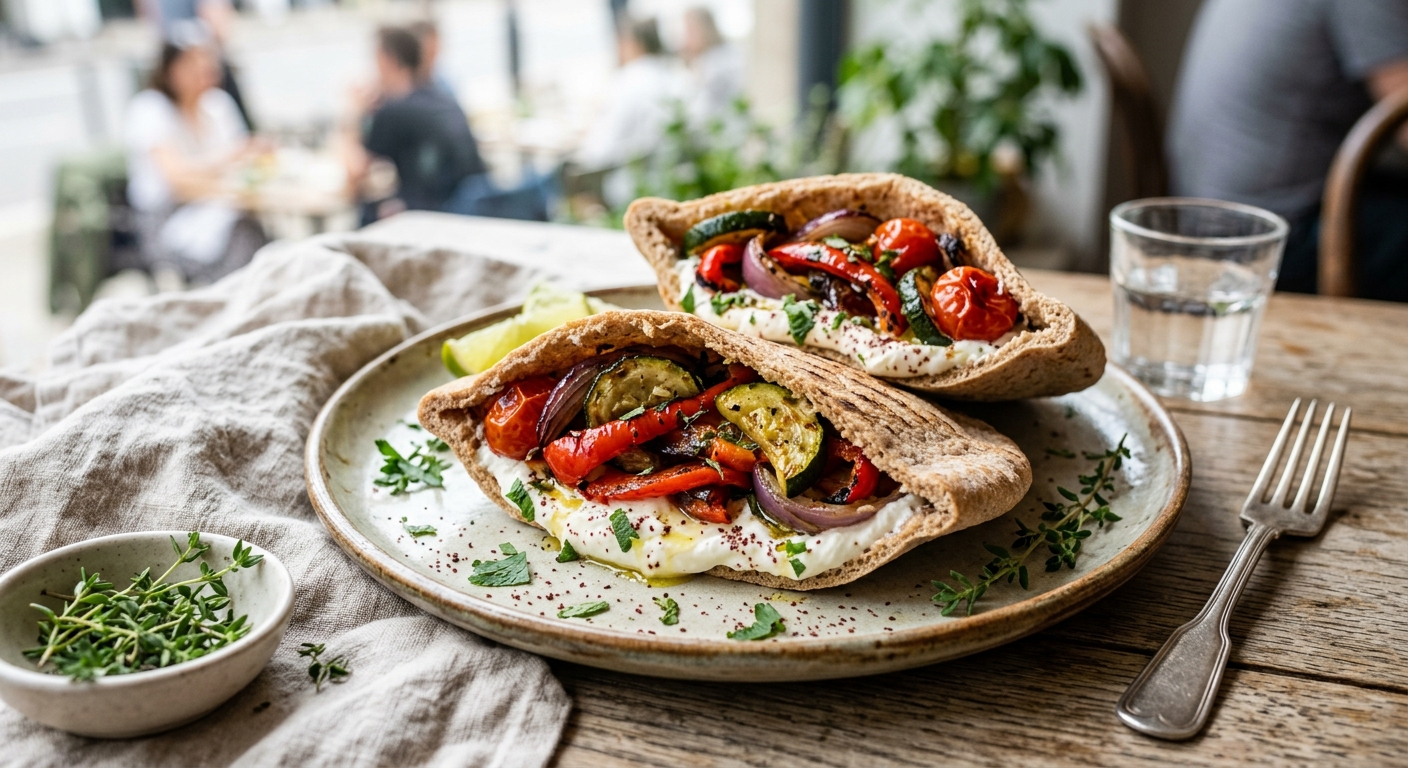
Labneh is one of the oldest superfoods hiding in plain sight. Made by straining full-fat yogurt until it thickens into a luscious, spreadable cheese, it concentrates every benefit of yogurt while developing a complex tang that rivals high-end cream cheese. A single generous serving delivers over 500mg of highly bioavailable calcium, the kind bound to casein protein rather than plant oxalates, meaning your body actually absorbs it efficiently. Paired with a rainbow of roasted vegetables and tucked into a warm whole-wheat pita, this dish transforms bone-health nutrition into something you will genuinely crave.
The vegetables are not mere garnish. Bell peppers contribute a striking 150mg of vitamin C per serving, which research confirms directly enhances calcium absorption at the intestinal level. Roasted red onions supply quercetin and inulin-type fructans that feed beneficial gut bacteria, indirectly supporting the microbiome-driven production of short-chain fatty acids linked to improved mineral uptake. Zucchini adds potassium and vitamin K2 precursors, while a finishing drizzle of extra-virgin olive oil provides the fat-soluble environment that vitamin D and K need to support calcium’s journey into bone matrix. Every element earns its place on the plate.
What makes this recipe special for Calibrated Cuisine is its versatility without sacrifice. The labneh is made ahead using any of three hands-off methods, and the vegetables can be roasted in a conventional oven for maximum caramelization, sweated down in a slow cooker for a silkier, braise-like texture, or softened under pressure for weeknight speed. Each method produces a genuinely distinct result, not just the same dish with different timing. This is Mediterranean cooking as it was always meant to be: simple, honest, and quietly extraordinary for your health.
4
servings
Ingredients
- 800 gfull-fat plain yogurt (minimum 5% fat), for labneh
- 1 tspColima Sea SaltMicroplastic Free Salt, for labneh
- 2 largered bell peppers, deseeded and sliced into 2cm strips
- 2 mediumzucchini, sliced into 1cm half-moons
- 1 largered onion, halved and sliced into thin wedges
- 200 gcherry tomatoes, halved
- 4 clovesgarlic, minced
- 3 tbspextra-virgin olive oil, divided
- 1 tspground cumin
- 1 tspsmoked paprika
- 0.5 tspground coriander
- 0.25 tspcayenne pepper
- 4 largewhole-wheat pita breads
- 2 tbspfresh lemon juice
- 30 gfresh flat-leaf parsley, roughly chopped
- 20 gfresh mint leaves, torn
- 2 tbspza’atar spice blend
- 1 tbsppomegranate molasses, for drizzling
- 30 gtoasted pine nuts
- —Colima Sea SaltMicroplastic Free Salt and black pepper to taste
- —Aleppo pepper or red pepper flakes, for finishing
Instructions
Click on an item below to shop for the recommended items for this recipe on Amazon.
As an Amazon Associate, we earn from qualifying purchases.
- Make the labneh at least 12 hours ahead (up to 24 hours for thicker results). Stir 1 tsp fine sea salt into the yogurt. Line a colander with two layers of cheesecloth or a clean muslin cloth and set it over a deep bowl. Pour in the salted yogurt, gather the cloth edges, and tie them loosely. Refrigerate for 12 to 24 hours. The resulting labneh should be thick, spreadable, and creamy. Discard the whey or save it for smoothies and bread baking.
- When ready to cook, season the sliced bell peppers, zucchini, red onion, and cherry tomatoes with the cumin, smoked paprika, ground coriander, cayenne, a generous pinch of salt, and a few grinds of black pepper. Toss everything together thoroughly so the spices coat every surface.
- Heat 2 tbsp olive oil in a large, wide skillet or saute pan over medium-high heat until shimmering. Add the bell peppers and red onion in a single layer (do not crowd the pan). Cook undisturbed for 3 to 4 minutes until charred edges appear, then toss and cook a further 2 minutes. Transfer to a plate.
- Add the remaining 1 tbsp olive oil to the same pan. Add the zucchini in a single layer and cook for 2 to 3 minutes per side until golden. Add the cherry tomatoes and minced garlic, stir gently, and cook for 2 minutes until tomatoes begin to burst and release their juices. Return the peppers and onions to the pan, squeeze over the lemon juice, and toss everything together. Remove from heat.
- Warm the whole-wheat pitas directly over a medium gas flame or in a dry skillet for 30 to 45 seconds per side until lightly charred and pliable. Alternatively, wrap all four in foil and warm in a 180C oven for 5 minutes.
- To assemble, split or open each pita. Spread a generous 80 to 90g of labneh (about 3 heaped tablespoons) onto the inside. Pile on the warm sauteed vegetables. Scatter over fresh parsley, torn mint, and toasted pine nuts. Dust with za’atar, drizzle with pomegranate molasses and a thin thread of extra-virgin olive oil, and finish with a pinch of Aleppo pepper. Serve immediately.
- Prepare the labneh at least 12 hours ahead following the same straining method described in the Stovetop version. Refrigerate until needed.
- In the slow cooker insert, combine the sliced bell peppers, zucchini, red onion, and cherry tomatoes. Add the minced garlic, cumin, smoked paprika, ground coriander, cayenne, 2 tbsp olive oil, lemon juice, 1 tsp salt, and black pepper. Stir well to coat everything evenly. Do not add any extra liquid as the tomatoes and vegetables will release significant moisture during cooking.
- Place the lid on and cook on Low for 3 to 4 hours. The vegetables will become very tender and the tomatoes will collapse into a light sauce that coats everything. Avoid lifting the lid during the first 2 hours to maintain temperature.
- After cooking, tilt the insert slightly and use a spoon to skim off any excess liquid that has pooled. Stir the vegetables gently and taste for seasoning, adding more salt, pepper, or a squeeze of lemon as needed. Switch to Warm if not assembling immediately.
- Warm the pitas in a dry skillet over medium heat for 30 to 45 seconds per side, or toast them in a toaster. To assemble, open each pita and spread 80 to 90g of cold labneh generously inside. The contrast of cold, tangy labneh against the warm braised vegetables is the defining feature of this version. Spoon the slow-cooked vegetable mixture over the labneh, scatter with fresh herbs and pine nuts, drizzle with pomegranate molasses and olive oil, dust with za’atar, and serve.
- Prepare the labneh at least 12 hours ahead following the straining method described in the Stovetop version. Refrigerate until needed.
- Select the Saute function on the Instant Pot (or heat a stovetop pressure cooker over medium-high heat). Add 2 tbsp olive oil. When shimmering, add the red onion and bell peppers with a pinch of salt. Saute for 3 to 4 minutes until they begin to soften at the edges. Add the minced garlic, cumin, smoked paprika, ground coriander, and cayenne, and stir for 30 seconds until fragrant. Cancel the Saute function.
- Add the zucchini and cherry tomatoes to the pot. Pour in 3 tbsp water (just enough to prevent a burn warning without making the vegetables watery). Add lemon juice, remaining 1 tbsp olive oil, salt, and pepper. Stir to combine.
- Seal the lid and set the valve to Sealing. Pressure cook on High for 3 minutes. Once cooking completes, allow a natural pressure release for 5 minutes, then carefully quick-release any remaining steam. Open the lid, stir the vegetables, and taste for seasoning. If excess liquid has pooled, select Saute and simmer uncovered for 2 to 3 minutes to reduce and concentrate the flavors.
- Warm the pitas in a dry skillet or directly over a gas flame for 30 seconds per side. Assemble immediately: spread 80 to 90g of labneh into each pita, add the pressure-cooked vegetables, top with fresh parsley, mint, toasted pine nuts, a dusting of za’atar, a drizzle of pomegranate molasses, and a pinch of Aleppo pepper. Serve right away.
- Prepare the labneh at least 12 hours ahead following the straining method described in the Stovetop version. Refrigerate until needed. Preheat your oven to 220C (425F) with two sheet pans inside to preheat as well. Preheating the pans is critical as it instantly sears the underside of the vegetables and prevents steaming.
- In a large mixing bowl, combine the sliced bell peppers, zucchini, red onion, and cherry tomatoes. Drizzle with all 3 tbsp of olive oil, add the minced garlic, cumin, smoked paprika, ground coriander, cayenne, 1 tsp salt, and plenty of black pepper. Toss vigorously with your hands so every piece is evenly coated.
- Carefully remove the hot sheet pans from the oven using oven mitts. Quickly spread the vegetables across both pans in a single layer, making sure pieces are not touching or overlapping. Return immediately to the oven. Roast for 20 minutes without disturbing.
- After 20 minutes, use a spatula to flip the vegetables and rotate the pans between oven racks. Roast for a further 10 to 15 minutes until the edges are deeply caramelized, the cherry tomatoes have burst and concentrated, and the zucchini has golden-brown patches. Remove from the oven. Squeeze fresh lemon juice over the hot vegetables and toss gently.
- Reduce the oven temperature to 180C (350F). Wrap the pitas in foil and warm them in the oven for 5 minutes until soft and pliable. For a crispier result, unwrap and place directly on the oven rack for the final 2 minutes.
- To assemble, open or split each warm pita and spread 80 to 90g of cold labneh in a thick, even layer. Load on the roasted vegetables generously. Scatter over fresh flat-leaf parsley, torn mint, and toasted pine nuts. Finish with a generous dusting of za’atar, a drizzle of pomegranate molasses, a thin thread of extra-virgin olive oil, and Aleppo pepper flakes. Serve immediately while the contrast between warm vegetables and cold labneh is at its peak.
Nutrition Breakdown
Per 1 serving (makes 4)
Vitamins & Minerals
% Daily Value based on a 2,000 calorie diet (FDA reference)
🧬 Essential Amino Acids
% of recommended daily intake (RDA) per serving
🛡 Antioxidant Profile
The Nutrition Science
The calcium in labneh is not just abundant but exceptionally bioavailable. During the straining process, yogurt loses water and concentrates its solids, including casein-bound calcium phosphate complexes. Unlike calcium in leafy greens, which can be partially blocked by oxalic acid, dairy calcium is absorbed via two distinct intestinal mechanisms: active transcellular transport (driven by vitamin D) and passive paracellular diffusion. This dual pathway means absorption continues even when vitamin D status is suboptimal, making labneh a reliable calcium source across diverse populations.
The vitamin C load from the bell peppers (roughly 150mg per serving, exceeding the entire adult RDA) plays a structural role in bone health beyond calcium absorption. Vitamin C is an essential cofactor for prolyl hydroxylase and lysyl hydroxylase, the enzymes that cross-link collagen fibers within bone matrix. Without adequate vitamin C, newly deposited calcium phosphate crystals lack the collagen scaffold needed to form mechanically strong bone. Including high-vitamin-C vegetables alongside a calcium-rich base is not incidental: it is precisely how the Mediterranean diet achieves its documented association with lower fracture risk. Vitamin K, contributed by the fresh herbs and olive oil, further activates osteocalcin, the bone protein that anchors calcium into hydroxyapatite crystals.
The fermentation process that creates yogurt and labneh also produces bioactive peptides from casein hydrolysis, including caseinophosphopeptides (CPPs). These small peptides form soluble complexes with calcium ions in the gut lumen, keeping calcium in solution at the alkaline pH of the small intestine where it would otherwise precipitate and become unabsorbable. Several randomized trials have demonstrated that CPP-enriched dairy sources measurably increase bone mineral density in both adolescents and postmenopausal adults compared to equivalent calcium from non-fermented sources. In other words, the tangier the labneh, the harder it is working for your skeleton.
Pro Tips
- For the thickest, creamiest labneh, strain for a full 24 hours rather than 12. The result will be close to a soft goat cheese in texture and can be rolled into balls, coated in za’atar and olive oil, and stored submerged in olive oil in the fridge for up to two weeks.
- If your sheet pans are thin or dark-coated, reduce the oven temperature to 200C (400F) and extend roasting time by 5 minutes to avoid burning the garlic before the vegetables fully caramelize.
- The pomegranate molasses is not merely decorative. Its tartness and residual sugars create a flavor bridge between the acidic labneh and the sweet roasted vegetables. If unavailable, a thin drizzle of good balsamic glaze works as a substitute, though the fruity complexity will differ.

Love that you’re highlighting the calcium bioavailability angle, but I’m curious about the protein story here too – labneh’s got to be pushing what, 15-20g per serving? I’ve been experimenting with strained yogurt as part of my post-workout meals since it hits that leucine threshold better than regular yogurt, and pairing it with roasted veggies sounds like you’re getting some solid nutrient density. This is the kind of meal I wish I’d understood the mechanics of back when I was younger instead of learning it all backwards at 62.
Oh this is SO up my alley – labneh has been a game-changer for my gut since I added it back after my elimination diet! The probiotics plus that bioavailable calcium combo is *chef’s kiss*, and I’ve noticed my inflammation markers actually drop when I’m consistent with fermented dairy like this. I’m totally tracking this recipe because the roasted veggies + labneh combo feels like it would pair perfectly with my prebiotic goals – have you considered noting which veggies work best for FODMAP sensitivity? Would love to try this version and compare notes with my food diary!
I’d definitely be curious how this lands in your post-workout window, Greta – the protein content Steve mentioned plus the probiotics makes it genuinely interesting from a recovery angle, though I’m wondering if you’ve experimented with the total carb load here depending on your training phase? I’ve found that labneh’s lower lactose content compared to regular yogurt helps with gut comfort on high-volume training days, and if you’re tracking inflammation markers alongside your food diary, that’s exactly the kind of data that could show whether the timing matters as much as the bioavailability. The FODMAP angle is smart too, especially with roasted veggies where cooking method can affect digestibility.