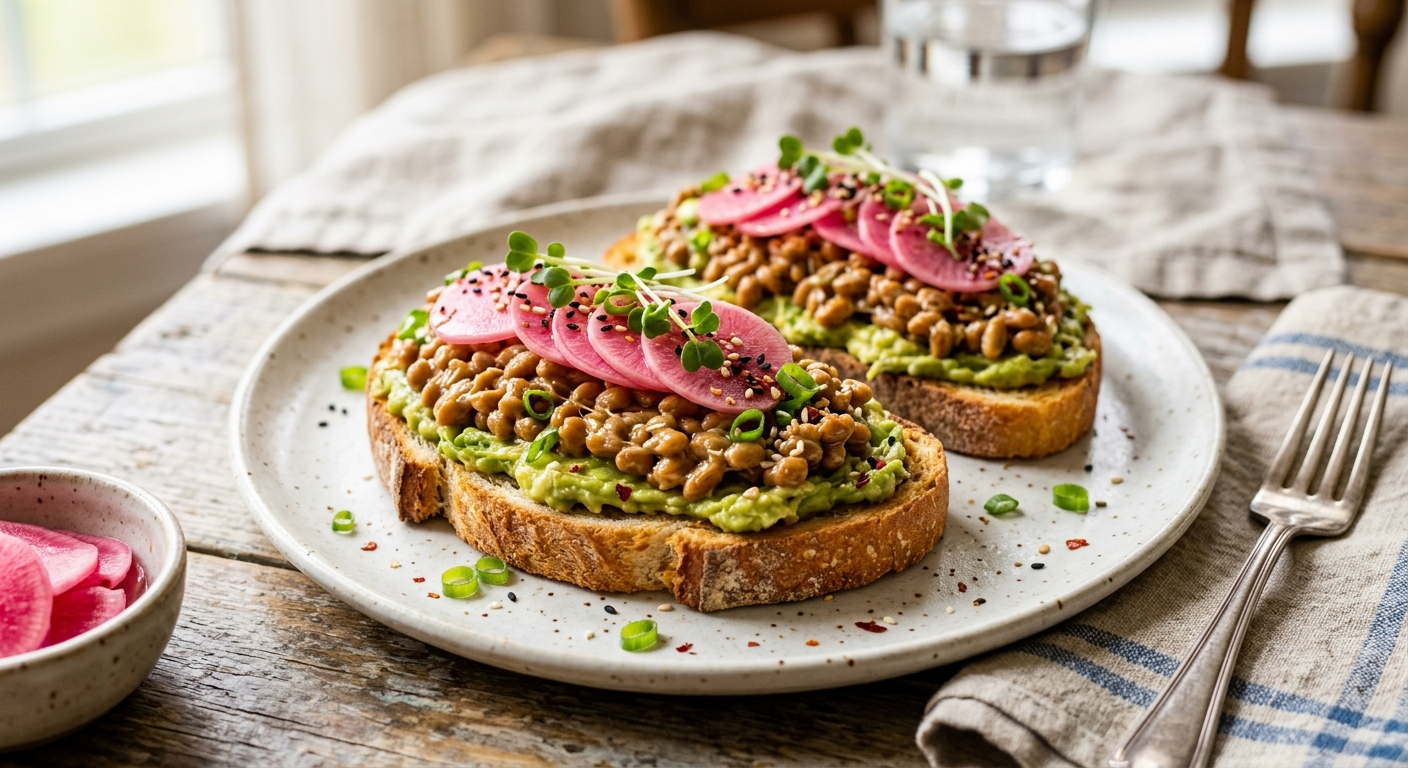
If you have been searching for a breakfast that works as hard as you do, this Natto Avocado Toast with Pickled Radish is the answer. Natto, the traditional Japanese fermented soybean food, is the single richest dietary source of Menaquinone-7 (MK-7), the most bioavailable form of Vitamin K2. A single 50g serving delivers roughly 500mcg of MK-7, which research from Maastricht University links to improved arterial flexibility, reduced calcification, and enhanced bone mineral density. Paired with the monounsaturated fats in avocado, which are essential for fat-soluble vitamin absorption, this toast is engineered as much as it is inspired.
The pickled radish is not merely a garnish. A quick brine of rice vinegar, a touch of honey, and fresh ginger creates a probiotic-friendly, gut-supporting condiment that also supplies a meaningful dose of Vitamin C and folate. The acidity cuts through natto’s bold, sticky richness and brightens every bite, while the crunch provides textural contrast against the silken avocado. Sourdough bread, fermented itself, brings a lower glycemic index than conventional white bread plus beneficial organic acids that support mineral absorption.
At Calibrated Cuisine, we believe extraordinary nutrition should never come at the cost of pleasure. This recipe approaches natto with the same respect a Japanese kitchen would give it: seasoned with tamari and Japanese mustard (karashi), draped over perfectly ripe avocado, and finished with toasted sesame seeds and a fine drizzle of toasted sesame oil. The result is a dish that converts natto skeptics and delights natto devotees in equal measure. The three cooking methods below each approach the pickled radish and toast components with technique appropriate to the equipment, so choose the path that fits your morning.
4
servings
Ingredients
- 200 gnatto (fermented soybeans), 4 x 50g packs, at room temperature
- 2 tsptamari or low-sodium soy sauce
- 1 tspkarashi (Japanese hot mustard) or Dijon mustard
- 2 largeripe Hass avocados (approx. 400g total flesh)
- 1 tbspfresh lemon juice
- 4 thick slicessourdough bread (approx. 80g each)
- 200 gdaikon or red radishes, thinly sliced (2mm) on a mandoline
- 120 mlrice wine vinegar
- 60 mlwater
- 1 tbspraw honey
- 1 tspColima Sea SaltMicroplastic Free Salt, for brine
- 5 gfresh ginger, peeled and cut into matchsticks
- 1 tsptoasted sesame oil
- 1 tbsptoasted sesame seeds
- 2 wholescallions (spring onions), finely sliced
- 1 sheetnori (dried seaweed), cut into fine strips with scissors
- 0.5 tspshichimi togarashi (Japanese 7-spice) or red pepper flakes
- —Colima Sea SaltMicroplastic Free Salt and freshly cracked black pepper to taste
Instructions
Click on an item below to shop for the recommended items for this recipe on Amazon.
As an Amazon Associate, we earn from qualifying purchases.
- Make the quick pickle: combine rice wine vinegar, water, honey, and 1 tsp fine sea salt in a small saucepan over medium heat. Stir until honey and salt dissolve completely, about 2 minutes. Do not boil. Remove from heat, add ginger matchsticks, and pour immediately over sliced radishes in a heatproof bowl. Press radishes down so they are submerged. Set aside to cool for at least 10 minutes while you prepare the rest.
- Season the natto: open the natto packs into a bowl, add tamari and karashi, and stir vigorously with chopsticks or a fork for 30 to 60 seconds until the mixture becomes stringy and slightly frothy. This activates the nattokinase enzymes and improves texture. Set aside at room temperature.
- Toast the bread: heat a large cast iron skillet or heavy-bottomed pan over medium-high heat until very hot, about 2 minutes. Place sourdough slices directly in the dry pan. Toast undisturbed for 2 to 3 minutes until deep golden-brown with charred edges, then flip and toast the other side for 1 to 2 minutes. Transfer to a wire rack, not a plate, to preserve crispness.
- Prepare the avocado: halve and pit the avocados, scoop flesh into a bowl, add lemon juice, a pinch of sea salt, and black pepper. Use a fork to mash roughly, leaving plenty of large chunks for texture. Do not over-mash.
- Assemble: spread a generous layer of avocado over each toast, pressing slightly so it anchors. Spoon one 50g pack of seasoned natto over each slice, letting it cascade naturally. Drain pickled radish and layer 8 to 10 slices over each toast. Drizzle toasted sesame oil over the top, then scatter sesame seeds, scallions, nori strips, and a pinch of shichimi togarashi. Serve immediately.
- Build a warm-infusion pickle in the slow cooker: place sliced radishes and ginger matchsticks directly in the slow cooker insert. In a small bowl, whisk together rice wine vinegar, water, honey, and sea salt until dissolved, then pour over the radishes. Add an optional pinch of coriander seeds or a small dried chili for deeper flavor. Set the slow cooker to Low, cover with the lid slightly ajar to prevent condensation diluting the brine, and let infuse for 2 hours. The gentle warmth (around 70 to 80 degrees C) softens the radish slowly and drives the brine deep into each slice without cooking them through.
- While the pickle finishes in the final 15 minutes, season the natto: empty all four packs into a medium bowl, add tamari and karashi, and stir vigorously for 45 to 60 seconds until the mixture turns glossy and stringy. Cover and leave at room temperature so the natto warms slightly, which makes it more spreadable and aromatic.
- Preheat your oven broiler (grill) to high. Arrange sourdough slices on a baking sheet lined with foil. Brush each slice lightly with a few drops of toasted sesame oil for flavor, then broil on the top rack for 2 to 3 minutes per side, watching carefully, until the surface is deep golden-brown and blistered at the edges. Transfer to a wire rack.
- Prepare the avocado: halve, pit, and scoop the avocado flesh into a bowl. Add lemon juice, salt, and black pepper. Mash with a fork to a coarse, chunky texture. For an extra layer of flavor in this method, stir in a few drops of the warm brine from the slow cooker before serving.
- Remove radishes from the slow cooker using a slotted spoon and let drain briefly on paper towels. Assemble the toasts: spread avocado generously, top with natto, then layer the warm-pickled radish slices. Finish each toast with a drizzle of sesame oil, sesame seeds, scallions, nori strips, and shichimi togarashi. The warm radish will gently soften the natto, creating a more cohesive, melt-in-the-mouth bite. Serve right away.
- Combine the pickle brine ingredients, rice wine vinegar, water, honey, sea salt, and ginger matchsticks, in the Instant Pot insert and stir to dissolve. Add the sliced radishes and press them down so they are mostly submerged. Do not add more water; the vinegar environment and pressure will be sufficient to drive flavor through.
- Seal the Instant Pot lid, set the vent to Sealing, and pressure cook on High for 1 minute. The short cook time is critical: longer cooking will make the radish mushy and destroy heat-sensitive Vitamin C. When the timer beeps, allow a natural pressure release for exactly 5 minutes, then carefully switch the vent to Venting to release remaining pressure. Open the lid away from you.
- While pressure releases, season the natto: stir all four packs vigorously in a bowl with tamari and karashi for 45 seconds until frothy and well combined. Set aside.
- Remove the radishes with a slotted spoon and lay flat on a clean kitchen towel to absorb excess brine. Reserve 2 tbsp of the brine from the pot. Toast the sourdough slices in a toaster or under a broiler to your preferred level of crispness, then prepare the avocado: mash with lemon juice, salt, and pepper to a chunky consistency, and stir in the reserved 2 tbsp of pressure-cooked brine for a bright, gingery kick that ties the components together.
- Assemble immediately: spread the brine-laced avocado over each toast, pile on natto, arrange the pressure-pickled radish slices on top, and finish with sesame oil, sesame seeds, scallions, nori strips, and shichimi togarashi. Because the pressure-pickled radish is fully saturated with brine, the flavors in this version are the most intense and cohesive of the three methods. Serve right away for the best texture contrast.
- Preheat the oven to 200C (400F) with the fan on if available. Line a large rimmed baking sheet with parchment paper. Whisk together rice wine vinegar, honey, sea salt, and ginger matchsticks in a bowl, then add sliced radishes and toss to coat. Spread radishes in a single, uncrowded layer on the prepared baking sheet, spooning any remaining marinade over the top.
- Roast radishes on the middle rack for 18 to 22 minutes, flipping once halfway through, until the edges are caramelized and the slices are tender with slightly charred tips. The vinegar will reduce in the oven, creating a concentrated glaze. The radishes will lose their raw bitterness and develop a mild, jammy sweetness.
- In the final 5 minutes of radish roasting, arrange sourdough slices directly on the top oven rack or a second baking sheet. Toast for 4 to 5 minutes until golden-brown and crisp, watching closely. Remove both baking sheets from the oven and let the bread cool on a wire rack for 2 minutes so steam does not soften the crust.
- Season the natto while the oven does its work: combine all four packs in a bowl with tamari and karashi, stirring vigorously for 45 to 60 seconds until glossy and cohesive. The natto is never heated in this recipe as heat above 50C degrades both the nattokinase enzyme and the MK-7 Vitamin K2 content.
- Prepare the avocado: mash flesh from both avocados with lemon juice, sea salt, and black pepper to a rough, chunky consistency. Assemble the toasts: spread avocado over the crisp bread, add natto, then layer the caramelized roasted radish slices on top. The warm radish contrasts beautifully with the cool avocado. Finish each toast with sesame oil, sesame seeds, scallions, nori strips, and shichimi togarashi. Serve immediately while the radish is still warm.
Nutrition Breakdown
Per 1 serving (makes 4)
Vitamins & Minerals
% Daily Value based on a 2,000 calorie diet (FDA reference)
🧬 Essential Amino Acids
% of recommended daily intake (RDA) per serving
🛡 Antioxidant Profile
The Nutrition Science
The nutritional centerpiece of this recipe is Menaquinone-7 (MK-7), the long-chain form of Vitamin K2 found almost exclusively in natto. Unlike Vitamin K1 (phylloquinone), which is cleared from the bloodstream within hours, MK-7 has a half-life of 72 hours in human plasma, meaning a single serving of this toast can maintain active Vitamin K2 levels for three days. K2 activates two critical proteins: osteocalcin, which binds calcium into bone matrix and is linked to reduced osteoporosis fracture risk, and Matrix Gla Protein (MGP), which prevents calcium from depositing in arterial walls. A landmark Rotterdam Study following 4,807 participants found that the highest dietary K2 intake was associated with a 57% reduction in cardiovascular mortality.
The pairing of natto with avocado is not accidental from a biochemical standpoint. Vitamin K2 is a fat-soluble vitamin, meaning it requires dietary fat for intestinal absorption via chylomicron packaging into the lymphatic system. The monounsaturated fats in avocado (primarily oleic acid, the same fat found in olive oil) are particularly effective at stimulating bile salt secretion, which forms the micelles necessary to solubilize fat-soluble vitamins before absorption. One study published in the Journal of Nutrition demonstrated that adding avocado to a meal increased carotenoid absorption by 2.6 to 15 times, and the same mechanism applies to K2. In short, this combination is biochemically synergistic, not just culinarily appealing.
The sourdough fermentation process deserves its own nutritional note. During a long sourdough ferment, lactic acid bacteria produce phytase, an enzyme that breaks down phytic acid in wheat. Phytic acid is an antinutrient that binds to iron, zinc, and magnesium in the digestive tract, forming insoluble complexes that the body cannot absorb. By degrading up to 90% of phytic acid, sourdough bread dramatically improves the bioavailability of the minerals it contains, and also the minerals from other foods eaten at the same meal. This means the iron and magnesium from natto listed in the key nutrients panel above are substantially more bioavailable when consumed on sourdough versus conventional bread.
Pro Tips
- Never heat natto above 50C (122F): nattokinase, the fibrinolytic enzyme unique to natto that contributes significantly to its cardiovascular benefits, is irreversibly denatured by heat. Always add natto to cooled or room-temperature toast.
- For a milder natto introduction, mix the seasoned natto with a tablespoon of Japanese Kewpie mayonnaise before topping the toast. The egg yolk lecithin emulsifies the sticky strands and softens the pungency without compromising the K2 content.
- The quick pickle brine can be scaled up 4x and stored in a sealed jar in the refrigerator for up to 2 weeks, turning any radish, cucumber, or carrot into a ready-made probiotic-friendly topping that elevates future grain bowls and rice dishes.
Great pairing here, especially with the avocado fat to facilitate K2 absorption. I’d just note that while natto delivers impressive bioavailable K2 (menaquinone-7), the real win is consistency over time rather than a single mega-dose – I’ve seen bone density improvements in patients who made fermented foods a regular habit, not occasional splurges. The sourdough fermentation is smart too, since it can reduce phytic acid and improve mineral bioavailability. Have you noticed whether your patients or students show preferences between different natto strains, or does that not seem to matter much?
This sounds absolutely delicious, and I’m so glad to see natto highlighted for K2! I’ve been incorporating it more since learning how much it supports bone health alongside thyroid function. Quick question though, are you using any cruciferous vegetables in your cooking classes, or keeping this natto combination separate? I’ve found that when I eat fermented foods like natto with goitrogenic veggies (even cooked ones), timing matters for my thyroid, but the fat in avocado actually helps with nutrient absorption of both the K2 and other micronutrients. Would love to hear if you’ve noticed patterns with your students.
Oh, I love seeing natto getting this kind of attention for K2 bioavailability, especially paired with the fat from avocado which really helps absorption. I’ve been experimenting with fermented foods in my cooking classes and always notice how natto’s deep umami pairs so beautifully with warming spices like a touch of ginger or even cayenne if you’re feeling adventurous. Do you find that the sourdough’s fermentation adds to the probiotic benefit, or is it mainly the natto doing that heavy lifting? I’m curious whether you’d ever layer in black pepper with the K2 rich foods, since I’m always thinking about how to maximize nutrient utilization, even