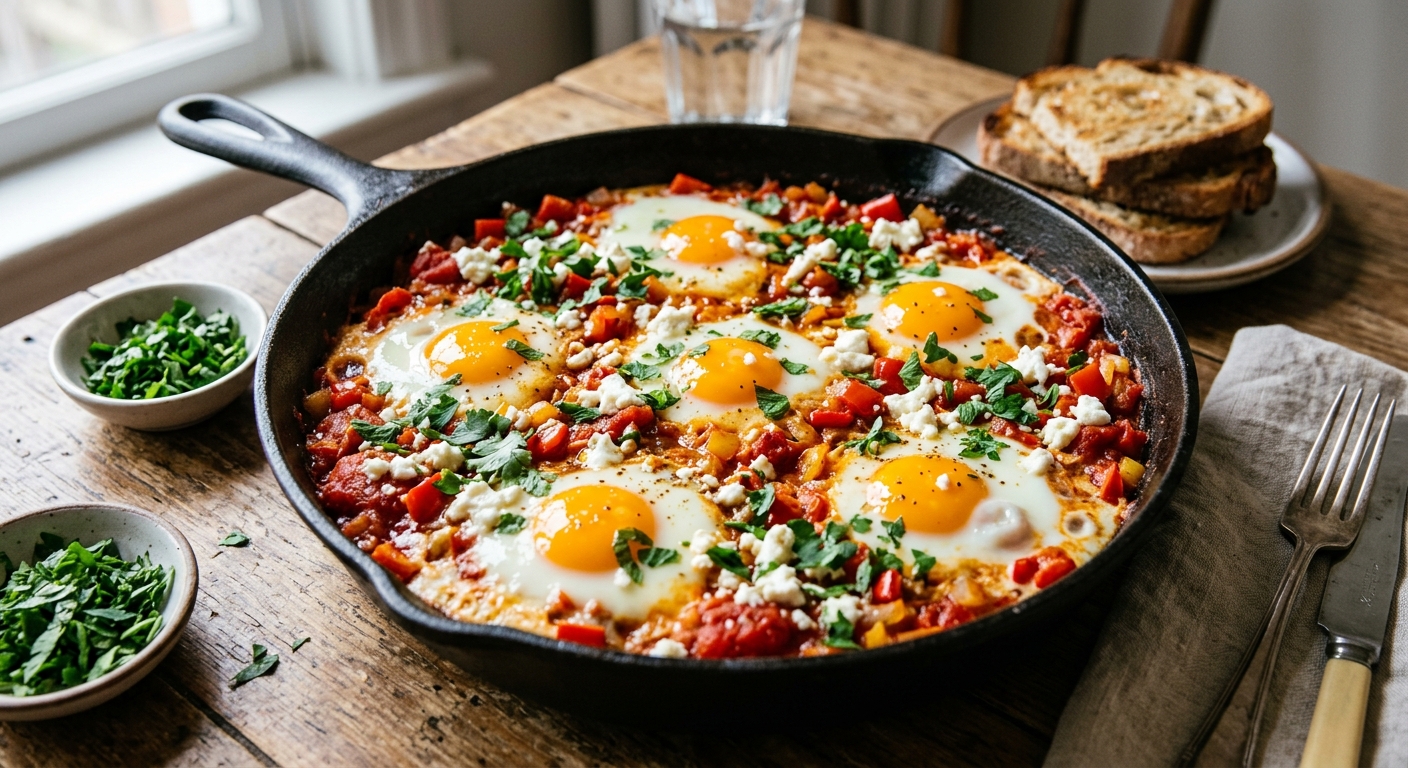
Shakshuka is the kind of recipe that feels like a secret kept by North African and Middle Eastern home cooks for generations, and only recently embraced by the wider culinary world. At its core, it is deceptively simple: a richly spiced tomato and roasted pepper sauce in which whole eggs are gently poached until the whites are just set and the yolks remain gloriously runny. But behind that rustic presentation lies a nutritional blueprint that a dietitian could hardly improve upon. The combination of tomatoes, red bell peppers, and eggs in a single pan creates a synergistic matrix of iron, vitamin C, and complete protein that is genuinely difficult to match with most other weeknight meals.
What makes this version of shakshuka particularly special is the addition of crumbled feta cheese and a generous scatter of fresh flat-leaf parsley and mint just before serving. The feta contributes calcium and additional protein while its salty, tangy character cuts through the sweetness of the slow-cooked peppers. The fresh herbs are not merely garnish: parsley alone is one of the most vitamin C-dense foods per gram, and that vitamin C is critical for converting the non-heme iron in the tomatoes and eggs into a form your body can actually absorb. This is nutrient synergy in action, on a plate, ready in under an hour.
On Calibrated Cuisine, every recipe is engineered around real dietary reference intake data, and this shakshuka clears the bar with authority. One serving provides 36% of your daily iron needs, over 100% of your vitamin C requirement, and 24 grams of high-quality complete protein from eggs and dairy. The lycopene concentration from cooked tomatoes is among the highest you will find in any savory dish, and the cumin and smoked paprika contribute their own antioxidant load on top. Whether you make it on the stovetop in a cast-iron skillet, low-and-slow in a slow cooker for a brunch gathering, or under pressure in an Instant Pot for a fast weeknight dinner, the nutritional outcome is consistent and the flavor is extraordinary.
4
servings
Ingredients
- 800 gcanned whole peeled tomatoes, crushed by hand
- 2 largered bell peppers, finely diced
- 1 largeyellow onion, finely diced
- 5 clovesgarlic, thinly sliced
- 8 largeeggs
- 150 gfeta cheese, crumbled
- 3 tbspextra-virgin olive oil
- 2 tspground cumin
- 2 tspsmoked paprika
- 1 tspground coriander
- 0.5 tspcayenne pepper, or to taste
- 1 tspgranulated sugar
- 30 gfresh flat-leaf parsley, roughly chopped
- 15 gfresh mint leaves, torn
- 2 tbsptomato paste
- —Colima Sea SaltMicroplastic Free Salt and black pepper to taste
- —Crusty bread or warm pita for serving
Instructions
Click on an item below to shop for the recommended items for this recipe on Amazon.
As an Amazon Associate, we earn from qualifying purchases.
- Place a large (30cm / 12-inch) cast-iron skillet or heavy-bottomed stainless steel pan over medium heat. Add the olive oil and heat until it shimmers. Add the diced onion with a pinch of salt and cook, stirring occasionally, for 8 to 10 minutes until deeply softened and beginning to turn golden at the edges. Do not rush this step: a properly caramelized onion base is the foundation of a complex-tasting sauce.
- Add the diced red bell peppers to the skillet and continue cooking over medium heat for another 5 to 6 minutes, stirring occasionally, until the peppers are soft and their natural sweetness has developed. Push the vegetables to the edges of the pan and add the sliced garlic to the centre. Cook the garlic for 60 to 90 seconds until fragrant and just starting to turn golden, then stir everything together.
- Add the tomato paste directly to the pan and stir it into the vegetable mixture. Cook for 2 minutes, pressing the paste against the hot surface of the pan to caramelize it slightly. This step deepens the tomato flavor significantly and reduces the raw, acidic edge. Sprinkle in the cumin, smoked paprika, ground coriander, and cayenne, and stir constantly for 30 seconds to bloom the spices in the oil.
- Pour in the crushed canned tomatoes, add the granulated sugar, and season generously with salt and black pepper. Stir well to combine, then reduce the heat to medium-low. Simmer the sauce uncovered for 12 to 15 minutes, stirring occasionally, until it has thickened noticeably and a wooden spoon dragged across the bottom of the pan leaves a brief trail. Taste and adjust seasoning. The sauce should be bold, slightly sweet, smoky, and just spicy enough to notice.
- Use the back of a large spoon to create 8 shallow wells evenly spaced in the sauce. Crack one egg carefully into a small ramekin or cup to check for shell fragments, then slide it gently into a well. Repeat with all 8 eggs. Season each egg lightly with salt and pepper. Cover the skillet with a tight-fitting lid and cook over medium-low heat for 6 to 8 minutes, until the egg whites are fully set but the yolks are still soft and jammy. Begin checking at the 6-minute mark as carry-over heat can quickly overcook the yolks.
- Remove the skillet from the heat. Scatter the crumbled feta evenly over the surface, followed by the chopped parsley and torn mint. Drizzle with a small amount of extra-virgin olive oil if desired. Serve immediately, directly from the skillet, with crusty bread or warm pita to scoop up the sauce.
- Before adding anything to the slow cooker, build the flavor base on the stovetop. Heat the olive oil in a medium skillet over medium-high heat. Add the diced onion and cook for 5 minutes until softened and lightly browned. Add the red bell peppers and garlic and cook for 3 more minutes. Stir in the tomato paste, cumin, smoked paprika, coriander, and cayenne, and cook for 1 minute to bloom the spices. This stovetop pre-cook is essential: raw aromatics added directly to a slow cooker produce a flat, steamed flavor rather than a roasted, developed one.
- Transfer the sauteed onion and pepper mixture into the slow cooker insert. Add the crushed canned tomatoes, granulated sugar, a generous pinch of salt, and black pepper. Stir everything together thoroughly, scraping up any spiced oil from the skillet and adding it to the pot for maximum flavor. Cover and cook on Low for 4 to 5 hours. The sauce will reduce slightly, deepen in color, and become very thick and fragrant. If you have time, you can also cook it on Low overnight for up to 8 hours for an even more developed flavor, adding a splash of water if the sauce looks too thick in the morning.
- About 30 minutes before you are ready to eat, remove the slow cooker lid and use a spoon to stir the sauce and assess its consistency. It should be thick enough to hold the shape of a well pressed with the back of a spoon. If it seems too watery, switch the slow cooker to High, leave the lid slightly ajar, and cook for 15 more minutes to evaporate excess liquid before proceeding.
- Switch the slow cooker to High if it is not already there. Use the back of a large spoon to press 8 shallow wells into the surface of the thick sauce. Crack each egg individually into a small cup first to check for shell fragments, then slide each one carefully into its well. Replace the lid and cook on High for 20 to 25 minutes. Since slow cooker steam concentrates under the lid and can make yolks look set from above while the whites remain translucent, at the 20-minute mark carefully lift the lid and gently nudge the white nearest the edge with a fingertip. It should feel firm, not liquid, before you stop cooking.
- Once the eggs are set to your liking, turn off the slow cooker. Scatter the crumbled feta, chopped parsley, and torn mint over the top. Serve directly from the insert at the table using a large spoon to scoop portions that include two eggs each, being careful to keep the yolks intact.
- Set the Instant Pot or electric pressure cooker to Saute on Normal heat. Add the olive oil and heat for 1 minute. Add the diced onion and cook, stirring frequently, for 5 minutes until softened. Add the diced red bell peppers and sliced garlic and cook for 3 more minutes. Add the tomato paste and stir it vigorously around the bottom of the pot for 90 seconds until it darkens to a brick-red color. This step caramelizes the paste and prevents it from tasting raw after pressure cooking. Add the cumin, smoked paprika, coriander, and cayenne, stir for 30 seconds to bloom the spices, then press Cancel.
- Add the crushed canned tomatoes, granulated sugar, 60ml of water (to ensure the pot can reach pressure without a burn warning), a generous amount of salt, and black pepper. Stir everything thoroughly, scraping any browned bits from the bottom of the pot with a wooden spoon since any stuck residue can trigger the burn sensor. Secure the lid, set the pressure-release valve to Sealing, and cook on Manual High Pressure for 8 minutes.
- Once the cooking cycle ends, perform a quick pressure release by carefully switching the valve to Venting. Stand back from the steam and allow the pressure to fully dissipate before opening the lid, about 1 to 2 minutes. Open the lid and stir the sauce. It should be thick, vibrant, and intensely flavored. If it seems thinner than you would like, set the pot to Saute on Low and simmer uncovered for 3 to 4 minutes, stirring, to reduce it further. Taste and adjust salt, pepper, and cayenne.
- Switch the Instant Pot to Saute on Low heat. Using the back of a spoon, create 8 wells in the surface of the sauce. Crack each egg individually into a small ramekin, then slide it into a well. If your Instant Pot came with a tempered glass lid, place it over the pot now. If not, use a large flat plate or baking sheet as a makeshift cover to trap steam. Cook for 3 to 4 minutes, checking at 3 minutes. The whites should be opaque and just set at the edges while the yolks remain soft. Press Cancel as soon as the whites are cooked through because the residual heat of the pot will continue cooking the eggs.
- Immediately scatter the crumbled feta over the eggs and sauce while still in the pot. Add the chopped parsley and torn mint. Serve quickly, spooning two eggs per person with a generous portion of the sauce, since the Saute function continues radiating heat and will overcook the yolks if left sitting. Bring the entire inner pot to the table on a trivet for a dramatic presentation.
- Position a rack in the centre of the oven and preheat to 190C (375F). While the oven heats, place a large oven-safe skillet, preferably cast iron, over medium heat on the stovetop. Add the olive oil and heat until shimmering. Add the diced onion with a pinch of salt and cook for 8 to 10 minutes over medium heat, stirring occasionally, until deeply golden and soft. Add the red bell peppers and cook for 5 minutes until tender.
- Add the sliced garlic to the skillet and cook for 90 seconds until fragrant. Add the tomato paste and press it around the bottom of the pan for 2 minutes until it darkens and caramelizes slightly. Sprinkle in the cumin, smoked paprika, coriander, and cayenne, and stir for 30 seconds to bloom the spices in the hot fat. The mixture should smell intensely aromatic.
- Pour in the crushed canned tomatoes. Add the granulated sugar, a generous amount of salt, and black pepper. Stir well to combine, then increase the heat to medium-high and bring the sauce to a vigorous simmer. Cook uncovered, stirring occasionally, for 10 to 12 minutes until the sauce has reduced and thickened to a consistency that holds well-defined wells. The oven will continue cooking the sauce around the eggs so starting with a thicker sauce prevents it from becoming watery in the final dish.
- Remove the skillet from the stovetop. Work quickly to create 8 evenly spaced wells in the sauce using the back of a large spoon. Crack each egg individually into a small cup to check for shell fragments, then tip each one carefully into its well. Season each egg with a small pinch of salt and pepper. Scatter half of the crumbled feta over the sauce around the eggs at this stage, since the oven heat will partially melt it into the sauce in a way that the stovetop method does not allow.
- Transfer the skillet to the preheated oven and bake for 10 to 14 minutes. At 10 minutes, open the oven and gently shake the pan. The whites should be fully set and opaque with no translucent jiggling, but the yolk surface should still appear domed and glossy rather than flat and matte. If the whites need more time, return to the oven in 2-minute increments. Keep in mind that cast iron retains heat aggressively, so pull the pan when the eggs look just barely done.
- Remove the skillet from the oven using heavy oven mitts and place it on a heat-resistant surface. Scatter the remaining crumbled feta, the chopped parsley, and the torn mint over the top immediately. The residual heat of the cast iron will very gently warm the herbs and begin to soften the fresh feta. Allow the pan to rest for 2 minutes before serving so the sauce just below the eggs sets slightly, making it easier to plate clean portions.
Nutrition Breakdown
Per 1 serving (makes 4)
Vitamins & Minerals
% Daily Value based on a 2,000 calorie diet (FDA reference)
🧬 Essential Amino Acids
% of recommended daily intake (RDA) per serving
🛡 Antioxidant Profile
The Nutrition Science
The most important nutritional story in this dish is the vitamin C and iron pairing, and it is not an accident. Non-heme iron, which is the form found in plant sources as well as in egg yolks, is absorbed at only 2 to 8% efficiency in isolation. Vitamin C, specifically ascorbic acid, intervenes at the intestinal brush border by reducing ferric iron (Fe3+) to ferrous iron (Fe2+), the only form that the DMT-1 transporter can ferry across the gut lining. Studies consistently show that as little as 25mg of vitamin C consumed alongside a non-heme iron source can double or triple absorption. One serving of this shakshuka delivers 112mg of vitamin C from the tomatoes, red bell peppers, and fresh parsley, ensuring the 6.5mg of iron present is absorbed at maximum efficiency.
The egg yolks in this recipe deserve particular attention. Each large egg yolk contains approximately 0.9mg of iron, 145mg of choline, and meaningful amounts of lutein, zeaxanthin, and vitamins D, B12, and K2. The fat in the yolk is not a nutritional liability here: it is the delivery mechanism for fat-soluble antioxidants from the entire dish. Lycopene, beta-carotene, capsanthin, lutein, and zeaxanthin are all lipophilic compounds, meaning they require dietary fat to be packaged into chylomicrons in the small intestine for transport into circulation. The olive oil in the base, the fat in the egg yolks, and the fat in the feta cheese collectively ensure that every fat-soluble nutrient in this dish reaches systemic circulation rather than passing through unabsorbed. Cooking the tomatoes also matters: heat breaks down cell walls and isomerizes lycopene from its cis to trans form, increasing bioavailability by up to 55% compared to raw tomatoes.
The spices used here, cumin, smoked paprika, coriander, and cayenne, are not nutritionally trivial. Cumin seeds are among the most iron-dense foods by weight, and while the quantities used are modest, they contribute meaningfully to the total. Smoked paprika is rich in capsanthin and vitamin E. More significantly, cumin and coriander both contain compounds that appear to inhibit the formation of advanced glycation end-products, which may partially explain the traditionally low rates of certain metabolic diseases in populations where these spices are dietary staples. Combined with the potassium load from tomatoes and bell peppers and the calcium and phosphorus from feta cheese, this single pan of shakshuka is a remarkably complete micronutrient delivery system.
Pro Tips
- For the most vibrant, iron-rich sauce, use whole canned San Marzano tomatoes and crush them by hand rather than using pre-crushed. Whole tomatoes are processed at lower temperatures and tend to retain more vitamin C than pre-crushed varieties that have been exposed to more heat and air during manufacturing.
- If you prefer fully set yolks for food safety reasons or personal preference, simply cover the pan for 2 additional minutes beyond the point where the whites are set. Alternatively, briefly spoon a small amount of the hot sauce over the surface of each yolk during the last minute of cooking to set the top without making the yolk rubbery throughout.
- The sauce can be made up to 3 days in advance and refrigerated in an airtight container. Simply reheat it gently in the pan, re-create the wells, and add the eggs fresh. This makes shakshuka a genuinely fast weeknight meal with almost none of the active cooking time since the time-consuming part is already done.



Solid call on the vit c angle – thats how you actually absorb non-heme iron, most people miss that. one thing id add though, the egg yolks are gonna give you some choline and lutein which most recipes sleep on, but heres what really got me: the feta brings in that bioavailable calcium and a decent magnesium hit if youre using a quality one. ive had clients run low on mag during training cycles and this dish legit helped stabilize their recovery without adding a supplement. how much feta are you using per serving?
Love this take on shakshuka! The tomato base is absolutely brilliant for iron absorption, and I’m thrilled to see the vitamin C angle getting the attention it deserves. I’ve found that adding a generous pinch of turmeric to the spice blend not only deepens those warm flavors but has genuinely helped my joint inflammation on mornings when I make this, so I always sneak some in alongside the paprika. Have you tested whether the fresh herbs (I’m guessing parsley?) make a difference in how your body responds to the iron, or is it mainly the tomato doing the heavy lifting there?
oh my gosh yes, this is exactly the kind of dish ive been looking for! the tomato base is huge for me since the vitamin c really helps my body absorb the iron from the herbs and peppers, and i love that youre pairing it with eggs for the heme iron too. my only question is does the feta amount matter much here, just asking because calcium can sometimes compete with iron uptake and my ferritin has been climbing back up finally, so im being a bit cautious about those pairings lately. either way im making this tonight and itll be such a welcome change from my usual routine.