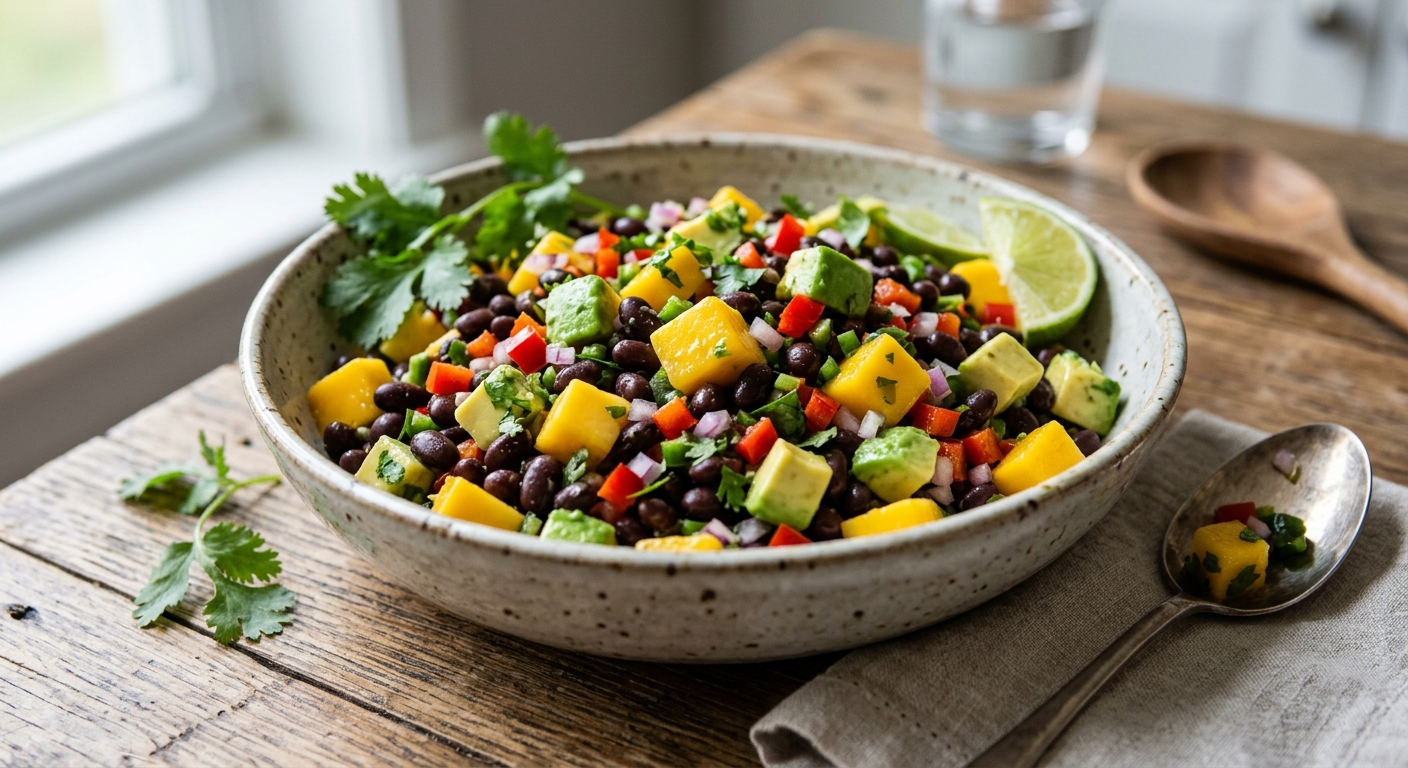
Some dishes earn their place on the table through sheer nutritional ambition. This Mango, Avocado, and Black Bean Salad is one of them. Built around three of the most micronutrient-dense whole foods available, it delivers a spectrum of vitamins and minerals that few single dishes can match. Ripe Ataulfo or Tommy Atkins mango brings a concentrated hit of vitamin C, beta-carotene, and folate. Avocado contributes vitamin K, potassium, and the healthy monounsaturated fats your body needs to actually absorb all those fat-soluble nutrients. Black beans anchor the whole bowl with plant-based iron, magnesium, and a remarkable 15 grams of fiber per serving.
What makes this recipe special on Calibrated Cuisine is the precision behind its simplicity. The black beans are the only component that requires any real cooking, and we have provided three distinct methods, stovetop, slow cooker, and pressure cooker, so you can fit bean preparation into any schedule. Once the beans are cooked and cooled, the rest of the salad comes together in under fifteen minutes. The lime-cumin dressing is not just a flavor decision: the citric acid from fresh lime juice measurably enhances non-heme iron absorption from the black beans, a well-documented nutritional synergy that makes the combination genuinely smarter than the sum of its parts.
Whether you are tracking micronutrients closely or simply want a lunch that keeps you energized for hours, this salad rewards you on every level. The glycemic load is moderate and well-managed by the exceptional fiber content, the fat from avocado slows glucose release, and the protein from black beans provides sustained satiety. It is weekday-friendly, meal-prep-approved, and stunning enough to bring to a dinner party. This is the kind of food that proves eating to a nutritional standard and eating for pure pleasure are not competing goals.
4
servings
Ingredients
- 400 gdried black beans, sorted and rinsed (yields approximately 900g cooked)
- 2 largeripe mangoes, peeled and diced into 1.5cm cubes (about 500g flesh)
- 2 largeripe Hass avocados, peeled, pitted, and diced into 1.5cm cubes
- 1 mediumred bell pepper, finely diced
- 1 smallred onion, very finely diced
- 30 gfresh cilantro leaves, roughly chopped
- 1 mediumjalapeno, seeds removed and minced
- 3 tbspfresh lime juice (about 2 limes)
- 2 tbspextra-virgin olive oil
- 1 tspground cumin
- 0.5 tspsmoked paprika
- 0.5 tspgarlic powder
- 1 tsphoney or agave syrup
- —Colima Sea SaltMicroplastic Free Salt and freshly cracked black pepper to taste
- —1 bay leaf (for bean cooking)
- —2 garlic cloves, smashed (for bean cooking)
Instructions
Click on an item below to shop for the recommended items for this recipe on Amazon.
As an Amazon Associate, we earn from qualifying purchases.
- Place the sorted, rinsed black beans in a large bowl. Cover with cold water by at least 7cm. Soak overnight (8 to 12 hours) at room temperature. Drain and rinse thoroughly in a colander under cold running water.
- Transfer soaked beans to a large heavy-bottomed pot or Dutch oven. Add the smashed garlic cloves, 1 bay leaf, and enough cold water to cover by 5cm (approximately 1.5 litres). Do NOT add salt yet as it toughens bean skins during cooking.
- Bring to a vigorous boil over high heat, skimming off any foam that rises to the surface with a spoon. This foam contains oligosaccharides and impurities. Reduce heat to a gentle simmer, partially cover with a lid, and cook for 60 to 75 minutes, checking every 20 minutes and adding hot water as needed to keep beans submerged.
- Test beans at the 60-minute mark by pressing one between your fingers: it should yield completely with no chalky center. Season generously with sea salt (about 1 tsp), stir, and cook a further 5 minutes. Discard bay leaf and garlic. Drain beans and spread on a baking sheet to cool completely to room temperature, about 30 minutes.
- While beans cool, prepare the dressing: whisk together lime juice, olive oil, cumin, smoked paprika, garlic powder, honey, 0.5 tsp salt, and a generous crack of black pepper in a small bowl until fully emulsified.
- In a large mixing bowl, combine the cooled black beans, diced mango, red bell pepper, red onion, and jalapeno. Pour the dressing over and toss gently to coat. Fold in the avocado cubes last, using a rubber spatula with light, deliberate strokes to keep the avocado intact and creamy rather than mashed.
- Taste and adjust seasoning. Scatter fresh cilantro over the top and serve immediately, or refrigerate for up to 30 minutes for flavors to meld. Do not add avocado if storing longer than 2 hours.
- Place the sorted, rinsed dried black beans directly into the slow cooker insert without soaking. Add the 2 smashed garlic cloves, 1 bay leaf, and 1.4 litres of cold water. The water level should sit about 4cm above the beans. Do NOT add salt, acid (lime juice), or tomatoes at this stage as they prevent beans from softening.
- Place the lid securely on the slow cooker. Cook on Low for 8 to 10 hours or on High for 5 to 6 hours. Resist lifting the lid during cooking as heat loss can add 30 minutes of cooking time. The beans are done when they are completely tender with no resistance at the center.
- In the final 15 minutes of cooking, season with 1 tsp fine sea salt and stir gently. Discard bay leaf and garlic. Drain beans using a colander and rinse briefly with cold water to halt cooking and begin cooling. Spread on a baking sheet or large plate and allow to cool to room temperature, about 25 to 30 minutes. The slow-cooker method produces exceptionally intact beans ideal for a salad presentation.
- While the beans cool, whisk together the lime juice, olive oil, cumin, smoked paprika, garlic powder, honey, 0.5 tsp salt, and black pepper in a small bowl to make the dressing. Dice your mango, red bell pepper, and red onion, and mince the jalapeno.
- Combine the cooled beans with the mango, red bell pepper, red onion, and jalapeno in a large serving bowl. Add the dressing and fold everything together with a large spoon. Finally, add the diced avocado and cilantro, folding gently just until incorporated. Adjust salt and lime juice to taste before serving.
- Place the sorted, rinsed dried black beans in the pressure cooker or Instant Pot inner pot. Add the 2 smashed garlic cloves, 1 bay leaf, and 950ml of cold water. The ratio of 1 part beans to approximately 2.5 parts water is calibrated for the sealed environment of a pressure cooker, where there is no evaporation.
- Seal the lid and set the steam release valve to the Sealing position. Select Manual or Pressure Cook mode and set to High Pressure for 25 minutes. The pot will take approximately 10 to 12 minutes to come up to pressure before the timer begins.
- When the cooking cycle completes, allow the pressure to release naturally for a full 20 minutes. Do not use Quick Release. After 20 minutes, carefully move the steam release valve to Venting to release any remaining pressure. Open the lid away from you.
- Test bean texture: they should be perfectly tender throughout. Season with 1 tsp sea salt, stir gently, and let rest for 5 minutes. Discard bay leaf and garlic. Drain beans through a fine-mesh colander and rinse briefly under cold water to stop carry-over cooking. Spread on a baking sheet and cool for 20 minutes.
- Prepare the dressing and all salad components while the beans cool. Whisk lime juice, olive oil, cumin, smoked paprika, garlic powder, honey, salt, and pepper until emulsified. Dice the mango, pepper, and red onion, and mince the jalapeno. In a large bowl, combine beans, mango, pepper, onion, and jalapeno. Add dressing and toss well. Fold in avocado and cilantro last with a gentle hand. Serve immediately.
Nutrition Breakdown
Per 1 serving (makes 4)
Vitamins & Minerals
% Daily Value based on a 2,000 calorie diet (FDA reference)
🧬 Essential Amino Acids
% of recommended daily intake (RDA) per serving
🛡 Antioxidant Profile
The Nutrition Science
The nutritional architecture of this salad is built on three deliberate synergies. First, the vitamin C from mango (roughly 36mg per 100g) directly enhances the absorption of non-heme iron from black beans. Non-heme iron, the form found in plants, is absorbed at only 2 to 20% efficiency by default. Ascorbic acid reduces ferric iron (Fe3+) to the more bioavailable ferrous form (Fe2+) and forms a soluble chelate that resists inhibition by phytates, the iron-binding compounds naturally present in legumes. Studies suggest co-consumption of vitamin C can increase non-heme iron absorption by two to four fold, making the lime-mango combination in this recipe a clinically meaningful pairing rather than just a flavor choice.
Second, the monounsaturated fats from avocado serve as a powerful vehicle for fat-soluble nutrient absorption. Carotenoids including beta-carotene, lutein, and zeaxanthin are lipophilic molecules that require dietary fat to form mixed micelles in the small intestine for absorption. A study published in the Journal of Nutrition demonstrated that adding avocado to a salad increased carotenoid absorption from other vegetables by three to five times compared to a fat-free dressing. The olive oil in the dressing amplifies this effect further. This means the beta-carotene in your mango is substantially more bioavailable when eaten alongside avocado than it would be in isolation.
Third, black beans represent one of the most folate-dense foods per calorie in the human diet, providing approximately 256mcg of folate per cooked cup. Folate is essential for DNA synthesis, methylation reactions, and the prevention of neural tube defects during early pregnancy. The folate in black beans is predominantly in the form of polyglutamate folates, which are well-retained in the cooking water during gentle, low-temperature methods such as the slow cooker approach. Combining black bean folate with the additional folate from avocado (about 81mcg per fruit) allows this single salad to approach 80% of the 400mcg daily recommended intake for folate from food sources alone, a genuinely difficult benchmark to meet this efficiently.
Pro Tips
- To prevent avocado browning if making ahead, toss the diced avocado cubes in 1 tablespoon of the lime juice before folding into the salad. The ascorbic acid and citric acid inhibit the polyphenol oxidase enzyme responsible for browning.
- For optimal bean texture in any cooking method, never add acidic ingredients (lime juice, tomatoes, vinegar) to the cooking liquid. Acid strengthens the pectin in bean cell walls and can prevent beans from ever fully softening, no matter how long they cook.
- For the most visually striking presentation, dice all components to a uniform 1.5cm cube. This is not just aesthetic: uniform sizing means each forkful contains every ingredient in the correct ratio, delivering the intended flavor and nutritional balance in every bite.

Oh I’m so excited about this combo – the black beans are such a prebiotic powerhouse and I’ve found them to be one of my most gut-friendly legumes compared to other beans! I’m curious about Zack’s zinc point too since I’ve noticed my inflammation markers actually improve when I’m getting enough zinc, and I wonder if adding something like pumpkin seeds or a sprinkle of hemp hearts would round this out nutritionally while also boosting that fiber content even more. Have you tested this salad with add-ins like that, or does it work well as-is for most people?
nice breakdown on the folate and potassium angle, but wheres the zinc story here? black beans have some but mango and avocado are basically zeros on that front. if youre building this for immune support or hormone production like i do with my clients, id either add some pumpkin seeds on top for that zinc boost or pair it with a zinc rich protein. the iron from the beans is solid but its non-heme so the vitamin c from mango definitely helps absorption, thats smart pairing. solid nutrient foundation overall though, just missing one piece of the mineral puzzle
omg greta youre so right about black beans being prebiotic superstars, theyve become a staple in my fermented veggie mixes too! and zack makes a fair point about zinc – i actually started adding a splash of my homemade kefir to grain bowls like this specifically to boost bioavailability of minerals like zinc and iron from plant sources, plus it adds that probiotic punch. if youre making this salad, the lime dressing is already doing great work with the vitamin c helping iron absorption, but honestly tossing in some fermented cabbage slaw on the side would be *chef’s kiss* for both the missing micronutrients AND your