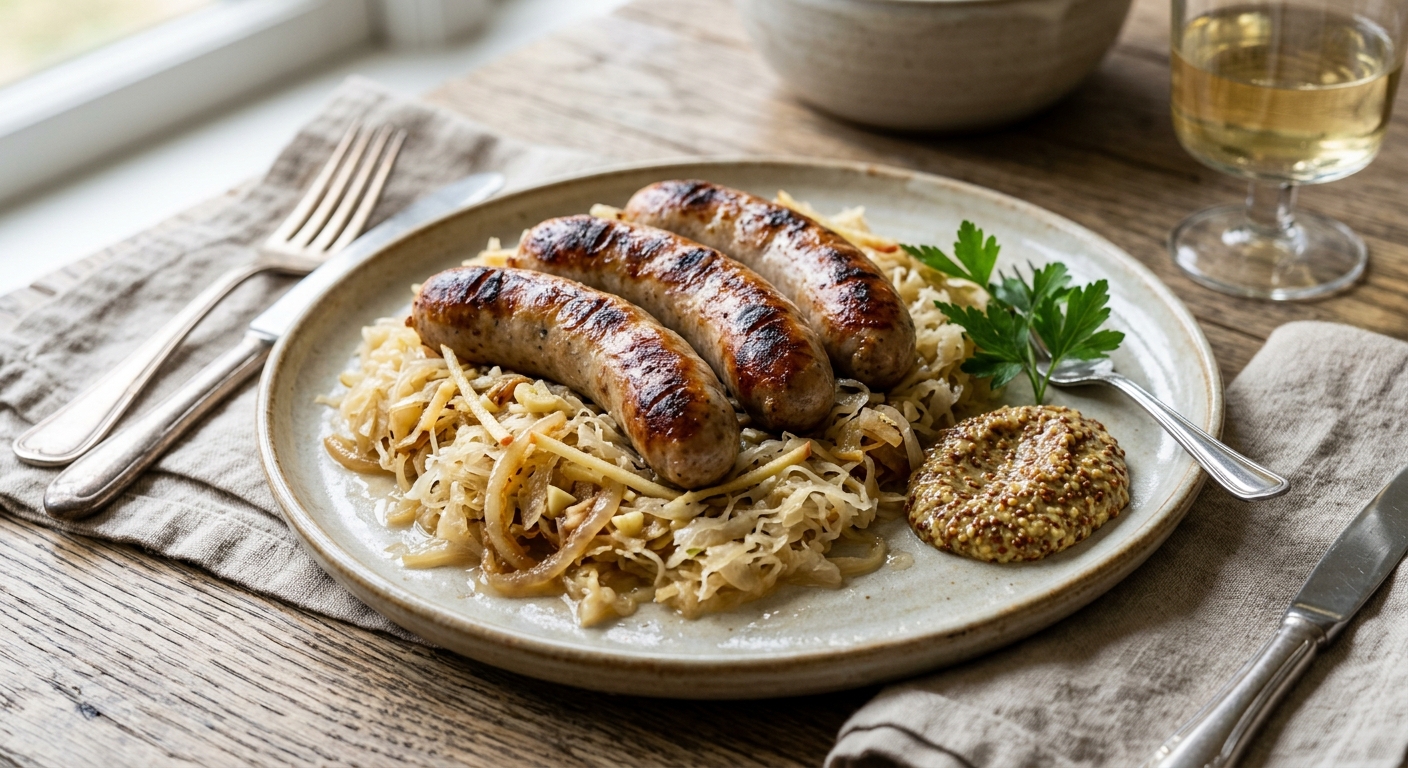
Few dishes in the European culinary canon are as deceptively nutritious as a well-made sauerkraut and bratwurst plate. The secret lies in the fermentation: raw, unpasteurized sauerkraut is teeming with Lactobacillus species that survive into your gut, where they reinforce the intestinal barrier, crowd out pathogenic bacteria, and produce short-chain fatty acids that actively calm inflammatory signaling. Pair that with a quality pork bratwurst, rich in zinc, selenium, and all nine essential amino acids, and you have a meal that feeds both your palate and your microbiome.
What elevates this recipe above a simple pub dish is the layering of anti-inflammatory aromatics: caraway seeds provide carvacrol and limonene, bay leaves contribute apigenin and linalool, and the apple cider vinegar sharpens flavors while preserving the sauerkraut’s beneficial acidity. Whole-grain mustard adds a final flourish of glucosinolates, the sulfur compounds also found in broccoli that support liver detoxification enzymes. Each ingredient earns its place not just for flavor but for function.
This recipe is calibrated so that one serving delivers over 40% of your daily vitamin C requirement from the sauerkraut alone, meaningful amounts of vitamin K2 (the bone-routing form of vitamin K), and a generous 36% of your daily manganese needs. The slow, moist cooking environment, whether on the stovetop, in a slow cooker, a pressure cooker, or the oven, keeps the bratwurst juicy while allowing the sauerkraut’s brine to weave into the entire dish, creating a complex, savory braising liquid that doubles as a finishing sauce.
4
servings
Ingredients
- 4 linkspork bratwurst (approximately 100g each)
- 700 graw unpasteurized sauerkraut, with its brine
- 2 tbspwhole-grain Dijon mustard
- 1 tbspextra-virgin olive oil
- 1 largeyellow onion, thinly sliced (about 200g)
- 3 clovesgarlic, minced
- 1 mediumapple, peeled, cored, and thinly sliced (about 150g)
- 120 mldry white wine or low-sodium chicken broth
- 1 tbspapple cider vinegar
- 1 tspcaraway seeds
- 2 wholebay leaves
- 1 tspsmoked paprika
- 0.5 tspblack pepper, freshly ground
- —Colima Sea SaltMicroplastic Free Salt to taste (the sauerkraut brine is already salty, so taste before adding)
- —Fresh flat-leaf parsley, chopped, for garnish
- —Additional whole-grain mustard for serving
Instructions
Click on an item below to shop for the recommended items for this recipe on Amazon.
As an Amazon Associate, we earn from qualifying purchases.
- Heat the olive oil in a large Dutch oven or heavy-bottomed skillet over medium-high heat until shimmering. Add the bratwurst links and sear without moving them for 3 to 4 minutes per side until deeply golden brown on all sides. The Maillard reaction crust will add significant flavor to the entire dish. Transfer the seared bratwurst to a plate and set aside. Do not drain the fat from the pan.
- Reduce heat to medium. Add the sliced onion to the rendered fat and cook, stirring occasionally, for 6 to 8 minutes until softened and beginning to caramelize at the edges. Add the garlic, caraway seeds, and smoked paprika and cook for 90 seconds, stirring constantly, until fragrant and the spices bloom in the oil.
- Add the apple slices and stir to coat in the spiced onion mixture. Pour in the white wine or chicken broth and the apple cider vinegar, scraping up any browned bits from the bottom of the pan with a wooden spoon. These fond bits carry concentrated flavor. Let the liquid reduce by half, about 2 minutes.
- Add the sauerkraut with all of its brine, the whole-grain mustard, black pepper, and bay leaves. Stir well to combine. Nestle the seared bratwurst back into the sauerkraut mixture, pushing them down so they are at least halfway submerged.
- Reduce heat to medium-low, cover the pot, and simmer for 20 to 25 minutes until the bratwurst are cooked through (internal temperature of 71 degrees C / 160 degrees F) and the sauerkraut has softened and absorbed the flavors. Remove the bay leaves. Taste and adjust seasoning with salt only if needed. Garnish with chopped parsley and serve with additional mustard on the side.
- Sear the bratwurst in olive oil in a skillet over medium-high heat, 3 to 4 minutes per side, until a golden-brown crust forms. This step is done on the stovetop separately from the slow cooker and cannot be skipped without sacrificing depth of flavor. Transfer seared bratwurst to the slow cooker insert.
- In the same skillet over medium heat, soften the sliced onion in the remaining fat for 5 minutes. Add garlic, caraway seeds, and smoked paprika and cook 60 seconds. Deglaze with the white wine or broth, scraping the pan. Pour this entire mixture over the bratwurst in the slow cooker.
- Add the apple slices, sauerkraut with brine, apple cider vinegar, whole-grain mustard, black pepper, and bay leaves directly to the slow cooker. Gently stir to distribute the ingredients around the bratwurst without disturbing the sausages too much. Do not add extra liquid: the sauerkraut brine and wine provide sufficient moisture for the slow cooker environment.
- Place the lid on the slow cooker and cook on Low for 6 to 7 hours or on High for 3 to 3.5 hours. The bratwurst should reach an internal temperature of 71 degrees C / 160 degrees F, and the sauerkraut should be meltingly tender. Avoid lifting the lid during cooking, as each peek adds 15 to 20 minutes to the effective cooking time.
- Remove the bay leaves. Taste the braising liquid: if it seems thin, transfer just the liquid to a small saucepan and simmer on the stovetop for 5 minutes to concentrate. Stir the whole-grain mustard into the reduced sauce, pour back over the dish, garnish with parsley, and serve directly from the slow cooker insert.
- Set the Instant Pot or electric pressure cooker to the Saute function on High. Add olive oil and heat until shimmering. Working in a single layer, sear the bratwurst for 2 to 3 minutes per side until browned. Because the pot is deeper and narrower than a skillet, use tongs to carefully turn the sausages. Transfer to a plate.
- With the Saute function still active, add the sliced onion to the pot and cook for 4 minutes, stirring frequently. Add garlic, caraway seeds, and smoked paprika and cook 60 seconds. Immediately pour in the white wine or broth and apple cider vinegar and scrape the bottom of the pot thoroughly with a silicone spatula to deglaze. Leaving any browned bits on the bottom risks a burn warning from the pressure sensor.
- Add the apple slices, sauerkraut with brine, whole-grain mustard, black pepper, and bay leaves. Stir to combine. The liquid level should be adequate from the brine and wine; do not add extra water, as too much liquid will dilute the final flavors. Nestle the bratwurst on top of the sauerkraut mixture.
- Cancel the Saute function. Secure the lid and set the pressure valve to Sealing. Cook on High Pressure for 8 minutes. When the cycle ends, allow a natural pressure release for 10 minutes, then carefully switch the valve to Venting to release any remaining pressure.
- Open the lid, remove the bay leaves, and check that bratwurst have reached 71 degrees C / 160 degrees F. If the braising liquid appears too thin, use the Saute function on Medium for 3 to 5 minutes with the lid off to reduce it to a glossy sauce. Stir in an extra teaspoon of whole-grain mustard, garnish with parsley, and serve immediately.
- Preheat the oven to 180 degrees C / 350 degrees F. Heat olive oil in a large oven-safe Dutch oven or deep baking dish over medium-high heat on the stovetop. Sear the bratwurst for 3 minutes per side until golden brown, then transfer to a plate. The searing must happen on the stovetop since the oven cannot brown the sausages at this low temperature.
- In the same Dutch oven over medium heat, cook the onion for 5 to 6 minutes until softened. Add garlic, caraway seeds, and smoked paprika and stir for 60 seconds. Deglaze with white wine or broth and apple cider vinegar, scraping up all browned bits. Allow to reduce by one-third, about 2 minutes.
- Remove the pot from the heat. Add the apple slices, sauerkraut with brine, whole-grain mustard, black pepper, and bay leaves. Stir to combine into an even layer. Arrange the seared bratwurst on top of the sauerkraut mixture in a single layer, pressing them down slightly but leaving the tops exposed above the sauerkraut level. This exposed surface will roast and develop color while the bottom braises in the brine.
- Cover the Dutch oven tightly with its lid or seal with a double layer of foil. Transfer to the preheated oven and cook for 30 minutes covered. Then remove the lid or foil and continue cooking for an additional 15 minutes, allowing the top of the sauerkraut to caramelize slightly and the bratwurst skins to tighten and color.
- Remove from the oven and check that bratwurst have reached 71 degrees C / 160 degrees F with an instant-read thermometer. Discard the bay leaves. Let the dish rest uncovered for 5 minutes, as the residual heat continues to reduce the braising liquid. The resting period also allows the flavors to settle and the sauce to thicken slightly. Garnish generously with parsley and serve with whole-grain mustard on the side.
Nutrition Breakdown
Per 1 serving (makes 4)
Vitamins & Minerals
% Daily Value based on a 2,000 calorie diet (FDA reference)
🧬 Essential Amino Acids
% of recommended daily intake (RDA) per serving
🛡 Antioxidant Profile
The Nutrition Science
The anti-inflammatory credentials of this dish rest on the interplay between fermented cabbage and the sulfur-rich mustard condiment. Sauerkraut produced by traditional lactic acid fermentation is rich in Lactobacillus plantarum and L. brevis, strains with well-documented ability to modulate intestinal immune cells and reduce circulating interleukin-6 (IL-6) and tumor necrosis factor-alpha (TNF-alpha), two key drivers of systemic low-grade inflammation. The organic acids produced during fermentation, primarily lactic and acetic acid, also lower the luminal pH of the gut, creating an environment where beneficial bacteria thrive and opportunistic pathogens struggle to colonize.
Bratwurst provides a nutritional anchor in the form of complete, highly bioavailable protein alongside zinc and selenium, two minerals that function as structural components of antioxidant enzymes. Zinc is required for over 300 enzymatic reactions and is a critical regulator of nuclear factor kappa B (NF-kB), the master transcription factor for inflammatory gene expression. Selenium is the essential cofactor for five families of selenoproteins, including thioredoxin reductase, which recycles oxidized antioxidant molecules back to their active forms. At 40% DV per serving, this dish makes a meaningful contribution to both minerals in a single meal.
The caraway seeds, though used in small quantities, are scientifically noteworthy. Research published in the Journal of Agricultural and Food Chemistry identifies carvone as caraway’s dominant bioactive monoterpene, demonstrating dose-dependent suppression of histamine release from mast cells and inhibition of the COX-2 enzyme pathway, the same pathway targeted by nonsteroidal anti-inflammatory drugs. Whole-grain mustard contributes intact glucosinolates (sinigrin and gluconapin) that are hydrolyzed by gut myrosinase-producing bacteria into allyl isothiocyanate, a potent activator of the Nrf2 cytoprotective pathway. Together, these humble seasonings deliver pharmaceutical-grade anti-inflammatory chemistry at the dinner table.
Pro Tips
- Always use raw, unpasteurized sauerkraut (found refrigerated, not shelf-stable) for the probiotic benefit. If you cook the dish above 46 degrees C / 115 degrees F for extended periods, the live cultures will be diminished, so consider stirring a tablespoon of fresh raw sauerkraut into each serving after plating to guarantee live probiotic delivery.
- The sodium content is high due to the sauerkraut brine, which is nutritionally useful for active individuals but should be noted by anyone monitoring sodium intake. Rinsing the sauerkraut briefly before using it reduces sodium by approximately 30% but also removes some of the beneficial organic acids and probiotics, so rinse only if medically necessary.
- For maximum glucosinolate activity from the whole-grain mustard, add half of it at the end of cooking rather than only at the beginning. Heat above 70 degrees C degrades the myrosinase enzyme in mustard, reducing isothiocyanate formation. Stirring in a finishing spoonful of raw mustard just before serving preserves these compounds.
OMG yes – fermented foods are literally my secret weapon for managing my IBS flare-ups! I’ve been tracking my gut response to different fermented ingredients for about three years now, and sauerkraut consistently shows up in my diary as one of my top triggers for reduced bloating the next day. The combination of probiotics plus the vitamin K2 in fermented cabbage is *chef’s kiss* – I’m definitely making this soon and documenting how the specific fermentation time affects my inflammation markers. @Sarah @Marcus – this is exactly what we talked about needing more recipes for!
Oh totally agree with you Oliver – that N=1 data is SO crucial, especially when it comes to fermented foods since tolerance really varies person to person! I’m curious though, what were you going to note about this dish? I’ve found that the fermentation time makes a huge difference for me – shorter ferments (3-5 days) tend to be gentler on my system than the really aged ones, which can sometimes trigger more gas despite being loaded with beneficial bacteria. Definitely want to hear what you were thinking since I’m planning to test this recipe against my usual sauerkraut brand!
Love seeing someone track their individual response like this, Greta – that’s the kind of N=1 data that often matters more than population studies when it comes to gut tolerance. One thing worth noting with this dish though: if that bratwurst is conventionally raised, you’re likely getting a significant omega-6 load that could blunt some of the anti-inflammatory benefit from the sauerkraut’s vitamin K2 and probiotics. Grass-fed or pasture-raised versions have a much better omega-3 to omega-6 ratio. Have you noticed whether the source of the meat changes your IBS response?