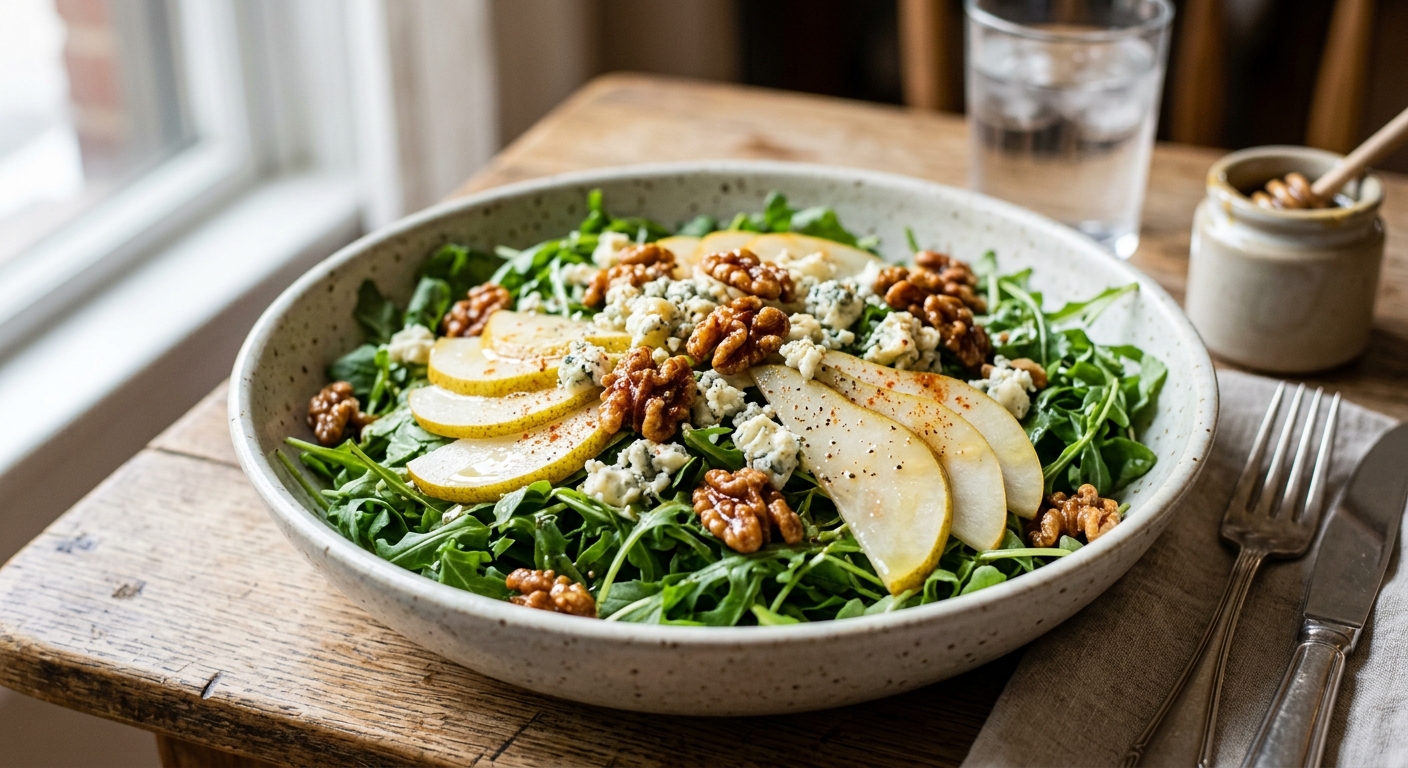
Some salads coast by on good looks. This one earns its place at the table with serious nutritional credentials. Arugula, the base of this recipe, is one of the most concentrated dietary sources of vitamin K1 (phylloquinone) available in any grocery store, delivering roughly 109 micrograms per 100-gram serving. Layered with juicy Bartlett pear for vitamin C and natural sweetness, sharp Gorgonzola for calcium and depth, and toasted walnuts for omega-3 fatty acids and crunch, every component was chosen because it contributes something meaningful, both to the flavour and to your daily micronutrient targets.
What makes this recipe distinctive on Calibrated Cuisine is the candied walnut component, which is prepared with genuine technique rather than a shortcut. Whether you toast them in a skillet, glaze them low-and-slow, finish them under pressure with a quick reduction, or roast them in the oven for deep caramelisation, each method produces a slightly different texture and flavour profile while delivering the same nutritional payload. The salad itself is assembled identically across methods; what changes is how you build that warm, caramelised walnut topping that elevates this from a weeknight salad to something worth making deliberately.
The lemon-honey vinaigrette does double nutritional duty: the lemon juice contributes additional vitamin C while its acidity enhances non-heme iron absorption from the arugula, a synergy backed by well-established nutritional science. A small amount of extra-virgin olive oil carries fat-soluble vitamin K into circulation far more efficiently than a fat-free dressing ever could. Every detail here is intentional, and the result tastes like something you would order at a serious bistro.
4
servings
Ingredients
- 160 gfresh arugula (rocket), washed and dried
- 2 mediumripe Bartlett or Anjou pears, cored and thinly sliced
- 90 gGorgonzola or Roquefort blue cheese, crumbled
- 120 graw walnut halves
- 2 tbspraw honey
- 1 tspunsalted butter
- 0.25 tspcayenne pepper
- 3 tbspextra-virgin olive oil
- 2 tbspfresh lemon juice (about 1 large lemon)
- 1 tspDijon mustard
- 1 tspraw honey (for vinaigrette)
- 1 smallshallot, finely minced
- —Colima Sea SaltMicroplastic Free Salt and freshly cracked black pepper to taste
Instructions
Click on an item below to shop for the recommended items for this recipe on Amazon.
As an Amazon Associate, we earn from qualifying purchases.
- Make the vinaigrette first so the flavours have time to meld. In a small bowl or jar, combine the 3 tablespoons of olive oil, lemon juice, Dijon mustard, 1 teaspoon honey, and minced shallot. Whisk vigorously until emulsified, then season with a pinch of fine sea salt and several cracks of black pepper. Set aside at room temperature.
- Line a plate or small baking sheet with parchment paper and set it near the stove. Place a medium skillet over medium heat and add the butter. Once it melts and foams subside (about 1 minute), add the walnut halves in a single layer. Toast, stirring frequently, for 3 to 4 minutes until the walnuts smell deeply nutty and show faint golden spots.
- Reduce the heat to medium-low. Drizzle in the 2 tablespoons of honey and sprinkle with cayenne and a pinch of salt. Stir constantly with a heatproof spatula for 1 to 2 minutes as the honey bubbles, thickens, and coats every walnut. Watch carefully: honey moves from golden to burnt quickly at this stage. As soon as the coating is glossy and amber, tip the walnuts immediately onto the prepared parchment in a single layer. Do not touch them for at least 5 minutes; they will be very hot and will harden as they cool.
- While the walnuts cool and set, prepare the pears. Core and slice them into thin wedges, roughly 5 mm thick. If preparing in advance, toss the slices with a squeeze of lemon juice to prevent browning.
- Build the salad in a wide, shallow serving bowl or on a large platter. Spread the arugula as an even base. Arrange the pear slices over the top, then scatter the crumbled blue cheese across the salad. Break the cooled candied walnuts apart if they have clumped, and distribute them over the salad. Drizzle the vinaigrette around the edges and over the centre, toss gently at the table just before serving to preserve the arrangement, and finish with a final crack of black pepper.
- Lightly coat the insert of a 3 to 6 quart slow cooker with a thin film of neutral oil or cooking spray to prevent sticking. Add the walnut halves, drizzle with the 2 tablespoons of honey, add the butter (no need to melt it first), the cayenne, and a generous pinch of sea salt. Stir everything together until the walnuts are as evenly coated as possible.
- Place the lid on the slow cooker and set it to Low. Cook for 1 hour, stirring once at the 30-minute mark to redistribute the coating and ensure even coverage. Do not cook on High, as the smaller thermal mass of nuts means High heat leads to uneven browning and potential scorching at the edges.
- After 1 hour, prop the lid open slightly with the handle of a wooden spoon to allow steam to escape. Continue cooking uncovered on Low for an additional 20 to 30 minutes, stirring every 10 minutes, until the coating is thick, glossy, and barely fluid. The walnuts should smell like toffee and the coating will have reduced significantly.
- Line a baking sheet with parchment. Using a silicone spatula, scrape the walnuts out immediately in a single layer. Allow them to cool completely, at least 15 minutes; the coating will harden into a brittle, satisfying shell as it sets.
- While the walnuts cool, prepare the vinaigrette by combining olive oil, lemon juice, Dijon, 1 teaspoon honey, and minced shallot in a jar. Seal the lid and shake vigorously for 20 seconds, then season with salt and pepper. Slice the pears. Assemble the salad on a platter by layering arugula, pear slices, and crumbled blue cheese, then top with the broken candied walnuts and dress at the table.
- Combine the walnut halves, 2 tablespoons honey, butter, cayenne, a pinch of sea salt, and 2 tablespoons of water in the pressure cooker insert. Stir to coat. The small amount of water is essential here: it prevents the Maillard reaction from starting before pressure is reached and ensures the pot comes to pressure safely.
- Seal the lid and set the valve to the sealing position. Cook on Manual High Pressure for 5 minutes. When the cycle completes, perform a quick release by carefully switching the vent to the venting position. Stand back from the steam.
- Open the lid and set the Instant Pot or pressure cooker to Saute mode on Medium heat (or place on the stovetop over medium heat if using a stovetop pressure cooker). Stir the walnuts continuously for 8 to 10 minutes as the liquid evaporates and the coating tightens, darkens, and becomes sticky. The walnuts are ready when the coating clings without pooling and takes on a deep amber colour.
- Immediately transfer the walnuts to a parchment-lined surface in a single layer. Allow to cool for at least 10 minutes until the coating hardens to a crisp shell.
- Prepare the lemon-honey vinaigrette by whisking together olive oil, lemon juice, Dijon mustard, 1 teaspoon honey, and minced shallot until emulsified. Season with salt and pepper. Slice the pears, assemble the arugula, pear, and blue cheese on a serving platter, scatter the cooled candied walnuts over the top, and drizzle with the vinaigrette just before serving.
- Preheat your oven to 175C (350F) with the rack positioned in the centre. Line a rimmed baking sheet with parchment paper (not foil; walnuts will stick to foil even with spray). In a medium mixing bowl, melt the butter in the microwave for 15 seconds, then whisk in the 2 tablespoons of honey, cayenne, and a generous pinch of sea salt until smooth.
- Add the walnut halves to the bowl and toss thoroughly with a spatula until every walnut is evenly coated. Spread them in a single, uncrowded layer on the prepared baking sheet. Crowding will cause steaming rather than roasting, leading to a sticky rather than crisp result.
- Roast in the preheated oven for 6 minutes, then remove the baking sheet and use a heatproof spatula to flip and redistribute the walnuts. Return to the oven for 6 to 8 more minutes, watching closely in the final 2 minutes. The walnuts are done when the coating is bubbling actively and smells like caramel. They will appear slightly underdone in the oven but will crisp dramatically as they cool.
- Remove the baking sheet and allow the walnuts to cool completely on the parchment, undisturbed, for at least 10 minutes. Resist moving them while hot as the coating is molten and will smear. Once cooled, break apart any clusters.
- Prepare the vinaigrette while the walnuts cool: whisk together olive oil, lemon juice, Dijon, 1 teaspoon honey, and minced shallot in a small bowl until emulsified. Season generously with salt and pepper. Slice the pears, assemble the salad on a wide platter with arugula as the base, layer in the pear slices and crumbled blue cheese, then finish with the oven-roasted candied walnuts and a tablespoon-by-tablespoon drizzle of vinaigrette.
Nutrition Breakdown
Per 1 serving (makes 4)
Vitamins & Minerals
% Daily Value based on a 2,000 calorie diet (FDA reference)
🧬 Essential Amino Acids
% of recommended daily intake (RDA) per serving
🛡 Antioxidant Profile
The Nutrition Science
Vitamin K1 (phylloquinone) is the headline nutrient in this recipe, and arugula is one of the most accessible dietary sources available. A 40-gram serving of arugula, roughly what fits in a single generous salad bowl, provides approximately 109 micrograms of K1, already exceeding the adult adequate intake of 90 to 120 micrograms established by the Institute of Medicine. Vitamin K1 is essential for activating the clotting factors II, VII, IX, and X via gamma-carboxylation, and emerging research implicates it in osteocalcin activation for bone mineralisation and arterial calcification prevention through matrix Gla protein. Crucially, the olive oil in the vinaigrette is not merely a flavour carrier: vitamin K1 is highly lipophilic, and studies confirm that co-ingestion with dietary fat increases phylloquinone bioavailability by three to four times compared to fat-free preparations.
The lemon juice in this vinaigrette serves two distinct nutritional functions. It provides roughly 14 milligrams of vitamin C per two-tablespoon serving of juice, adding to the vitamin C already present in the arugula and pear. More importantly, the ascorbic acid in lemon juice actively reduces ferric iron (Fe3+) found in plant foods to ferrous iron (Fe2+), the only form readily transported by the divalent metal transporter-1 (DMT1) in the duodenum. Arugula contains meaningful amounts of non-heme iron, approximately 1.5 milligrams per 100 grams, and dressing it with lemon-based vinaigrette rather than a neutral oil can increase iron absorption from that serving by 50 to 67 percent according to controlled absorption studies.
The walnuts in this recipe contribute alpha-linolenic acid (ALA), the plant-form omega-3 fatty acid, at approximately 1.3 grams per 30-gram serving. While the conversion efficiency of ALA to EPA and DHA is limited (typically 5 to 10 percent for EPA and under 1 percent for DHA), walnuts remain one of the richest plant sources of ALA available and contribute meaningfully to total polyunsaturated fat intake. They are also the source of ellagic acid and its colonic metabolites, the urolithins, which have demonstrated capacity to inhibit mTORC1 signalling and promote mitophagy in emerging cellular research. The blue cheese component rounds out the calcium and vitamin B12 profile while introducing a concentration of conjugated linoleic acid (CLA) and short-chain fatty acids associated with positive gut microbiome modulation.
Pro Tips
- Dry your arugula completely before dressing. Residual water on the leaves dilutes the vinaigrette and prevents it from coating the greens properly. A salad spinner followed by a gentle pat with a clean kitchen towel is ideal.
- Do not dress the salad more than 5 minutes before serving. Arugula wilts rapidly under acidity and will lose both texture and a portion of its water-soluble folate if left dressed too long.
- For the best pear flavour and texture, choose fruit that yields very slightly to thumb pressure near the neck. Underripe pear will be starchy and bland; overripe pear will break down into the salad and become unpleasant. Bartlett, Anjou, and Bosc all work well in this application.
solid breakdown on the K absorption angle, jasmine nailed it. the fat pairing is key for that fat-soluble vitamin uptake. id just add that the magnesium in those walnuts is gonna support your cardiovascular system too, which synergizes with the K2 angle if theres any fermented element here. ive noticed clients who optimize mineral combos like this report better energy than just chasing individual nutrients. curious if anyone here tests their vitamin K status before and after adding more leafy greens into rotation, or if thats overkill for functional eating purposes?
This is such a smart nutritional pairing, and I love seeing the fat solubility principle highlighted, since it’s something I catch all the time in the pharmacy when patients ask why their vitamin D isn’t working, then it turns out they’re taking it fasted. Quick note for anyone on warfarin or other anticoagulants, though, this salad is absolutely delicious and safe, just worth keeping consistent in your diet since vitamin K does interact with these medications, not because you should avoid it but because your anticoagulation levels adjust to your typical intake. The lemon-honey vinaigrette is a particularly nice touch because that acidity might help with iron bioavailability from the greens
Love this take on arugula’s bioavailability, especially pairing it with the fat from blue cheese and walnuts to maximize that vitamin K absorption! This reminds me why I always encourage folks to think beyond just the individual nutrient when they’re building meals, because arugula actually has this beautiful mineral density that gets overlooked when people brush past it as “just a salad green.” The pear addition is smart too, since that gentle sweetness makes bitter greens way more accessible for people who are still building their palate around nutrient-dense foods, which is so important in communities where traditional bitter greens like collards and mustards were staple sources of these nutrients before food access shifted. Have