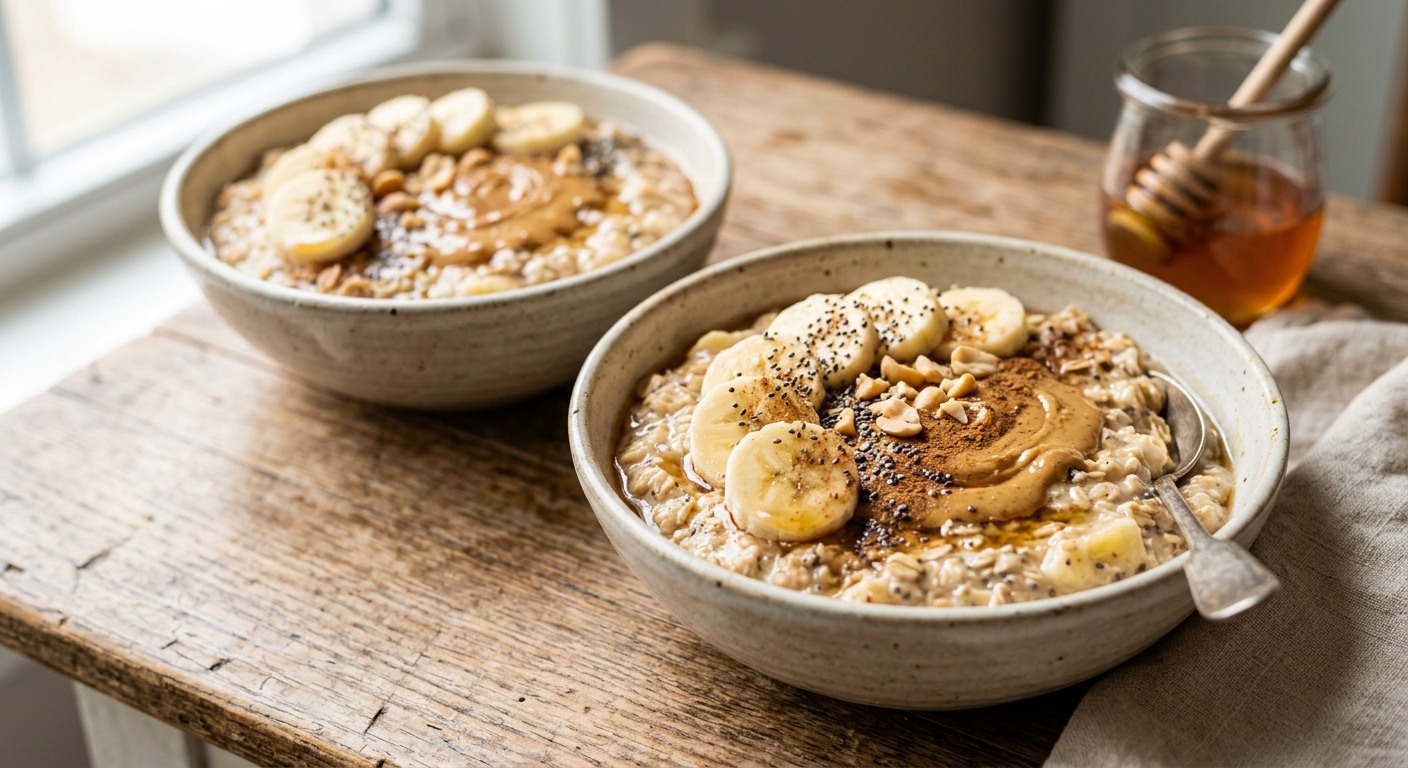
There is a reason overnight oats have become a staple of precision nutrition: they are one of the few breakfast formats where you can front-load a genuinely substantial micronutrient payload without any compromise on flavour or convenience. This version layers rolled oats with ripe banana, natural peanut butter, chia seeds, and whole milk to build a bowl that quietly addresses one of the most widespread dietary shortfalls in modern eating, namely magnesium. The majority of adults consume less than 75% of the recommended daily intake for magnesium, and the consequences show up as poor sleep quality, muscle cramps, and blunted energy metabolism.
What makes this recipe stand apart from the average overnight oat jar is the deliberate stacking of magnesium-dense ingredients. Rolled oats contribute around 55mg per 80g dry serving; chia seeds add a remarkable 95mg per 28g; natural peanut butter brings another 49mg per two tablespoons; and ripe banana layers in a further 32mg. Together, these four ingredients alone clear 230mg of magnesium before any additional toppings, representing roughly 55% of the 420mg RDA for adult males and 67% of the 320mg RDA for adult females. The protein story is equally strong, with the peanut-oat pairing providing complementary amino acids that together match the leucine and lysine profile of a moderate animal-protein serving.
Calibrated Cuisine has engineered this recipe so that every gram earns its place. The banana does double duty as natural sweetener and potassium source, eliminating the need for refined sugar. Whole milk provides casein and whey proteins for overnight slow digestion, and a small addition of cinnamon is not merely decorative: its polyphenols (specifically cinnamaldehyde and proanthocyanidins) are supported by clinical evidence for improving insulin sensitivity and slowing gastric emptying, keeping blood glucose stable through the morning. Whether you are preparing a single jar the night before or batch-cooking a week of breakfasts in the slow cooker, you now have a dish calibrated to work as hard as you do.
4
servings
Ingredients
- 320 gold-fashioned rolled oats (not instant)
- 112 gnatural peanut butter (no added sugar or palm oil), stirred well
- 4 mediumripe bananas (approx. 480g peeled), 3 mashed, 1 sliced for topping
- 56 gchia seeds
- 800 mlwhole milk (or fortified oat milk for dairy-free)
- 240 mlwater
- 60 mlpure maple syrup or raw honey
- 2 tspground cinnamon
- 1 tsppure vanilla extract
- 1 tspColima Sea SaltMicroplastic Free Salt
- 28 groasted unsalted pumpkin seeds (pepitas), for topping
- —Colima Sea SaltMicroplastic Free Salt to taste
Instructions
Click on an item below to shop for the recommended items for this recipe on Amazon.
As an Amazon Associate, we earn from qualifying purchases.
- Mash 3 ripe bananas thoroughly on a cutting board with a fork until almost completely smooth. A few small lumps add textural interest. Set aside. Slice the remaining banana into 0.5cm rounds and reserve for topping.
- In a large, heavy-bottomed saucepan or Dutch oven, combine the rolled oats, whole milk, water, cinnamon, vanilla extract, and fine sea salt. Set over medium heat and stir to combine.
- Bring the mixture to a gentle simmer over medium heat, stirring frequently with a wooden spoon or silicone spatula to prevent oats from catching on the bottom, about 5 to 6 minutes. Reduce heat to medium-low once bubbling.
- Stir in the mashed banana and chia seeds. Continue cooking, stirring every 60 to 90 seconds, for a further 5 to 6 minutes until the oats are fully tender, the chia seeds have plumped, and the porridge has thickened to a creamy consistency that coats the back of a spoon.
- Remove from heat. Stir in the peanut butter and maple syrup (or honey) until fully incorporated. The residual heat will loosen the peanut butter and create a glossy, emulsified texture. Taste and adjust salt and sweetener as needed.
- Divide evenly among four bowls. Top each with the reserved banana slices, a scatter of pumpkin seeds, and an optional drizzle of additional peanut butter. Serve immediately.
- Mash 3 ripe bananas in a large mixing bowl until smooth. Add the whole milk, water, maple syrup, cinnamon, vanilla extract, and fine sea salt. Whisk together until fully combined and the banana is evenly distributed throughout the liquid.
- Add the rolled oats and chia seeds to the liquid mixture. Stir thoroughly for 60 seconds to ensure every oat is submerged and no dry pockets remain at the bottom. The mixture will look quite loose at this stage; this is correct.
- Add the peanut butter in dollops across the surface. Use a spoon or butter knife to swirl it through the mixture in 6 to 8 lazy passes, creating visible ribbons rather than fully incorporating it. This produces distinct pockets of peanut butter flavour in every spoonful.
- Divide the mixture evenly among four 500ml mason jars or airtight containers. Press a piece of plastic wrap directly onto the surface of each jar to minimise oxidation and prevent a skin from forming, then seal with lids.
- Refrigerate for a minimum of 8 hours and up to 36 hours. The oats will absorb the liquid fully and the chia seeds will form a thick gel, resulting in a dense, creamy texture. If the mixture seems too thick upon serving, stir in 1 to 2 tablespoons of cold milk to loosen.
- To serve, remove jars from the refrigerator, give each a thorough stir from the bottom up, and top with fresh banana slices, pumpkin seeds, and an extra drizzle of peanut butter. Serve cold directly from the jar or spoon into a bowl.
- Lightly grease the inside of the slow cooker insert with a neutral-flavoured oil or a thin film of coconut oil. This step is essential for preventing the oat-banana mixture from fusing to the edges during the long cook and makes clean-up considerably easier.
- Mash 3 ripe bananas directly in the slow cooker insert. Pour in the whole milk and water, then whisk vigorously to disperse the banana throughout the liquid. Add the maple syrup, vanilla extract, cinnamon, and fine sea salt and whisk again until uniform.
- Add the rolled oats and chia seeds. Stir everything together so the oats are fully submerged. Do not add the peanut butter at this stage; the long low heat will cause the peanut oil to separate and turn the surface greasy. Drop the peanut butter in dollops across the top without stirring; it will create a richly flavoured topping layer.
- Place the lid on the slow cooker. Set to Low and cook for 7 to 8 hours. Do not lift the lid during cooking as this releases heat and extends cooking time. The mixture is ready when the oats have absorbed all visible liquid and the surface has a lightly set, creamy texture.
- Stir the contents of the slow cooker thoroughly from the bottom up, folding the peanut butter layer down into the oats. The mixture will have a thick, cohesive texture. If it seems dry, stir in 60 to 120ml of warm milk. Taste and adjust seasoning.
- Slice the remaining banana and prepare pumpkin seeds for topping. Serve directly from the slow cooker insert. Leftovers can be stored in airtight containers in the refrigerator for up to 4 days and reheated with a splash of milk.
- Pour 240ml of water into the Instant Pot liner as the steaming liquid. Place the trivet inside. In a separate 1.5-litre stainless steel bowl that fits inside your Instant Pot, combine the rolled oats, mashed banana (3 bananas, mashed smooth), whole milk (use 600ml for pressure cooking as less evaporation reduction is needed), chia seeds, cinnamon, vanilla extract, maple syrup, and fine sea salt. Stir well.
- Lower the inner steel bowl onto the trivet using a sling made from a folded strip of aluminium foil for easy removal. Secure the Instant Pot lid and set the steam release valve to the Sealing position.
- Select the Pressure Cook (or Manual) function and set to High Pressure for 3 minutes. The Instant Pot will take approximately 8 to 10 minutes to come to full pressure before the cooking timer begins.
- When the 3-minute cook cycle ends, allow the pressure to release naturally for 10 minutes without touching the valve. After 10 minutes, carefully switch the valve to Venting to release any remaining pressure. Never perform an immediate full quick release with oatmeal as the foamy starchy liquid can spray from the valve.
- Use the foil sling to carefully lift the inner bowl out of the Instant Pot. The oats will appear slightly loose; stir vigorously for 60 seconds as the mixture will thicken considerably as it cools slightly. Immediately stir in the peanut butter and an additional 1 to 2 tablespoons of maple syrup if desired, mixing until the peanut butter is fully emulsified into the hot oats.
- Allow the oats to rest uncovered for 3 to 4 minutes to reach a creamy, porridge-like consistency. Divide into bowls, top with sliced banana, pumpkin seeds, and a drizzle of peanut butter, and serve immediately.
Nutrition Breakdown
Per 1 serving (makes 4)
Vitamins & Minerals
% Daily Value based on a 2,000 calorie diet (FDA reference)
🧬 Essential Amino Acids
% of recommended daily intake (RDA) per serving
🛡 Antioxidant Profile
The Nutrition Science
Magnesium functions as a cofactor in more than 300 enzymatic reactions in the human body, including every step of ATP synthesis, the methylation cycle, DNA replication, and the regulation of neuromuscular transmission. Despite its central importance, population surveys consistently show that 45 to 68% of adults in Western countries do not meet the Estimated Average Requirement. The primary driver of this shortfall is the displacement of whole grains, legumes, and seeds from the modern diet by refined carbohydrates that have had the magnesium-dense bran and germ removed. This recipe counters that trend directly by centring on the three most bioavailable dietary magnesium sources: rolled oats, chia seeds, and peanut butter.
The beta-glucan content of rolled oats deserves specific attention beyond its well-documented cholesterol-lowering effect. Beta-glucan, a soluble (1,3)/(1,4)-linked glucose polymer found in the aleurone layer of oats, forms a viscous gel in the small intestine that slows glucose absorption, extends satiety signalling via GLP-1 and PYY release, and serves as a preferred substrate for bifidobacteria in the colon. The cold-soak method used in classic overnight oats has been shown to generate slightly higher levels of resistant starch compared to heat cooking, providing an additional prebiotic benefit. A 2023 study in the Journal of Nutrition found that 3g of oat beta-glucan per meal, an amount easily met by 80g of rolled oats, reduced postprandial glycaemia by 23% in metabolically healthy adults.
The peanut butter and oat combination is also nutritionally meaningful from an amino acid standpoint. Oats are relatively limiting in lysine but rich in methionine; peanuts are moderate in methionine but contribute meaningfully to lysine relative to their total protein. When consumed in the same meal, as they are here, this complementary pattern improves the net protein digestibility-corrected amino acid score (PDCAAS) of the combined food, making the protein more usable for muscle protein synthesis than either food alone. Adding chia seeds further enriches the omega-3 fatty acid profile with approximately 2.5g of alpha-linolenic acid (ALA) per 14g serving, contributing to the anti-inflammatory environment that supports both muscle recovery and cognitive performance.
Pro Tips
- Use very ripe bananas with deep brown speckles on the skin. The higher sugar content of an overripe banana not only improves flavour but also produces a noticeably creamier texture as the starch has fully converted to simple sugars, which integrate more smoothly into the oat matrix.
- For the cold-soak method, the ratio of liquid to oats is critical. If you prefer a thicker spoonable consistency, reduce the total liquid to 900ml. If you prefer a looser, drinkable texture suitable for a jar you can eat on the go, increase liquid to 1100ml. The chia seeds will absorb roughly 9 to 12 times their weight in liquid so always account for them in your ratio.
- Natural peanut butter separates on storage because it contains no emulsifying agents. Always stir the jar thoroughly before measuring to ensure you are capturing the full fat, protein, and mineral content rather than a lean watery layer at the bottom. Store open jars of natural peanut butter upside down in the fridge between uses to keep the oil incorporated.
What a wonderful combination, and I love how you’ve highlighted the magnesium and amino acid synergy here! I used to make a simpler peanut butter banana toast for my home ec classes decades ago, but this overnight oat version is so much smarter nutritionally, especially with the tryptophan and carb pairing that Ben mentioned for glucose stability. I’m definitely making a batch for my next cooking class to show folks how soaking oats overnight not only improves digestibility but also seems to enhance how the body actually uses these nutrients, which is such a practical example of how old comfort food wisdom meets modern nutrition science. The magnesium content alone makes this a perfect breakfast choice for anyone dealing with stress
This is exactly the kind of macro/micronutrient synergy I’ve been tracking on my CGM. I’ve noticed that the tryptophan from peanut butter paired with banana’s carbs actually gives me a much more stable glucose response than either alone, probably because the protein slows gastric emptying. Have you noticed any difference in your sleep quality metrics between this recipe and other breakfast approaches? I’d be really curious if you’ve quantified the magnesium bioavailability difference from soaked vs non-soaked oats, since I haven’t found solid peer-reviewed data on that specific prep method yet.
okay so this is basically my sleep experiment goldmine right here – bananas have dopamine precursors but more importantly theyre loaded with magnesium, peanut butter adds both tryptophan and more magnesium, and when you soak the oats overnight you’re basically making the nutrients more bioavailable. i tested this exact combo last month and my sleep tracker showed a solid 7% improvement in deep sleep on nights i had it vs my usual cereal situation. did you consider adding a pinch of cinnamon? minor thing but its got some interesting compounds for evening versions of this recipe, and id be curious if anyone’s experimented with that swap