
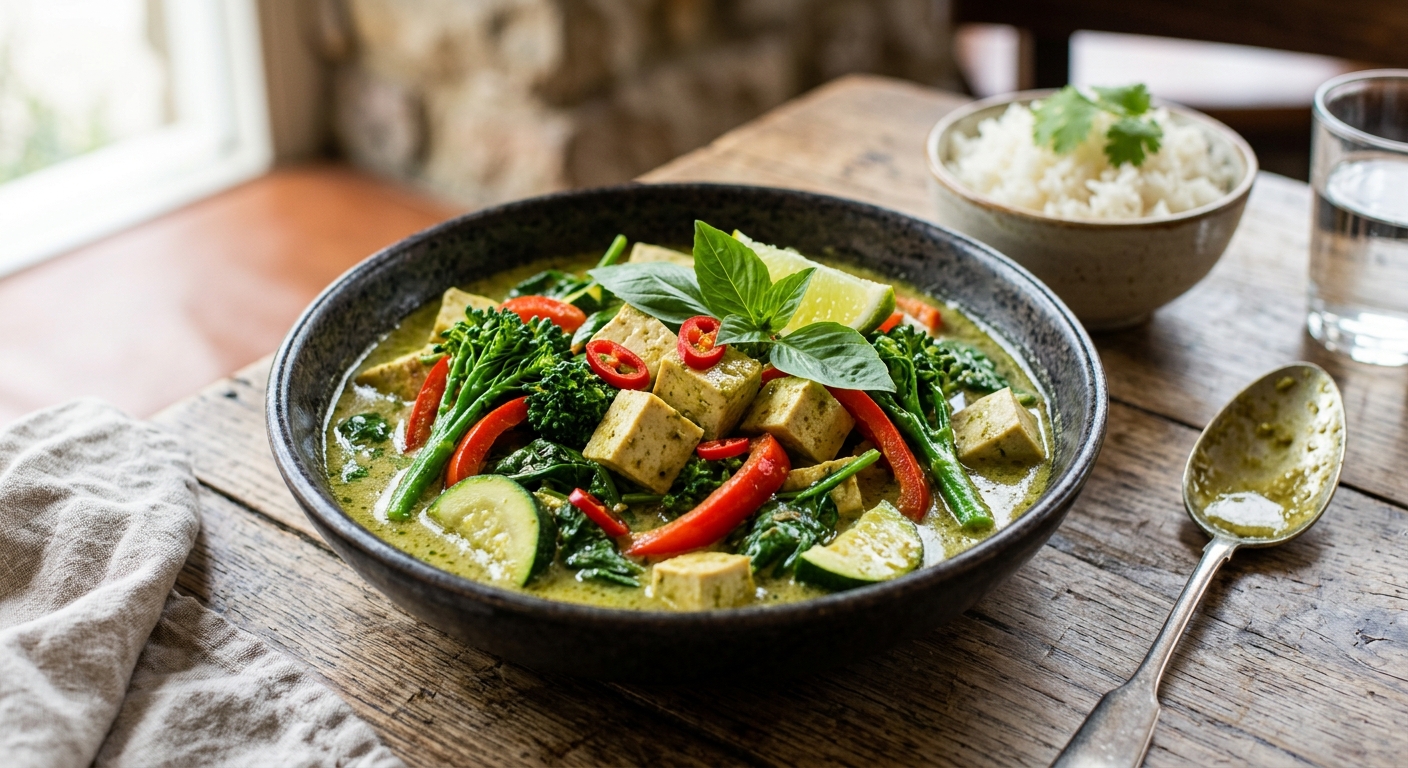
Thai green curry sits at a rare intersection of bold, complex flavor and genuine nutritional density. The paste alone, built from fresh green chilies, lemongrass, galangal, kaffir lime zest, and Thai basil, is a concentrated source of anti-inflammatory compounds that rival many dedicated supplement regimens. When you layer in firm tofu for plant-based protein, broccolini for sulforaphane, red bell pepper for vitamin C, and baby spinach for iron and folate, you get a dish that is not just delicious but nutritionally engineered for recovery, immunity, and long-term cellular health.
Coconut milk is the backbone of this curry, and it deserves a closer look beyond its reputation for richness. Full-fat coconut milk provides medium-chain triglycerides (MCTs), particularly lauric acid, which research suggests supports immune function and has antimicrobial properties. More importantly for nutrient absorption, the fat in coconut milk dramatically increases the bioavailability of fat-soluble vitamins A, K, and E present in the vegetables. This is not indulgence for its own sake; it is culinary science at work. The mild sweetness of the coconut milk also tempers the heat of the green curry paste, creating a sauce that is aromatic and layered rather than simply spicy.
What makes this recipe special on Calibrated Cuisine is the precision of the vegetable selection. Every ingredient earns its place not just for flavor but for a specific nutritional contribution. Broccolini brings glucosinolates and vitamin K. Red bell pepper delivers more vitamin C per gram than an orange. Zucchini adds potassium and B6 without spiking the glycemic load. Baby spinach wilts seamlessly into the sauce, contributing iron and folate in a form whose absorption is enhanced by the vitamin C already present in the dish. Together, these ingredients create a synergistic nutritional profile that is genuinely difficult to beat in a single meal.
4
servings
Ingredients
- 400 gfirm tofu, pressed and cut into 2cm cubes
- 400 mlfull-fat coconut milk (1 can)
- 250 mlvegetable broth, low-sodium
- 80 gThai green curry paste (store-bought or homemade)
- 200 gbroccolini, cut into 5cm pieces
- 1 largered bell pepper, deseeded and sliced into strips
- 2 mediumzucchini, halved lengthwise and sliced into half-moons
- 80 gbaby spinach, loosely packed
- 2 tbspcoconut oil or Avocado Oil100% Pure Avocado Oil
- 4 clovesgarlic, finely minced
- 1 tbspfresh ginger, grated
- 2 stalkslemongrass, bruised and tied in a knot
- 4 leaveskaffir lime leaves, central rib removed and torn
- 2 tbspfish sauce (or soy sauce for vegan)
- 1 tbspfresh lime juice
- 1 tspcoconut sugar or palm sugar
- 15 gfresh Thai basil leaves, for finishing
- 400 gcooked jasmine rice, for serving
- —Colima Sea SaltMicroplastic Free Salt and white pepper to taste
- —Thinly sliced red chili and lime wedges, to serve
Instructions
Click on an item below to shop for the recommended items for this recipe on Amazon.
As an Amazon Associate, we earn from qualifying purchases.
- Press the tofu: Wrap the tofu block in a clean kitchen towel, place a heavy pan on top, and press for at least 20 minutes. Once pressed, cut into 2cm cubes and pat dry with paper towels. Season lightly with salt and white pepper.
- Sear the tofu: Heat 1 tablespoon of coconut oil in a large Dutch oven or wok over medium-high heat until shimmering. Add the tofu cubes in a single layer, working in batches if needed to avoid crowding. Sear undisturbed for 2 to 3 minutes per side until golden and lightly crisp on at least two faces. Transfer to a plate and set aside.
- Bloom the aromatics: Reduce heat to medium. Add the remaining tablespoon of coconut oil to the same pan. Add the minced garlic and grated ginger, stirring constantly for 45 seconds until fragrant but not browned. Add the green curry paste and cook, pressing it into the base of the pan and stirring frequently, for 2 full minutes. This step is critical: frying the paste in oil activates its fat-soluble flavor compounds and eliminates the raw edge.
- Build the sauce: Pour in the coconut milk, scraping up any paste stuck to the bottom of the pan. Add the vegetable broth, lemongrass stalks, and kaffir lime leaves. Stir in the fish sauce (or soy sauce) and coconut sugar. Bring to a gentle simmer over medium heat, not a rolling boil, to preserve the coconut milk’s emulsion.
- Add vegetables in stages: Add the broccolini and zucchini to the simmering sauce. Cook for 5 minutes. Add the red bell pepper strips and the seared tofu. Cook for 3 more minutes until all vegetables are tender but retain a slight bite. In the final 60 seconds, stir in the baby spinach and allow it to wilt completely.
- Finish and season: Remove the lemongrass stalks and kaffir lime leaves. Add the fresh lime juice and taste for seasoning, adjusting with more fish sauce for saltiness, lime for brightness, or coconut sugar for balance. Stir in half the Thai basil. Ladle over jasmine rice and garnish with the remaining basil, sliced red chili, and lime wedges.
- Prep the tofu and bloom the paste: Press and cube the tofu as directed. In a small skillet over medium heat, warm 1 tablespoon of coconut oil. Add garlic, ginger, and curry paste, and fry for 2 minutes, stirring constantly, until the paste darkens slightly and smells intensely aromatic. This stovetop step is non-negotiable for slow cooker curries, where there is no high-heat searing phase to develop the paste’s depth.
- Load the slow cooker base: Transfer the bloomed paste mixture to the slow cooker insert. Pour in the coconut milk and vegetable broth, whisking to combine. Add the lemongrass stalks, kaffir lime leaves, fish sauce, coconut sugar, and a pinch of salt. Stir well.
- Add sturdy vegetables: Add the zucchini and broccolini to the slow cooker. These vegetables can withstand longer cooking times without completely losing texture at low heat. Do not add the bell pepper, spinach, or tofu yet. Cover and cook on Low for 3 hours.
- Add tofu and bell pepper: After 3 hours, gently stir in the cubed tofu and red bell pepper strips. Replace the lid and continue cooking on Low for 1 additional hour. The bell pepper added late will remain slightly crisp, preserving more of its vitamin C content.
- Finish the curry: Remove and discard the lemongrass stalks and kaffir lime leaves. Stir in the baby spinach, replace the lid, and let it wilt in the residual heat for 5 minutes without additional cooking. Add the fresh lime juice and stir in half the Thai basil. Taste and adjust seasoning. Serve over jasmine rice with remaining basil, sliced chili, and lime wedges.
- Sear the tofu using the Saute function: Set the Instant Pot or pressure cooker to Saute on High. Add 1 tablespoon of coconut oil. Once hot, sear the pressed tofu cubes in batches until golden on two sides, about 2 minutes per side. Remove to a plate. This step builds fond on the base that adds complexity to the final sauce.
- Bloom the paste in the pot: Without wiping out the pot, add the remaining tablespoon of coconut oil. Add garlic and ginger, sauteing for 30 seconds. Add the green curry paste and stir-fry for 90 seconds until fragrant. Pour in a splash of vegetable broth to deglaze, scraping up all browned bits from the bottom. This prevents a burn warning during pressurization.
- Add liquids and aromatics: Pour in the remaining vegetable broth and coconut milk. Add the lemongrass stalks, kaffir lime leaves, fish sauce, and coconut sugar. Stir to combine. Add the broccolini and zucchini only; hold back the bell pepper, spinach, and tofu for post-pressure additions, as these will turn mushy under pressure.
- Pressure cook: Secure the lid and set the valve to Sealing. Select Manual or Pressure Cook on High for 5 minutes. When the cycle ends, perform an immediate quick release by carefully turning the valve to Venting. Open the lid away from you.
- Add delicate ingredients: Switch back to Saute on Low. Stir in the seared tofu and red bell pepper strips. Cook for 2 to 3 minutes, just until the pepper softens slightly. Turn off the heat, then stir in the baby spinach and let it wilt for 1 minute. Remove the lemongrass and kaffir lime leaves. Stir in lime juice and half the Thai basil. Taste and adjust seasoning before serving over jasmine rice with remaining garnishes.
Nutrition Breakdown
Per 1 serving (makes 4)
Vitamins & Minerals
% Daily Value based on a 2,000 calorie diet (FDA reference)
🧬 Essential Amino Acids
% of recommended daily intake (RDA) per serving
🛡 Antioxidant Profile
The Nutrition Science
The anti-inflammatory credentials of this curry are rooted in the synergistic action of several distinct phytochemical pathways. The turmeric within the green curry paste contains curcuminoids that suppress the transcription factor NF-kB, the master regulator of the inflammatory response. Simultaneously, the sulforaphane from broccolini activates the Nrf2 pathway, which upregulates the body’s endogenous antioxidant enzymes such as glutathione peroxidase and superoxide dismutase. These two mechanisms work in complementary, non-overlapping ways, meaning you are not getting redundancy but genuinely additive anti-inflammatory protection from a single bowl.
The iron in this dish deserves special attention. Plant-based non-heme iron from tofu and spinach has a baseline absorption rate of roughly 2 to 8%, significantly lower than the heme iron in meat. However, the 85mg of vitamin C per serving from the red bell pepper and lime juice can increase non-heme iron absorption by up to 300% by reducing ferric iron (Fe3+) to the more bioavailable ferrous form (Fe2+) in the gut. The practical result is that the functional iron you absorb from this meal rivals what you would get from many meat-based dishes, making this an especially valuable recipe for those following plant-forward diets who are monitoring their iron status.
Coconut milk’s medium-chain triglycerides (MCTs) serve a dual nutritional role here. First, they provide a readily oxidized fuel source that is less likely to be stored as body fat compared to long-chain triglycerides. Second, and more critically for this dish, they act as a fat-soluble vitamin delivery vehicle. Vitamins A (from beta-carotene), K, and E are all fat-soluble, meaning their absorption from the broccolini and spinach is negligible without co-consumed dietary fat. Studies show that consuming carotenoids with just 3 to 5 grams of fat can increase their absorption by 4 to 10 times compared to a fat-free preparation. The roughly 20 grams of fat per serving in this curry ensure you are capturing the full nutritional value of every vegetable on your plate.
Pro Tips
- Press the tofu for at least 20 minutes using a dedicated tofu press or a weighted cutting board to remove maximum moisture. Properly pressed tofu will develop a golden crust rather than steaming in the pan, which creates textural contrast that makes each bite more satisfying.
- Fry the curry paste in oil for a full 2 minutes before adding any liquid, even in the slow cooker version where you do this in a separate skillet. Raw curry paste has a sharp, grassy edge from uncooked lemongrass and chili that disappears entirely when the paste contacts hot fat and caramelizes slightly.
- Add vegetables in order of their cooking time, from densest to most delicate. Spinach should never enter the pot more than 2 minutes before serving; prolonged heat destroys its folate content and turns it from vibrant green to army drab. The same principle applies to the fresh Thai basil, which should be added off the heat to preserve its volatile aromatic oils.

Oh I love where your head’s at with the mineral angle, Zack! You’re totally right that the broccolini is a zinc and magnesium MVP here, though I’d gently point out that plant-based zinc absorption gets a real boost when you pair it with that vitamin C in the peppers and curry broth, so the timing actually works in favor of this dish. If pumpkin seeds are in the mix that’s fantastic, but I’m curious if the recipe includes them or if you’re suggesting an add-on, because that would genuinely round out the mineral profile even more for hormone support like you mentioned.
This is such a smart mineral conversation, and I’m nodding along with both of you! I’ve found over my eight years managing RA that pairing my zinc sources with vitamin C foods makes a real difference in how I feel, and this curry does exactly that naturally. Zack, I love that you’re thinking about the hormone support angle because I’ve noticed better joint stability when my magnesium intake is solid, and broccolini has become a staple for me alongside turmeric dishes like this one. Priya’s point about absorption timing is gold, too, because my inflammation markers respond better when I’m thoughtful about combining nutrients instead of just checking boxes.
nice breakdown on the vitamin C, but im curious about the zinc and magnesium play here too – the broccolini and pumpkin seeds if youre using them would be clutch for hormone support alongside all that immune function. tofu’s decent for magnesium but id probably throw some cashews or pumpkin seeds on top to really lock in the mineral profile. have you tested the iron bioavailability with the vitamin C and fat combo, or just going off the raw numbers? that lemongrass-ginger broth probably helps with absorption too which is the move.