
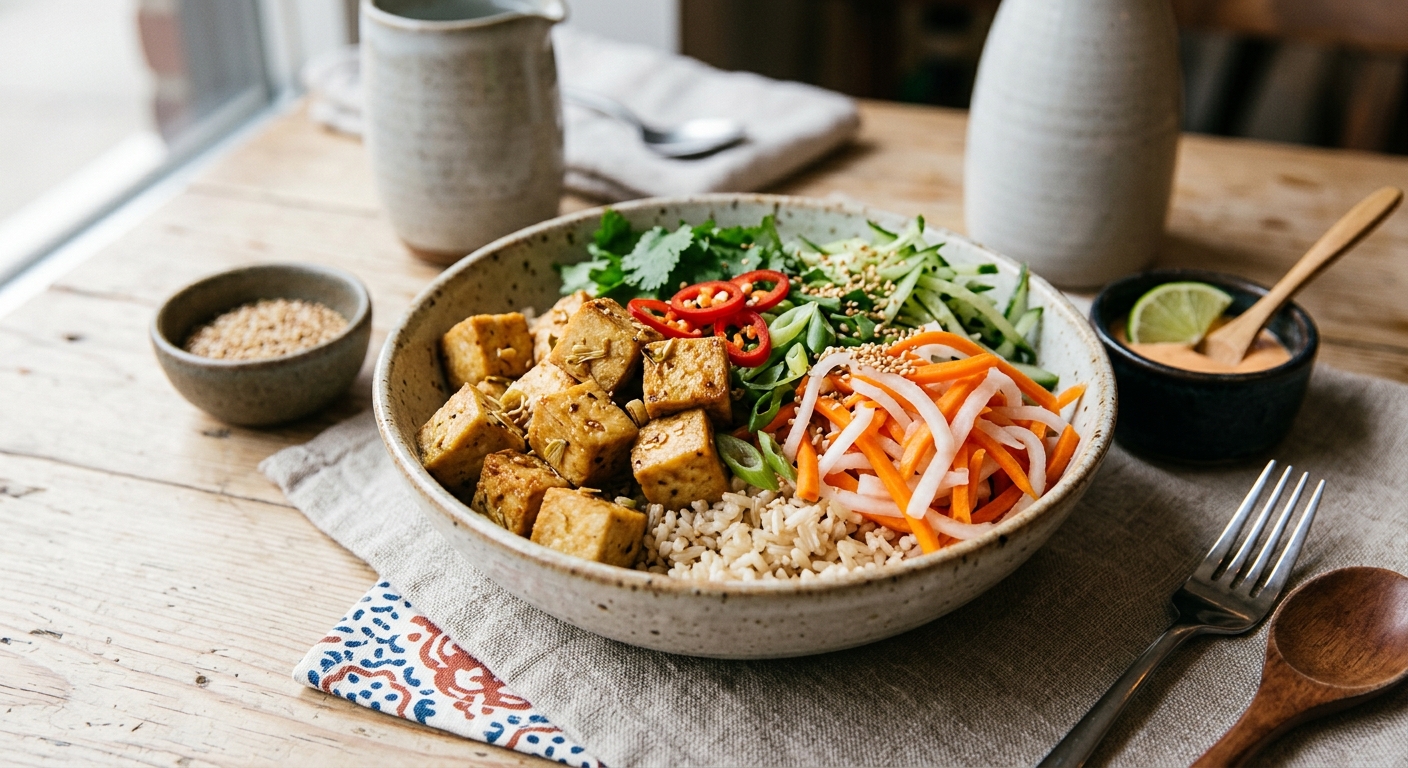
The bánh mì sandwich is one of the great culinary fusions in history, a collision of French baguette tradition and Vietnamese flavors that produces something entirely its own. This bowl format captures every element that makes bánh mì so irresistible: the tangy crunch of pickled vegetables, the fragrant umami of marinated protein, the cooling brightness of fresh cilantro and jalapeño, and that creamy, spicy drizzle that ties everything together. By swapping the bread for a base of brown jasmine rice and shredded purple cabbage, we transform an occasional street-food treat into a precisely calibrated, anti-inflammatory meal you can eat on rotation.
The lemongrass tofu is the nutritional and culinary centerpiece. Extra-firm tofu is pressed, marinated in a paste of fresh lemongrass, ginger, garlic, turmeric, and tamari, then cooked until deeply caramelized on the outside while staying tender within. Lemongrass is a rich source of citral, a compound with demonstrated anti-inflammatory and antimicrobial properties in peer-reviewed literature. Turmeric contributes curcumin, one of the most studied natural anti-inflammatory agents, and pairing it with black pepper in this recipe increases curcumin bioavailability by up to 2,000 percent according to research published in Planta Medica. Every ingredient here earns its place both on the palate and in the body.
The quick-pickled daikon and carrots, known as đồ chua in Vietnamese cooking, are more than a garnish. Daikon radish provides a meaningful hit of vitamin C and folate, while the fermentation-adjacent pickling process supports a favorable gut environment. This recipe is designed to hit or exceed 8 percent Daily Value for at least five key micronutrients per serving, and it clears that bar with room to spare. Whether you cook the tofu on the stovetop for maximum crust, in the oven for hands-off caramelization, in a pressure cooker for speed, or develop a slow-braised version with deeper flavor, this bowl delivers precision nutrition without asking you to compromise on pleasure.
4
servings
Ingredients
- 400 gextra-firm tofu, pressed for 30 minutes and cut into 2cm cubes
- 300 gbrown jasmine rice, rinsed
- 600 mllow-sodium vegetable broth (for rice cooking)
- 200 gdaikon radish, peeled and julienned
- 200 gcarrots, peeled and julienned
- 120 mlrice wine vinegar
- 1 tbspgranulated sugar
- 1 tspColima Sea SaltMicroplastic Free Salt (for pickling brine)
- 2 stalksfresh lemongrass, tender inner core only, finely minced
- 20 gfresh ginger, peeled and finely grated
- 4 clovesgarlic, minced
- 1 tspground turmeric
- 0.5 tspfreshly ground black pepper
- 3 tbsplow-sodium tamari (gluten-free soy sauce)
- 1 tbsptoasted sesame oil
- 1 tbsppure maple syrup
- 2 tbspAvocado Oil100% Pure Avocado Oil (for cooking tofu)
- 150 gpurple cabbage, finely shredded
- 1 mediumEnglish cucumber, thinly sliced into half-moons
- 1 largeripe avocado, sliced
- 30 gfresh cilantro leaves
- 2 mediumjalapeños, thinly sliced (seeds optional)
- 3 tbspsriracha hot sauce
- 2 tbspvegan mayonnaise
- 1 tbspfresh lime juice
- 1 tbspsesame seeds, toasted
- —Colima Sea SaltMicroplastic Free Salt and black pepper to taste
- —Lime wedges, to serve
Instructions
Click on an item below to shop for the recommended items for this recipe on Amazon.
As an Amazon Associate, we earn from qualifying purchases.
- Make the pickling brine: Combine rice wine vinegar, sugar, and 1 tsp fine sea salt in a small saucepan over medium heat. Stir for 2 minutes until sugar and salt fully dissolve. Remove from heat and let cool for 5 minutes, then pour over the julienned daikon and carrots in a non-reactive bowl. Press the vegetables down to submerge them, cover, and refrigerate for at least 30 minutes (up to 24 hours for deeper flavor).
- Make the lemongrass marinade: Combine minced lemongrass, grated ginger, minced garlic, turmeric, black pepper, tamari, sesame oil, and maple syrup in a medium bowl. Whisk thoroughly. Add the pressed and cubed tofu, toss gently to coat every surface, and marinate for at least 15 minutes at room temperature while you cook the rice.
- Cook the brown jasmine rice: Bring 600ml vegetable broth to a rolling boil in a medium saucepan with a tight-fitting lid. Add the rinsed rice, stir once, and reduce heat to the lowest possible setting. Cover and cook for 35 minutes without lifting the lid. Remove from heat and let steam, covered, for 10 minutes. Fluff with a fork and season lightly with salt.
- Sear the tofu: Heat avocado oil in a large cast-iron skillet or non-stick skillet over medium-high heat until shimmering. Using tongs or a slotted spoon, lift the tofu cubes from the marinade (reserve the marinade) and arrange them in a single layer. Do not crowd the pan. Cook undisturbed for 4 to 5 minutes until a deep golden crust forms on the bottom. Turn each cube and sear for another 3 to 4 minutes. Pour the reserved marinade into the pan during the final 2 minutes, tossing to glaze. The tofu should be amber and sticky. Remove from heat.
- Make the sriracha-lime drizzle: Whisk together sriracha, vegan mayonnaise, and fresh lime juice in a small bowl until smooth. Taste and adjust heat with more sriracha if desired.
- Assemble the bowls: Divide the brown rice among four wide bowls. Arrange piles of shredded purple cabbage, drained pickled vegetables, cucumber slices, and avocado slices around the rice. Top with the caramelized lemongrass tofu. Garnish generously with cilantro, jalapeño slices, toasted sesame seeds, and a drizzle of sriracha-lime sauce. Serve immediately with lime wedges.
- Prepare the pickled vegetables and lemongrass marinade as described in steps 1 and 2 of the Stovetop method. For the slow cooker, add an extra tablespoon of tamari and 60ml of vegetable broth to the marinade to create enough braising liquid to keep the tofu moist over the longer cook time.
- Place the pressed and cubed tofu in a single layer on the bottom of a 4-quart or larger slow cooker insert. Pour the extended lemongrass marinade evenly over the tofu, ensuring every cube is coated. Lay a piece of parchment paper directly on top of the tofu to trap steam and help the tofu absorb flavor rather than dry out. Cover with the lid.
- Cook on Low for 3 hours. The tofu will become very tender and deeply golden, absorbing the lemongrass, ginger, and turmeric into its core. The aroma at this stage will be extraordinary. Do not cook on High setting, as the garlic and lemongrass will become acrid.
- While the tofu finishes cooking, prepare the brown jasmine rice using the stovetop absorption method (see Stovetop step 3) or use a rice cooker. Make the sriracha-lime drizzle as described in Stovetop step 5.
- Optional but recommended broiler finish: Position an oven rack 15cm from the broiler element and preheat to High. Using a slotted spoon, transfer the braised tofu cubes to a parchment-lined baking sheet in a single layer. Brush or spoon any remaining braising liquid over the tops. Broil for 3 to 4 minutes until the edges char slightly and the surface firms into a glaze. Watch closely to prevent burning.
- Assemble the bowls exactly as in Stovetop step 6. The slow-braised tofu will have a softer interior with a more complex, layered lemongrass flavor compared to the stovetop version.
- Begin the pickled vegetables first as they need at least 20 minutes of resting time. Combine rice wine vinegar, sugar, and salt in a small bowl; microwave for 60 seconds and stir until dissolved, then pour over julienned daikon and carrots. Set aside at room temperature while you proceed.
- Prepare the lemongrass marinade as in Stovetop step 2. Toss the pressed and cubed tofu in the marinade and set aside.
- Set up pot-in-pot cooking: Pour 600ml vegetable broth into the Instant Pot inner pot. Place the trivet inside. In an oven-safe bowl or pot that fits inside your Instant Pot, combine the rinsed brown jasmine rice with 480ml water, a pinch of salt, and a light drizzle of sesame oil. Place this bowl on the trivet. Arrange the marinated tofu cubes directly on top of the rice in the bowl, or in a second stacked steamer basket above, so the tofu juices drip into the rice as it cooks, infusing it with lemongrass fragrance.
- Seal the Instant Pot lid and set the steam release valve to Sealing. Select Pressure Cook (Manual) on High Pressure and set the timer for 22 minutes (this cooks both the brown rice and the tofu simultaneously). Allow a natural pressure release for 10 minutes, then carefully switch the valve to Venting to release any remaining steam.
- Remove the lid. Lift out the bowl using oven mitts. The tofu will be tender and golden, and the rice will be perfectly cooked and aromatic. For those who prefer a firmer tofu texture, transfer the tofu cubes to a hot cast-iron skillet over high heat for 2 to 3 minutes to develop a quick crust. Fluff the rice with a fork. Make the sriracha-lime drizzle in a small bowl. Assemble the bowls as in Stovetop step 6.
- Preheat the oven to 220°C (425°F) with convection fan if available, or 230°C (450°F) for a conventional oven. Line a large rimmed baking sheet with parchment paper. Prepare the pickled vegetables as in Stovetop step 1.
- Prepare the lemongrass marinade as in Stovetop step 2. Toss the pressed tofu cubes thoroughly in the marinade. For oven roasting, add 1 teaspoon of arrowroot powder or cornstarch to the marinade before tossing; this creates a light coating that crisps dramatically in the dry heat of the oven, forming a lacquered crust.
- Spread the marinated tofu cubes in a single layer on the prepared baking sheet, ensuring they are not touching. Drizzle the avocado oil evenly over the top. Roast on the upper-middle rack for 15 minutes, then use a thin spatula to carefully flip each cube. Return to the oven for another 12 to 15 minutes until the tofu is deeply golden-brown, the edges are slightly charred, and the lemongrass coating has caramelized into a sticky, fragrant crust.
- While the tofu roasts, cook the brown jasmine rice using the stovetop absorption method (Stovetop step 3). Set a timer so both components finish within a few minutes of each other.
- In the last 5 minutes of the tofu roasting, brush any remaining marinade over the cubes for an extra glaze layer. Make the sriracha-lime drizzle. Drain the pickled vegetables. Slice the cucumber, avocado, and jalapeños.
- Remove the tofu from the oven and let it rest on the pan for 2 minutes; it will firm up further as it cools slightly. Assemble the bowls as in Stovetop step 6. The oven-roasted tofu has a uniquely satisfying chew and a more intense, concentrated lemongrass-turmeric flavor than any other method.
Nutrition Breakdown
Per 1 serving (makes 4)
Vitamins & Minerals
% Daily Value based on a 2,000 calorie diet (FDA reference)
🧬 Essential Amino Acids
% of recommended daily intake (RDA) per serving
🛡 Antioxidant Profile
The Nutrition Science
The anti-inflammatory credentials of this bowl trace back to three key bioactive compounds acting through complementary pathways. Curcumin, the polyphenol responsible for turmeric’s vivid color, suppresses nuclear factor kappa-B (NF-kB), the master transcription factor that switches on genes encoding pro-inflammatory cytokines including TNF-alpha, IL-1beta, and IL-6. This is the same pathway targeted by many pharmaceutical anti-inflammatory drugs, which is why turmeric has attracted serious clinical interest. The critical detail is bioavailability: curcumin is poorly absorbed alone, but piperine, the active compound in black pepper, inhibits glucuronidation in the liver and intestinal wall, allowing far more curcumin to enter systemic circulation. This recipe includes both, intentionally. Citral from fresh lemongrass works through a parallel mechanism, inhibiting COX-2 enzyme activity and thereby reducing prostaglandin E2 synthesis, the molecule that directly signals pain and inflammatory swelling.
The protein profile of extra-firm tofu deserves particular attention for plant-based eaters. Soy protein is one of only two complete plant proteins (alongside quinoa) that contains all nine essential amino acids in proportions close to human requirements. At 400g for four servings, this recipe delivers approximately 21g of total protein per bowl, with a PDCAAS (Protein Digestibility Corrected Amino Acid Score) of around 0.91, comparable to beef. Tofu is also one of the most concentrated plant sources of calcium when made with calcium sulfate coagulant, contributing meaningfully to the 22% DV calcium figure in this recipe. The isoflavones in soy, including genistein and daidzein, function as selective estrogen receptor modulators and have been associated in meta-analyses with reduced markers of systemic inflammation.
Brown jasmine rice retains its bran and germ layers, which is where the manganese, magnesium, and B vitamins reside. The manganese content alone clears 100% DV per serving, which matters because manganese is an essential cofactor for superoxide dismutase (MnSOD), the mitochondrial antioxidant enzyme that neutralizes the superoxide radical produced during normal cellular energy metabolism. Purple cabbage contributes anthocyanins, the same class of pigment-antioxidants found in blueberries, which have been shown in randomized controlled trials to reduce serum CRP, a primary biomarker of systemic inflammation, by a statistically significant margin over 12 weeks of regular consumption.
Pro Tips
- Press the tofu thoroughly: 30 minutes under a heavy skillet or in a dedicated tofu press removes enough moisture to allow the marinade to penetrate deeply rather than sitting on the surface. This single step is the difference between bland and exceptional tofu.
- Make double the pickled vegetables: They keep refrigerated for up to 5 days and transform grain bowls, tacos, and noodle soups. The brine can be reused once for a second, lighter batch.
- Fresh lemongrass is non-negotiable for optimal anti-inflammatory benefit: Dried lemongrass or lemongrass paste contains a fraction of the citral concentration. Peel away the tough outer layers until you reach the pale, almost translucent inner core, which is where the aromatic oils are most concentrated.
ooh this is so relevant for me rn! im constantly hunting for that vitamin c boost with my meals since it literally makes non-heme iron absorption so much better, and pickling in vinegar is actually genius for both things at once. the acidity helps preserve the vitamin c AND the acidic environment helps with iron uptake if youre eating this with something iron rich. ive been pairing pickled veggie heavy bowls with beans or lentils and my last ferritin panel actually showed improvement, so this banh mi bowl setup sounds like its basically designed for iron absorption optimization without even trying, which is kind of the dream?
ooh the pickled veggies caught my eye tbh – im curious if you tested the vitamin c content raw vs after the pickling process? like ive noticed the acidity seems to preserve some of it but im wondering if theres actual data showing how much degrades during fermentation. also does the lemongrass stay more potent in raw prep or does light cooking actually activate some of those compounds? ive been experimenting with raw lemongrass paste and its definitely different from steeped but idk if im getting the full anti-inflammatory profile you’re talking about
This is such a smart question, Remy, and honestly something I’ve been curious about too for my own meal prep. I know pickling in vinegar can actually help stabilize vitamin C in some vegetables, though heat during the process does degrade it somewhat. I’d love to see if the post author tested this or has data on it, because the difference between raw and pickled C content would totally change how I’m building my weekly bowls around inflammation management. The lemongrass and ginger are doing heavy lifting here regardless, but if those pickled veggies are retaining even 60-70% of the raw C content, that’s still a solid contribution to my antioxidant intake for the