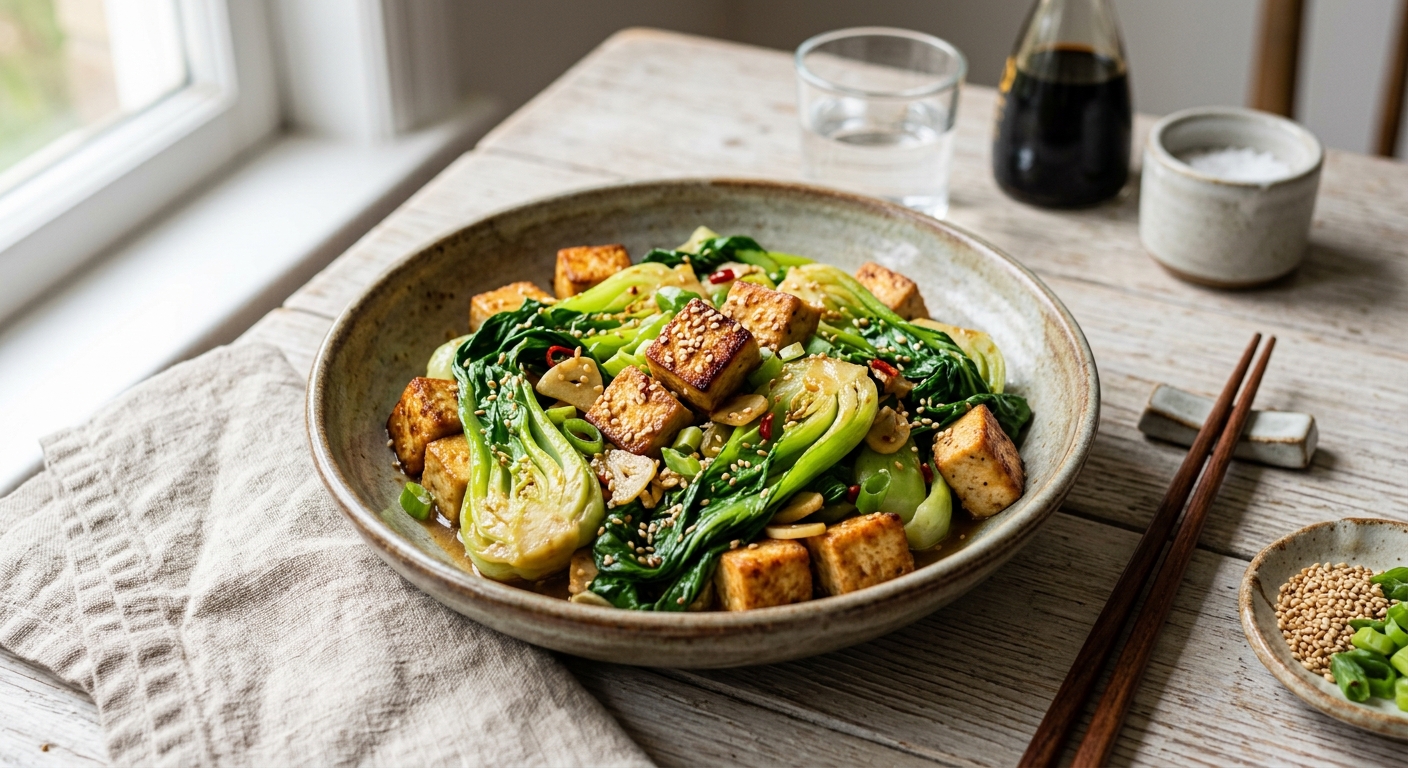
If you have ever wondered how to build strong bones without relying on dairy, this Tofu and Bok Choy Stir-Fry is your answer. Calcium-set firm tofu (made with calcium sulfate as a coagulant) is one of the most concentrated plant-based calcium sources available, delivering roughly 350mg per 100g serving. Paired with bok choy, which gram-for-gram rivals dairy milk for calcium bioavailability thanks to its low oxalate content, and finished with tahini and toasted sesame seeds, this single dish provides a remarkable foundation for daily skeletal health.
Beyond calcium, this stir-fry is a nutritional triple threat for bone integrity. The tofu provides magnesium and zinc, two cofactors that regulate calcium deposition into bone matrix, while bok choy contributes vitamin K1, the fat-soluble vitamin that activates osteocalcin, the protein responsible for binding calcium to bone. The sesame oil and a drizzle of tahini add healthy monounsaturated and polyunsaturated fats, which are necessary for absorbing the fat-soluble vitamin K in the greens. Every ingredient here is doing precise, coordinated work at the cellular level.
Culinarily, this dish rewards technique. High-heat searing gives the tofu a golden, crisp crust with a creamy center, while the bok choy needs only 90 seconds of contact heat to transform from raw to brilliantly jade-green and tender-crisp. The sauce, built from tamari, fresh ginger, rice vinegar, and a spoonful of tahini, clings to every surface and brings a nutty, umami depth that makes this feel indulgent rather than medicinal. This is bone health that tastes like a restaurant.
4
servings
Ingredients
- 600 gcalcium-set firm tofu, pressed and cut into 2cm cubes
- 500 gbaby bok choy, halved lengthways
- 3 tbsptamari (or soy sauce if not avoiding gluten)
- 2 tbsptahini (sesame seed paste)
- 2 tbsptoasted sesame seeds
- 2 tbsptoasted sesame oil
- 2 tbspAvocado Oil100% Pure Avocado Oil (avocado or grapeseed), divided
- 1 tbsprice vinegar
- 1 tbsppure maple syrup
- 4 clovesgarlic, minced
- 20 gfresh ginger, peeled and finely grated
- 2 tspcornstarch
- 3 tbspwater
- 1 tspchili flakes (optional)
- —Colima Sea SaltMicroplastic Free Salt and white pepper to taste
- —Steamed jasmine or brown rice, to serve
Instructions
Click on an item below to shop for the recommended items for this recipe on Amazon.
As an Amazon Associate, we earn from qualifying purchases.
- Press the tofu firmly between two clean kitchen towels, stacking a heavy pan on top for 10 to 15 minutes to expel maximum moisture. While it presses, whisk together the tamari, tahini, rice vinegar, maple syrup, sesame oil, grated ginger, minced garlic, chili flakes (if using), and 3 tablespoons of water in a small bowl until smooth. In a separate tiny bowl, stir the cornstarch with 1 tablespoon of cold water to make a slurry and set aside.
- Heat a wok or large heavy skillet over the highest heat your stove allows for 2 full minutes until the surface just begins to smoke. Add 1 tablespoon of neutral oil and swirl to coat. Add the tofu cubes in a single layer, resisting the urge to move them for 3 minutes until a deep golden crust forms on the bottom. Turn each piece and sear for another 2 minutes on the second side. Transfer the seared tofu to a plate and season lightly with sea salt.
- Add the remaining 1 tablespoon of neutral oil to the same wok. Add the bok choy halves cut-side down in a single layer. Sear undisturbed over high heat for 90 seconds until the cut faces are lightly charred and caramelized. Flip and cook for another 60 seconds. The leaves should be bright jade-green and the stems just barely tender. Transfer to the plate with the tofu.
- Reduce the heat to medium-high. Pour the sauce mixture into the wok and let it bubble for 30 seconds, scraping up any browned bits from the bottom. Stir in the cornstarch slurry and cook, stirring constantly, for 60 to 90 seconds until the sauce thickens to a glossy, coating consistency.
- Return the tofu and bok choy to the wok. Gently fold everything together for 30 seconds to coat in the sauce without breaking the tofu. Taste and adjust seasoning. Divide over steamed rice, finish with a generous scatter of toasted sesame seeds, and serve immediately.
- Press the tofu as directed. In a medium bowl, whisk together the tamari, tahini, rice vinegar, maple syrup, sesame oil, grated ginger, minced garlic, chili flakes (if using), and 3 tablespoons of water until completely smooth. Do not add the cornstarch slurry yet as it will be used at the end.
- Lightly grease the insert of a 4-quart or larger slow cooker with a thin film of neutral oil. Arrange the pressed tofu cubes in a single layer across the bottom. Pour the prepared sauce evenly over the tofu, making sure all pieces are coated. Place the lid on and cook on Low for 2 hours 40 minutes. The tofu will absorb the sauce and become deeply flavored throughout.
- At the 2 hour 40 minute mark, stir the cornstarch with 1 tablespoon of cold water to make a slurry. Drizzle the slurry over the tofu and gently stir to distribute it through the sauce without breaking the tofu pieces. Lay the halved bok choy on top of the tofu in a single layer, cut-side up. Replace the lid and cook on Low for a final 20 minutes.
- The bok choy should be tender but still hold its structure, and the sauce should have thickened slightly around the tofu. If the sauce seems thin, remove the lid and cook on High for 10 minutes to reduce. Taste the sauce and adjust with extra tamari or rice vinegar as needed.
- Using a wide spoon, gently transfer the tofu and bok choy over steamed rice, spooning the sauce generously over everything. Finish with toasted sesame seeds and a light drizzle of additional sesame oil. Serve straight from the slow cooker for a family-style presentation.
- Press the tofu and prepare the sauce as in the stovetop method, whisking together tamari, tahini, rice vinegar, maple syrup, sesame oil, ginger, garlic, chili flakes, and 3 tablespoons of water. Set the cornstarch slurry aside separately.
- Set the Instant Pot to Saute on High. Once the display reads Hot, add 1 tablespoon of neutral oil. Add the tofu cubes in batches without crowding and sear for 2 minutes per side until golden on at least two faces. Remove the tofu and set aside. Add the remaining tablespoon of oil, then the garlic and ginger, and saute for 30 seconds until fragrant, scraping up any browned bits.
- Pour in the prepared sauce and stir to deglaze the bottom completely. Return all the seared tofu to the pot and toss gently to coat. Press Cancel to end the Saute function. Secure the lid, set the valve to Sealing, and cook on Manual High Pressure for 5 minutes.
- When the cook time ends, perform a quick pressure release by carefully turning the valve to Venting. Once pressure is fully released, open the lid. The sauce will be thin and very liquid at this stage. Switch back to Saute on Normal heat. Stir in the cornstarch slurry and cook, stirring gently, for 2 minutes until the sauce thickens and becomes glossy.
- Add the halved bok choy directly to the pot, gently nestling the pieces into the sauce around the tofu. Press Cancel and place the lid on loosely (do not seal). Let the residual heat steam the bok choy for exactly 3 minutes. The stems should be just tender and the leaves vivid green. Serve immediately over rice with a heavy scatter of toasted sesame seeds.
- Preheat the oven to 220C (425F) with the convection fan on if available. Line a large rimmed baking sheet with parchment paper. Press the tofu thoroughly and pat completely dry with paper towels. In a large bowl, toss the tofu cubes with 1 tablespoon of neutral oil, 1 tablespoon of tamari, and a pinch of white pepper until evenly coated.
- Spread the tofu in a single layer on the prepared baking sheet with at least 1cm of space between each piece. Roast on the top third rack for 25 to 30 minutes, flipping each piece at the 15-minute mark, until deeply golden-brown and slightly chewy on the outside with a custard-soft center. The roasted tofu should hold its shape firmly when picked up.
- While the tofu roasts, whisk together the remaining tamari, tahini, rice vinegar, maple syrup, sesame oil, grated ginger, minced garlic, chili flakes (if using), and 3 tablespoons of water in a bowl. In a separate small bowl, mix the cornstarch with 1 tablespoon of cold water for the slurry.
- In the final 8 minutes of tofu roasting time, toss the halved bok choy in the remaining 1 tablespoon of neutral oil and season lightly with salt. Arrange them cut-side up on a second baking sheet. Slide into the oven on the middle rack and roast for 7 to 8 minutes until the cut surfaces begin to caramelize at the edges and the stems are just tender. Do not over-roast.
- While the bok choy roasts, pour the sauce into a small saucepan over medium heat. Bring to a gentle simmer and stir in the cornstarch slurry. Cook, stirring constantly, for 90 seconds until the sauce thickens to a glossy, spoonable consistency. Remove from heat. Arrange the roasted tofu and bok choy on a serving platter or over rice, drizzle the sauce generously over everything, and scatter with toasted sesame seeds to finish.
Nutrition Breakdown
Per 1 serving (makes 4)
Vitamins & Minerals
% Daily Value based on a 2,000 calorie diet (FDA reference)
🧬 Essential Amino Acids
% of recommended daily intake (RDA) per serving
🛡 Antioxidant Profile
The Nutrition Science
The calcium story in this dish is about both quantity and bioavailability, and both metrics are exceptional. Calcium-set tofu is manufactured using calcium sulfate as a coagulant, a process that binds calcium directly into the tofu curd, yielding roughly 200 to 220mg of calcium per 100g. Bok choy provides an additional 100 to 105mg per 100g cooked, and critically, its oxalate content is very low (under 10mg per 100g), meaning approximately 54% of its calcium is absorbed, compared to just 5% from high-oxalate spinach. Sesame seeds and tahini contribute a further 88mg per 2 tablespoons. When combined at these recipe quantities, a single serving delivers over 530mg of highly bioavailable calcium, more than 50% of the adult RDI.
Vitamin K2 is often cited as the bone-health vitamin, but K1 (phylloquinone), found abundantly in bok choy at roughly 45mcg per 100g cooked, performs the same essential function: carboxylating osteocalcin, the bone matrix protein that anchors calcium ions into hydroxyapatite crystals. Crucially, the sesame oil and tahini in this recipe provide the dietary fat required to absorb vitamin K1, which is fat-soluble and largely wasted when consumed without fat. This is nutritional synergy by design. The magnesium from tofu and sesame seeds further activates vitamin D receptors in the gut, amplifying calcium uptake from the intestinal wall.
The soy isoflavones in tofu, particularly genistein and daidzein, deserve specific attention in the context of bone preservation. These phytoestrogens bind weakly to estrogen receptor beta (ERb), which is expressed on osteoclasts, the cells responsible for breaking down bone. By partially occupying these receptors, genistein blunts the osteoclast activation signal, effectively slowing the rate of bone resorption. Meta-analyses of postmenopausal populations have found that regular soy consumption (40 to 60mg isoflavones daily, achievable with this recipe) is associated with a statistically significant improvement in lumbar spine bone mineral density. This dish provides approximately 50 to 60mg of isoflavones per serving from the 150g of tofu it contains.
Pro Tips
- Always buy tofu labeled with calcium sulfate (E516) in the ingredients list. Tofu set with magnesium chloride (nigari) contains significantly less calcium, sometimes 5 to 10 times less, and will underdeliver on the nutritional promise of this dish.
- For the stovetop method, dry the tofu aggressively after pressing. Any surface moisture will cause violent steaming when it hits the hot pan and prevent the golden crust from forming. A 30-second rest on fresh paper towels after pressing makes a measurable difference.
- To maximize vitamin K1 absorption from the bok choy, do not reduce the fat in this recipe. The sesame oil and tahini are not optional garnishes; they are functional components that ensure the fat-soluble vitamin is carried through the intestinal wall rather than lost in digestion.
Great question, Sylvia! The quick stir-fry heat is actually your friend here – brief, high-heat cooking doesn’t meaningfully degrade the calcium in tofu or bok choy, and the sesame seeds stay intact. What *does* matter for bioavailability is that both bok choy and sesame are relatively low in oxalates compared to spinach, so you’re getting better calcium absorption than you might with other greens. One small pharmacist note: if your kids are on any calcium supplements or fortified products, this dish is such a great food-first approach that it might actually let you dial back supplemental doses, which is always preferable for avoiding mineral imbal
oh this is so perfect for what ive been trying to do with my kids’ calcium intake! quick question though – does the cooking method affect the bioavailability at all, or since its a quick stir-fry the heat doesnt really break down the calcium the way it might with longer cooking? also im wondering if theres any concern about oxalates in the bok choy interfering with absorption since tofu already has that calcium-set with nigari… my oldest refuses anything “too healthy looking” so im betting the sesame seeds will be my secret weapon to get her excited about it lol we tried sprouted chickpeas in her last bowl and she actually asked for seconds which never happens!
this is exactly the kind of dish my avó would’ve made if shed grown up with asian ingredients instead of just her brazilian ferments, and honestly thats what im excited about here – the bioavailable calcium is great, but i love that youre stacking calcium *and* the enzymes from that ginger-garlic base that help your gut actually absorb it better. ive noticed in my workshops that when people combine fermented condiments or even just fresh ginger with mineral-rich foods like this, theres almost a synergy happening in the microbiome. have you ever experimented with a miso or tamari swap in the sauce to add those beneficial bacteria on top of the minerals?