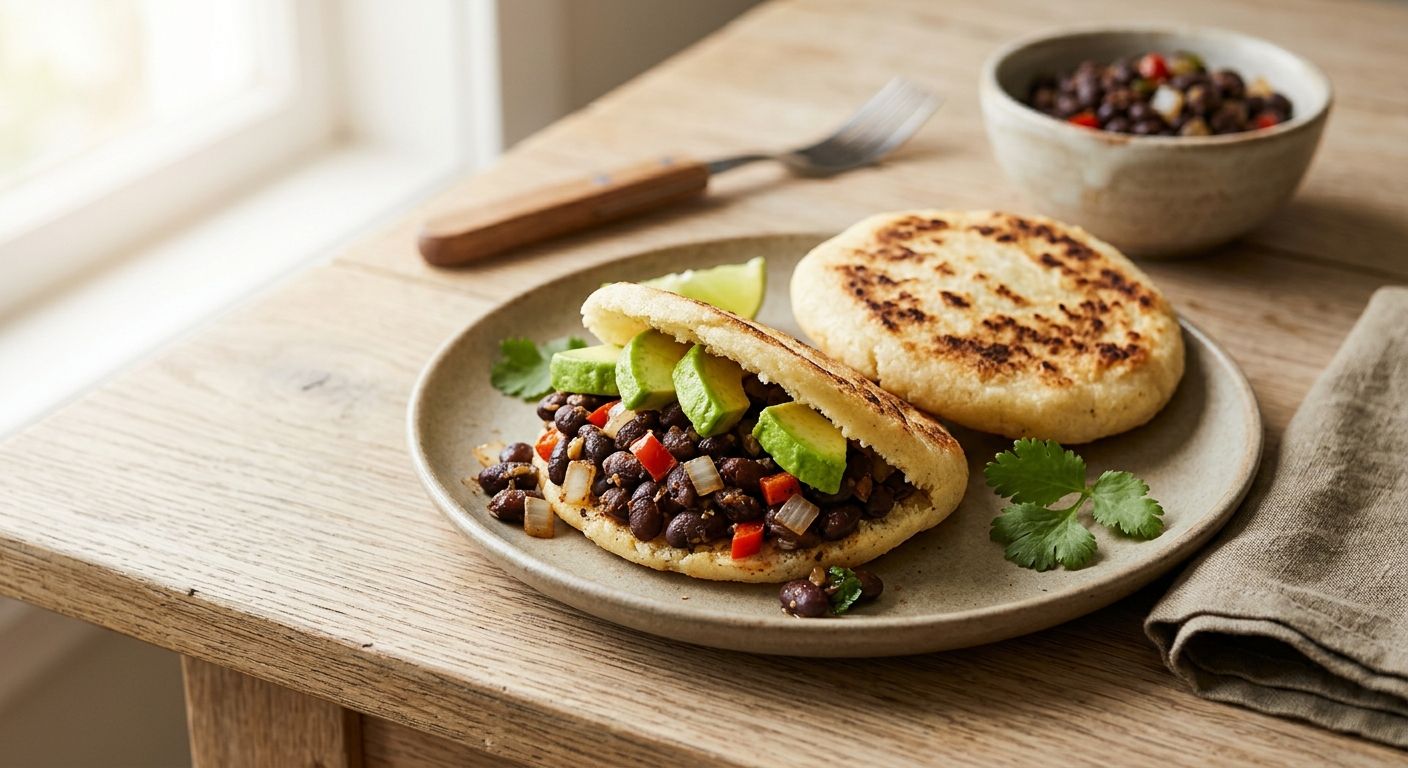
Arepas are one of the oldest foods in the Americas, eaten daily across Colombia and Venezuela for centuries, and for good reason. Made from masa harina or pre-cooked white corn flour (masarepa), they are naturally gluten-free, satisfying, and extraordinarily versatile. Paired with black beans and ripe avocado, they transform into a nutritionally complete plant-based meal that checks every box: complete protein via complementary amino acids, healthy monounsaturated fats, resistant starch, and a staggering lineup of vitamins and minerals.
What makes this combination so nutritionally elegant is the protein synergy at work. Black beans are rich in lysine but lower in methionine, while corn masa contributes the methionine side of the equation. Together, they cover all nine essential amino acids at meaningful levels, achieving what nutritionists call complementary protein, the same principle that makes rice and beans a global staple. Add avocado, and you also dramatically increase the bioavailability of fat-soluble nutrients like beta-carotene from the beans and vitamin K from the greens, since these require dietary fat to be absorbed efficiently.
On Calibrated Cuisine, we have calculated every gram so you know exactly what each serving delivers. One portion provides over 35% of your daily iron needs, more than 50% of your folate requirement, and a glycemic load kept firmly in the medium range by the resistant starch in the corn and the fiber-fat matrix of the avocado and beans. Whether you cook the beans from scratch in a pressure cooker, set them in a slow cooker overnight, or rely on canned beans for a quick stovetop weeknight dinner, this recipe adapts to your schedule without sacrificing an ounce of flavour or nutrition.
4
servings
Ingredients
- 280 gmasarepa (pre-cooked white corn flour, such as P.A.N. brand)
- 480 mlwarm water
- 1 tspColima Sea SaltMicroplastic Free Salt, for arepa dough
- 1 tspAvocado Oil100% Pure Avocado Oil (avocado or sunflower), for cooking arepas
- 400 gdried black beans, soaked overnight (or 2 x 400g cans, drained)
- 1 mediumwhite onion, finely diced
- 4 clovesgarlic, minced
- 1 mediumred bell pepper, finely diced
- 2 tspground cumin
- 1 tspsmoked paprika
- 0.5 tspdried oregano
- 0.25 tspcayenne pepper
- 2 tbspextra-virgin olive oil, for sauteing beans
- 500 mllow-sodium vegetable broth
- 2 largeripe Hass avocados
- 2 tbspfresh lime juice (about 1 large lime)
- 20 gfresh cilantro, roughly chopped
- 1 smalljalapeño, seeded and minced (optional)
- —Colima Sea SaltMicroplastic Free Salt and black pepper to taste
- —Lime wedges, to serve
Instructions
Click on an item below to shop for the recommended items for this recipe on Amazon.
As an Amazon Associate, we earn from qualifying purchases.
- If using dried soaked beans, drain and rinse them thoroughly. Place in a large saucepan, cover with fresh cold water by at least 5cm, and bring to a vigorous boil over high heat. Boil hard for 10 minutes (this is especially important for black beans), then reduce heat to a steady simmer. Cook uncovered for 50 to 70 minutes until completely tender. Drain and set aside. If using canned beans, drain and rinse them and proceed directly to the next step.
- Heat 2 tablespoons of olive oil in a wide, heavy-based skillet or Dutch oven over medium heat. Add the diced onion and a pinch of salt and cook, stirring occasionally, for 6 to 8 minutes until soft and translucent with golden edges. Add the diced red bell pepper and cook for another 3 minutes. Add the minced garlic, cumin, smoked paprika, oregano, and cayenne and stir constantly for 90 seconds until the spices are fragrant and coating the vegetables.
- Add the cooked or canned beans to the skillet and pour in the vegetable broth. Stir everything together, scraping up any browned bits from the bottom of the pan. Bring to a simmer and cook uncovered for 15 to 20 minutes, stirring occasionally, until the broth has reduced by about two-thirds and the mixture is thick and saucy but not dry. Taste and adjust salt and pepper. Keep warm on the lowest heat setting while you make the arepas.
- Combine the masarepa and 1 teaspoon of salt in a large mixing bowl. Pour in the warm water gradually while mixing with your hand or a wooden spoon, until a smooth, pliable dough forms. It should feel like soft playdough and hold its shape without cracking at the edges. Rest the dough for 5 minutes, then divide into 8 equal portions (about 95g each). Roll each portion into a ball and press between your palms to form a disk about 1cm thick and 8 to 9cm in diameter. Smooth any cracks at the edges by pressing gently.
- Heat a cast iron skillet or non-stick griddle over medium heat. Brush lightly with neutral oil. Cook the arepas in batches of 3 to 4, without crowding the pan. Cook for 5 to 6 minutes on the first side without pressing or moving them, until a dry, slightly matte crust forms and the edges start to look cooked. Flip and cook for another 5 to 6 minutes on the second side until both sides are deep golden with characteristic dark spots. The arepas are done when they sound hollow if you tap the centre lightly. Transfer to a wire rack, not a plate, so the bottoms stay crisp.
- While the arepas cook, make the avocado topping. Halve and pit the avocados, then scoop the flesh into a bowl. Add the lime juice, minced jalapeño if using, and a generous pinch of salt. Mash with a fork to your preferred texture, leaving some chunks for contrast. Do not over-season at this stage as you will adjust at the table.
- To serve, split each arepa open along the equator with a sharp knife, or simply top them. Spoon a generous portion of spiced black beans onto each arepa, add a heaped tablespoon of avocado mash, and scatter fresh cilantro over the top. Serve immediately with lime wedges alongside.
- If using dried soaked beans, drain and rinse them. Place in a saucepan with fresh water, bring to a hard rolling boil over high heat, and boil for a full 10 minutes. Drain completely. This safety step cannot be done in the slow cooker itself due to insufficient temperature. Transfer the parboiled beans to the slow cooker insert.
- Without washing the saucepan, heat the olive oil over medium heat and add the diced onion. Saute for 5 minutes until softened, then add the red bell pepper and cook for 2 more minutes. Add the minced garlic, cumin, smoked paprika, oregano, and cayenne and stir for 60 seconds until fragrant. Scrape this entire sofrito mixture directly into the slow cooker on top of the beans. This brief stovetop step builds far more flavour than adding raw aromatics to the slow cooker, which tend to produce a flat, uniform taste.
- Pour the vegetable broth over the bean and sofrito mixture in the slow cooker. Stir gently to combine. Place the lid on securely and cook on Low for 7 to 8 hours or on High for 4 hours, until the beans are completely tender and have absorbed most of the liquid into a thick, glossy sauce. In the final 30 minutes of cooking, remove the lid and stir to allow excess moisture to evaporate and the sauce to tighten. If using canned beans, reduce to 3 hours on Low or 1.5 hours on High as they only need to absorb the flavours.
- About 25 minutes before serving, make the arepa dough. Combine the masarepa and salt in a bowl. Add warm water gradually, mixing until a smooth, non-sticky dough forms. Rest for 5 minutes, divide into 8 portions, and shape each into a 1cm-thick disk about 8 to 9cm wide, smoothing any edge cracks.
- Heat a cast iron skillet or heavy griddle over medium heat, lightly oiled. Cook the arepas in batches for 5 to 6 minutes per side, undisturbed, until deeply golden and hollow-sounding when tapped. Transfer to a wire rack. While the last batch cooks, mash the avocados with lime juice, jalapeño, and salt in a bowl.
- Spoon the slow-cooked black beans generously over the warm arepas. The long cook time produces beans with a silky, almost creamy interior and a deeply savoury braised sauce that you cannot achieve in under an hour. Top with avocado mash and a handful of fresh cilantro, and serve with lime wedges.
- Drain and rinse the soaked dried black beans. Set aside. Select the Saute function on your Instant Pot (or heat the stovetop pressure cooker over medium heat). Add the olive oil and saute the diced onion with a pinch of salt for 4 minutes until softened. Add the red bell pepper and cook for 2 minutes, then add the garlic, cumin, smoked paprika, oregano, and cayenne and stir for 60 seconds until deeply fragrant. Press Cancel to turn off the Saute function.
- Add the drained soaked beans directly to the pot with the sofrito. Pour in the vegetable broth plus 250ml of additional water (pressure cooking requires extra liquid to build steam, and beans absorb significantly more liquid than in a stovetop braise). Stir to combine. Ensure the total liquid level does not exceed the pot’s maximum fill line.
- Seal the lid and ensure the pressure valve is set to Sealing. Cook on Manual High Pressure for 25 minutes. Once the cycle completes, allow a natural pressure release for 15 minutes (do not touch the valve), then carefully turn the valve to Venting to release any remaining pressure. This natural release prevents the beans from breaking apart and allows the cooking to continue gently as pressure drops.
- Open the lid carefully away from your face. The beans should be completely tender. If there is more liquid than desired, select the Saute function again and cook uncovered for 5 to 8 minutes, stirring, until the sauce reaches your preferred consistency. Taste and adjust salt and black pepper. The flavour at this stage will be bold and concentrated.
- While the pressure releases, prepare the arepa dough. Mix the masarepa and salt in a bowl. Add warm water gradually, working the dough until smooth and pliable, about 2 minutes of kneading. Rest for 5 minutes. Divide into 8 equal portions and press each into a 1cm-thick disk, smoothing any cracks along the edges with damp fingertips.
- Cook the shaped arepas on a lightly oiled cast iron skillet or griddle over medium heat for 5 to 6 minutes per side, undisturbed, until golden and hollow when tapped. While they cook, mash the avocados with lime juice, jalapeño, and salt.
- Assemble immediately: spoon the pressure-cooked beans onto the arepas, top with avocado mash and fresh cilantro, and serve with lime wedges. The pressure-cooked beans will have an exceptionally creamy, almost buttery interior with a sauce that is rich and deeply flavoured from the concentrated broth.
- Preheat your oven to 220C (425F) with a heavy baking sheet inside on the middle rack. The pre-heated pan acts like a griddle and helps the arepas develop a proper base crust rather than steaming on a cold surface. If you have a second baking sheet, preheat both to cook all 8 arepas simultaneously.
- While the oven heats, prepare the black beans. Heat olive oil in a saucepan or skillet over medium heat. Saute the onion for 6 minutes until soft and golden, then add the bell pepper and cook for 3 minutes. Add the garlic and all the spices and stir for 90 seconds. Add the cooked or canned beans and vegetable broth, bring to a simmer, and cook for 15 minutes until the sauce is thick. (For this oven method, canned beans are recommended for timing efficiency.) Season to taste, cover, and keep warm on low heat.
- Make the arepa dough while the beans simmer. Combine masarepa and salt in a bowl. Add warm water gradually, mixing until a smooth, soft dough forms with no dry patches. Rest for 5 minutes. Divide into 8 equal portions and shape each into a 1cm-thick disk. For oven baking, make the disks very uniform in thickness so they cook evenly; use a flat-bottomed measuring cup pressed gently over each disk to standardise the height.
- Carefully remove the hot baking sheet from the oven using thick oven mitts. Brush the surface quickly with neutral oil. Place the shaped arepas on the hot sheet, evenly spaced. Return immediately to the oven. Bake for 10 minutes, then flip each arepa using a thin spatula. Bake for another 8 to 10 minutes until both sides are golden-brown with a dry, set crust. They should sound hollow when tapped and have a slightly firmer texture than griddle-cooked arepas.
- While the arepas finish baking, mash the avocados with lime juice, jalapeño if using, and salt in a small bowl. Keep chunky for texture contrast against the crispy arepa crust.
- Remove the arepas from the oven and allow to rest for 2 minutes on a wire rack. Top each one generously with spiced black beans, a heap of avocado mash, and fresh cilantro. Serve immediately with lime wedges. The oven-baked arepas have a notably crispier, more uniform exterior compared to the stovetop version, making them ideal for loading with the saucy beans without going soggy.
Nutrition Breakdown
Per 1 serving (makes 4)
Vitamins & Minerals
% Daily Value based on a 2,000 calorie diet (FDA reference)
🧬 Essential Amino Acids
% of recommended daily intake (RDA) per serving
🛡 Antioxidant Profile
The Nutrition Science
The nutritional architecture of this meal is built on the principle of protein complementarity. Black beans supply an amino acid profile rich in lysine (critical for muscle repair and collagen synthesis) but limited in sulfur-containing amino acids, particularly methionine. Corn masa, on the other hand, contains a more meaningful methionine contribution relative to its lysine content. When consumed together in a single meal, these two plant foods collectively provide all nine essential amino acids at levels approaching or exceeding adult RDA benchmarks per serving, which is a feat rarely achievable from a single plant source. This is the biochemical logic that has made corn-and-bean combinations a nutritional cornerstone across Mesoamerican and Andean civilisations for thousands of years.
Avocado plays a dual role in this dish that goes beyond its well-publicised monounsaturated fat content. The oleic acid and smaller amounts of polyunsaturated fats in avocado significantly increase the absorption of fat-soluble phytonutrients present in the other ingredients. Research published in the Journal of Nutrition demonstrated that adding avocado to meals containing carotenoid-rich foods increased beta-carotene absorption by up to 13 times and lycopene absorption by up to 4 times compared to fat-free controls. In the context of this recipe, the avocado effectively acts as a bioavailability amplifier for the anthocyanins, beta-carotene, and lutein present in the black beans and peppers, making every antioxidant in the dish more available to your tissues.
The black bean anthocyanins deserve particular attention. The same class of pigments that make blueberries a celebrated superfood are present in concentrated form in the skins of black beans. Studies in the Journal of Agricultural and Food Chemistry have measured black bean anthocyanin content at 214 to 270mg per 100g of dry beans, comparable to wild blueberries. These compounds are potent inhibitors of LDL oxidation, a key early event in atherosclerosis, and have been shown in human trials to reduce markers of systemic inflammation within eight weeks of regular consumption. Importantly, cooking does not destroy these compounds; in fact, the slow cooker method used in this recipe may preserve them better than rapid high-heat methods due to lower temperatures over longer periods.
Pro Tips
- The texture of your arepa dough is the single most important variable: it should feel exactly like soft, smooth playdough. If it cracks at the edges when you form the disks, add water one tablespoon at a time. If it sticks to your hands, let it rest for 2 more minutes rather than adding more flour.
- To test if your arepas are fully cooked, tap the centre of one firmly with your knuckle. A hollow, drum-like sound means the interior has set and they are done. A dull, dense sound means they need another 2 minutes per side.
- For maximum iron absorption from the black beans, the vitamin C from the lime juice and bell pepper in this recipe already does significant work. Avoid drinking coffee or black tea within 60 minutes of eating this meal, as the tannins in both bind non-heme iron and can reduce its absorption by up to 60 percent.

ooh YES this is so exciting because arepas are actually one of my go-to meals when im trying to pack in magnesium and zinc for the kids without them knowing! the combo of corn and black beans together is just *chef’s kiss* for amino acids. anna, great question about nightshades – i actually sub in extra cumin and garlic like you mentioned since my oldest does better without peppers, and honestly it makes the flavor even more developed. do you find you need to increase other seasonings when you cut nightshades or does it stay pretty balanced?
This looks amazing, but I have to ask before I dive in: are the black beans traditionally seasoned with any nightshades here, or would those be easy to swap out? I’ve found that cumin and garlic can carry a lot of flavor on their own, but I’m always cautious with beans since spice blends can be sneaky. Also, if you have iodine content info for the corn cakes themselves, I’d love to know – I’m managing Hashimoto’s and trying to balance iodine intake carefully. I’m definitely trying this though, it sounds like exactly the kind of satisfying, macro-balanced meal I’ve been craving!
omg yes to the nightshade question – thats such smart thinking for managing inflammation! the good news is black beans with cumin and garlic is absolutely the move, super flavorful and you can totally skip the peppers if theyre a trigger for you. on the iodine front, cornmeal quality varies depending on whether its iodized so definitely check your ingredient sourcing there, especially since youre being strategic about it for hashimotos. honestly though this meal hits different post-WOD too – that complete amino acid profile plus the healthy fats from avocado keep inflammation down while your muscles repair, so its a win on both ends!