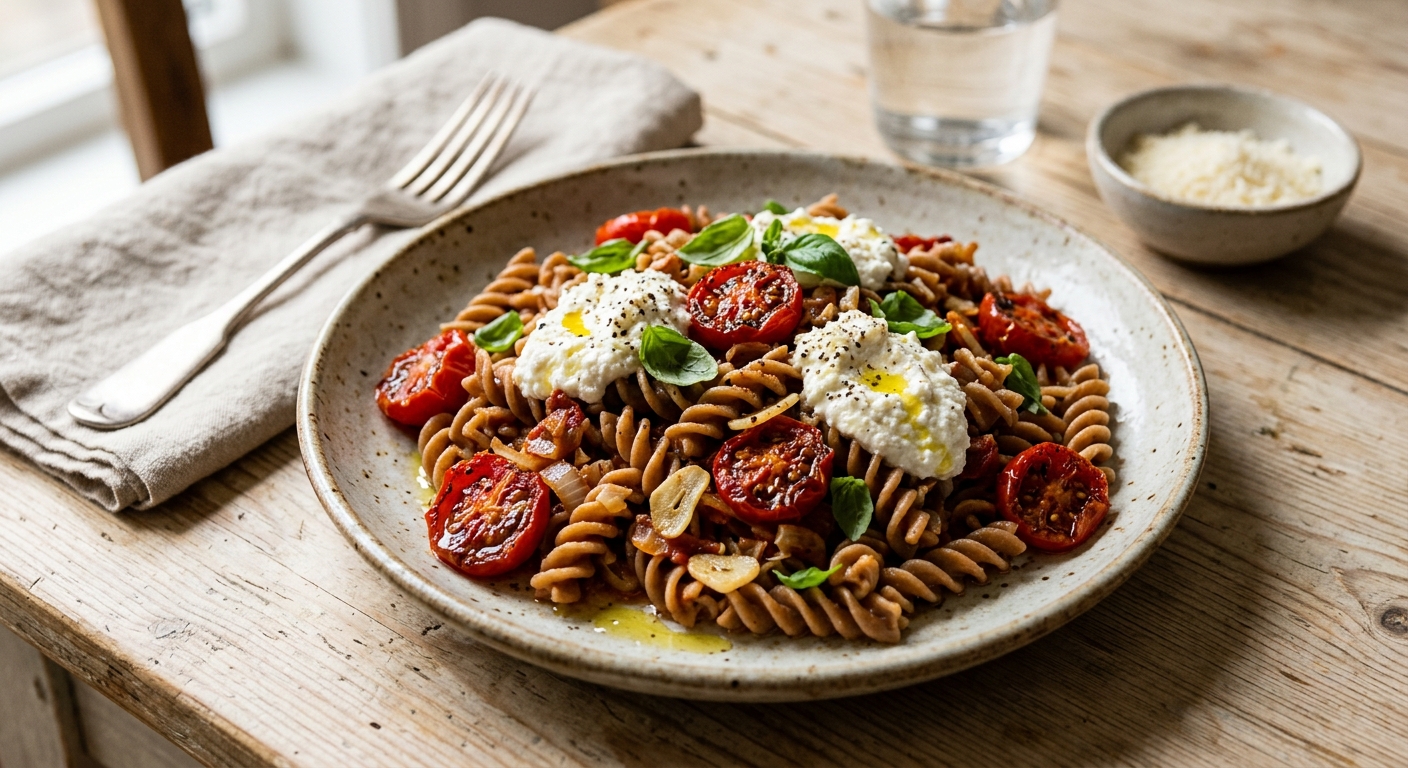
Spelt is one of the oldest cultivated grains on earth, domesticated in the Near East over 8,000 years ago, and modern nutritional science keeps confirming what ancient farmers intuited: this grain is worth eating. Unlike refined durum wheat pasta, whole-grain spelt pasta retains its bran and germ, delivering a genuinely different nutritional profile with higher levels of manganese, magnesium, phosphorus, and B vitamins per serving. The slightly nutty, subtly sweet flavour also happens to pair beautifully with acidic, concentrated tomatoes and cooling dairy fat.
The roasted tomato component here is not decorative. Heating cherry tomatoes transforms them on two levels simultaneously: it concentrates their natural sugars and glutamates for deeper flavour, and it actually increases the bioavailability of lycopene, their primary carotenoid antioxidant. Lycopene is fat-soluble, and cooking breaks down the cell walls that trap it, while the olive oil in this recipe provides the lipid environment needed for absorption. The ricotta, meanwhile, contributes high-quality whey protein and a meaningful dose of calcium and riboflavin, rounding out a dish that hits multiple key nutrient targets in a single bowl.
This recipe is designed for four servings and scales cleanly. Each serving provides over 30% of the daily value for folate, manganese, and selenium, while delivering a complete protein profile when the spelt pasta and ricotta are considered together. The glycemic load is kept moderate by the fiber content of the whole-grain spelt and the fat and protein from the ricotta, which slow gastric emptying and blunt the postprandial glucose response. Whether you are cooking on a weeknight stovetop, setting a slow cooker in the morning, or reaching for your pressure cooker, the nutritional outcome is consistent.
4
servings
Ingredients
- 320 gwhole-grain spelt pasta (penne or fusilli)
- 600 gcherry tomatoes, halved
- 250 gfull-fat ricotta cheese
- 4 tbspextra-virgin olive oil, divided
- 4 clovesgarlic, thinly sliced
- 1 mediumyellow onion, finely diced
- 2 tbsptomato paste
- 120 mldry white wine
- 30 gfresh basil leaves, torn
- 25 gParmigiano-Reggiano, freshly grated
- 1 tspdried oregano
- 0.5 tspred chilli flakes
- 1 tspcaster sugar
- 2 tbsplemon juice, freshly squeezed
- 1 tsplemon zest
- —Colima Sea SaltMicroplastic Free Salt and black pepper to taste
- —Reserved pasta cooking water as needed
Instructions
Click on an item below to shop for the recommended items for this recipe on Amazon.
As an Amazon Associate, we earn from qualifying purchases.
- Bring a large pot of water to a rolling boil over high heat. Add a generous two-finger pinch of fine sea salt, enough that the water tastes lightly of the sea. This is the only opportunity to season the pasta from within.
- While the water heats, warm two tablespoons of olive oil in a wide, heavy-based skillet over medium-high heat. Add the diced onion with a pinch of salt and cook, stirring occasionally, for 6 to 8 minutes until softened and beginning to turn golden at the edges.
- Add the sliced garlic and chilli flakes to the onion and stir constantly for 90 seconds until the garlic is fragrant and just starting to colour. Stir in the tomato paste and cook for a further 2 minutes, pressing it against the pan so it caramelises slightly and loses its raw edge.
- Increase the heat to high and add the halved cherry tomatoes, cut side down if possible. Pour in the white wine and let it bubble vigorously for 2 minutes to burn off the alcohol. Add the dried oregano, caster sugar, lemon zest, and a generous pinch each of salt and pepper. Reduce heat to medium and cook the sauce, stirring occasionally and pressing some tomatoes gently to burst them, for 12 to 15 minutes until the sauce is thick, jammy, and deeply fragrant.
- Cook the spelt pasta in the boiling salted water according to package directions, typically 9 to 11 minutes for al dente. Before draining, scoop out at least 240ml of the starchy pasta water and reserve it. Drain the pasta but do not rinse it.
- Add the drained pasta directly to the skillet with the tomato sauce over medium-low heat. Add the lemon juice and toss to combine. Add pasta water a splash at a time, tossing continuously, until the sauce coats every piece of pasta in a glossy, cohesive emulsion. The starch in the water is essential for this texture.
- Remove the skillet from heat. Drizzle the remaining two tablespoons of olive oil over the pasta and fold in half the torn basil. Divide among four warm bowls. Spoon a generous heap of ricotta onto the centre of each portion, then scatter with the remaining basil and grated Parmigiano-Reggiano. Finish with a crack of black pepper and serve immediately.
- Place the halved cherry tomatoes, diced onion, sliced garlic, tomato paste, white wine, dried oregano, caster sugar, chilli flakes, lemon zest, two tablespoons of olive oil, and a generous seasoning of salt and pepper into the slow cooker insert. Stir everything together until the tomato paste is evenly distributed and no dry pockets remain.
- Place the lid on the slow cooker and cook on Low for 4 hours. The tomatoes will break down almost completely, releasing their liquid and then slowly concentrating it into a deeply flavoured sauce. Do not lift the lid during cooking as each peek adds 20 to 30 minutes to the effective cook time.
- At the end of the 4-hour cook time, remove the lid and stir the sauce. If it appears thin, switch the slow cooker to High and leave the lid ajar for 20 to 30 minutes, stirring once, until the sauce thickens to a jammy consistency. Taste and adjust salt, pepper, and sugar as needed. Stir in the lemon juice.
- About 15 minutes before serving, bring a large pot of generously salted water to a boil on the stovetop. Cook the spelt pasta according to package directions until al dente. Reserve 240ml of the starchy cooking water before draining.
- Add the drained pasta to the slow cooker insert along with the remaining two tablespoons of olive oil. Stir and fold vigorously, adding splashes of the reserved pasta water until the sauce loosens and clings to the pasta in a silky coat. The residual heat of the slow cooker insert is sufficient to bring everything together.
- Serve directly from the insert. Spoon into four warm bowls, place a generous dollop of ricotta at the centre of each, and top with torn basil, grated Parmigiano-Reggiano, a drizzle of good olive oil, and freshly cracked black pepper.
- Set the pressure cooker or Instant Pot to Saute mode on medium-high heat. Add two tablespoons of olive oil and, once shimmering, add the diced onion with a pinch of salt. Cook for 4 to 5 minutes, stirring frequently, until the onion is softened. Add the sliced garlic, chilli flakes, and tomato paste and stir constantly for 1 to 2 minutes until the paste darkens slightly and the garlic is fragrant.
- Pour in the white wine and stir, scraping any browned bits from the bottom of the pot. This step is critical: any residue left stuck to the base will trigger a burn warning. Let the wine reduce for 1 to 2 minutes. Cancel the Saute mode.
- Add the halved cherry tomatoes, dried oregano, caster sugar, lemon zest, salt, and pepper. Pour in 480ml of cold water and stir to combine. Add the dry spelt pasta, pressing it down so it is mostly submerged. Do not stir the pasta after adding, as layering helps prevent it from clumping or sticking to the base.
- Secure the lid and set the pressure release valve to Sealing. Cook at High Pressure for 5 minutes (for penne or fusilli cut to roughly 3 to 4 cm; adjust by 1 minute for longer shapes). When the cook cycle ends, allow a natural pressure release for 3 minutes, then carefully perform a quick release for any remaining pressure.
- Open the lid and immediately stir the contents with a wooden spoon or silicone spatula, folding the pasta and sauce together. The sauce will look slightly loose at first but will thicken within 2 minutes as the pasta absorbs the liquid and the starch activates. Add the lemon juice and the remaining two tablespoons of olive oil and stir to emulsify.
- Fold in half the torn basil. If the sauce is thicker than desired, stir in a splash of hot water from the kettle. Divide into four warm bowls, top each with a generous spoonful of ricotta, the remaining basil, grated Parmigiano-Reggiano, and a crack of black pepper. Serve immediately while the pasta is at its best texture.
- Preheat the oven to 200 degrees Celsius (180 degrees Celsius fan, 400 degrees Fahrenheit). Line a large, rimmed baking sheet with parchment paper or use a 30cm x 40cm roasting tin.
- Spread the halved cherry tomatoes cut side up across the baking sheet. Scatter the diced onion and sliced garlic over the tomatoes. Drizzle with two tablespoons of olive oil, dot the tomato paste across the tray in small spoonfuls, and season generously with salt, pepper, dried oregano, caster sugar, and chilli flakes. Toss gently on the tray to coat everything, then return the tomatoes to cut side up. Pour the white wine around the edges of the tray.
- Roast for 35 to 40 minutes until the tomato skins are blistered and slightly charred at the edges, the onion is caramelised, and the juices have reduced to a thick, syrupy pan sauce pooling at the base of the tray. The deeper the colour, the more intense the flavour. Do not rush this step.
- While the tomatoes finish roasting, bring a large pot of generously salted water to a boil. Cook the spelt pasta until al dente according to package directions. Reserve 240ml of the starchy pasta water before draining.
- Remove the roasting tray from the oven. Add the lemon juice, lemon zest, and remaining two tablespoons of olive oil directly to the tray. Use a wooden spoon to scrape and stir all the caramelised bits from the base of the tray into the sauce, these carry enormous flavour. Add the drained pasta to the tray and toss it directly in the roasting tin, adding splashes of reserved pasta water as needed to loosen the sauce into a glossy coating that clings to every piece.
- Fold in half the torn basil leaves. Serve directly from the roasting tin for a rustic presentation, or divide into four warm bowls. Place a heaped spoonful of cold ricotta at the centre of each serving. Top with the remaining basil, grated Parmigiano-Reggiano, a final drizzle of olive oil, and cracked black pepper. The contrast between the hot pasta and the cold ricotta is intentional and delicious.
Nutrition Breakdown
Per 1 serving (makes 4)
Vitamins & Minerals
% Daily Value based on a 2,000 calorie diet (FDA reference)
🧬 Essential Amino Acids
% of recommended daily intake (RDA) per serving
🛡 Antioxidant Profile
The Nutrition Science
Whole-grain spelt is nutritionally distinct from modern whole-wheat pasta in ways that matter. Spelt contains a higher proportion of water-soluble carbohydrates, which makes its nutrients more readily absorbed in the small intestine. Its manganese content is exceptional: a single serving of this dish delivers over 100% of the daily value, which is significant because manganese is an essential cofactor for superoxide dismutase (MnSOD), the primary antioxidant enzyme operating inside the mitochondria of every cell in the body. Spelt also provides meaningful amounts of selenium, a trace mineral that is a structural component of glutathione peroxidase enzymes, another critical arm of the body’s endogenous antioxidant defence system.
The tomato roasting process in this recipe is not merely culinary tradition but applied nutritional biochemistry. Raw tomatoes contain lycopene locked within chloroplasts and bound to cell wall proteins. Heat disrupts these structures, releasing lycopene into the food matrix. The all-trans isomers of lycopene present in raw tomatoes are partially converted to cis-isomers during cooking, and while total lycopene is slightly reduced by heat exposure, the cis-isomers are more bioavailable in the human gut. The simultaneous presence of extra-virgin olive oil is essential: lycopene is lipophilic and requires dietary fat for incorporation into intestinal micelles before it can be absorbed across the enterocyte brush border. Consuming this dish without a fat source would waste most of its lycopene content.
Ricotta contributes more than texture and flavour. As a whey-dominant fresh cheese, it provides a high biological value protein that complements the limiting amino acids in spelt (primarily lysine), and it supplies riboflavin (B2) at levels that support the flavin coenzymes FAD and FMN required for mitochondrial energy metabolism. The calcium in ricotta is highly bioavailable relative to plant sources because it is already ionised in the aqueous cheese matrix and does not require acid dissolution. Notably, this dish contains no significant oxalic acid or phytic acid inhibitors competing for that calcium, making the mineral profile of this meal unusually accessible.
Pro Tips
- Do not skip salting the pasta water: whole-grain spelt pasta has a robust flavour that can taste flat and one-dimensional if the cooking water is unseasoned, and no amount of sauce will fully compensate once the pasta is cooked.
- For the oven method, choose a dark metal roasting tin over a light-coloured one if available. Darker metal absorbs more radiant heat and will caramelise the tomatoes and onions more effectively at the same oven temperature.
- Ricotta quality matters enormously in a dish this simple. Seek out fresh ricotta from a deli or Italian grocer rather than the stabilised supermarket tub variety. Fresh ricotta has a looser, creamier texture and a delicate milky sweetness that balances the acidic tomatoes far better than the dense, grainy commercial alternative.
Great question, Anna! I’d actually want to know more about your sourcing on those cherry tomatoes first, since they’re on the Dirty Dozen list and conventional ones tend to carry higher pesticide residues, which can trigger inflammation in sensitive systems like Hashimoto’s. If you do go the nightshade-free route, caramelized onions would give you that umami depth, though you’d lose the lycopene benefits. That said, I’ve found that organic roasted tomatoes sometimes feel gentler for clients with autoimmune sensitivities than fresh ones, possibly because cooking breaks down certain compounds, so it might be worth testing before you swap them out entirely.
This looks absolutely delicious, but I have to ask about the tomatoes since I’m navigating Hashimoto’s and nightshade sensitivity! Are the roasted cherry tomatoes a significant part of the dish, or could someone substitute roasted red peppers or caramelized onions and still get that sweet, jammy element? Also, I’m curious whether spelt is something you’d consider AIP-friendly or if you have thoughts on swapping it for cassava or another ancient grain that sits better with autoimmune protocols. The ricotta and folate focus really appeals to me though, so I’d love to make this work somehow!
Anna, I love that you’re being intentional about what works for your body, and yes, absolutely, you can swap those tomatoes for caramelized onions or roasted red peppers and still get that deep, sweet richness! Spelt does contain gluten so it wouldn’t fit a strict AIP protocol, but teff flour or even a blend of cassava with arrowroot could work if you want to keep that pasta texture while staying compliant. The real nutritional star here is actually the folate from the ricotta and greens (if you add them), so you’re not losing the micronutrient density with those swaps. I’m curious whether you’ve explored nutrient-dense