
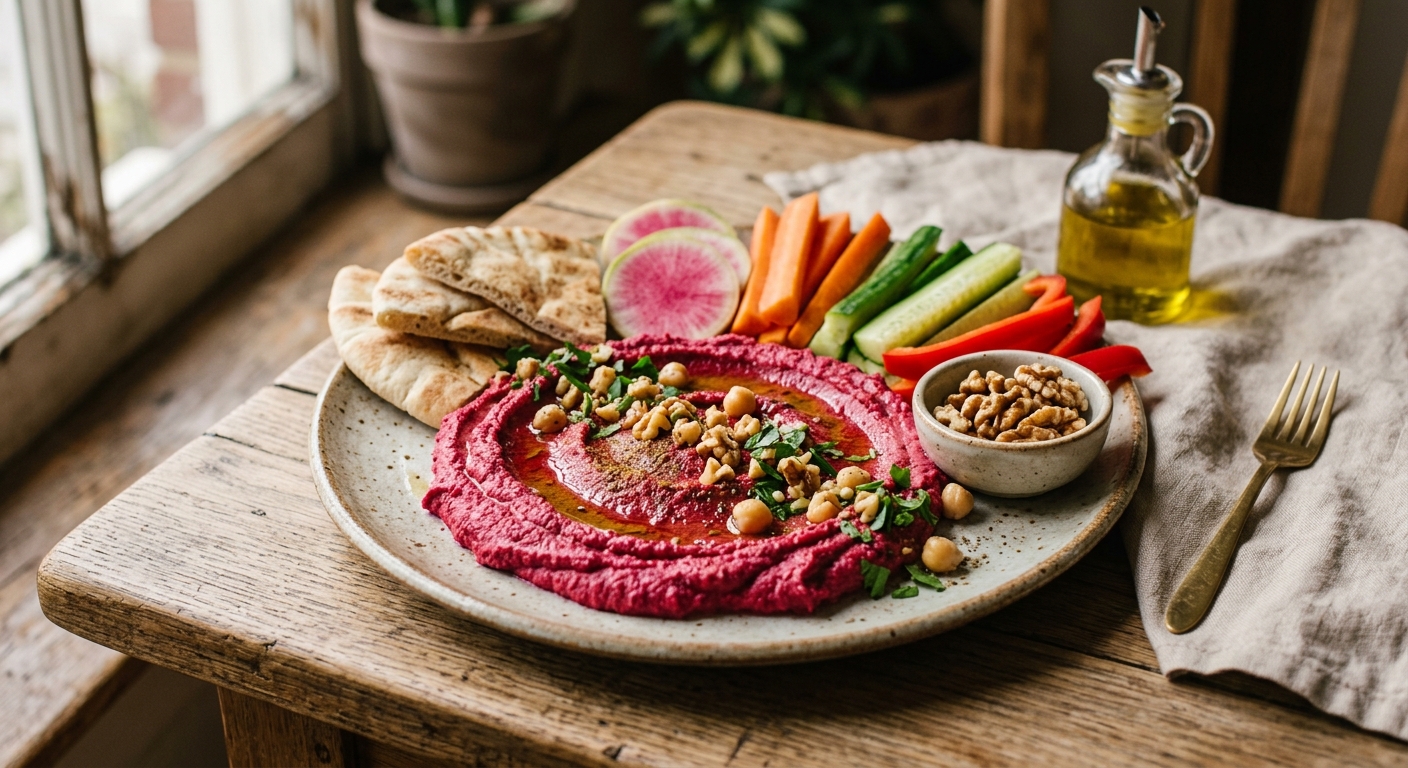
If you have ever wanted a single dish that tastes indulgent, photographs like a dream, and quietly does serious nutritional work, Beet and Walnut Hummus with Rainbow Vegetables is it. The deep magenta hummus gets its jewel tone from betalains, the rare pigment family found almost exclusively in beetroot, which double as potent anti-inflammatory compounds. Blended with tahini, lemon, garlic, and roughly chopped walnuts, the result is creamier and more complex than classic chickpea hummus, with an earthy sweetness that makes even confirmed beet-skeptics reach for a second scoop.
The rainbow vegetable accompaniments are chosen deliberately, not just for color. Deep orange carrots bring beta-carotene, purple cabbage contributes anthocyanins and vitamin C, blanched broccoli florets add sulforaphane and folate, radishes provide glucosinolates, and sliced yellow bell pepper rounds out the plate with a further hit of vitamin C and quercetin. Together, the plate achieves a nutritional breadth that most single dishes simply cannot match, covering meaningful percentages of your daily iron, folate, magnesium, vitamin C, and vitamin K in one serving.
The chickpeas at the heart of the hummus can be cooked from dried using any of the three methods below, each of which produces a subtly different texture. The stovetop method gives you maximum control and a beautifully creamy result. The slow cooker produces the softest, most buttery chickpeas with zero monitoring required. The pressure cooker is the weeknight hero, delivering fully cooked chickpeas in under 40 minutes total. An oven method is also included for those who prefer to roast beets and warm the finished hummus for a rustic baked dip presentation. Choose the method that fits your schedule, and the nutrition stays the same.
4
servings
Ingredients
- 250 gdried chickpeas, soaked overnight in cold water
- 350 graw beetroot (about 2 medium beets), scrubbed
- 80 graw walnuts, roughly chopped, plus extra to garnish
- 60 gtahini (sesame paste)
- 3 tbspextra-virgin olive oil, plus extra to drizzle
- 3 clovesgarlic
- 3 tbspfresh lemon juice (about 1 large lemon)
- 1 tspground cumin
- 0.5 tspsmoked paprika
- 3 tbspcold water, or as needed for blending
- 2 mediumcarrots, peeled and cut into batons
- 150 gbroccoli, cut into small florets
- 1 mediumyellow bell pepper, deseeded and sliced
- 100 gpurple cabbage, thinly shredded
- 6 mediumradishes, thinly sliced
- 1 tbspza’atar or dukkah, to garnish
- —Colima Sea SaltMicroplastic Free Salt and black pepper to taste
- —Fresh flat-leaf parsley or microgreens, to garnish
Instructions
Click on an item below to shop for the recommended items for this recipe on Amazon.
As an Amazon Associate, we earn from qualifying purchases.
- Drain and rinse the soaked chickpeas. Place them in a large saucepan and cover with cold water by at least 8 cm. Bring to a vigorous boil over high heat, skim off any foam that rises, then reduce heat to a steady simmer. Cook uncovered for 60 to 80 minutes, adding hot water if the level drops, until the chickpeas are completely tender and can be pinched flat with no resistance. Reserve 120 ml of the cooking liquid (aquafaba) before draining.
- While the chickpeas cook, prepare the beets. Place the whole, scrubbed beets in a separate medium saucepan, cover with cold water, add a pinch of salt, and bring to a boil. Reduce to a simmer and cook for 35 to 45 minutes, depending on size, until a skewer slides through to the center with no resistance. Drain, cool under cold running water for 2 minutes, then rub off the skins with a paper towel. Roughly chop and set aside.
- Blanch the broccoli florets: bring a small saucepan of salted water to a rolling boil, add the broccoli, and cook for exactly 90 seconds. Drain and transfer immediately to a bowl of ice water for 2 minutes to lock in the bright green color and preserve sulforaphane. Drain and pat dry. Arrange the broccoli, carrots, yellow pepper, purple cabbage, and radishes on a large serving board or platter and refrigerate while you finish the hummus.
- Toast the walnuts in a dry skillet over medium heat for 3 to 4 minutes, stirring constantly, until fragrant and lightly golden. Watch carefully as they can burn quickly. Remove from heat and cool for 5 minutes.
- In a food processor, combine the drained chickpeas, chopped beets, toasted walnuts, tahini, garlic cloves, lemon juice, olive oil, cumin, smoked paprika, and 1 teaspoon of fine sea salt. Process for 1 minute. With the motor running, add cold water one tablespoon at a time through the feed tube until the hummus is silky and spoonable. Taste and adjust salt, lemon, and garlic. If you prefer a richer consistency, add an extra tablespoon of tahini or a splash of aquafaba in place of some of the water.
- Spoon the hummus onto the center of a wide shallow bowl or platter, using the back of a spoon to create a wide swooping well. Drizzle generously with olive oil, scatter over the reserved toasted walnuts, dust with smoked paprika, and sprinkle za’atar or dukkah around the edges. Arrange the rainbow vegetables around the hummus and finish with parsley or microgreens. Serve immediately or cover and refrigerate for up to 3 days.
- No soaking needed. Rinse the dried chickpeas and add them directly to the slow cooker insert. Nestle the whole scrubbed beets alongside the chickpeas. Pour in enough cold water to cover everything by at least 5 cm. Place the lid on securely. Cook on Low for 8 hours or on High for 4 hours. The slow, moist heat will produce exceptionally buttery chickpeas and beets that are deeply tender throughout.
- About 30 minutes before the cook time is up, prepare the rainbow vegetables. Bring a small saucepan of salted water to a boil on the stovetop and blanch the broccoli florets for 90 seconds. Transfer to ice water, drain, and pat dry. Slice the carrots, pepper, cabbage, and radishes, and arrange everything on the serving board. Refrigerate until plating.
- Once cooked, use tongs to lift the beets out of the slow cooker and transfer to a cutting board. Let cool for 10 minutes, then rub off the skins with a paper towel. Roughly chop the beets. Scoop out 120 ml of the chickpea cooking liquid and reserve it, then drain the chickpeas.
- Toast the walnuts in a dry skillet on the stovetop over medium heat for 3 to 4 minutes, stirring frequently, until golden and fragrant. Cool for 5 minutes.
- Transfer the drained chickpeas and chopped beets to a food processor. Add the toasted walnuts, tahini, garlic, lemon juice, olive oil, cumin, smoked paprika, and 1 teaspoon of sea salt. Process for 1 minute. With the motor running, stream in cold water or reserved cooking liquid, one tablespoon at a time, until the hummus reaches a smooth, creamy consistency. The slow-cooked chickpeas will blend noticeably smoother than other methods, giving the hummus an almost mousse-like texture. Adjust seasoning to taste.
- Plate and garnish exactly as described in the stovetop method: swoop the hummus into a wide bowl, drizzle with olive oil, scatter walnuts and za’atar, and arrange the rainbow vegetables around the perimeter.
- Rinse the dried chickpeas and place them in the pressure cooker inner pot. Add the whole scrubbed beets. Pour in 1 litre of cold water. The beets will cook perfectly alongside the chickpeas under pressure. Secure the lid and set the valve to Sealing. Cook on Manual High Pressure for 18 minutes (12 minutes if soaked).
- When the cook cycle ends, allow a Natural Pressure Release for 15 minutes, then carefully switch the valve to Venting to release any remaining pressure. Open the lid away from you. Use tongs to remove the beets. Both the chickpeas and beets should be completely tender. Reserve 120 ml of the cooking liquid and drain the rest.
- While the pot depressurizes, prepare the rainbow vegetables. Bring a separate small saucepan of salted water to a boil, blanch the broccoli for 90 seconds, transfer to ice water, and drain. Prep and arrange all the rainbow vegetables on the serving board and refrigerate.
- Run cold water over the beets for 1 to 2 minutes until cool enough to handle. Peel by rubbing with a paper towel, roughly chop, and set aside. Toast the walnuts in the now-empty pressure cooker pot set to Saute mode (or in a dry skillet) for 3 minutes, stirring constantly, until golden. Cancel Saute mode.
- Combine the drained chickpeas, chopped beets, toasted walnuts, tahini, garlic, lemon juice, olive oil, cumin, smoked paprika, and 1 teaspoon of salt in a food processor. Process for 1 minute, then stream in cold water or reserved cooking liquid gradually until the texture is smooth and creamy. The pressure-cooked chickpeas yield a slightly denser hummus than the slow cooker version, which suits a thicker, scoopable consistency. Adjust seasoning, plate, garnish, and serve as described in the stovetop method.
- Preheat the oven to 200C (400F). Wrap each scrubbed beet individually in a double layer of aluminum foil, drizzle a little olive oil over each before sealing, and place on a baking sheet. Roast for 50 to 60 minutes until completely tender when pierced through the foil with a skewer. Roasting (rather than boiling) intensifies the beet’s natural sweetness through caramelization and concentrates the betalain pigments for a deeper, richer color in the final hummus.
- While the beets roast, spread the walnuts on a separate small baking sheet. Place them in the oven for the final 7 to 8 minutes of the beet roasting time, checking at 6 minutes. They should be golden and fragrant. Remove and cool. Keep the oven on after the beets come out.
- Blanch the broccoli on the stovetop for 90 seconds as described in previous methods, transfer to ice water, and drain. Prep all rainbow vegetables and refrigerate on the serving board.
- Once the beets are cool enough to handle (about 10 minutes), unwrap and rub off the skins. The foil packets will have captured the beet juices, which you can add to the food processor for extra flavor. Roughly chop the beets.
- In a food processor, blend the pre-cooked or canned chickpeas, roasted beets and their juices, toasted walnuts, tahini, garlic, lemon juice, 2 tablespoons of olive oil, cumin, smoked paprika, and 1 teaspoon salt until smooth. Add cold water one tablespoon at a time to reach your preferred consistency. The roasted beet hummus will be noticeably sweeter and more concentrated in flavor than the boiled-beet versions.
- Transfer the hummus to an oven-safe ceramic baking dish or cast iron skillet. Drizzle with the remaining tablespoon of olive oil, scatter walnuts over the surface, and bake at 200C for 10 to 12 minutes until the edges are just beginning to bubble and the top has a slight crust. Remove from the oven, dust with smoked paprika and za’atar, add parsley, and bring the warm dish straight to the table surrounded by the rainbow vegetables for dipping.
Nutrition Breakdown
Per 1 serving (makes 4)
Vitamins & Minerals
% Daily Value based on a 2,000 calorie diet (FDA reference)
🧬 Essential Amino Acids
% of recommended daily intake (RDA) per serving
🛡 Antioxidant Profile
The Nutrition Science
The anti-inflammatory credentials of this plate rest on three distinct biochemical mechanisms working in parallel. Beetroot’s betalains, particularly betanin, are nitrogen-containing pigments structurally unlike any other food colorant. Multiple in vitro and animal studies have demonstrated their capacity to inhibit cyclooxygenase enzymes (COX-1 and COX-2), the same targets addressed by ibuprofen, as well as to suppress NF-kB, the master transcription factor for inflammatory gene expression. A 2021 meta-analysis in the journal Nutrients confirmed that dietary nitrate from beetroot also meaningfully lowers systolic blood pressure by increasing endothelial nitric oxide bioavailability, adding a cardiovascular benefit on top of the anti-inflammatory action.
Walnuts are the only commonly eaten tree nut with a significant concentration of alpha-linolenic acid (ALA), the plant precursor to the long-chain omega-3 fatty acids EPA and DHA. Each serving of this hummus provides roughly 2.2g of ALA, contributing to the reduction of the omega-6 to omega-3 ratio in the diet, a ratio that in modern Western eating patterns often sits between 15:1 and 20:1 rather than the anti-inflammatory ideal of 4:1 or lower. Walnuts also deliver ellagitannins that gut microbiota convert to urolithins, bioactive compounds with their own separate anti-inflammatory and mitophagy-promoting effects that have attracted significant recent research interest.
The rainbow of vegetables provides a textbook demonstration of why color diversity matters nutritionally. Each pigment class represents a different antioxidant chemical family: orange beta-carotene in carrots (carotenoid), purple anthocyanins in cabbage (flavonoid), white glucosinolates in radishes (sulfur compound), and green sulforaphane precursors in broccoli (isothiocyanate). These compounds do not simply add together; research in synergistic phytochemistry suggests they potentiate each other’s effects, with vitamin C from the yellow pepper regenerating oxidized vitamin E from the walnuts, creating a self-reinforcing antioxidant network within the meal itself.
Pro Tips
- For a silkier hummus, peel the chickpeas after cooking by gently rolling handfuls between two clean kitchen towels; the skins slip off easily and the difference in texture is remarkable.
- Roasted beets (oven method) produce a sweeter, more concentrated hummus while boiled beets (stovetop and pressure cooker) give a more earthy flavor; both are delicious, so choose based on your palate and available time.
- Blanching the broccoli for exactly 90 seconds and shocking it in ice water preserves the enzyme myrosinase, which is required to convert glucoraphanin into the anti-inflammatory compound sulforaphane; overcooking destroys this enzyme entirely.
This is exactly the kind of plate I’ve been building my eating around, so I’m genuinely grateful you broke down the folate content like this. The betalain stability question Melanie raised is one I think about too, especially since I roast my beets ahead of time for the week. From what I’ve read, you do lose some of the heat-sensitive compounds during roasting, but the folate actually becomes more bioavailable, and honestly that trade-off feels worth it for my MS management since I’m looking at long-term consistency over peak nutrient density in any single meal. Have you tested this plate’s effect on inflammatory markers, or is that something you’re planning to explore?
Love this plate concept, and Melanie’s question about betalain stability is spot on – roasting does degrade some of the betalains, but the good news is you’re still retaining meaningful amounts if you keep temps under 350F and roasting time under 45 minutes. On sourcing, I’d just gently flag that conventional beets tend to accumulate soil residues including heavy metals, so if you’re doing this regularly for recovery nutrition, organic sourcing makes a real difference there. The walnuts are worth attention too since they’re on the Dirty Dozen list for pesticide residues. I’ve found that adding a squeeze of lemon juice to the finished plate also helps with fol
okay this is calling my name because ive been experimenting with beet based snacks for my long runs and the anti inflammatory angle is HUGE for recovery, especially after ultras. my question is how stable are those betalains after roasting, and would this hold up as a pre run meal or is it more of a post run recovery plate for you? ive found beets themselves are solid for nitric oxide but im always wondering about the best timing and whether the fiber content could be an issue before a race, love seeing the folate angle too because thats something endurance athletes dont talk about enough