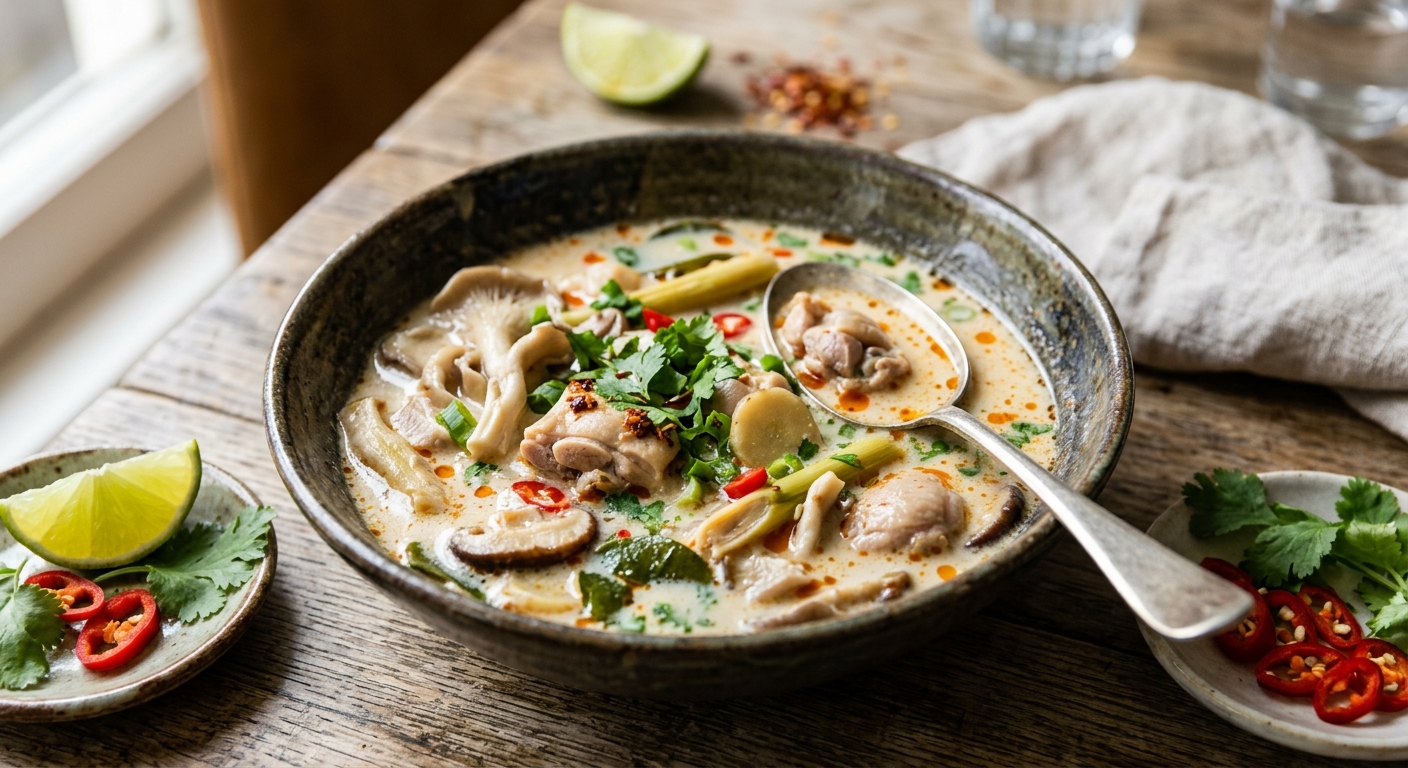
Tom Kha Gai translates roughly as ‘boiled galangal chicken,’ and that humble name undersells one of Southeast Asia’s most nutritionally sophisticated dishes. Every component in this soup has been used in Thai and Ayurvedic medicine for centuries, and modern nutritional science is catching up with what traditional cooks already knew: the combination of coconut milk, galangal, lemongrass, and kaffir lime leaves creates a broth that is simultaneously anti-inflammatory, antifungal, and genuinely nourishing to the immune system. This is not wellness theatre. The compounds are real, the mechanisms are documented, and the flavour is extraordinary.
What makes this version of Tom Kha Gai different from a restaurant bowl is precision. We use full-fat coconut milk for its medium-chain triglycerides and lauric acid content, bone-in chicken thighs for a collagen-rich broth that supports gut-lining integrity, and a measured amount of fresh Thai chillies whose capsaicin content has been linked to reduced circulating inflammatory markers. The mushrooms, typically oyster or shiitake, contribute a meaningful dose of beta-glucans, the immunomodulatory polysaccharides that activate natural killer cells. This is a soup you can feel working.
We have calibrated this recipe to four servings, each delivering over 30% of your daily vitamin C requirement, more than 25% of your selenium needs from the chicken and mushrooms, and a substantial hit of manganese from lemongrass. The coconut milk contributes healthy saturated fats that actually improve the bioavailability of the fat-soluble compounds in the galangal and lemongrass. Every ingredient earns its place here, and the result is a bowl that is as deeply comforting on a cold evening as it is restorative when your immune system needs support.
4
servings
Ingredients
- 600 gboneless, skinless chicken thighs, cut into 3 cm pieces
- 800 mlfull-fat coconut milk (two 400 ml cans)
- 500 mlgood-quality chicken stock, low sodium
- 60 gfresh galangal, peeled and sliced into 5 mm coins
- 2 stalkslemongrass, tough outer layers removed, bruised and cut into 5 cm pieces
- 8 leavesfresh or frozen kaffir lime leaves, torn in half
- 200 goyster mushrooms, torn into bite-size pieces
- 100 gshiitake mushrooms, stems removed, caps sliced
- 3 wholeThai bird’s eye chillies, lightly bruised (adjust to heat preference)
- 3 tbspfish sauce (nam pla), plus more to taste
- 2 tbspfresh lime juice (approximately 2 limes), plus wedges to serve
- 1 tspcoconut sugar or palm sugar
- 200 gcherry tomatoes, halved
- 4 stalksfresh coriander (cilantro), leaves and tender stems, roughly chopped
- 2 stalksspring onions (scallions), thinly sliced
- 1 tbspcoconut oil or Avocado Oil100% Pure Avocado Oil
- —Colima Sea SaltMicroplastic Free Salt to taste, if needed
Instructions
Click on an item below to shop for the recommended items for this recipe on Amazon.
As an Amazon Associate, we earn from qualifying purchases.
- Set a large, heavy-bottomed saucepan or Dutch oven over medium heat. Add the coconut oil and warm until shimmering. Add the galangal coins, bruised lemongrass pieces, torn kaffir lime leaves, and bruised bird’s eye chillies. Stir-fry the aromatics gently for 2 to 3 minutes until the oil is intensely fragrant and the lemongrass has softened slightly at the edges. This brief blooming step extracts fat-soluble volatile oils that would otherwise remain locked in the fibrous aromatics.
- Pour in the chicken stock and bring to a gentle simmer over medium-high heat. Reduce heat to medium-low and simmer the aromatic-infused stock uncovered for 8 minutes. This steeping period allows the galangal’s bioactive compounds, particularly galangin and alpinetin, to fully dissolve into the liquid.
- Add the chicken thigh pieces in a single layer if possible. Simmer gently, never boiling hard, for 7 to 8 minutes until the chicken is just cooked through with no pink remaining. A hard boil will tighten the proteins and make the chicken rubbery; a gentle simmer keeps the pieces tender and silky.
- Reduce heat to low. Pour in the coconut milk in a slow, steady stream, stirring as you go. It is critical that you do not allow the soup to boil once the coconut milk has been added, as vigorous boiling causes the emulsion to break, producing a greasy, separated broth. Maintain a bare simmer with the surface just trembling.
- Add both varieties of mushrooms and the halved cherry tomatoes. Cook at a gentle simmer for 4 to 5 minutes until the mushrooms are tender but still hold their shape. The tomatoes should soften but not collapse entirely.
- Season the soup with fish sauce, lime juice, and coconut sugar. Stir and taste carefully: the soup should be simultaneously salty, sour, subtly sweet, and deeply savoury. Adjust each element in small increments. Remove and discard the lemongrass stalks, galangal coins, and whole chilli pieces if desired (they are not meant to be eaten).
- Ladle into warmed bowls. Garnish generously with fresh coriander leaves, sliced spring onions, and a lime wedge on the side. Serve immediately while the coconut milk is at its creamiest.
- No pre-cooking is needed for this method. Place the galangal coins, bruised lemongrass, torn kaffir lime leaves, and bruised bird’s eye chillies directly into the slow cooker insert. Pour the chicken stock over the aromatics and stir briefly to distribute.
- Nestle the chicken thigh pieces into the aromatic stock. Add the fish sauce, coconut sugar, and cherry tomatoes. Do not add the coconut milk yet. Place the lid on the slow cooker and cook on Low for 3 hours and 30 minutes. The extended low-heat steeping extracts the aromatics more thoroughly than a quick stovetop infusion, producing an exceptionally deep, layered broth.
- After 3 hours and 30 minutes, carefully lift the lid (mind the steam) and use two forks to gently tear each chicken piece into slightly smaller, more rustic chunks if desired. This releases more gelatin into the broth. Add both types of mushrooms, pressing them gently below the surface of the liquid.
- Pour in the coconut milk slowly and stir to incorporate. Replace the lid and continue cooking on Low for a further 25 to 30 minutes, until the mushrooms are tender and the soup is uniformly creamy and hot throughout. Do not switch to High at this stage.
- Stir in the fresh lime juice. Taste and adjust the fish sauce and lime as needed. Remove and discard the lemongrass, galangal, and whole chillies. Ladle into bowls, top with fresh coriander and spring onions, and serve with lime wedges.
- Select the Saute function on your Instant Pot (or activate your stovetop pressure cooker over medium heat). Add the coconut oil and heat until shimmering. Add the galangal, lemongrass, kaffir lime leaves, and chillies and saute for 2 minutes, pressing the aromatics lightly with a wooden spoon to help release their essential oils into the oil. This short bloom accelerates flavour extraction under the pressure that follows.
- Add the chicken thigh pieces and saute briefly for 1 to 2 minutes per side, just until the exterior turns opaque. Do not aim for browning; this step simply sets the surface proteins. Pour in the chicken stock, fish sauce, coconut sugar, and cherry tomatoes. Stir once to combine. Do not add the coconut milk or mushrooms at this stage.
- Secure the lid and set the pressure-release valve to Sealing. Cook on High Pressure for 5 minutes. The sealed environment drives the aromatic compounds deeply into the chicken and stock, achieving a flavour equivalent to 20 to 25 minutes of stovetop simmering. Allow a 5-minute natural pressure release, then carefully switch to Quick Release to vent the remaining steam.
- Open the lid. Select the Saute function again on its Low or Less setting (or set stovetop pressure cooker over low heat). Stir in both types of mushrooms. Pour in the coconut milk in a slow, steady stream while stirring continuously. Maintain a very gentle simmer for 5 to 6 minutes until the mushrooms are tender and the coconut milk is fully integrated and creamy. Do not allow the mixture to come to a rolling boil.
- Add the fresh lime juice and taste for seasoning, adjusting fish sauce and lime as needed. Cancel the Saute function and let the soup rest for 2 minutes off heat before serving. Remove and discard the lemongrass, galangal, and whole chillies. Serve topped with fresh coriander, spring onions, and lime wedges.
Nutrition Breakdown
Per 1 serving (makes 4)
Vitamins & Minerals
% Daily Value based on a 2,000 calorie diet (FDA reference)
🧬 Essential Amino Acids
% of recommended daily intake (RDA) per serving
🛡 Antioxidant Profile
The Nutrition Science
The anti-inflammatory power of Tom Kha Gai operates through several distinct and complementary mechanisms. Galangal (Alpinia galanga) contains galangin, kaempferol, and alpinetin, three flavonoids that have been shown in clinical and in-vitro research to inhibit both COX-2 enzyme activity and NF-kB transcription factor signalling. These are the same two pathways targeted by many pharmaceutical anti-inflammatory drugs, which makes galangal a genuinely potent food-as-medicine ingredient rather than a marketing claim. The fat in coconut milk meaningfully improves the bioavailability of these fat-soluble compounds, which is one reason this combination has survived centuries of traditional use.
The mushroom combination provides beta-glucans, a class of branched polysaccharides that are among the best-studied natural immunomodulatory agents. Shiitake mushrooms are particularly rich in lentinan, a specific beta-1,3/1,6-glucan that has been studied in clinical settings for its ability to enhance activity of natural killer (NK) cells and macrophages. Oyster mushrooms contribute ergothioneine, a unique antioxidant amino acid that humans cannot synthesise and must obtain through diet, which accumulates in tissues under oxidative stress and acts as a cellular protectant. Together, the two mushrooms in this recipe deliver a meaningfully broad spectrum of immunomodulatory compounds.
Coconut milk’s medium-chain triglycerides (MCTs), particularly lauric acid (C12), deserve specific attention in an immunity context. Lauric acid is converted in the body to monolaurin, a compound with well-documented antiviral and antifungal properties that disrupts the lipid envelope of enveloped viruses. At the quantities in a 200ml serving of this soup (approximately 4 to 5g of lauric acid per serving), the concentration is meaningful rather than merely trace. Combined with selenium from the chicken and mushrooms, a mineral that is the cofactor for glutathione peroxidase (one of the body’s primary antioxidant enzymes), and zinc which supports the development of immune cells, this soup functions as a coherent nutritional intervention rather than a collection of isolated superfoods.
Pro Tips
- Never boil the soup after adding coconut milk. The emulsion breaks above a rolling boil, leaving a greasy, separated broth. A surface that barely trembles is perfect. If your soup does break, whisk in 2 tablespoons of cold coconut milk off heat to re-emulsify.
- Galangal is not a substitute for ginger and ginger is not a substitute for galangal. They share a family but have entirely different flavour profiles and different bioactive compound sets. Seek out fresh or frozen galangal at Asian grocery stores. It freezes well for up to 6 months, so buy a large piece and freeze in sliced portions.
- For maximum beta-glucan content from the mushrooms, do not wash them under running water. Instead, wipe them clean with a damp cloth or brush. Mushrooms are highly porous and waterlogging them dilutes both their flavour and their water-soluble immunomodulatory compounds before they even reach the pot.
oh man this hits different when you know the science behind what your family was already doing, you know? my avó used to make this Brazilian version with coconut milk and lime and id never thought about it as immune support, just as comfort, but then i started reading about lauric acid and how it actually works with your gut bacteria and it clicked. the thing that gets me about tom kha gai is how every single ingredient is doing work – galangal isnt just flavor, its doing actual anti-inflammatory stuff, and the fresh lime at the end… thats not just brightness, thats bioavailable vitamin c hitting right when your body needs it. would love to know if youve played around with adding any fer
Oh Mike, what a wonderful idea about those mushrooms! I’m actually planning to test exactly that for my next class – the beta glucans in maitake would layer beautifully with the lauric acid, and you’re so right about that umami depth playing against the brightness of the lime and lemongrass. I’ve made tom kha for thirty years now, and I have to say, understanding the “why” behind each ingredient, like this post explains so well, has completely transformed how I approach it. The students always light up when they realize their grandmothers were doing functional nutrition before we even had the research to prove it!
oh dude this is SO good but now im thinking – have you ever tried adding dried shiitake or maitake to the broth? the umami from the shiitakes would be incredible with the galangal and coconut, plus youre talking immune boosting and those mushrooms have serious beta-glucans and polysaccharides that would actually synergize really well with the lauric acid from the coconut milk. i made a version last month and the depth it added was wild, plus the immune compounds from the mushrooms work through different pathways than what youre already getting from the galangal and citrus so theres some real nutritional synergy happening