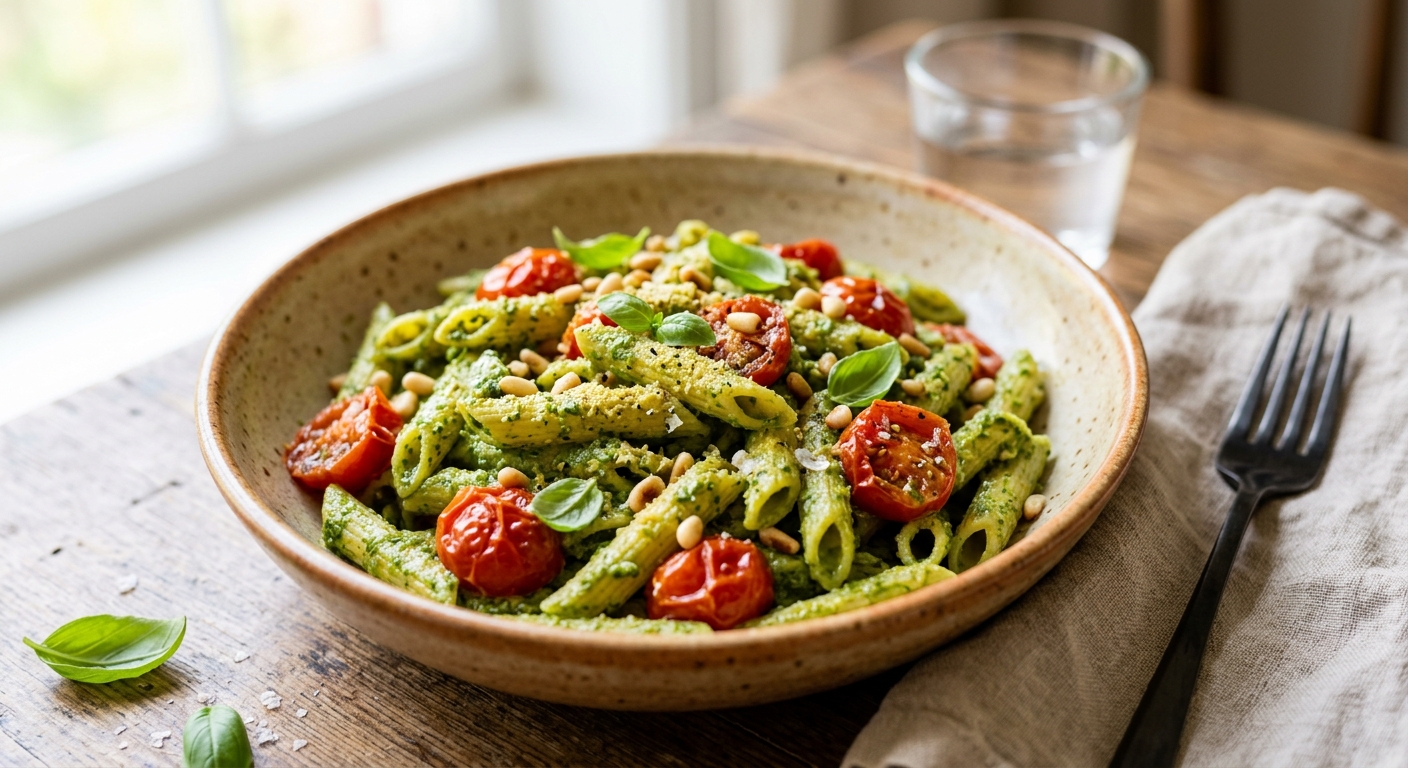
Chickpea pasta has quietly become one of the most nutritionally impressive pantry staples of the last decade, and this recipe is built to showcase exactly why. Unlike refined wheat pasta, chickpea flour noodles carry genuine protein density, roughly 13 to 14 grams per 85g dry serving, along with a meaningful fiber payload and a lower glycemic response that keeps energy levels stable long after the meal. Paired with a whole-food basil pesto made from pine nuts and extra-virgin olive oil, and finished with slow-roasted cherry tomatoes bursting with lycopene, this dish punches well above its weight on every nutritional metric that matters.
The culinary logic here is equally compelling. Chickpea pasta has a naturally nutty, slightly earthy flavor that marries beautifully with the grassy brightness of fresh basil pesto. Cherry tomatoes, whether quickly blistered on the stovetop, slowly concentrated in the oven, or softened in a slow cooker, contribute acidity and sweetness that balance the richness of the pesto. A finishing shower of nutritional yeast adds a savory, cheese-like depth while contributing B12 and additional protein, making this dish feel indulgent while remaining entirely plant-based and gluten-free.
From a precision nutrition standpoint, every component was chosen deliberately. Pine nuts supply cysteine and methionine, the sulfur-containing amino acids that legume-based proteins tend to be lower in, effectively creating a more complete amino acid profile across the whole dish. Garlic and lemon zest in the pesto contribute quercetin and limonene respectively, adding to an already impressive antioxidant roster. Whether you are an athlete chasing recovery nutrition, a flexitarian reducing meat consumption, or simply someone who wants a genuinely delicious weeknight dinner that does real nutritional work, this bowl delivers on every level.
4
servings
Ingredients
- 340 gdry chickpea pasta (penne or fusilli)
- 400 gcherry tomatoes, halved
- 3 tbspextra-virgin olive oil, divided
- 4 clovesgarlic, minced
- 60 gfresh basil leaves, packed
- 40 gpine nuts, toasted
- 2 tbspnutritional yeast
- 1 tbspfresh lemon juice
- 1 tsplemon zest
- 480 mllow-sodium vegetable broth
- 2 tbspwater (for pesto emulsification)
- —Colima Sea SaltMicroplastic Free Salt and black pepper to taste
- —Extra fresh basil and toasted pine nuts for garnish
Instructions
Click on an item below to shop for the recommended items for this recipe on Amazon.
As an Amazon Associate, we earn from qualifying purchases.
- Make the pesto first: combine basil leaves, toasted pine nuts, nutritional yeast, lemon juice, lemon zest, 2 tablespoons of olive oil, and a generous pinch of salt in a food processor. Pulse 8 to 10 times, scraping down the sides, then process continuously for 20 seconds until a coarse, vibrant paste forms. Add the 2 tablespoons of water and pulse briefly to loosen. Taste and adjust salt. Set aside with plastic wrap pressed directly onto the surface to prevent oxidation.
- Bring a large pot of generously salted water to a rolling boil over high heat. Add the chickpea pasta and cook according to package directions, typically 7 to 9 minutes, stirring frequently during the first 2 minutes to prevent sticking (chickpea pasta is more prone to clumping than wheat pasta). Reserve 180ml of starchy cooking water before draining. Drain and set aside.
- While the pasta cooks, heat the remaining 1 tablespoon of olive oil in a wide skillet over medium-high heat until shimmering. Add the halved cherry tomatoes cut-side down in a single layer. Do not stir for 2 to 3 minutes, allowing them to blister and caramelize on the cut surface. Add the minced garlic, stir once, and cook for 45 seconds until fragrant. Season with salt and pepper.
- Reduce the skillet heat to medium-low. Add the drained chickpea pasta directly to the tomato skillet. Add the prepared pesto and 60ml of the reserved pasta water. Toss vigorously with tongs for 60 to 90 seconds, adding more pasta water a splash at a time until the pesto emulsifies into a glossy sauce that coats every piece of pasta. The starch in the pasta water is essential for this emulsification.
- Remove from heat immediately. Taste and adjust seasoning. Divide among four warm bowls and garnish generously with fresh basil leaves, extra toasted pine nuts, a crack of black pepper, and a drizzle of olive oil if desired. Serve within 5 minutes for the best texture.
- Make the pesto in advance and refrigerate it: combine basil, toasted pine nuts, nutritional yeast, lemon juice, lemon zest, 2 tablespoons of olive oil, a pinch of salt, and the 2 tablespoons of water in a food processor. Process until a loose, bright paste forms. Transfer to a small jar, press plastic wrap onto the surface, and refrigerate until needed.
- Add the cherry tomatoes (whole, not halved, to preserve their structure during the long cook), minced garlic, 1 tablespoon of olive oil, the full 480ml of vegetable broth, and a generous pinch of salt and pepper to the slow cooker insert. Stir to combine. Cook on Low for 2 hours and 15 minutes, until the tomatoes have completely softened and released their juices into a light, fragrant broth.
- Add the dry chickpea pasta directly to the slow cooker, pushing it down into the tomato broth. The broth level should just cover the pasta. If needed, add up to 60ml of hot water. Place the lid back on and cook on Low for an additional 35 to 45 minutes, checking at 35 minutes. Chickpea pasta absorbs liquid faster than wheat pasta, so check early. The pasta is done when it is just tender with a slight bite and has absorbed most of the liquid.
- Turn the slow cooker off and remove the lid. Let the pasta rest uncovered for 5 minutes to allow excess steam to escape and the texture to firm slightly. Add the refrigerated pesto to the insert and fold gently with a silicone spatula, working in a figure-eight motion to coat the pasta without breaking it up. The residual heat will warm the pesto through without cooking it.
- Taste and adjust seasoning, adding lemon juice if the dish needs brightness after the long cook. Serve directly from the insert into warm bowls, garnishing with fresh basil, toasted pine nuts, and a final crack of black pepper.
- Make the pesto while the pressure cooker comes to pressure: combine basil, toasted pine nuts, nutritional yeast, lemon juice, lemon zest, 2 tablespoons of olive oil, salt, and the 2 tablespoons of water in a food processor. Process to a loose paste. Set aside at room temperature, covered.
- Select the Saute function on your Instant Pot or pressure cooker and heat 1 tablespoon of olive oil over medium-high heat. Add the cherry tomatoes and cook undisturbed for 2 minutes until they begin to blister. Add the minced garlic and stir for 30 seconds. Press Cancel to stop the Saute function.
- Add the dry chickpea pasta to the pot, breaking any long pieces if needed. Pour in the 480ml of vegetable broth. Use a silicone spatula to gently push the pasta below the liquid surface without pressing it into a mass. Do not stir further, as this can cause sticking. Secure the lid, set the valve to Sealing, and cook on Manual High Pressure for 4 minutes (half the package cook time, rounded down by 1 minute).
- Perform an immediate quick release by carefully switching the valve to Venting as soon as the 4 minutes are complete. Stand back during the initial steam burst. Once pressure is fully released, open the lid away from you and stir once gently to separate any pasta that has stuck together.
- The pasta will appear slightly saucy from the concentrated tomato broth. Add the prepared pesto immediately and fold it through the hot pasta using a silicone spatula. The residual heat will warm and loosen the pesto into a glossy, cohesive sauce. If the dish seems dry, add a splash of hot water or broth. Taste for seasoning, then serve immediately in warm bowls with fresh basil and toasted pine nuts.
- Preheat the oven to 200 degrees Celsius (400 degrees Fahrenheit). Make the pesto as directed: blend basil, toasted pine nuts, nutritional yeast, lemon juice, lemon zest, 2 tablespoons of olive oil, salt, and 2 tablespoons of water until a rough paste forms. Refrigerate, covered, until the final step.
- In a 9 by 13 inch baking dish, combine the dry chickpea pasta, halved cherry tomatoes (cut-side up for caramelization), minced garlic, 1 tablespoon of olive oil, the full 480ml of vegetable broth, and a generous pinch of salt and black pepper. Stir everything together, ensuring the pasta is as evenly submerged in the broth as possible.
- Cover the baking dish very tightly with aluminum foil, crimping the edges firmly so no steam escapes. Bake covered at 200 degrees Celsius for 25 minutes. The sealed environment allows the pasta to hydrate and cook fully in the broth without drying out.
- Remove the foil carefully (hot steam will escape from the edges). Stir the pasta gently once. Return the dish to the oven uncovered for an additional 8 to 10 minutes. This final uncovered stage concentrates the tomato juices, caramelizes the top layer of tomatoes, and creates lightly crisped pasta edges that add textural contrast.
- Remove from the oven and let the dish rest for 5 minutes, which allows the sauce to tighten as it cools slightly. Drop spoonfuls of the refrigerated pesto across the top of the hot pasta rather than stirring it in fully, preserving swirls of vivid green throughout. Garnish with fresh basil and toasted pine nuts. Serve directly from the baking dish for a rustic, family-style presentation.
Nutrition Breakdown
Per 1 serving (makes 4)
Vitamins & Minerals
% Daily Value based on a 2,000 calorie diet (FDA reference)
🧬 Essential Amino Acids
% of recommended daily intake (RDA) per serving
🛡 Antioxidant Profile
The Nutrition Science
The protein quality story of this dish is more nuanced than a simple gram count. Chickpeas and chickpea-derived pasta are rich in lysine, the amino acid most limiting in cereal grains, which is why legume-grain combinations have been nutritional cornerstones of traditional diets worldwide. At 28 grams of protein per serving, this bowl approaches the threshold that research suggests maximizes muscle protein synthesis in a single meal (approximately 0.4g per kg of body weight), and the essential amino acid distribution, particularly high levels of threonine, histidine, and tryptophan, makes it genuinely competitive with moderate portions of animal protein for anabolic signaling purposes.
The 11 grams of fiber per serving represent a meaningful contribution toward the 25 to 38 grams per day recommended by the Dietary Guidelines, and this particular fiber blend matters. Chickpea pasta delivers a mix of soluble fiber (which ferments into short-chain fatty acids like butyrate in the colon, feeding the intestinal epithelium) and insoluble fiber (which accelerates intestinal transit). This dual action supports a favorable gut microbiome composition associated with reduced systemic inflammation, improved insulin sensitivity, and lower LDL cholesterol over time. The resistant starch present in cooked-and-cooled chickpea pasta further amplifies this effect, which is one reason leftover pasta from this recipe eaten cold or at room temperature has an even lower glycemic impact than freshly cooked portions.
Vitamin K at 93% DV per serving deserves special attention. Supplied almost entirely by the fresh basil in the pesto, this fat-soluble vitamin is often overlooked in nutrition conversations dominated by macronutrients. Vitamin K2 activates osteocalcin, the protein responsible for binding calcium into bone matrix, and activates Matrix Gla Protein, which prevents arterial calcification. Critically, the generous olive oil and pine nut fat in this pesto significantly enhances K absorption, since fat-soluble vitamins require dietary fat for micellar solubilization in the small intestine. The combination of a fat-rich delivery vehicle alongside a vitamin K-dense herb is a textbook example of food synergy working in your favor.
Pro Tips
- Salt your pasta water until it tastes like mild seawater, approximately 10g of salt per liter. Chickpea pasta has a neutral-to-earthy base flavor that genuinely depends on well-salted cooking water to taste its best.
- Toast the pine nuts in a dry skillet over medium heat for 3 to 4 minutes, shaking constantly, until golden. This step is not optional: toasting develops pyrazines and Maillard compounds that give the pesto a deeper, nuttier backbone that raw pine nuts simply cannot provide.
- If your pesto turns brownish-green within 15 minutes of making it, your food processor blade is generating too much heat. Chill the basil leaves for 10 minutes in the freezer before processing, and pulse in short bursts rather than running the motor continuously.
- For higher protein needs, stir 2 tablespoons of white cannellini beans, mashed into a paste, into the pesto before tossing. This is virtually undetectable in flavor but adds another 4 to 5 grams of protein and improves the creaminess of the sauce.
- Chickpea pasta continues absorbing liquid even after cooking, so if you are making this dish ahead, store the pasta and pesto separately and combine just before serving, or add a splash of broth when reheating to restore the sauce consistency.
oh okay, 28g of plant protein is legit impressive for a single serving! the amino acid profile on chickpea pasta is way better than regular semolina too, so thats actually perfect post-wod timing if you pair it with the healthy fats from the pesto. been experimenting with these noodles for recovery meals and the digestibility is solid, plus the cherry tomatoes add lycopene which helps with inflammation management. definitely trying this one after our next conditioning block!
Oh, this is exactly the kind of recipe I’m planning to feature in next month’s class! I’ve been making pesto pasta for years, but I have to admit, swapping regular pasta for chickpea flour noodles is such a smart move – not only does it bump up that protein to levels my older recipes never dreamed of, but the nutty flavor actually complements basil in a way I didn’t expect. My question: does the chickpea pasta hold up well if you’re making this ahead for meal prep, or do you find it gets softer faster than traditional noodles? I’m curious about the texture staying power since so many home cooks are juggling busy schedules like mine used
ooh this is such a great question for meal prep! honestly i’ve noticed chickpea pasta does soften a bit faster than semolina, especially if its sitting in sauce, but here’s my hack – i keep the pesto and tomatoes separate and toss them together like 30 mins before eating, which keeps everything from getting mushy. the nutty flavor you mentioned is perfect for longer endurance training too, those essential amino acids really help with muscle repair after hard efforts, and i’ve found the slower carb digestion from the chickpea flour keeps my energy more stable than regular pasta would. definitely test a couple batches with your class timing so you can dial in how far ahead works best for your