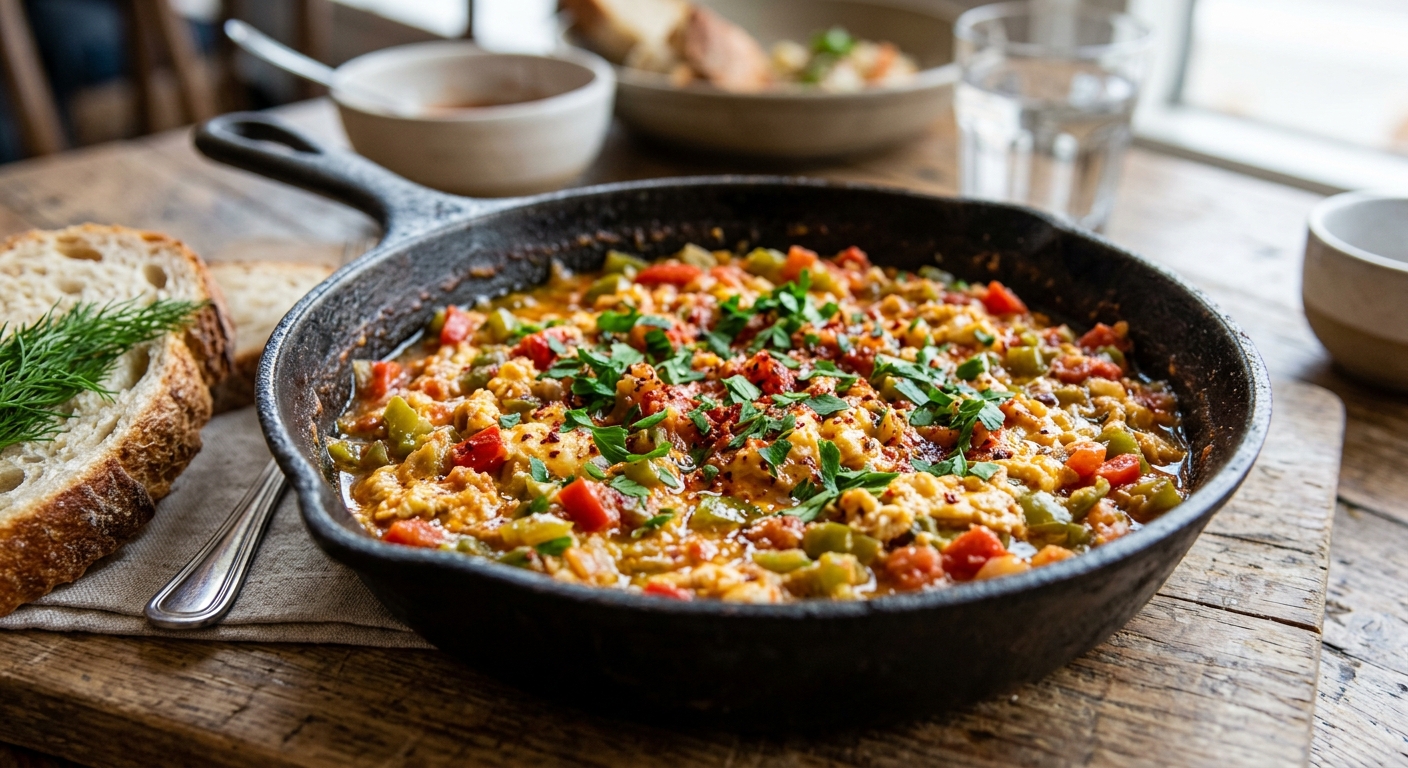
Walk through any Turkish neighborhood at breakfast time and you will catch the scent of sizzling peppers and tomatoes long before you see the pan. Menemen is one of those dishes that feels almost too simple to be extraordinary, yet every bite delivers a depth of flavor that belies its short ingredient list. Eggs, sweet green peppers, ripe tomatoes, a thread of olive oil, and a whisper of red pepper flakes: that is the whole story. What makes it special is the technique. Unlike a Western scramble where the eggs are moved constantly over high heat, menemen demands patience. The eggs are poured into a slowly bubbling tomato-pepper base and stirred gently, just enough to form soft, custard-like curds that carry the sauce in every fold.
From a nutritional standpoint, menemen is a rare breakfast that truly earns the term “balanced.” Four eggs split across two servings provide a complete amino acid profile, meaningful choline for cognitive function, and a trifecta of B-vitamins critical for energy metabolism. The tomatoes and red peppers are not merely flavor vehicles: they are dense sources of vitamin C, which actively enhances the non-heme iron present in the eggs, and lycopene, a potent carotenoid linked to cardiovascular protection. Cooking the tomatoes in olive oil, as is traditional, measurably increases lycopene bioavailability compared to raw consumption, so the heat is working for you nutritionally as well as culinarily.
At Calibrated Cuisine we have tested this recipe across four cooking methods, from the classic stovetop skillet to a slow cooker brunch version perfect for feeding a crowd, and each method is engineered to preserve the dish’s nutritional integrity while delivering the texture that makes menemen worth eating at any time of day. The glycemic load is low-to-medium, the dish is naturally gluten-free and dairy-free, and it comes together in under 30 minutes on the stovetop. This is weekday nutrition that tastes like a weekend.
4
servings
Ingredients
- 8 largefree-range eggs
- 3 tbspextra-virgin olive oil
- 2 mediumgreen Turkish peppers (or 1 large green bell pepper), finely diced
- 1 mediumred bell pepper, finely diced
- 500 gripe plum tomatoes, grated on a box grater (about 4 medium)
- 1 mediumyellow onion, finely diced
- 3 clovesgarlic, minced
- 1 tspTurkish red pepper flakes (pul biber) or Aleppo pepper
- 0.5 tspground cumin
- 0.5 tspsweet smoked paprika
- 1 tbsptomato paste
- 15 gfresh flat-leaf parsley, roughly chopped
- —Colima Sea SaltMicroplastic Free Salt and black pepper to taste
- —Crusty sourdough bread or warm pide to serve (optional)
Instructions
Click on an item below to shop for the recommended items for this recipe on Amazon.
As an Amazon Associate, we earn from qualifying purchases.
- Place a wide, heavy-bottomed skillet or saute pan over medium heat and add the olive oil. Once the oil shimmers, add the diced onion with a pinch of salt and cook, stirring occasionally, for 5 to 6 minutes until the onion is soft and just starting to turn golden at the edges.
- Add the diced green and red peppers to the pan. Cook for 4 to 5 minutes, stirring occasionally, until the peppers have softened and their raw edge is completely gone. Add the minced garlic and cook for 1 minute until fragrant, then stir in the tomato paste and cook for 1 minute more to caramelize it slightly.
- Pour in the grated tomatoes and add the pul biber, cumin, and smoked paprika. Stir everything together and increase the heat to medium-high. Cook the sauce uncovered for 6 to 8 minutes, stirring occasionally, until it has thickened noticeably and the excess liquid has evaporated. The sauce should hold its shape briefly when you drag a spoon through it. Season generously with salt and black pepper.
- Reduce the heat to medium-low. Crack the eggs directly into the pan, distributing them evenly across the surface. Using a silicone spatula or wooden spoon, gently fold the eggs into the tomato sauce with slow, deliberate strokes, pulling the set egg from the bottom and folding it over the saucy top. Do not rush this. The goal is large, glossy, barely-set curds suspended in the sauce, not a dry scramble.
- After 3 to 4 minutes of gentle folding, when the eggs are just set but still look slightly underdone, remove the pan from the heat immediately. Residual heat will finish the cooking. Scatter the chopped parsley over the top and serve directly from the pan with warm bread.
- Lightly grease the insert of a 4 to 6 quart slow cooker with 1 tablespoon of the olive oil. Add the diced onion, green and red peppers, minced garlic, tomato paste, grated tomatoes, pul biber, cumin, smoked paprika, the remaining 2 tablespoons of olive oil, salt, and black pepper directly to the insert. Stir thoroughly to combine everything into a cohesive sauce.
- Place the lid on the slow cooker and cook on Low for 3 hours. The sauce will deepen in color and the peppers will become very tender. At the 2.5-hour mark, remove the lid and stir the sauce. If it looks very thin, leave the lid slightly ajar for the final 30 minutes to allow some steam to escape and the sauce to concentrate.
- After 3 hours, taste the sauce and adjust seasoning. Switch the slow cooker to the High setting. Using a spoon, create 8 small wells in the thickened sauce. Crack one egg into each well, then replace the lid. Cook on High for 12 to 18 minutes, checking at 12 minutes. The whites should be just set and the yolks still soft. For a scrambled texture, gently stir the eggs into the sauce once the whites begin to turn opaque, then replace the lid for 3 to 4 more minutes.
- Once the eggs are cooked to your liking, scatter the parsley over the top and serve directly at the table from the slow cooker insert. The retained heat will keep the dish warm for serving.
- Set the Instant Pot or electric pressure cooker to Saute mode on Normal heat. Add the olive oil and heat for 1 minute. Add the diced onion and a pinch of salt, and saute for 3 to 4 minutes until softened. Add the green and red peppers and saute for 2 more minutes. Stir in the garlic and tomato paste and cook for 1 minute until fragrant. Press Cancel to stop the Saute function.
- Add the grated tomatoes, pul biber, cumin, smoked paprika, salt, and black pepper to the pot. Stir well to combine. Secure the lid and set the pressure release valve to Sealing. Cook on Manual High Pressure for 5 minutes. The pressure environment will break down the tomatoes and meld the pepper flavor into the sauce far more quickly than the stovetop.
- When the cook time ends, perform a Quick Release by carefully turning the pressure valve to Venting. Once all steam has escaped and the float valve has dropped, open the lid away from you. The sauce inside will be thick, fragrant, and deeply colored. Stir it and assess the consistency: if it is thinner than you would like, switch back to Saute mode for 2 to 3 minutes to reduce it, stirring frequently.
- Switch the Instant Pot back to Saute mode on the Low or Less setting (to prevent scorching). Allow the sauce to stop bubbling vigorously, about 1 minute. Crack the eggs into the sauce and fold gently with a silicone spatula using the same slow, deliberate strokes as the stovetop method, pulling set egg from the bottom and incorporating it into the sauce. Cook for 3 to 5 minutes until the eggs form soft, creamy curds.
- Press Cancel immediately when the eggs are just set and still glossy. The ceramic insert retains heat aggressively, so do not leave the eggs sitting on the heat. Top with fresh parsley and serve straight from the pot.
- Position a rack in the upper-middle section of your oven and preheat to 200 degrees Celsius (400 degrees Fahrenheit). If using individual cast iron skillets or oven-safe ramekins (approximately 15cm), place them on a baking sheet while the oven preheats so they are hot when the sauce goes in.
- Build the tomato-pepper sauce on the stovetop first. Heat the olive oil in a medium saucepan over medium heat. Add the onion and cook for 5 minutes until soft. Add the peppers and cook for 4 minutes. Stir in the garlic, tomato paste, pul biber, cumin, and smoked paprika and cook for 1 minute. Add the grated tomatoes, season with salt and pepper, and simmer over medium-high heat for 7 to 8 minutes until the sauce is thick and concentrated. Taste and adjust seasoning.
- Carefully remove the hot skillets or ramekins from the oven using oven mitts. Divide the thickened tomato-pepper sauce evenly among the vessels. The sauce should sizzle when it hits the hot surface, which is exactly what you want. Use the back of a spoon to make two wells per individual skillet (or a single well per ramekin if using 8 individual portions).
- Crack one egg into each well. For a set white with a runny yolk, return the skillets to the oven and bake for 7 to 9 minutes. For fully set yolks, bake for 10 to 12 minutes. Watch carefully from the 7-minute mark as oven temperatures vary. The whites should be completely opaque and just firm at the edges.
- Remove from the oven, scatter fresh parsley generously over each skillet, and serve immediately on heat-proof mats or trivets directly at the table. Warn guests that the vessels are extremely hot. Crusty bread for dipping is essential with this presentation.
Nutrition Breakdown
Per 1 serving (makes 4)
Vitamins & Minerals
% Daily Value based on a 2,000 calorie diet (FDA reference)
🧬 Essential Amino Acids
% of recommended daily intake (RDA) per serving
🛡 Antioxidant Profile
The Nutrition Science
Eggs are one of the most nutritionally complete single foods available, and menemen is engineered by tradition to maximize their value. Each large egg contains roughly 145mg of choline, a nutrient the majority of adults do not consume in sufficient quantities. Choline is the direct precursor to acetylcholine, a neurotransmitter critical to memory and muscle control, and it is also required for the structural integrity of every cell membrane in the body. Two eggs per serving in this recipe provides approximately 56% of the adequate intake for choline in one meal, a contribution that is genuinely difficult to replicate without eggs.
The synergy between vitamin C and iron in this dish is a textbook example of nutrient interaction. The tomatoes and peppers together supply nearly 110% of the Daily Value for vitamin C per serving. Non-heme iron, the form found in plant foods and eggs, has relatively poor bioavailability on its own, typically 2 to 20% absorption efficiency. However, vitamin C consumed in the same meal converts ferric iron (Fe3+) to the more soluble ferrous form (Fe2+), and can increase non-heme iron absorption by up to 300%. The olive oil in the recipe plays a parallel role for fat-soluble antioxidants: lycopene, beta-carotene, lutein, and capsanthin are all lipophilic compounds whose micellar solubilization in the small intestine is significantly enhanced by the presence of dietary fat. Cooking the tomatoes and peppers in olive oil is not just a culinary tradition; it is biochemically optimal.
The B-vitamin trio in menemen, riboflavin (B2), B6, and B12, functions as a coordinated metabolic team. Riboflavin is a cofactor in both the electron transport chain and in the conversion of B6 and folate into their active forms. Vitamin B6 is required for over 100 enzymatic reactions, most critically the transamination reactions that allow the body to synthesize and interconvert amino acids from the protein-rich eggs. Vitamin B12, found exclusively in animal products, is essential for neurological function and DNA synthesis. A single serving of this menemen provides meaningful percentages of all three, making it one of the most efficient B-vitamin delivery vehicles in the breakfast category.
Pro Tips
- Grating whole tomatoes on a box grater rather than chopping them creates a finer, more homogeneous pulp that reduces faster and coats the eggs more evenly. Hold the tomato cut-side down against the coarse side of the grater and the skin will stay behind in your hand.
- The single biggest mistake in menemen is high heat during the egg stage. If the pan is too hot, the egg proteins contract too quickly and expel moisture, leaving you with dry, rubbery curds floating in watery tomato liquid. Medium-low heat and patience are mandatory.
- Pul biber (Turkish red pepper flakes) is not a direct substitute for standard chili flakes. It is dried, oiled, and has a fruity, moderately spiced character closer to Aleppo pepper. Seek it out at Turkish grocery stores or online for an authentically flavored result. In a pinch, use a 50/50 blend of sweet paprika and a pinch of cayenne.



omg yes, ive been making this for my family and the kids actually ASK for it now which never happens with eggs lol! do you have any thoughts on sprouting the peppers or tomatoes beforehand to lower any antinutrient content, or is the cooking process itself enough to break those down? ive been curious if theres a way to amp up the bioavailability even more since the choline content is such a game changer for brain development. my 7 year old definitely seems more focused on mornings when we do this vs cereal!
ok so im gonna be real with you – ive never sprouted peppers or tomatoes but i do know that cooking breaks down a lot of those antinutrient inhibitors anyway, and honestly the heat from the scramble probably does most of the work for you. that said, if youre already seeing focus improvements in your kid thats genuinely amazing and the choline from the eggs is legit doing heavy lifting there. my thing with menemen specifically is the soft cooking method is actually perfect because youre not overcooking the veggies which keeps more nutrients intact, so i wouldnt stress too much about optimizing further unless youre noticing digestive issues – sometimes more processing/prep isnt always better
This is such a beautiful example of how traditional dishes from different cultures are basically functional nutrition working perfectly! I love that your kids are actually requesting it, because that’s the real win right there. On the sprouting question, honestly peppers and tomatoes are already so bioavailable and low in problematic antinutrients compared to grains and legumes that you’re getting the carotenoids and vitamin C really efficiently as is, but if you want to level it up even more, I’d suggest adding some leafy greens like collards or even moringa powder to the sauce for extra B vitamins and iron that your body will actually absorb because of the eggs’ choline content. Have you ever tried it with