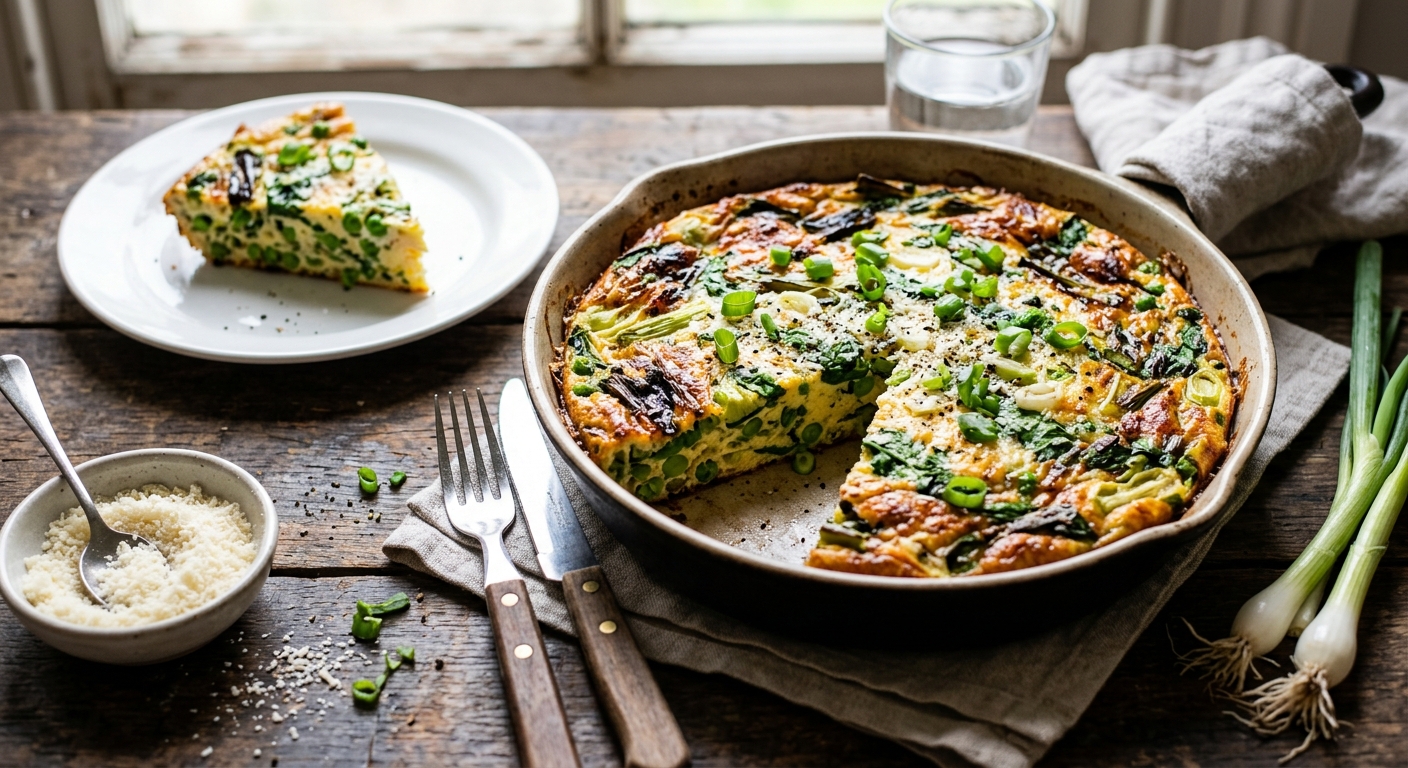
When spring onions arrive at the market, bright green and barely an inch thick, they bring with them one of the season’s most underappreciated nutritional gifts. A single generous bunch contributes meaningful amounts of folate, vitamin C, and vitamin K, nutrients that are often hard to hit from a single meal. Paired with eggs, one of nature’s most complete protein sources and a reliable delivery vehicle for choline, riboflavin, and selenium, the humble frittata becomes something worth writing home about.
The frittata has a long tradition in Italian home cooking as a way to honour whatever is freshest and most abundant. Unlike a French omelette, which demands speed and a trembling wrist, the frittata is patient and forgiving. It sets slowly, develops a custardy interior, and holds its structure beautifully at room temperature, making it equally at home on a weeknight dinner table, a weekend brunch spread, or sliced cold into a lunchbox. That flexibility is part of its charm, and part of why it suits so many cooking methods so well.
At Calibrated Cuisine, we chose this frittata specifically because it punches well above its weight nutritionally for its calorie count. At roughly 280 calories per serving, you are getting a genuinely complete micronutrient profile anchored by folate, vitamin C, choline, and selenium, with a glycemic load low enough to keep blood sugar stable for hours. Whether you make it on the stovetop in a cast iron skillet, set it in a slow cooker for a hands-off brunch, or finish it in the oven for a perfectly even set, the nutritional story remains the same: this is seasonal eating calibrated to your biology.
4
servings
Ingredients
- 8 largepasture-raised eggs
- 180 gspring onions (approximately 2 large bunches), trimmed and thinly sliced, white and green parts separated
- 80 gbaby spinach, roughly chopped
- 60 gfrozen peas, thawed
- 40 gParmesan cheese, finely grated
- 3 tbspextra-virgin olive oil, divided
- 60 mlwhole milk
- 2 clovesgarlic, minced
- 15 gfresh flat-leaf parsley, finely chopped
- 10 gfresh chives, finely snipped
- 0.5 tspsweet smoked paprika
- 0.25 tspfreshly grated nutmeg
- —Colima Sea SaltMicroplastic Free Salt and freshly cracked black pepper to taste
- —Extra chives and parsley to garnish
Instructions
Click on an item below to shop for the recommended items for this recipe on Amazon.
As an Amazon Associate, we earn from qualifying purchases.
- Crack the eggs into a large mixing bowl. Add the milk, half the Parmesan, the parsley, chives, smoked paprika, nutmeg, a generous pinch of salt, and several grinds of black pepper. Whisk vigorously for about 90 seconds until the mixture is uniform in colour and slightly frothy. Set aside.
- Place a 25cm (10-inch) cast iron or heavy oven-safe nonstick skillet over medium heat. Add 2 tablespoons of the olive oil and let it warm until it shimmers but does not smoke. Add the white parts of the spring onions and the garlic. Cook, stirring frequently, for 3 to 4 minutes until softened and faintly golden at the edges.
- Add the baby spinach and toss it through the onion mixture with tongs. Cook for 1 to 2 minutes until just wilted. Scatter in the thawed peas and the green parts of the spring onions. Stir briefly to combine, then spread the vegetables in an even layer across the base of the pan.
- Reduce the heat to low. Drizzle the remaining tablespoon of olive oil around the edge of the pan so it runs under the vegetables. Pour the egg mixture evenly over the vegetables, gently pressing any exposed greens down into the egg with a spatula. Do not stir once the egg is in. Cook undisturbed on low heat for 10 to 12 minutes until the edges are set and opaque and the centre is just barely wobbly when you nudge the pan.
- While the frittata finishes on the stovetop, preheat your broiler to high. Scatter the remaining Parmesan evenly over the surface. Transfer the skillet to the broiler, 15cm (6 inches) from the element, and broil for 2 to 3 minutes until the top is golden and set. Watch it closely as broilers vary. Remove, let rest in the pan for 5 minutes, then slice into wedges and garnish with fresh chives and parsley.
- Preheat your oven to 180C (350F) with a rack positioned in the centre. Lightly grease a 20 x 28cm (8 x 11-inch) ceramic or glass baking dish, or a 25cm (10-inch) cast iron skillet, with 1 tablespoon of the olive oil.
- Heat the remaining 2 tablespoons of olive oil in a medium skillet over medium heat. Add the white parts of the spring onions and the garlic and sauté for 3 to 4 minutes until softened. Add the baby spinach and cook until wilted, about 1 to 2 minutes. Remove from the heat and stir in the peas and the green parts of the spring onions. Season lightly with salt and pepper. Spread the vegetable mixture evenly into the prepared baking dish.
- In a large bowl, whisk together the eggs, milk, all the Parmesan, parsley, chives, smoked paprika, nutmeg, 0.5 teaspoon salt, and a generous amount of cracked black pepper until smooth and homogenous. Pour the egg mixture over the vegetables in the baking dish, using a fork to gently distribute the greens evenly through the custard.
- Bake in the preheated oven for 22 to 26 minutes. The frittata is ready when the centre is just set, with a very slight jiggle but no liquid egg visible, and the edges are pulling away from the sides of the dish. The top should be pale gold and lightly puffed. If you want more colour, switch to broil for the final 2 minutes.
- Remove from the oven and allow to rest for 5 minutes before slicing. The frittata will continue to firm up as it rests. Garnish with fresh chives and parsley and serve directly from the baking dish.
- Line the base and sides of a 4.5 to 6 litre (4 to 6 quart) slow cooker insert with a large sheet of parchment paper, pressing it into the corners and leaving an overhang on two sides to act as lifting handles. Grease the parchment lightly with olive oil. This step is essential for a clean release.
- In a skillet over medium heat, warm 2 tablespoons of olive oil. Sauté the white parts of the spring onions and garlic for 3 to 4 minutes until softened. Add the spinach and cook until just wilted. Remove from the heat, stir in the peas and the green spring onion tops, and allow the mixture to cool for 5 minutes so it does not pre-cook the eggs on contact.
- Whisk together the eggs, milk, all the Parmesan, parsley, chives, smoked paprika, nutmeg, 0.5 teaspoon salt, and plenty of black pepper in a large bowl. Fold the cooled vegetable mixture into the egg base. Pour everything into the lined slow cooker insert and spread into an even layer.
- Lay a double layer of paper towels across the top of the slow cooker before fitting the lid. This absorbs condensation so that water droplets do not drip back onto the frittata and create wet patches on the surface. Cook on High for 1.5 to 2 hours, checking at the 1.5-hour mark. The frittata is done when the centre is fully set and does not jiggle when the insert is gently moved.
- Turn off the slow cooker and leave the lid slightly ajar for 10 minutes to allow residual steam to escape. Use the parchment handles to lift the frittata cleanly onto a cutting board. If you would like a golden top, slide it under a preheated broiler on a baking sheet for 2 to 3 minutes. Garnish and slice into wedges to serve.
- Select a 1.5 litre (6-cup) round oven-safe glass or silicone container that fits comfortably inside your pressure cooker with at least 2.5cm (1 inch) of clearance on all sides. Grease it generously with olive oil. Pour 250ml (1 cup) of water into the pressure cooker insert and place the trivet inside.
- In a skillet over medium heat, warm 2 tablespoons of olive oil. Sauté the white spring onion parts and garlic for 3 minutes until softened. Add spinach and cook until wilted. Remove from the heat, stir in peas and spring onion greens, and allow the mixture to cool for 5 minutes.
- Whisk the eggs, milk, all the Parmesan, parsley, chives, smoked paprika, nutmeg, 0.5 teaspoon salt, and black pepper together in a large bowl until fully combined. Fold in the cooled vegetables. Pour the mixture into the greased container, filling it no more than three-quarters full to allow the frittata to expand. Cover the container tightly with aluminium foil, pressing the edges to seal.
- Lower the covered container onto the trivet using a foil sling (a strip of folded foil looped under the container with the ends folded over the top to form handles). Seal the pressure cooker lid and set to Low pressure for 20 minutes. Once the cook time is complete, allow a natural pressure release for 10 minutes, then manually release any remaining pressure.
- Carefully remove the container using the foil sling. Peel back the foil. The frittata should be fully set and pulled slightly away from the sides. If the centre still appears underdone, re-cover with foil and return to Low pressure for an additional 3 minutes. Allow to rest for 5 minutes. Run a thin spatula around the edge, invert onto a cutting board, and garnish with fresh chives and parsley before slicing.
Nutrition Breakdown
Per 1 serving (makes 4)
Vitamins & Minerals
% Daily Value based on a 2,000 calorie diet (FDA reference)
🧬 Essential Amino Acids
% of recommended daily intake (RDA) per serving
🛡 Antioxidant Profile
The Nutrition Science
Eggs are one of the most folate-efficient animal foods available, with each large egg contributing roughly 24mcg of dietary folate equivalents. But the real folate story in this frittata is in the spring onions. A 180g serving of raw spring onions contains approximately 150 to 170mcg of folate, making them one of the highest-folate allium vegetables by weight. Folate is the natural form of vitamin B9 and is critical for one-carbon metabolism, a biochemical process that underpins DNA synthesis, DNA methylation, and the production of SAM-e, the body’s primary methyl donor. Inadequate folate intake is associated with elevated homocysteine, impaired neural tube development during pregnancy, and increased colorectal cancer risk.
Spring onions also provide a meaningful contribution of vitamin C, a nutrient that is frequently underestimated in allium vegetables. The vitamin C in this dish serves a double nutritional duty: it directly meets roughly 24% of your RDI, and it simultaneously enhances the bioavailability of the non-heme iron present in the spinach and peas by reducing ferric iron (Fe3+) to the more readily absorbed ferrous form (Fe2+) in the gut lumen. This interaction is particularly valuable for those following plant-forward diets. Baby spinach further adds beta-carotene and the carotenoids lutein and zeaxanthin, both of which are fat-soluble and are absorbed significantly better in the presence of the olive oil and egg yolk fat in this recipe.
Choline, present at 310mg per serving primarily from the egg yolks, deserves special mention as a nutrient that over 90% of adults fail to meet from diet alone. Choline is the biosynthetic precursor to acetylcholine, the neurotransmitter governing muscle contraction and memory encoding, and to phosphatidylcholine, the dominant phospholipid in cell membranes. Two eggs per serving of this frittata delivers more than half the adequate intake for choline in a single meal. Selenium, provided by both eggs and Parmesan, supports the selenoprotein family including glutathione peroxidase and thioredoxin reductase, enzymes that form the front line of the body’s endogenous antioxidant defence network.
Pro Tips
- Do not over-whisk the eggs once you add the milk as this incorporates excess air and can cause the frittata to puff dramatically and then collapse. Whisk until just combined and uniformly coloured, then stop.
- The green tops of spring onions are significantly higher in folate and vitamin C than the white bases. Use both parts but add the greens only at the very end of the sauté to preserve their heat-sensitive vitamins.
- Cold eggs straight from the refrigerator will seize slightly when they hit a hot pan, leading to uneven setting. Allow your eggs to sit at room temperature for 15 minutes before whisking for the smoothest, most even custard.

dude this looks incredible, spring onions are so underrated. quick question though – whats the net carb count per slice? im guessing pretty low with mostly eggs and onions but spring onions do have some carbs so just wondering where it lands. either way this is exactly the kind of nutrient dense meal i love, way better than loading up on processed stuff to hit your vitamins. the folate and c combo is legit, especially heading into summer.
Spring onions really are underrated, and you’re spot on about the carb profile – they’re actually quite reasonable at around 7g carbs per 100g since most of that weight is water. With eggs being essentially carb-free and the folate-to-carb ratio being so favorable here, this is genuinely one of my favorite seasonal nutrient plays. One thing I always mention to patients: if you’re taking any medications like metformin or blood thinners, the vitamin K in those green onion tops is worth noting for consistency (not avoiding, just being intentional), but the folate here is a real win for methylation support heading into warmer months when we often shift our eating
This recipe is exactly what I’ve been looking for – the folate content alone makes it valuable for my MS protocol, since B vitamin depletion is something I track closely. I’m curious about the same carb question Kurt mentioned, but I’m also wondering if you have thoughts on pairing this with a vitamin D source (maybe a drizzle of quality fish oil or serving it alongside something fatty?). The egg yolks are great, but I always look for ways to maximize absorption and anti-inflammatory impact in a single meal. Thank you for focusing on the micronutrient density rather than just calories, that’s genuinely helpful when you’re eating strategically.