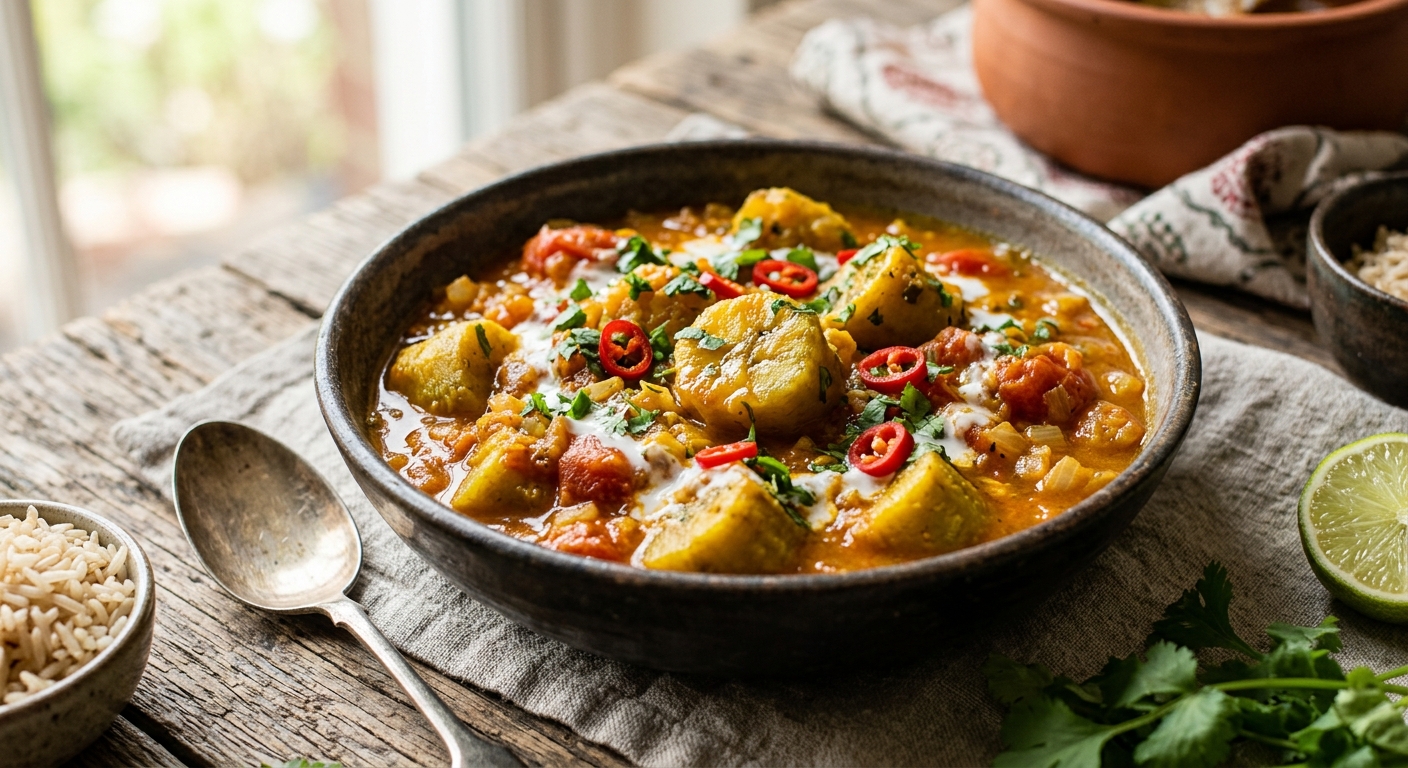
In Uganda, matoke is more than a meal. It is a cultural cornerstone, served at family gatherings, celebrations, and everyday dinners across the country. The dish centers on green cooking plantains, a starchy, savory cousin of the dessert banana that transforms completely during cooking. Where a raw green plantain is firm and almost chalky, a properly braised matoke becomes soft, golden, and deeply savory, absorbing the aromatics around it like a sponge. Traditional preparation wraps the plantains in banana leaves and steams them over a fire, but the home kitchen versions we share here honor that spirit while making the process accessible on any stovetop, slow cooker, or pressure cooker.
What sets matoke apart nutritionally is its extraordinary mineral profile. Green plantains are among the richest food sources of potassium available, surpassing even bananas gram for gram at the unripe stage. Combined with a generous base of tomatoes, onions, and ground turmeric, this stew delivers meaningful amounts of potassium, vitamin B6, vitamin C, magnesium, and manganese in every bowl. The addition of groundnut paste, a traditional Ugandan enrichment, contributes heart-healthy monounsaturated fats, plant-based protein, and a silky body that rounds out the broth beautifully.
This recipe has been calibrated to serve four as a main course, pairing the stew with a side of steamed brown rice or fermented ugali for a complete amino acid profile. Every ingredient was selected not only for flavor but for documented nutritional contribution. The turmeric brings curcumin for anti-inflammatory support, the tomatoes supply lycopene, and the cilantro finish adds a fresh hit of vitamin K. Whether you grew up eating matoke or are discovering it for the first time, this is the kind of deeply nourishing, genuinely delicious dish that earns a permanent place in your weeknight rotation.
4
servings
Ingredients
- 1000 ggreen cooking plantains (about 4 medium), peeled and cut into 5cm chunks
- 2 tbsprefined coconut oil or Avocado Oil100% Pure Avocado Oil
- 1 largeyellow onion, finely diced
- 4 clovesgarlic, minced
- 1 tbspfresh ginger, grated
- 400 gcanned whole peeled tomatoes, crushed by hand
- 2 mediumfresh ripe tomatoes, diced
- 1 tspground turmeric
- 1 tspground coriander
- 0.5 tspground cumin
- 0.25 tspcayenne pepper (adjust to taste)
- 3 tbspnatural unsweetened groundnut (peanut) paste
- 500 mlvegetable stock, low sodium
- 1 mediumgreen bell pepper, diced
- 15 gfresh cilantro, roughly chopped, for serving
- 1 tbspfresh lime juice
- —Colima Sea SaltMicroplastic Free Salt and black pepper to taste
Instructions
Click on an item below to shop for the recommended items for this recipe on Amazon.
As an Amazon Associate, we earn from qualifying purchases.
- Peel the green plantains by scoring the skin along each ridge with a sharp knife, then submerging them in a bowl of cold salted water for 5 minutes. Remove and peel away the skin. Cut each plantain into 5cm chunks and keep submerged in the salted water to prevent oxidation while you prepare the aromatics.
- Heat the oil in a large, heavy-bottomed Dutch oven or wide saucepan over medium heat. Once shimmering, add the diced onion with a pinch of salt and cook, stirring occasionally, for 8 to 10 minutes until the onion is fully softened, translucent, and beginning to show golden edges. Do not rush this step, as properly sweated onions form the flavor foundation of the entire stew.
- Add the minced garlic and grated ginger to the onions and stir constantly for 90 seconds until fragrant. Add the turmeric, coriander, cumin, and cayenne, stirring them into the aromatics for another 60 seconds. This dry-frying of the spices in the oil blooms their fat-soluble compounds, dramatically increasing both flavor and bioavailability of curcumin.
- Add the crushed canned tomatoes and fresh diced tomatoes along with the green bell pepper. Increase the heat to medium-high and cook the tomato mixture, stirring frequently, for 8 to 10 minutes until it darkens, thickens, and the oil begins to separate around the edges. This is the Ugandan technique of cooking down the tomato base fully before adding other ingredients.
- In a small bowl, whisk the groundnut paste with 120ml of the vegetable stock until smooth and lump-free. Pour this mixture along with the remaining stock into the pot, stir to combine, and bring to a gentle boil.
- Drain the plantain chunks and add them to the pot. Stir gently to coat everything in the broth. Reduce the heat to low, cover with a lid leaving a small gap for steam to escape, and simmer for 25 to 30 minutes, stirring every 8 minutes, until the plantains are completely tender when pierced with a fork and beginning to absorb the broth around their edges.
- Taste and adjust salt and pepper. Stir in the lime juice. Serve in deep bowls scattered with fresh cilantro. Pair with steamed brown rice or fermented ugali.
- Peel and cut the green plantains as described in the stovetop instructions. Place the chunks directly in the slow cooker insert. No need to soak in water beforehand as oxidation is less of a concern when you are building the stew immediately.
- In a skillet over medium-high heat, warm the oil and cook the diced onion for 5 minutes until lightly softened. Add the garlic and ginger for 60 seconds, then add all four spices (turmeric, coriander, cumin, cayenne) and stir for 30 seconds. Add both the canned and fresh tomatoes and the green bell pepper and cook the mixture for just 4 to 5 minutes until it begins to concentrate. This shorter stovetop bloom is essential even for slow cooker recipes because the low, moist environment of the slow cooker cannot adequately develop raw spice flavors or caramelize tomatoes.
- In a medium bowl, whisk the groundnut paste together with all 500ml of vegetable stock until completely smooth. Pour this liquid over the plantains in the slow cooker insert.
- Scrape the cooked tomato and onion mixture directly into the slow cooker over the plantains and stock. Stir gently once to distribute the aromatics throughout. Do not stir vigorously, as the plantain chunks are fragile when raw and you want them to hold their shape as they cook.
- Place the lid on the slow cooker and cook on Low for 6 to 7 hours or on High for 3 to 3.5 hours. The stew is done when the plantains are very tender and the broth has thickened to a silky, glossy consistency that coats the back of a spoon.
- Remove the lid, taste for salt and pepper, and stir in the lime juice. Scatter fresh cilantro over the top and serve directly from the insert at the table for a communal presentation in the Ugandan spirit.
- Set your electric pressure cooker or Instant Pot to the Saute function on Normal heat. Add the oil and let it heat for 1 minute. Add the diced onion and cook, stirring occasionally, for 5 minutes until softened. Add the garlic and ginger and saute for 60 seconds, then add the turmeric, coriander, cumin, and cayenne and stir for 30 seconds.
- Add both the canned and fresh tomatoes and the green bell pepper to the pot and cook on the Saute function for 5 minutes, pressing the tomatoes against the base of the insert to break them down and reduce the mixture slightly. This reduction is important to prevent a watery final result and to ensure the Maillard and caramelization reactions that build depth of flavor occur before pressure is applied.
- Whisk the groundnut paste into the vegetable stock in a separate bowl until fully smooth. Cancel the Saute function. Pour the groundnut stock into the pot and scrape up any browned bits from the base of the insert with a wooden spoon. This deglaze step is critical to avoid the burn notice common in pressure cookers when tomato solids stick to the bottom.
- Peel the green plantains (using the score and soak method if needed), cut into 5cm chunks, and add them to the pot. Stir once to submerge the plantains in the liquid. Secure the lid and set the pressure release valve to Sealing. Cook on Manual or Pressure Cook at High Pressure for 10 minutes.
- Allow the pressure to release naturally for 10 minutes, then carefully turn the valve to Venting to release any remaining steam. Open the lid, taste for seasoning, and stir in the lime juice. Serve immediately with fresh cilantro and a starchy side.
- Preheat your oven to 175C (350F) with a rack positioned in the lower third. Peel the green plantains and cut into 5cm chunks. The lower oven position distributes heat more evenly to the base of the braising pot, preventing the bottom layer of plantains from overcooking relative to the top.
- On the stovetop over medium heat, warm the oil in a large, oven-safe Dutch oven with a tight-fitting lid. Saute the diced onion for 8 to 10 minutes until deeply golden. Add the garlic, ginger, and all four spices and stir for 90 seconds until fragrant and the oil turns a vivid orange-yellow from the turmeric.
- Add the canned tomatoes, fresh tomatoes, and green bell pepper. Increase to medium-high heat and cook, stirring occasionally, for 10 to 12 minutes. You want a thick, jammy tomato paste consistency before you add the liquid. The extra reduction time here is important because once the Dutch oven goes into the oven, evaporation slows significantly and you will not be able to cook off excess water.
- Whisk the groundnut paste with the vegetable stock until smooth and pour it into the Dutch oven. Stir to combine, scraping the base clean. Nestle the plantain chunks into the liquid so they are at least two-thirds submerged. The broth should just barely cover the plantains. If needed, add a splash of water.
- Place the Dutch oven on the stovetop and bring the liquid to a bare simmer. Remove from the heat, seal the Dutch oven with its lid (you can place a sheet of foil between the pot and lid for an extra tight seal to trap steam), and transfer to the preheated oven.
- Braise for 55 to 65 minutes without opening the lid. After 55 minutes, carefully remove the lid (steam will rush out), pierce a plantain chunk with a skewer or fork, and check for complete tenderness. The stew should be thick, aromatic, and the plantains should yield with no resistance. Return to the oven uncovered for the final 5 to 10 minutes if you prefer a slightly reduced, richer broth.
- Remove from the oven, stir in lime juice, adjust seasoning, and finish with fresh cilantro. Bring the Dutch oven directly to the table for a dramatic, aromatic presentation.
Nutrition Breakdown
Per 1 serving (makes 4)
Vitamins & Minerals
% Daily Value based on a 2,000 calorie diet (FDA reference)
🧬 Essential Amino Acids
% of recommended daily intake (RDA) per serving
🛡 Antioxidant Profile
The Nutrition Science
The nutritional headline of this dish is its extraordinary vitamin B6 content. A single serving of matoke made with 250g of green plantain delivers over 100% of the adult RDA for pyridoxine. Vitamin B6 is a coenzyme involved in more than 100 enzymatic reactions, most critically in amino acid metabolism and the synthesis of neurotransmitters including serotonin, dopamine, and GABA. Chronic low-grade B6 insufficiency is more common than clinical deficiency and is associated with elevated homocysteine, impaired immune response, and mood dysregulation. Green plantains are one of the most concentrated whole-food sources of B6 available, making matoke an elegant dietary solution to this widespread gap.
The potassium story is equally compelling. At over 1,500mg per serving, this stew provides more potassium than three medium bananas. Potassium functions as the primary intracellular cation, counteracting the vasoconstrictive effects of dietary sodium and directly relaxing vascular smooth muscle. The DASH dietary pattern, the most evidence-supported dietary approach for managing hypertension, targets 4,700mg of potassium daily; a single bowl of matoke contributes nearly a third of that goal. The stew also delivers meaningful magnesium, a mineral that works synergistically with potassium at the cellular level to maintain membrane potential and regulate blood pressure.
The groundnut paste is not merely a culinary enrichment. It serves a precise nutritional function: the monounsaturated and polyunsaturated fats it contributes dramatically increase the absorption of the fat-soluble antioxidants present in this dish. Lycopene from tomatoes, beta-carotene from the tomato and turmeric base, and curcumin from the turmeric are all lipophilic compounds whose bioavailability increases substantially when consumed alongside dietary fat. Research published in the American Journal of Clinical Nutrition found that fat co-ingestion can increase carotenoid absorption by three to five times compared to fat-free meals. The recipe is therefore calibrated not just to include these antioxidants but to ensure your body can actually absorb them.
Pro Tips
- Choose plantains that are fully green with no yellow showing for the best texture. The greener the plantain, the higher the resistant starch content and the lower the glycemic impact, and they will hold their shape far better during long cooking.
- Wear gloves or oil your hands before peeling green plantains. The raw sap contains tannins that can stain skin and cutting boards a dark brown color that is difficult to remove.
- For a more traditional Ugandan presentation, mash or press half of the cooked plantain chunks against the side of the pot with a wooden spoon to partially thicken the broth naturally, creating a texture somewhere between a chunky stew and a rustic puree.

This sounds absolutely delicious, and I’m really curious about the cooking method here! Since you’re slow-simmering the plantains, are you finding that breaks down the resistant starch in a way that makes the potassium and B6 more bioavailable? I’ve noticed with my own thyroid health that cooking methods matter so much for nutrient absorption, and a long braise like this seems ideal. Also wondering if you typically pair this with any selenium or zinc-rich proteins, since those micronutrients work beautifully with the B vitamins for energy metabolism?
oh WOW matoke sounds incredible and honestly the potassium content just caught my attention bc my family has been working on getting enough of that without relying on bananas all the time, my kids are SO over bananas lol. im really curious if this is something that works for picky eaters bc green plantains can be pretty mild right? like could i sneak it past my crew the way i do with sweet potato and squash, or does the spiced tomato broth make it too “adventurous” for the under ten crowd?
Oh, this is right up my alley! I’ve been experimenting with plantains for years since they’re so gentle on my joints and packed with anti-inflammatory compounds, and I’m thrilled to see matoke getting featured here. I actually modified my version by adding a generous amount of turmeric to the broth (about a teaspoon) and cooking it low and slow like you describe, which seems to help my CRP markers even more than plantains alone. The combination of potassium for muscle recovery and the vitamin B6 for inflammation management is exactly the kind of functional nutrition that’s made a real difference in my RA symptoms over time!