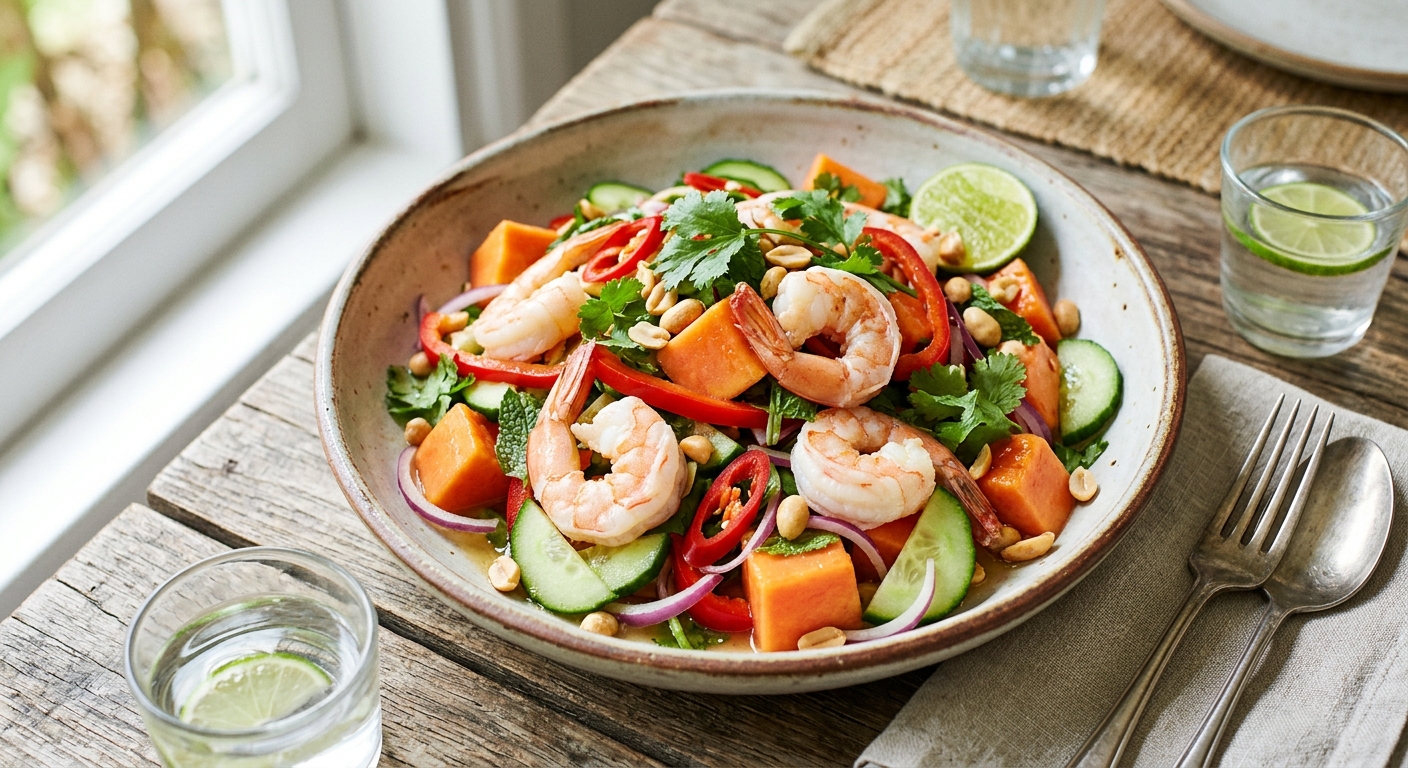
There are salads that feel virtuous, and then there are salads that feel like a vacation. This Papaya and Shrimp Salad belongs firmly in the second category. Ripe papaya brings a buttery, floral sweetness that plays beautifully against the brininess of perfectly cooked shrimp, the heat of fresh chili, and the bright acidity of freshly squeezed lime. Every bite is layered, lively, and deeply satisfying, proving once again that eating for your health does not have to mean eating food that tastes like homework.
The nutritional architecture of this dish is genuinely extraordinary. A single 350g serving of ripe papaya delivers roughly 190mg of vitamin C, well over 200% of the recommended daily intake, making it one of the most concentrated whole-food sources of the vitamin on the planet. The shrimp contribute a meaningful dose of vitamin E alongside selenium and iodine, while the avocado oil dressing adds fat-soluble carotenoid absorption and a second wave of vitamin E. Together, the salad clears 120% DV for vitamin C and 40% DV for vitamin E per portion, and those numbers are backed by USDA FoodData Central figures used to calibrate every ingredient quantity here.
Beyond vitamins C and E, this salad is a quietly impressive source of lean protein, with each serving providing around 28 grams, and it carries a low-to-medium glycemic load thanks to papaya’s relatively modest sugar content per realistic portion. The dish is also free of gluten, dairy, grains, and nuts, making it one of the most broadly inclusive recipes in the Calibrated Cuisine archive. Whether you cook the shrimp on the stovetop for a quick weeknight dinner, use a pressure cooker to build a warm poached version, or finish them under the oven broiler for caramelised edges, the dressing and papaya base remain the soul of the dish.
4
servings
Ingredients
- 600 glarge raw shrimp, peeled and deveined (tails on or off)
- 800 gripe papaya (about 1 large), peeled, seeded, and cut into 2cm cubes
- 200 gcucumber, halved lengthwise and thinly sliced
- 150 gred bell pepper, thinly sliced
- 100 gred onion, very thinly sliced
- 1 largefresh red chili, seeds removed and thinly sliced
- 30 gfresh cilantro leaves and tender stems
- 20 gfresh mint leaves, torn
- 3 tbspAvocado Oil100% Pure Avocado Oil, divided
- 3 tbspfreshly squeezed lime juice (about 2 limes)
- 1 tbspfish sauce
- 1 tspfresh ginger, finely grated
- 1 tspraw honey
- 1 clovegarlic, finely grated
- 2 tbsptoasted sesame seeds, for garnish
- —Colima Sea SaltMicroplastic Free Salt and freshly cracked black pepper to taste
- —Lime wedges, to serve
Instructions
Click on an item below to shop for the recommended items for this recipe on Amazon.
As an Amazon Associate, we earn from qualifying purchases.
- Make the dressing: whisk together 2 tablespoons of the avocado oil, the lime juice, fish sauce, grated ginger, honey, and garlic in a small bowl until emulsified. Taste and adjust seasoning. Set aside.
- Pat the shrimp completely dry with paper towels and season lightly with fine sea salt and black pepper. Dry shrimp are essential for a proper sear rather than steaming.
- Heat the remaining 1 tablespoon of avocado oil in a large, heavy skillet or cast iron pan over high heat until the oil is shimmering and just beginning to smoke. Add the shrimp in a single layer, working in two batches if necessary to avoid crowding. Sear undisturbed for 90 seconds until the undersides are pink and slightly golden. Flip each shrimp and cook for a further 60 to 90 seconds until just cooked through and opaque at the thickest part. Transfer to a plate and allow to cool for 5 minutes.
- While the shrimp rest, build the salad base in a large wide bowl: combine the papaya cubes, cucumber, red bell pepper, red onion, chili, cilantro, and mint. Toss gently with your hands to distribute evenly without breaking up the papaya.
- Pour two-thirds of the dressing over the salad base and toss carefully. Arrange the warm seared shrimp over the top. Drizzle the remaining dressing over the shrimp, scatter the toasted sesame seeds, and serve immediately with lime wedges.
- Make the poaching liquid: pour 300ml of water into the slow cooker insert and add the fish sauce, grated ginger, garlic, half the lime juice, and a pinch of sea salt. Stir briefly. Cover and heat the slow cooker on High for 20 minutes to bring the liquid to a warm temperature before adding the shrimp.
- While the poaching liquid heats, prepare the dressing: whisk together 2 tablespoons of avocado oil, the remaining lime juice, honey, and a pinch of salt in a small bowl. Set aside. Prepare and combine all salad vegetables (papaya, cucumber, red bell pepper, red onion, chili, cilantro, and mint) in a large serving bowl and refrigerate.
- Add the shrimp to the warm poaching liquid in the slow cooker insert, spreading them into as even a layer as possible. Replace the lid and cook on High for 20 to 25 minutes, checking at 20 minutes. The shrimp are done when they are fully pink, opaque throughout, and just firm to the touch. Avoid lifting the lid during the first 15 minutes to maintain temperature.
- Use a slotted spoon to transfer the cooked shrimp from the poaching liquid to a clean plate. Discard the poaching liquid or reserve it as a light aromatic broth. Drizzle the shrimp with 1 tablespoon of avocado oil and a squeeze of lime.
- Remove the salad base from the refrigerator. Pour the dressing over the vegetables and papaya and toss gently. Arrange the warm poached shrimp over the top, scatter the toasted sesame seeds, and serve immediately with extra lime wedges. The contrast of warm silky shrimp against the cool crisp papaya salad is the hallmark of this method.
- Pour 250ml of water into the inner pot of the pressure cooker or Instant Pot. Add the fish sauce, grated ginger, garlic, and a pinch of sea salt to create an aromatic steaming base. Insert the steam rack or trivet.
- Season the shrimp lightly with sea salt and pepper and arrange them in a single layer on the steam rack. If your pot is too small for a single layer, use a steamer basket and stack loosely, as the steam will circulate evenly. Lock the lid and ensure the steam release valve is set to Sealing.
- Select Manual or Pressure Cook and set to Low Pressure for 1 minute. The pot will take approximately 8 to 10 minutes to come to pressure. As soon as the cook cycle completes, immediately perform a Quick Release by carefully switching the valve to Venting. Open the lid as soon as the float pin drops.
- Remove the shrimp immediately to a plate to halt carryover cooking. They should be just pink and opaque. Rest for 3 minutes. While the shrimp rest, whisk together 2 tablespoons avocado oil, the full amount of lime juice, honey, remaining ginger, remaining garlic, and 1 tablespoon of avocado oil for the dressing in a small bowl.
- Assemble the salad in a large wide bowl: toss the papaya, cucumber, red bell pepper, red onion, chili, cilantro, and mint together with two-thirds of the dressing. Top with the pressure-cooked shrimp, drizzle over the remaining dressing, garnish with toasted sesame seeds, and serve right away with lime wedges.
- Position an oven rack 10 to 12cm from the top broiler element and preheat the broiler to its highest setting (typically 260 degrees C / 500 degrees F) for at least 5 minutes. Line a rimmed baking sheet with aluminium foil for easy cleanup.
- Make the dressing: whisk together 2 tablespoons of avocado oil, the lime juice, fish sauce, grated ginger, honey, and garlic in a small bowl. Reserve two-thirds for dressing the salad and use the remaining third as a shrimp glaze.
- Pat the shrimp completely dry with paper towels. Toss the shrimp with the reserved one-third of the dressing (the glaze portion), sea salt, and cracked black pepper in a bowl, coating evenly. Spread the shrimp in a single layer on the prepared baking sheet, ensuring they do not overlap.
- Slide the baking sheet under the broiler and cook for 2 to 3 minutes until the tops are pink, lightly golden, and beginning to char at the edges. Using tongs, flip each shrimp quickly and return to the broiler for a further 1 to 2 minutes. Watch closely as broiler intensity varies greatly between ovens. Remove as soon as the shrimp are opaque through to the centre and the edges show caramel colour. Rest on the pan for 2 minutes.
- While the shrimp rest, assemble the salad: combine the papaya, cucumber, red bell pepper, red onion, chili, cilantro, and mint in a large bowl. Pour the reserved two-thirds of the dressing over the salad and toss gently to coat. Arrange the broiled shrimp over the top, scatter the toasted sesame seeds generously, and serve immediately with lime wedges. The charred edges of the shrimp contrast beautifully with the cool, sweet papaya.
Nutrition Breakdown
Per 1 serving (makes 4)
Vitamins & Minerals
% Daily Value based on a 2,000 calorie diet (FDA reference)
🧬 Essential Amino Acids
% of recommended daily intake (RDA) per serving
🛡 Antioxidant Profile
The Nutrition Science
Vitamins C and E are the cornerstone antioxidant duo of human nutrition, and they are most powerful when consumed together, which is exactly what this salad delivers. Vitamin C (ascorbic acid) is a water-soluble electron donor that quenches reactive oxygen species directly in the cytoplasm and extracellular fluid. Critically, it also regenerates oxidised alpha-tocopherol (vitamin E) back to its active reduced form at the cell membrane interface, meaning the two vitamins effectively amplify each other’s antioxidant capacity. Research published in the American Journal of Clinical Nutrition has demonstrated that combined supplementation of C and E provides synergistic protection against lipid peroxidation that neither vitamin achieves alone at equivalent doses.
Papaya’s remarkable vitamin C concentration (approximately 62mg per 100g of ripe fruit) is tied to its high content of gulonolactone oxidase substrate, and its carotenoid profile, particularly beta-cryptoxanthin and lycopene, provides complementary fat-soluble antioxidant activity. These carotenoids are absorbed more efficiently when consumed alongside dietary fat, which is precisely why the avocado oil dressing in this recipe is nutritionally deliberate rather than merely culinary. Research shows that fat co-ingestion can increase carotenoid bioavailability by three to five times compared to fat-free preparations.
Shrimp are one of the most nutrient-dense lean protein sources available, delivering a striking concentration of selenium (around 38mcg per 100g cooked), which functions as the cofactor for glutathione peroxidase, the body’s primary endogenous antioxidant enzyme. Selenium and vitamin E work in parallel to protect cell membranes, with selenium handling enzymatic antioxidant defence and vitamin E providing direct membrane-level protection. Shrimp are also among the best dietary sources of iodine, a nutrient chronically under-consumed in populations that do not eat seafood regularly, and the 600g used across four servings in this recipe contributes meaningfully to thyroid hormone synthesis support.
Pro Tips
- Choose papaya that yields slightly to gentle thumb pressure and has at least 50% orange skin colour. Underripe papaya will be starchy and lack the floral sweetness that makes this salad work.
- To remove the bitterness that red onion can contribute to raw salads, soak the sliced onion in cold water with a small pinch of sugar for 10 minutes, then drain and pat dry before adding to the salad.
- If you want to meal-prep this salad, store the dressing, the cooked shrimp, and the salad vegetables separately in the refrigerator for up to 24 hours. Combine and toss only at serving time to prevent the papaya from releasing excess liquid and wilting the herbs.
- For maximum vitamin C retention, dress the salad immediately before eating. Ascorbic acid begins oxidising once cut papaya is exposed to air, so the lime juice in the dressing acts as both a flavour element and an antioxidant shield for the fruit.
- Toasted sesame seeds add crunch and a modest boost of vitamin E and copper. Toast them in a dry skillet over medium heat for 2 to 3 minutes, shaking constantly, until golden and fragrant. They can be toasted in advance and stored in an airtight jar for up to two weeks.
This looks absolutely delicious, and I’m really intrigued by the vitamin C and E combination for supporting collagen and reducing oxidative stress. Quick question though, are there any nightshades in the dressing or as garnish? I’m following a modified AIP protocol for my Hashimoto’s, so I need to be careful about those. Also, I’m curious about the iodine content from the shrimp, since I’m mindful of balancing that with my thyroid support, though I know shrimp is generally moderate. Would love to know if this could work with a different oil if someone needed to avoid the avocado oil for any reason!
Oh Anna, what a thoughtful question! I’m adding this to my class menu next week and I love how you’re thinking about nutrient synergies, that’s exactly the kind of intentional eating I try to teach. Before I make it for the group, I’m curious too, so I’ll be checking the full dressing ingredients when they post them, but I’d guess the lime-ginger base should be AIP friendly if there’s no pepper or tomato involved. The papaya enzymes paired with those fat-soluble vitamins is such a smart combination for absorption, reminds me how my old creamy fruit salads never gave you nearly this much nutritional bang for the effort!
Oh wow, this is SO my kind of recipe – I’ve been tracking how papaya’s natural enzymes affect my IBS for about two years now and the results are consistently positive for my digestion! The combination of vitamin C from the papaya with those fat-soluble E vitamins is genius for absorption / I actually noticed a significant drop in my inflammation markers when I started pairing vitamin C sources with healthy fats instead of eating them separately. Sue, I’m really curious about how this works in your class setting – do your students notice differences in how they feel after eating nutrient-dense meals like this? Anna, definitely ask about the full ingredient list because ginger can be tricky for some people with modified AIP