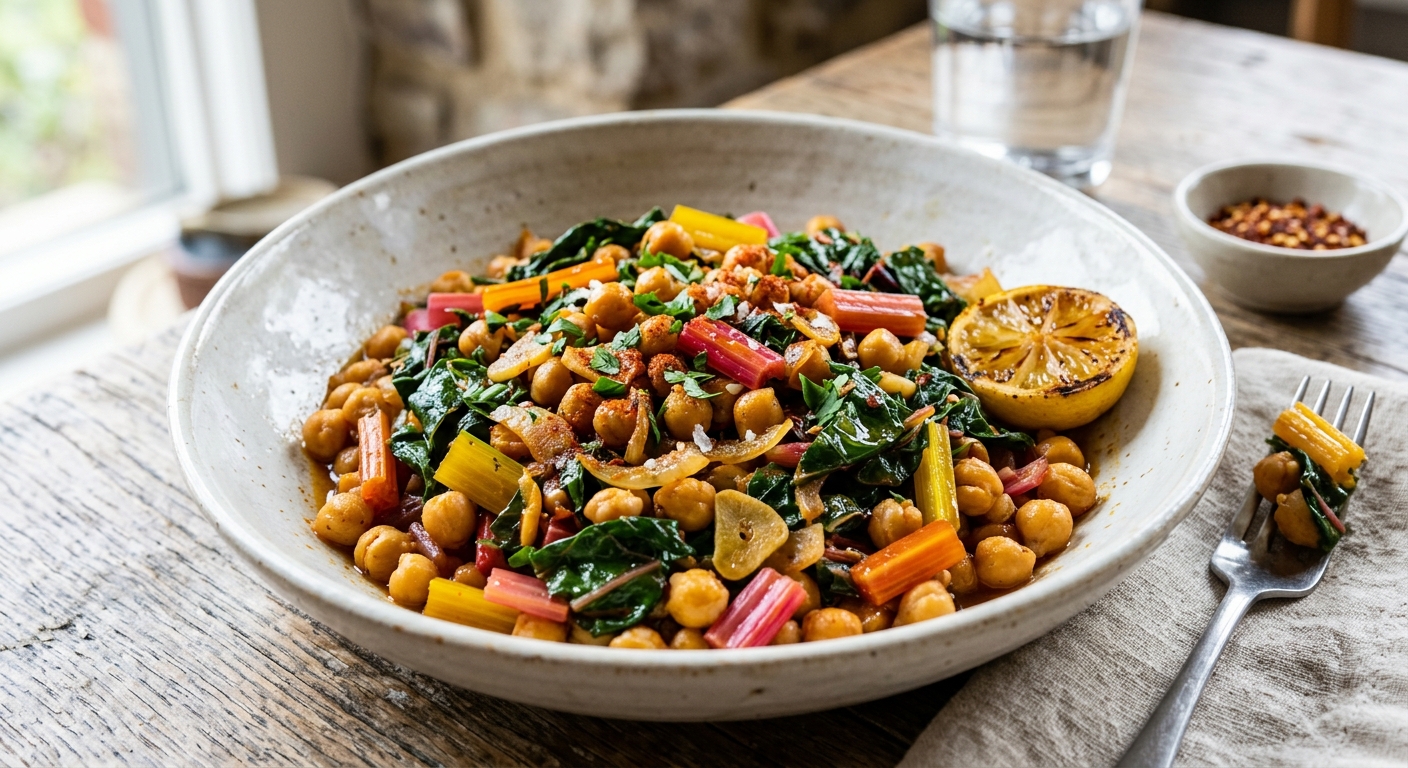
Rainbow chard is one of the most underutilized vegetables in the modern kitchen, and that is a genuine nutritional tragedy. A single 100g serving of cooked chard delivers staggering amounts of vitamins K, A, and C, along with meaningful doses of magnesium, potassium, and iron. Paired with chickpeas, which contribute plant-based protein, folate, and slow-digesting complex carbohydrates, this saute becomes what nutritional scientists call a nutrient-dense meal: high in micronutrients relative to its calorie load. The rainbow varieties, with their crimson, golden, and white stalks, are not merely decorative. Each pigment represents a distinct class of phytonutrients, from betalains in the red stems to carotenoids in the leaves, all working synergistically to protect cells from oxidative stress.
The chickpeas here are not an afterthought. Beyond their impressive fiber and protein profile, they provide the dish with body and a satisfying, creamy texture that balances the slight bitterness of the chard. A hit of smoked paprika and cumin bridges the earthy legume with the mineral-forward greens, while a finish of fresh lemon juice does double duty: it brightens the flavors and, critically, the vitamin C in the lemon amplifies iron absorption from both the chard and the chickpeas by converting non-heme iron into its more bioavailable ferrous form. This is nutritional synergy you can taste.
Whether you are building a nutrient-dense weeknight dinner in under 30 minutes on the stovetop, or setting a deeply flavored braise in your slow cooker before you leave for work, this recipe adapts to your schedule without compromising its nutritional integrity. Each cooking method is calibrated to preserve the dish’s key micronutrients as effectively as possible, with specific technique notes where heat and time affect vitamin retention.
4
servings
Ingredients
- 600 grainbow chard, stems and leaves separated, both roughly chopped
- 480 gcooked chickpeas (two 400g cans, drained and rinsed, or 480g home-cooked)
- 3 tbspextra-virgin olive oil
- 1 largeyellow onion, finely diced
- 6 clovesgarlic, thinly sliced
- 1 tspsmoked paprika
- 1 tspground cumin
- 0.5 tspcrushed red pepper flakes
- 400 gcanned crushed tomatoes
- 120 mllow-sodium vegetable broth
- 2 tbspfresh lemon juice (about 1 large lemon)
- 1 tsplemon zest
- 15 gfresh flat-leaf parsley, roughly chopped
- —Colima Sea SaltMicroplastic Free Salt and freshly cracked black pepper to taste
Instructions
Click on an item below to shop for the recommended items for this recipe on Amazon.
As an Amazon Associate, we earn from qualifying purchases.
- Heat a large, wide skillet or saute pan (at least 30cm) over medium-high heat. Add the olive oil and let it shimmer for about 30 seconds. Add the diced onion and the chopped chard stems, which take longer to soften than the leaves. Season with a pinch of salt and cook, stirring occasionally, for 6 to 8 minutes until the onion is translucent and the chard stems have softened and taken on a little color at the edges.
- Push the onion and stems to the edges of the pan and add the sliced garlic to the center. Cook for 60 to 90 seconds, stirring constantly, until fragrant and just beginning to turn golden. Do not let the garlic brown fully at this stage. Add the smoked paprika, cumin, and red pepper flakes directly onto the garlic and stir everything together for 30 seconds to bloom the spices in the residual oil.
- Pour in the crushed tomatoes and vegetable broth. Stir to combine, scraping up any browned bits from the bottom of the pan. Bring to a vigorous simmer and cook for 3 to 4 minutes, allowing the sauce to reduce slightly and deepen in flavor.
- Add the drained chickpeas to the pan and stir to coat them in the tomato mixture. Cook for 3 minutes, stirring occasionally, so the chickpeas absorb flavor and heat through completely.
- Add the chard leaves in large handfuls, folding them into the sauce as each batch wilts down. This will take 2 to 3 additions over about 4 minutes. Once all the chard is incorporated and wilted but still vibrantly green (not gray or dull), remove the pan from the heat immediately.
- Stir in the lemon juice and lemon zest. Taste and adjust seasoning with salt and black pepper. Scatter the chopped parsley over the top and serve immediately from the pan for the best texture and maximum vitamin retention.
- No pre-saute is needed, but for a noticeably richer flavor, briefly microwave the diced onion and chard stems with one tablespoon of olive oil in a microwave-safe bowl on high for 3 minutes, stirring once halfway through. This step is optional but recommended. It softens the raw edge of the onion and reduces any sulfurous bitterness in the slow cooker environment.
- Add the onion and chard stems (microwaved or raw), sliced garlic, smoked paprika, cumin, red pepper flakes, crushed tomatoes, vegetable broth, and the remaining two tablespoons of olive oil directly into the slow cooker insert. Stir to combine everything evenly, then nestle the drained chickpeas into the mixture. Do not add the chard leaves yet as they will turn gray and mushy over a long cook.
- Place the lid on the slow cooker and cook on Low for 4 hours and 30 minutes. The chickpeas will absorb the spiced tomato broth and the chard stems will become completely tender and meld into the sauce. Avoid lifting the lid during cooking as each peek adds approximately 15 to 20 minutes to the effective cook time.
- At the 4 hours 30 minutes mark, open the lid and add the chard leaves. Stir them down into the hot liquid, replace the lid, and cook on Low for a final 25 to 30 minutes. The residual heat and steam will wilt the leaves without overcooking them. They should be tender but still hold a deep, olive-green color.
- Turn off the slow cooker and stir in the lemon juice, lemon zest, and chopped parsley. Taste carefully for seasoning, as slow-cooked dishes often need a generous pinch of salt and extra black pepper at the end to revive the flavors. Serve directly from the insert.
- Select the Saute function on your Instant Pot or electric pressure cooker and set it to Medium (or Normal). Add the olive oil and heat for 1 minute. Add the diced onion and chopped chard stems and cook, stirring frequently, for 4 to 5 minutes until the onion softens and becomes translucent. Add the sliced garlic, smoked paprika, cumin, and red pepper flakes and stir for 60 seconds until fragrant.
- Pour in the crushed tomatoes and vegetable broth and stir, scraping any bits off the bottom of the insert to prevent a burn notice. Add the drained chickpeas and stir to combine. Do NOT add the chard leaves at this stage because they will turn unpleasantly mushy under pressure. Press Cancel to turn off the Saute function.
- Secure the lid and set the pressure valve to Sealing. Select Manual or Pressure Cook on High Pressure for 8 minutes. The pot will take approximately 8 to 10 minutes to come up to full pressure before the timer begins.
- Once the 8-minute cook time completes, perform a Quick Release by carefully switching the valve to Venting. Stand clear of the steam. Once all pressure has released and the float valve has dropped, open the lid safely.
- The chickpea and tomato mixture will be thick and deeply flavored. Select Saute (Low) and add the chard leaves in batches, pressing them down into the hot mixture with a wooden spoon. Cook for 2 to 3 minutes, stirring, until the leaves are just wilted and bright. Press Cancel immediately once the leaves are done to avoid overcooking.
- Stir in the lemon juice, lemon zest, and chopped parsley. Taste and adjust seasoning. Serve promptly for the best texture.
- Preheat your oven to 190 degrees C (375 degrees F) with the rack in the center position. Place a Dutch oven or large oven-safe skillet over medium-high heat on the stovetop. Add the olive oil and heat until shimmering. Add the diced onion and chopped chard stems with a pinch of salt and cook for 5 to 6 minutes, stirring occasionally, until softened and lightly golden at the edges.
- Add the sliced garlic, smoked paprika, cumin, and red pepper flakes. Stir constantly for 60 seconds to bloom the spices in the oil. Pour in the crushed tomatoes and vegetable broth, scraping the bottom of the pot clean. Bring to a simmer, then add the chickpeas and stir to combine. Remove from the stovetop heat.
- Tuck the chard leaves into the chickpea mixture, pressing them down into the liquid so they are mostly submerged. They will look voluminous but will settle as they cook. Do not cover the Dutch oven with a lid. The open braising environment allows moisture to evaporate from the top, concentrating the sauce and allowing the exposed chickpeas to lightly caramelize.
- Transfer the uncovered Dutch oven to the preheated oven. Braise for 35 to 40 minutes, until the chard leaves are fully tender, the sauce has thickened and reduced, and the top layer of chickpeas has taken on a slightly roasted, golden appearance. Check at the 25-minute mark. If the sauce looks dry, add a splash of broth or water.
- Remove from the oven. The residual heat of the Dutch oven will continue cooking the dish for a minute or two, so do not wait for the greens to look overdone in the oven. Stir in the lemon juice, lemon zest, and parsley. Season generously with salt and black pepper and serve directly from the pot.
Nutrition Breakdown
Per 1 serving (makes 4)
Vitamins & Minerals
% Daily Value based on a 2,000 calorie diet (FDA reference)
🧬 Essential Amino Acids
% of recommended daily intake (RDA) per serving
🛡 Antioxidant Profile
The Nutrition Science
The extraordinary vitamin K content of this dish (over 550% DV per serving) deserves careful context. Vitamin K1 (phylloquinone), found abundantly in dark leafy greens like chard, plays an irreplaceable role in the gamma-carboxylation of coagulation proteins and, critically, in activating osteocalcin, the protein responsible for binding calcium into bone matrix. Research published in the American Journal of Clinical Nutrition consistently associates higher dietary vitamin K1 intake with greater bone mineral density and reduced hip fracture risk. For individuals on anticoagulant medications such as warfarin, however, maintaining a consistent (not necessarily low) daily vitamin K intake is important to avoid fluctuating drug efficacy. Consult your physician before making dramatic changes to your leafy green consumption if you are on such medications.
The carotenoid content of this dish is nutritionally significant beyond its headline vitamin A contribution. Beta-carotene and other carotenoids in chard are fat-soluble, meaning their absorption is dramatically enhanced by dietary fat. The three tablespoons of extra-virgin olive oil in this recipe are not merely a cooking medium; they serve as a precision delivery vehicle for these fat-soluble micronutrients. A landmark study from the Journal of Nutrition demonstrated that adding fat to a carotenoid-rich vegetable meal increased beta-carotene absorption by up to 15-fold compared to a fat-free preparation. This is a concrete example of why low-fat cooking techniques can paradoxically reduce the nutritional value of vegetable-heavy meals.
Chickpeas bring a nutritional dimension that chard alone cannot provide: resistant starch and soluble fiber, specifically galacto-oligosaccharides, that act as prebiotic substrates for beneficial gut bacteria including Bifidobacterium and Lactobacillus species. When these bacteria ferment resistant starch in the colon, they produce short-chain fatty acids (SCFAs), primarily butyrate, acetate, and propionate. Butyrate is the primary energy source for colonocytes and has well-documented anti-inflammatory effects on the gut epithelium. The combination of chard’s magnesium (a cofactor in over 300 enzymatic reactions) and chickpeas’ prebiotic fiber creates a dish that supports both systemic metabolic function and local gastrointestinal health simultaneously.
Pro Tips
- Do not discard the colorful chard stems. They contain a different but equally valuable set of nutrients compared to the leaves, including betalains and additional potassium. Chopping them finely and adding them early (as this recipe instructs) ensures they cook through completely without becoming stringy.
- For maximum iron absorption, serve this dish with the lemon juice stirred in at the very end rather than during cooking. Heat degrades vitamin C rapidly, so adding acid off the heat preserves more of the ascorbic acid that is needed to convert ferric iron (Fe3+) to the absorbable ferrous form (Fe2+).
- If using dried chickpeas instead of canned, soak 240g dried chickpeas overnight in cold water, then cook in fresh water until just tender before using. This reduces the sodium content by approximately 40% compared to canned and allows you to control the texture. Slightly undercooked dried chickpeas (still with a touch of firmness) hold their shape better in sauteed and braised applications.
this is exactly the kind of nutrient density i look for in my recovery meals, especially after long runs when inflammation is a real concern! the vitamin k in chard is huge for bone health which matters so much for us endurance athletes doing repetitive impact work, and those chickpeas give you the plant protein without sitting heavy in your stomach. would love to know if youve tested this as a post-run meal or if it works better as a training day lunch, cause the spice combo sounds like it could have some nice anti-inflammatory properties too.
This sounds amazing, but I have to ask before I dive in: are there any nightshades in the spice blend, and do you know the iodine content of the chard? Since my Hashimoto’s, I’ve found that both can be tricky for me, though I know everyone’s tolerance is different. Also, would this work with an AIP adaptation (maybe swapping the chickpeas for another legume or protein source)? I’m always excited to find dishes this nutrient-dense that could potentially fit my protocol.
oh love the vitamin c combo here because that chard c plus the chickpeas means your body will actually absorb that iron way better than if you ate them separately, and thats huge for those of us managing anemia! my ferritin has been so much more stable since i started pairing iron rich plant foods with vitamin c sources in the same meal. did you include any lemon or citrus in the final seasoning? that would be the cherry on top for absorption.