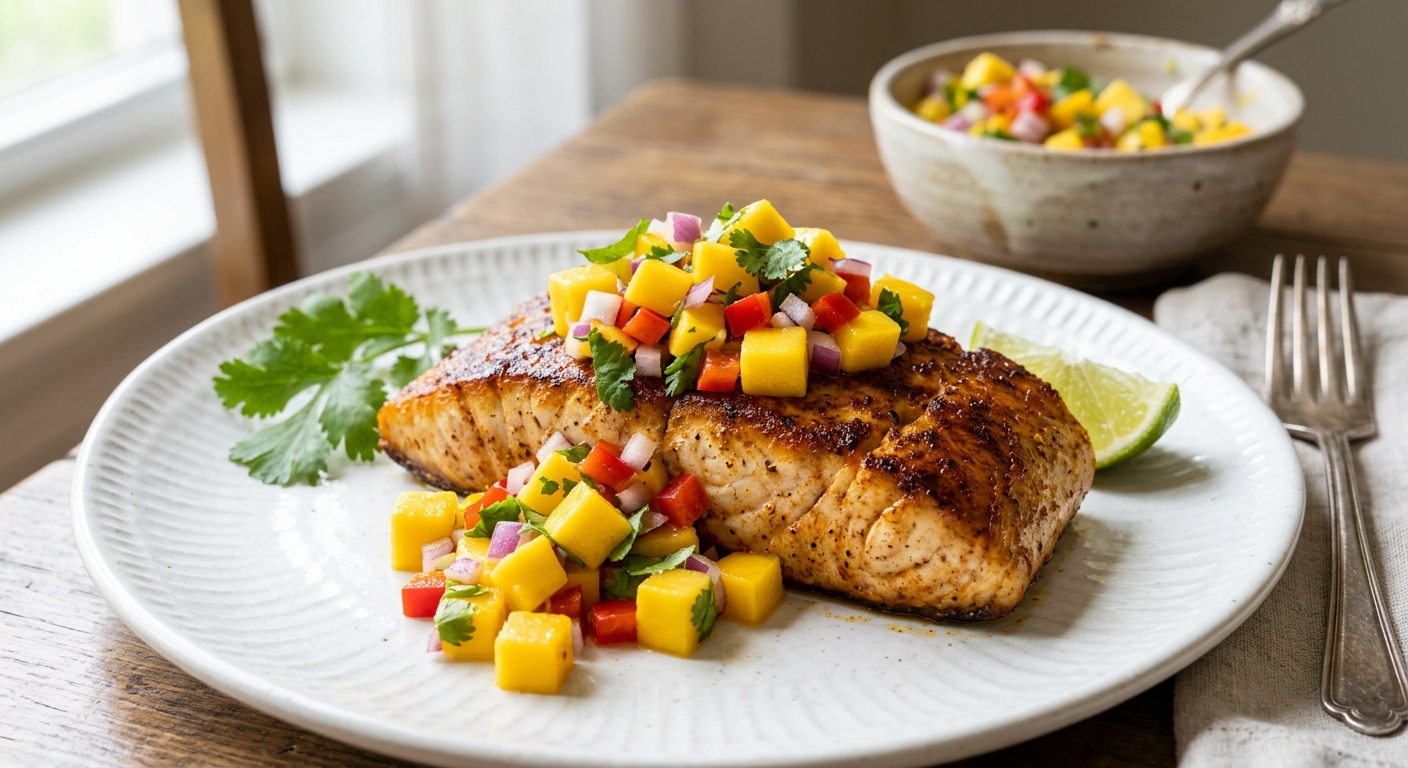
Mahi-mahi, also known as dolphinfish, is one of the ocean’s most nutritionally generous proteins. With roughly 30 grams of complete protein per 170-gram fillet and less than 2 grams of saturated fat, it occupies a rare sweet spot: rich enough in flavour to hold up to bold accompaniments, yet lean enough to keep total calories well within a balanced daily budget. Its firm, meaty texture means it performs beautifully across multiple cooking methods, from a hard sear in a cast-iron skillet to a gentle oven roast, without ever turning rubbery or dry when handled with care.
The mango salsa is far more than a garnish. A single ripe mango contributes roughly 60 mg of vitamin C per 100 grams, and when combined with fresh lime juice and red bell pepper, the salsa alone can push a single serving past the 90 mg RDA threshold for vitamin C. Vitamin C is not simply an immune nutrient. It is the essential co-factor for collagen synthesis, a potent enhancer of non-haem iron absorption, and a water-soluble antioxidant that operates directly in plasma and cytosol to neutralise reactive oxygen species before they can damage cell membranes. Pairing it with the iron naturally present in mahi-mahi is a textbook example of food synergy working in your favour.
At Calibrated Cuisine, every component of this dish was selected for both culinary and biochemical purpose. The red onion in the salsa adds quercetin and prebiotic fructooligosaccharides. The cilantro contributes measurable lutein and zeaxanthin. The jalapeño brings capsaicin, which research associates with improved lipid metabolism. And the extra-virgin olive oil used for searing provides oleocanthal, a phenolic compound with COX-inhibitory properties comparable to a low dose of ibuprofen. This is a plate that does serious nutritional work while tasting like a vacation.
4
servings
Ingredients
- 680 gmahi-mahi fillets, skin removed, cut into 4 equal portions (about 170g each)
- 2 tbspextra-virgin olive oil
- 1 tspsmoked paprika
- 1 tspground cumin
- 0.5 tspgarlic powder
- 0.5 tsponion powder
- 0.25 tspcayenne pepper
- 2 largeripe mangoes (approx. 600g total), peeled and diced into 1cm cubes
- 1 mediumred bell pepper (approx. 150g), finely diced
- 0.5 mediumred onion (approx. 80g), finely diced
- 1 mediumjalapeño, seeds removed for medium heat, finely minced
- 30 gfresh cilantro leaves, roughly chopped
- 3 tbspfresh lime juice (from approx. 2 limes)
- 1 tsplime zest
- 1 tbsphoney
- 1 clovegarlic, finely minced
- —Colima Sea SaltMicroplastic Free Salt and freshly cracked black pepper to taste
Instructions
Click on an item below to shop for the recommended items for this recipe on Amazon.
As an Amazon Associate, we earn from qualifying purchases.
- Make the mango salsa first so the flavours have time to marry. Combine the diced mango, red bell pepper, red onion, jalapeño, cilantro, lime juice, lime zest, honey, and minced garlic in a medium bowl. Season with a pinch of fine sea salt, stir well to combine, then cover and refrigerate while you prepare the fish. The salsa can rest up to 2 hours ahead.
- In a small bowl, mix together the smoked paprika, cumin, garlic powder, onion powder, and cayenne. Pat the mahi-mahi fillets completely dry with paper towels on both sides. Moisture on the surface is the enemy of a good sear. Brush each fillet lightly with 1 tablespoon of the olive oil, then press the spice blend evenly onto both sides of each fillet. Season generously with sea salt and black pepper.
- Heat a 12-inch cast-iron or heavy stainless steel skillet over medium-high heat for 2 full minutes until the pan is thoroughly hot. Add the remaining tablespoon of olive oil and swirl to coat. The oil should shimmer immediately. Carefully lay the fillets into the pan, presentation-side down, and do not move them. Cook undisturbed for 4 to 5 minutes. A properly seared mahi-mahi will release cleanly from the pan when it is ready; if it sticks, it needs another 30 to 60 seconds.
- Using a thin fish spatula, flip each fillet in one confident motion. Reduce the heat to medium and cook a further 3 to 4 minutes, depending on fillet thickness. The fish is done when it registers 63 degrees C (145 degrees F) on an instant-read thermometer, or when it flakes easily at the thickest point with light pressure from a fork and the flesh has turned opaque throughout.
- Transfer the fillets to warmed serving plates and rest for 2 minutes. Remove the mango salsa from the refrigerator, give it one final stir, and taste for seasoning. Spoon generously over each fillet and serve immediately, with lime wedges on the side.
- Prepare the mango salsa ahead of time. Combine the diced mango, red bell pepper, red onion, jalapeño, cilantro, lime juice, lime zest, honey, and minced garlic in a bowl. Season with a pinch of salt, stir, cover, and refrigerate for at least 30 minutes. Cold salsa on warm fish is the ideal temperature contrast for this method.
- Mix the smoked paprika, cumin, garlic powder, onion powder, and cayenne together in a small bowl. Pat the mahi-mahi fillets completely dry with paper towels. Rub the spice mixture evenly over both sides of each fillet and season with sea salt and black pepper. Drizzle the fillets with the full 2 tablespoons of olive oil, turning to coat.
- Lightly grease the insert of a 5- to 6-quart slow cooker with a small amount of olive oil or cooking spray. Arrange the seasoned fillets in a single layer in the insert. If needed, slightly overlap the thin ends of fillets, but keep the thicker portions flat. Pour 3 tablespoons of water or low-sodium fish stock around the base of the fillets, not over them. This creates a gentle steaming environment that keeps the fish moist.
- Place the lid on the slow cooker and cook on Low for 1.5 to 2 hours. Begin checking at the 90-minute mark. The fish is done when it is opaque throughout and flakes cleanly when pressed with a fork at the thickest part. It should read 63 degrees C (145 degrees F) on an instant-read thermometer. Mahi-mahi fillets thinner than 2.5 cm will be ready closer to 90 minutes.
- Using a wide spatula, carefully transfer the fillets from the slow cooker to serving plates. The fish will be very tender at this stage, so move it gently. Discard any liquid remaining in the insert. Remove the mango salsa from the refrigerator, taste for seasoning, and spoon generously over each fillet. Finish with a squeeze of fresh lime juice and serve immediately.
- Prepare the mango salsa completely before cooking the fish. Combine mango, red bell pepper, red onion, jalapeño, cilantro, lime juice, lime zest, honey, and minced garlic. Season with salt, stir, cover, and set aside at room temperature for up to 30 minutes, or refrigerate if working further ahead.
- Combine the smoked paprika, cumin, garlic powder, onion powder, and cayenne. Pat the mahi-mahi fillets dry with paper towels and season generously on both sides with the spice blend, sea salt, and black pepper. Drizzle with the olive oil and rub to coat evenly.
- Pour 240 ml (1 cup) of water into the inner pot of a 6-quart pressure cooker or Instant Pot. Insert the trivet or a steamer basket. Place the seasoned fillets on the trivet in a single layer, or slightly overlapped at the thin ends if necessary to fit. The fillets must be elevated above the water, not submerged, to steam rather than poach.
- Secure the lid and set the pressure valve to Sealing. Select Manual or Pressure Cook on High Pressure and set the timer for 3 minutes. The pot will take approximately 5 to 7 minutes to come to pressure before the cook time begins.
- When the 3-minute cook cycle ends, allow a natural pressure release for exactly 2 minutes, then carefully switch the valve to Venting to release any remaining steam. Open the lid away from you. Using a wide spatula, gently transfer the fillets to serving plates. Spoon the mango salsa over each portion and serve immediately, with lime wedges.
- Position an oven rack in the upper-middle position and preheat the oven to 220 degrees C (425 degrees F). Line a rimmed baking sheet with aluminium foil and set a wire rack on top. Lightly spray the rack with cooking spray or brush with a small amount of olive oil to prevent sticking.
- Prepare the mango salsa while the oven preheats. Combine mango, red bell pepper, red onion, jalapeño, cilantro, lime juice, lime zest, honey, and minced garlic in a bowl. Season with salt and stir to combine. Cover and refrigerate until the fish is ready.
- Combine the smoked paprika, cumin, garlic powder, onion powder, and cayenne in a small bowl. Pat the mahi-mahi fillets completely dry with paper towels. Brush all sides of each fillet with the 2 tablespoons of olive oil, then press the spice mixture firmly onto the top and sides of each fillet. Season well with sea salt and black pepper. Arrange the fillets on the prepared wire rack with at least 2 cm of space between them.
- Transfer the baking sheet to the preheated oven and roast for 12 to 15 minutes, depending on fillet thickness, without flipping. A 2.5 cm thick fillet will take approximately 12 minutes; thicker portions up to 4 cm may need the full 15 minutes. The fish is done when the exterior is lightly golden, the flesh is opaque throughout, and an instant-read thermometer inserted at the thickest point reads 63 degrees C (145 degrees F).
- Remove the baking sheet from the oven and rest the fillets on the rack for 2 minutes. Transfer to serving plates using a wide spatula. Remove the salsa from the refrigerator, taste and adjust seasoning with a final pinch of salt if needed, and spoon generously over each fillet. Serve immediately with lime wedges and extra cilantro if desired.
Nutrition Breakdown
Per 1 serving (makes 4)
Vitamins & Minerals
% Daily Value based on a 2,000 calorie diet (FDA reference)
🧬 Essential Amino Acids
% of recommended daily intake (RDA) per serving
🛡 Antioxidant Profile
The Nutrition Science
Mahi-mahi is classified as a low-fat, high-protein white fish, but that classification understates its micronutrient density. A single 170-gram fillet provides over 100% of the RDA for vitamin B12, which is required for myelin sheath synthesis, DNA replication in rapidly dividing cells, and the methylation of homocysteine to methionine. Elevated plasma homocysteine is an independent cardiovascular risk factor, and adequate B12 intake, alongside B6 and folate, is one of the most well-supported dietary strategies for keeping it in a healthy range. Mahi-mahi is also an outstanding source of selenium, a trace mineral that is the essential cofactor for glutathione peroxidase, the body’s frontline enzymatic defence against lipid peroxidation.
The vitamin C in the mango salsa operates on multiple levels beyond its antioxidant role. At the gut level, ascorbic acid reduces ferric iron (Fe3+) to the more bioavailable ferrous form (Fe2+), meaningfully improving absorption of the non-haem iron present in the fish. At the cellular level, vitamin C is required for the hydroxylation of proline and lysine residues during collagen triple-helix formation. Without adequate vitamin C, newly synthesised collagen cannot cross-link properly, which impairs wound healing, vascular integrity, and connective tissue resilience. The 95 mg delivered by this dish exceeds the RDA and approaches the level associated with optimal plasma saturation in most adults.
The fat profile of this dish deserves attention. The monounsaturated oleic acid from extra-virgin olive oil accounts for the majority of total fat, a lipid class consistently associated with improved LDL particle size distribution and reduced cardiovascular risk in large cohort studies including PREDIMED. The small amount of omega-3 fatty acids naturally present in mahi-mahi, though lower than in fatty fish like salmon, still contributes to the EPA and DHA pool. Critically, the absence of trans fats and the very low saturated fat content means this dish imposes essentially no atherogenic lipid burden while delivering a 34-gram complete protein payload with all nine essential amino acids above RDA thresholds per serving.
Pro Tips
- For the crispest sear on the stovetop and oven methods, dry-brine the mahi-mahi fillets by salting them lightly on both sides and leaving them uncovered on a rack in the refrigerator for 30 minutes before cooking. This draws surface moisture out and back in, seasoning the flesh more deeply and producing a dramatically better crust.
- Choose mangoes that yield slightly to gentle pressure and have a sweet, floral aroma at the stem end. Ataulfo (Champagne) mangoes produce a silkier, less fibrous salsa than Tommy Atkins varieties, and their higher sugar concentration intensifies the contrast with the savoury spiced fish.
- The spice rub can be doubled and stored in an airtight jar for up to 3 months. It works equally well on chicken thighs, shrimp, and firm tofu, making it a versatile pantry staple for quickly calibrated weeknight meals.
omg yes to the mango vitamin c pairing! i’ve been reading so much about how vitamin c actually enhances nutrient absorption and that whole methylation thing carla mentioned is wild. one thing id love to experiment with is adding some fermented hot sauce or a quick pickled red onion situation to this because the probiotics + the fresh fish + all those micronutrients together would be such a gut-friendly power combo, and honestly fermented condiments take literally five minutes to throw together. anyone else think about the microbiome angle when building meals like this?
okay so mahi-mahi is legit one of my favorite post-WOD proteins because its so lean and digests clean, plus that B12 is clutch for recovery and methylation. the vitamin C with the mango is genius too since it helps with collagen synthesis and reduces that inflammation spike after heavy lifting. if youre looking to dial in the recovery window, pairing this with some carbs (the mango does some of that work) and maybe a bit of fat would be the move. are you serving it with anything else or is this the main event?
This looks delicious, though I’m curious about the B12 source here since mahi-mahi is the only animal product I’m seeing! Is there something in the salsa or preparation I’m missing, or are you counting a fortified ingredient? I work with a lot of clients who ask about getting B12 from seafood, and while fish does contain it, the amounts can vary quite a bit depending on the species and sourcing. That said, the vitamin C from the mango with the lean protein is such a smart pairing for iron and nutrient absorption, so even my vegetarian clients could adapt this beautifully with a hearty white bean or tofu sub!