
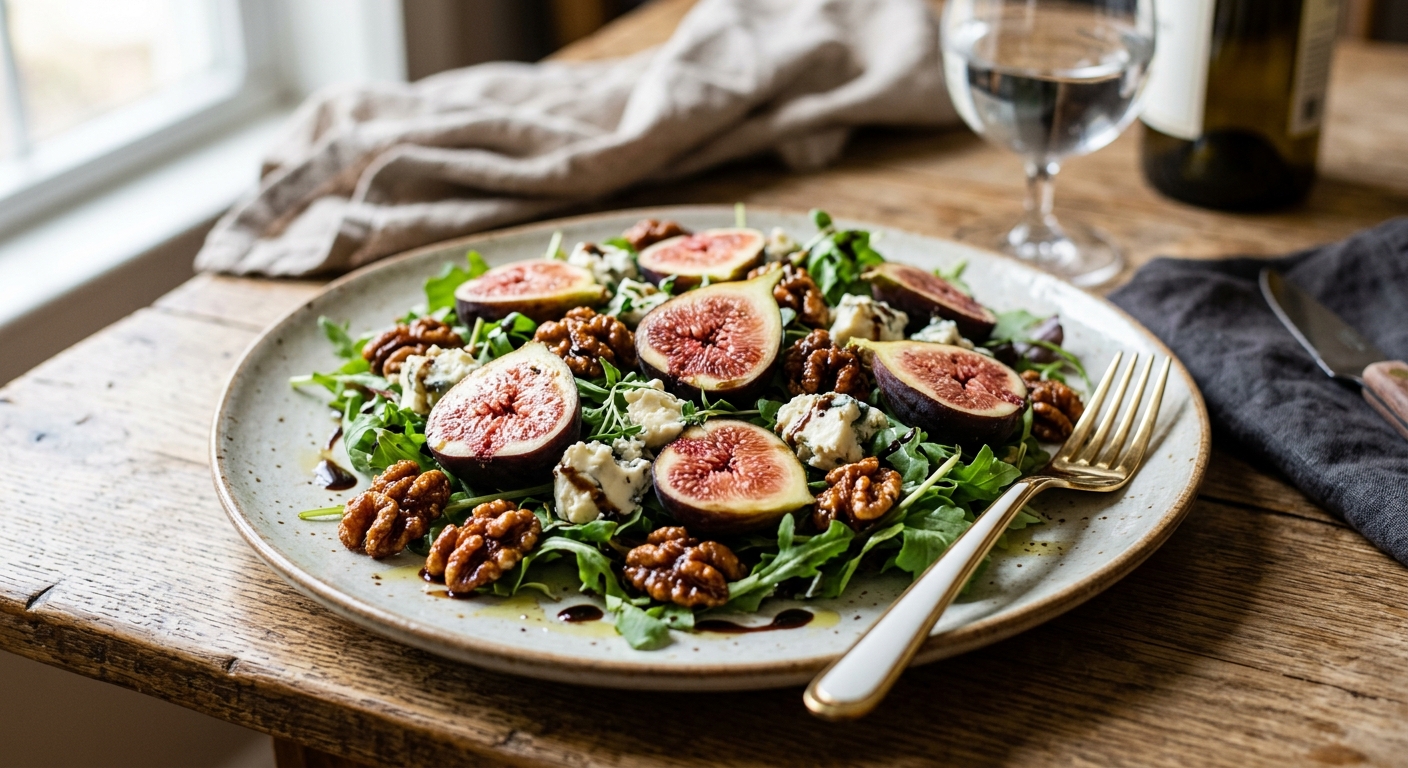
Some salads are merely side dishes. This one is a nutritional statement. The Fig and Gorgonzola Salad with Candied Walnuts was engineered from the ground up to deliver maximum anti-inflammatory benefit without sacrificing a single note of culinary pleasure. Fresh figs bring a honeyed, jammy sweetness alongside one of the most diverse polyphenol profiles of any fruit, while Gorgonzola contributes conjugated linoleic acid, calcium, and a bold umami depth that anchors the entire composition.
The candied walnuts are far more than a textural flourish. Walnuts are the only nut with a significant source of plant-based omega-3 alpha-linolenic acid (ALA), and their ellagitannins are converted by gut bacteria into urolithins, compounds with potent anti-inflammatory and even cellular-protective properties. Candying them in coconut sugar rather than refined white sugar keeps the glycemic impact measured while adding a caramel complexity that pairs beautifully with the sharp cheese and sweet fruit.
The warm honey-balsamic reduction that serves as the dressing is the dish’s secret weapon. Gently heating aged balsamic concentrates its acetic acid content, which research associates with improved insulin sensitivity, while raw honey contributes methylglyoxal and flavonoids that support the body’s antioxidant enzyme systems. Together, every component of this salad has been chosen with both a chef’s palate and a scientist’s precision.
4
servings
Ingredients
- 8 wholefresh black mission figs, halved lengthwise
- 120 gGorgonzola dolce, crumbled
- 100 graw walnut halves
- 3 tbspcoconut sugar
- 1 tbspunsalted butter
- 80 mlaged balsamic vinegar
- 2 tbspraw honey
- 3 tbspextra-virgin olive oil
- 1 tspfresh thyme leaves
- 100 gbaby arugula, washed and dried
- 60 gradicchio, thinly sliced
- 30 gshaved Parmigiano-Reggiano
- 1 tspDijon mustard
- 1 smallshallot, very finely minced
- —Colima Sea SaltMicroplastic Free Salt and freshly cracked black pepper to taste
- —Colima Sea SaltMicroplastic Free Salt (such as Maldon) for finishing
Instructions
Click on an item below to shop for the recommended items for this recipe on Amazon.
As an Amazon Associate, we earn from qualifying purchases.
- Line a small baking sheet or large plate with parchment paper and set it near the stove. In a small, heavy skillet over medium heat, melt the butter until it begins to foam. Add the walnut halves and toast, stirring constantly, for 2 minutes until they smell fragrant and begin to darken slightly.
- Sprinkle the coconut sugar evenly over the walnuts and reduce heat to medium-low. Stir continuously with a silicone spatula for 3 to 4 minutes until the sugar fully melts, caramelises to a deep amber, and coats every walnut. Watch carefully as coconut sugar can scorch quickly. Immediately tip the candied walnuts onto the prepared parchment in a single layer, sprinkle with a pinch of flaky salt, and leave undisturbed to cool and harden for at least 10 minutes.
- Wipe the skillet clean with a paper towel. Add the balsamic vinegar, honey, and thyme leaves to the skillet over medium heat. Bring to a gentle simmer, stirring to combine, then reduce heat to low and cook uncovered for 6 to 8 minutes, stirring occasionally, until the mixture reduces by about half and coats the back of a spoon. Remove from heat and whisk in 1 tablespoon of the olive oil. Season with a pinch of black pepper. The reduction will thicken further as it cools.
- While the reduction cools slightly, make the base vinaigrette. In a small bowl or jar, combine the minced shallot, Dijon mustard, remaining 2 tablespoons of olive oil, a small pinch of fine sea salt, and a few grinds of black pepper. Whisk or shake vigorously until emulsified and creamy.
- In a large salad bowl, gently toss the arugula and radicchio with the shallot vinaigrette, using your hands or tongs to ensure every leaf is lightly coated. Divide the dressed greens among four plates. Arrange 4 fig halves on each plate, cut side up. Scatter the crumbled Gorgonzola and shaved Parmigiano evenly over the figs. Break the candied walnuts into clusters and distribute them over each salad. Finally, drizzle the warm balsamic reduction over everything in a thin, artful stream and serve immediately.
- Place 4 of the fig halves (cut side down) and all of the balsamic vinegar, honey, thyme leaves, and 2 tablespoons of water into a small slow cooker (1.5 to 2 quart size) or use a bowl insert. Stir gently to combine. Cover and cook on Low for 2 hours, until the figs have completely broken down and the liquid has reduced to a glossy, syrupy compote. Do not cook on High as the sugars can scorch against the ceramic walls.
- After 1.5 hours of slow cooker time, prepare the candied walnuts on the stovetop. Melt the butter in a small heavy skillet over medium heat. Add the walnuts and toast for 2 minutes, stirring constantly. Add the coconut sugar and stir continuously over medium-low heat for 3 to 4 minutes until fully caramelised. Spread immediately on parchment, sprinkle with flaky salt, and allow to cool completely.
- Once the slow cooker compote is ready, use the back of a spoon to press and stir it into a smooth, pourable sauce. Whisk in 1 tablespoon of the olive oil directly into the slow cooker insert, and season with black pepper. The compote should be thick enough to mound slightly on a spoon. If it is too thick, stir in a teaspoon of warm water.
- Prepare the vinaigrette by whisking together the minced shallot, Dijon mustard, remaining 2 tablespoons of olive oil, fine sea salt, and black pepper in a small bowl until fully emulsified.
- Toss the arugula and radicchio with the shallot vinaigrette until lightly coated. Divide among four plates. Arrange the remaining 4 fresh fig halves (cut side up) on each plate alongside the dressed greens, so diners experience both the fresh fruit and the slow-cooked compote. Spoon the warm fig-balsamic compote generously over the figs and greens. Top with crumbled Gorgonzola, shaved Parmigiano, and clusters of candied walnuts. Finish with flaky sea salt and cracked black pepper.
- Add 4 of the fig halves (cut side down), the balsamic vinegar, honey, thyme leaves, and 3 tablespoons of water to the inner pot of your pressure cooker or Instant Pot. Stir briefly to combine. Secure the lid, set the steam-release valve to Sealing, and cook on Manual or Pressure Cook at High Pressure for 3 minutes.
- When the cook time ends, allow a natural pressure release for 5 minutes, then carefully switch the valve to Venting to release any remaining steam. Open the lid and use a silicone spatula to vigorously stir and crush the figs, which will have become completely tender. The liquid should be noticeably syrupy.
- Set the Instant Pot to the Saute function on Low (or use a small saucepan if your pressure cooker lacks a saute mode). Cook the compote uncovered, stirring frequently, for 3 to 4 minutes until it reduces to a thick, glossy sauce that coats a spoon heavily. Turn off the heat, whisk in 1 tablespoon of olive oil, and season with black pepper. Transfer to a small bowl to stop the cooking.
- While the compote cools to a warm, pourable temperature, make the candied walnuts in a small skillet on the stovetop. Melt the butter over medium heat, add the walnuts, and toast for 2 minutes. Add the coconut sugar and stir constantly over medium-low heat for 3 to 4 minutes until amber and caramelised. Spread on parchment with a sprinkle of flaky salt and cool for at least 8 minutes.
- Whisk together the shallot vinaigrette by combining the minced shallot, Dijon mustard, remaining 2 tablespoons of olive oil, fine sea salt, and black pepper until emulsified. Toss the arugula and radicchio in the vinaigrette. Plate the dressed greens and arrange the 4 remaining fresh fig halves on top. Drizzle the warm pressure-cooked balsamic-fig compote over the salad, then finish with crumbled Gorgonzola, shaved Parmigiano, and broken candied walnut clusters. Serve immediately.
- Preheat your oven to 200C (400F) with a rack in the upper-middle position. Line a rimmed baking sheet with parchment paper. Arrange all 8 fig halves cut side up on one half of the sheet. Drizzle the figs with 1 tablespoon of the honey and 1 tablespoon of the olive oil, scatter the fresh thyme leaves over them, and season lightly with black pepper. The figs should not overlap.
- In a small bowl, toss the walnut halves with the melted butter, coconut sugar, and a pinch of flaky salt until evenly coated. Spread the coated walnuts on the other half of the baking sheet, leaving a clear gap between the walnuts and the figs to prevent their juices from merging during cooking.
- Roast at 200C for 10 minutes. Remove the tray, gently flip the walnuts with a spatula (they will still be soft at this stage), and continue roasting for another 8 to 10 minutes until the figs are deeply caramelised and beginning to collapse at the edges, and the walnuts are amber and glossy. Remove from the oven immediately and allow the walnuts to cool on the tray without touching them, as they harden as they cool.
- While the figs and walnuts cool slightly, prepare the balsamic reduction on the stovetop. Combine the balsamic vinegar and remaining 1 tablespoon of honey in a small saucepan over medium heat. Simmer for 5 to 6 minutes until reduced by half and syrupy. Remove from heat and whisk in 1 tablespoon of olive oil. Prepare the shallot vinaigrette by whisking together the minced shallot, Dijon mustard, remaining 2 tablespoons of olive oil, fine sea salt, and black pepper until emulsified.
- Toss the arugula and radicchio in the shallot vinaigrette and divide among four plates. Place 2 warm roasted fig halves on each plate, spooning any caramelised juices from the baking sheet directly over the figs. Crumble the Gorgonzola and scatter the shaved Parmigiano over the salad. Break the candied walnuts into clusters and add them to each plate. Finish with a generous drizzle of the warm balsamic reduction, a pinch of flaky sea salt, and cracked black pepper.
Nutrition Breakdown
Per 1 serving (makes 4)
Vitamins & Minerals
% Daily Value based on a 2,000 calorie diet (FDA reference)
🧬 Essential Amino Acids
% of recommended daily intake (RDA) per serving
🛡 Antioxidant Profile
The Nutrition Science
The anti-inflammatory credentials of this salad operate on multiple mechanistic levels simultaneously. Walnuts are the standout ingredient from a biochemical perspective: their ellagitannins are hydrolysed in the gut into ellagic acid and then further transformed by Gordonibacter and Eggerthella species in the colon into urolithins A and B. Clinical trials have demonstrated that urolithin A activates mitophagy, the process by which damaged mitochondria are cleared, reducing the burden of mitochondrial reactive oxygen species that drive chronic low-grade inflammation. Crucially, this conversion only occurs in individuals with the right gut microbiome composition, which is itself supported by the 5g of dietary fiber in each serving of this salad.
Gorgonzola and aged balsamic vinegar contribute more than flavour. Blue-veined cheeses such as Gorgonzola are fermented by Penicillium glaucum, and fermentation produces short-chain fatty acids and bioactive peptides, including those with ACE-inhibitory properties that support vascular health. Balsamic vinegar’s acetic acid content, meanwhile, has been shown in peer-reviewed research to reduce the post-meal glycaemic response by up to 31% when consumed alongside carbohydrate-containing foods, largely by inhibiting salivary and pancreatic amylase activity and slowing gastric emptying. This mechanism directly limits the inflammatory spike associated with hyperglycaemia.
The peppery glucosinolates in arugula deserve special mention in an anti-inflammatory context. Upon chewing, the enzyme myrosinase converts glucosinolates into isothiocyanates, particularly erucin and sulforaphane, which induce phase II detoxification enzymes via the Nrf2 transcription factor pathway. This Nrf2 activation upregulates the body’s own antioxidant defences, including glutathione peroxidase and superoxide dismutase, providing a durable, cell-intrinsic anti-inflammatory effect that outlasts the meal itself.
Pro Tips
- Choose figs that yield slightly to gentle pressure and have a faint honey scent at the stem end. Overly firm figs lack the sugar concentration needed to caramelise well, while overripe figs will collapse too quickly under heat and make a soggy salad.
- Make the candied walnuts up to 3 days ahead and store them in an airtight container at room temperature between layers of parchment. They lose their crunch rapidly once exposed to humid air or refrigerated, so do not store them in the fridge.
- If fresh figs are out of season, dried Calimyrna figs rehydrated in warm water for 20 minutes and then halved make a reasonable substitute with an even higher concentration of polyphenols per gram, though the texture will be chewier and the glycaemic load slightly higher.
Oh, this is beautiful! I’ve been making fig and blue cheese salads for close to thirty years now, but I never thought about the specific antioxidants I was delivering until I started diving into nutrition science. The candied walnuts are such a smart touch, because raw walnuts can feel a bit bitter to some folks, and that gentle sweetness with the nuttiness really helps them shine, especially for my newer students who are still building their palate for whole foods. I’m definitely making this for next week’s class to show how a proper composed salad can be both a showstopper AND genuinely functional, not just a pretty plate. Do you find the honey-balsamic reduction holds
oh this sounds absolutely gorgeous and i love that you’ve been making this combo for so long – like you were accidentally eating for antioxidants before it was even a thing! quick question though, are you soaking or sprouting your walnuts before candying them? i’ve been experimenting with sprouted walnuts to reduce phytic acid and honestly the flavor becomes so much more delicate and buttery, my kids actually ask for them as snacks now instead of just tolerating them on salads. curious if you’ve tried it or if the candying process is enough to activate those enzymes for better nutrient bioavailability, because i’m trying to figure out if i need to do an extra step with
Sprouting before candying is a game changer if you’re after bioavailability, though honestly the heat from candying does degrade some of those enzyme benefits you’d get from raw sprouted nuts. That said, I’ve found sprouted walnuts take on caramelization differently – they brown faster and can turn bitter if you’re not careful with temp control, so low and slow is key if you go that route. The flavor shift you’re describing is real, that buttery note comes from the sprouting breaking down some of the lignans, which your body actually absorbs better anyway. For this salad specifically, I’d probably skip the candying step with sprouted walnuts and just do a