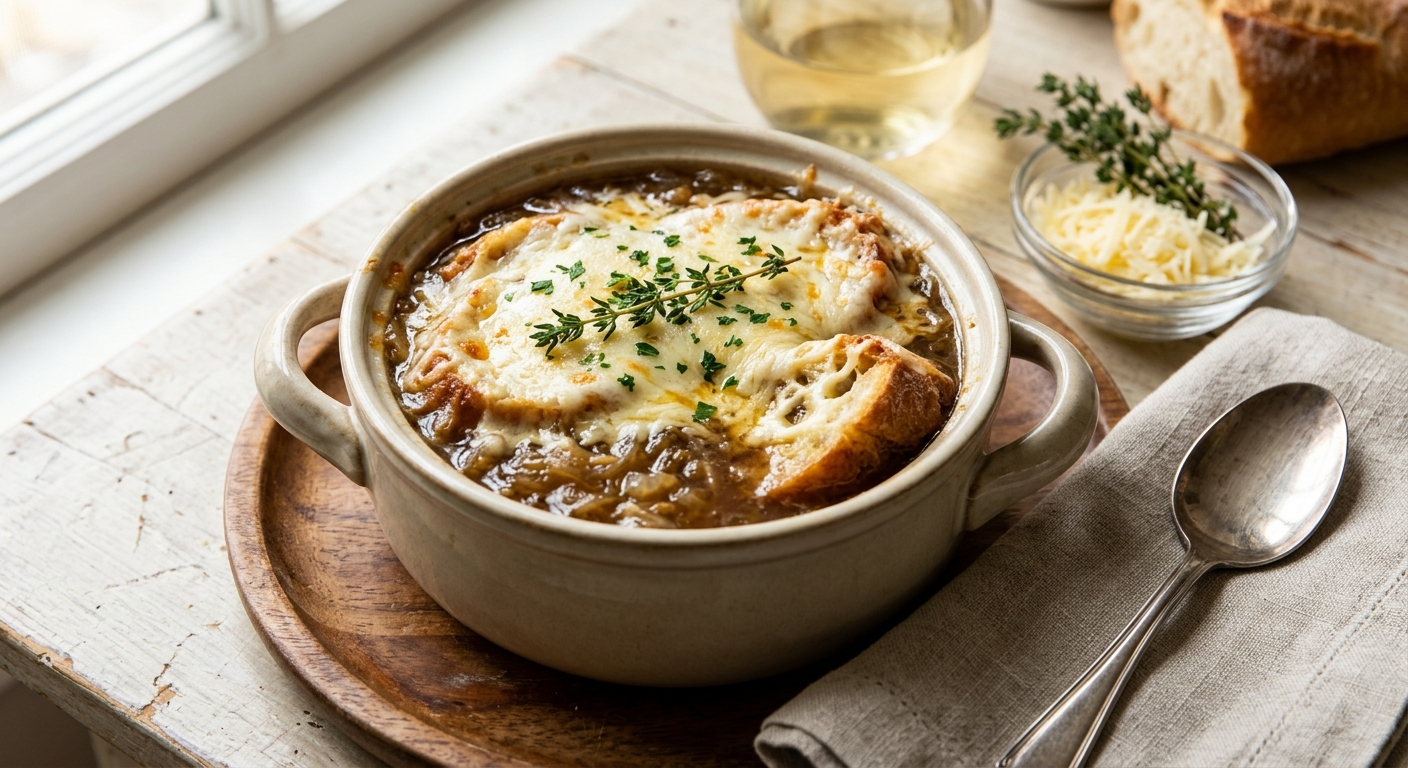
French onion soup has been warming Parisian bistros since the 18th century, and it turns out that centuries of intuitive cooking quietly assembled one of the most bone-supportive meals in the European repertoire. The foundation of this dish, the humble yellow onion, is gram-for-gram among the top ten food sources of quercetin, a flavonoid that research published in the Journal of Nutritional Biochemistry has linked to reduced osteoclast activity, meaning it may literally slow the cellular process that breaks down bone. Pile a generous lid of aged Gruyère on top and you layer in calcium, phosphorus, and vitamin K2 precursors that work synergistically to mineralise the bone matrix quercetin is busy protecting.
What separates a transcendent French onion soup from a mediocre one is patience with the caramelisation. Onions are roughly 5% sugar by weight, and only a long, low-heat cook coaxes those sugars through the Maillard reaction into the complex, mahogany-deep sweetness that defines the dish. We have engineered three genuinely different cooking paths, stovetop, slow cooker, and pressure cooker, so you can achieve that same depth whether you have 90 minutes or want to walk away for eight hours. An oven-gratinée finish is included as a fourth method for those who want the full classic theatre of a bubbling crock straight from the broiler.
From a culinary standpoint, the beef stock is your second structural pillar. A good homemade or high-quality store-bought stock brings gelatin, which gives the broth its silky body, along with naturally occurring glycine and proline, amino acids that are direct precursors to collagen. Combined with the quercetin from the onions and the calcium from the cheese, this bowl genuinely earns its place in the Bone and Joint category, not as a superfood gimmick, but as a thoughtfully calibrated meal built on centuries of culinary wisdom.
4
servings
Ingredients
- 1200 gyellow onions (about 6 medium), peeled, halved, and thinly sliced
- 3 tbspunsalted butter
- 1 tbspextra-virgin olive oil
- 4 clovesgarlic, minced
- 1 tspcaster sugar
- 2 tbspall-purpose flour
- 150 mldry white wine (e.g. Sauvignon Blanc or Pinot Grigio)
- 1 literbeef bone broth, high-quality store-bought or homemade
- 500 mllow-sodium beef stock
- 2 sprigsfresh thyme
- 1 wholebay leaf
- 1 tspWorcestershire sauce
- 8 slicesbaguette (1.5 cm thick), ideally day-old
- 200 gGruyère cheese, coarsely grated
- —Colima Sea SaltMicroplastic Free Salt and freshly cracked black pepper to taste
Instructions
Click on an item below to shop for the recommended items for this recipe on Amazon.
As an Amazon Associate, we earn from qualifying purchases.
- Set a large, heavy-bottomed Dutch oven or enamelled cast-iron pot over medium-low heat. Add the butter and olive oil together. Once the butter is foamy, add all the sliced onions and a generous pinch of salt. Stir to coat every strand in fat.
- Cook the onions uncovered, stirring every 5 to 7 minutes, for 45 to 55 minutes. In the first 20 minutes they will soften and turn translucent. Around the 30-minute mark they will begin to colour. Towards 50 minutes they should be deeply mahogany, jammy, and reduced to roughly one-fifth of their original volume. If the pot bottom threatens to scorch at any point, add a splash of water or stock and scrape up the fond. Sprinkle in the caster sugar at the 35-minute mark to encourage even caramelisation.
- Add the minced garlic, stir, and cook for 2 minutes until fragrant. Sprinkle the flour evenly over the onions and stir constantly for 2 minutes to cook out the raw flour taste, creating a light onion roux.
- Pour in the white wine and scrape up every bit of fond from the bottom of the pot. Let the wine reduce by half, about 3 minutes, then pour in the beef bone broth and the beef stock. Add the thyme sprigs, bay leaf, and Worcestershire sauce. Increase heat to bring the soup to a gentle boil, then reduce to a low simmer.
- Simmer uncovered for 15 minutes to meld the flavours. Taste and adjust salt and pepper. Remove the thyme sprigs and bay leaf.
- While the soup simmers, toast the baguette slices under the grill or in a dry pan until golden on both sides. Ladle the soup into oven-safe crocks or bowls, float two croutons on top of each serving, and pile the grated Gruyère generously over the bread. Place the filled bowls on a baking sheet and slide under a hot grill for 3 to 4 minutes until the cheese is bubbling, blistered, and golden. Serve immediately.
- Pre-caramelise the onions on the stovetop: melt the butter and olive oil together in a large skillet over medium heat. Add the sliced onions and salt, then cook, stirring every 5 minutes, for 25 to 30 minutes until the onions are golden-amber and noticeably sweet. They do not need to reach the full mahogany of the stovetop method since the slow cooker will continue deepening them. Add the garlic and sugar in the final 3 minutes, stirring constantly.
- Transfer the caramelised onions to the slow cooker insert. Sprinkle the flour directly over the hot onions in the insert and stir well for 1 full minute so the flour absorbs into the onion mixture rather than clumping in the broth.
- Deglaze the still-hot skillet with the white wine, scraping up all the fond, and let it reduce for 2 minutes. Pour this into the slow cooker. Add the beef bone broth, beef stock, thyme sprigs, bay leaf, and Worcestershire sauce. Stir gently to combine. Season lightly with salt (you will adjust at the end).
- Set the slow cooker to Low and cook for 7 to 8 hours. The long cook time allows the gelatin from the bone broth to fully dissolve into the broth, creating a silkier, more unctuous texture than the stovetop version. Check at the 6-hour mark: if the broth tastes flat, remove the lid for the final hour to concentrate the flavours slightly.
- Remove the thyme sprigs and bay leaf. Taste and adjust salt, pepper, and Worcestershire sauce. The broth should be savoury, slightly sweet, and deeply beefy. Toast the baguette slices until crisp. Ladle the soup into oven-safe crocks, top with two croutons per bowl, and cover generously with grated Gruyère. Grill under a hot broiler for 3 to 4 minutes until the cheese is molten and blistered. Serve immediately.
- Set your Instant Pot or electric pressure cooker to Sauté on the High setting. Add the butter and olive oil. When the butter foams, add the sliced onions, salt, and sugar. Sauté, stirring every 3 to 4 minutes, for 22 to 28 minutes. The high, dry heat of the Sauté function accelerates caramelisation significantly compared to a standard stovetop. You are looking for deep amber colour and a sticky, reduced texture. If the onions stick and the bottom darkens, add a tablespoon of water and scrape immediately.
- Add the minced garlic and stir for 90 seconds. Sprinkle the flour over the onions and stir constantly for 2 minutes to form a roux. Pour in the white wine and scrape up all the browned fond from the bottom of the pot. This step is critical: any unscraped fond will trigger the burn warning during pressure cooking. Let the wine reduce for 2 minutes.
- Pour in the beef bone broth and beef stock. Add the thyme sprigs, bay leaf, and Worcestershire sauce. Stir well and ensure nothing is stuck to the bottom. Cancel the Sauté function.
- Secure the lid, set the valve to Sealing, and pressure cook on High for 20 minutes. The pressure environment extracts collagen from the bone broth proteins more efficiently than a stovetop simmer, producing a notably richer, more gelatinous broth in a fraction of the time.
- Allow the pressure to release naturally for 10 minutes, then carefully switch the valve to Venting for a quick release of any remaining steam. Open the lid, remove the thyme sprigs and bay leaf, and taste. Adjust salt, pepper, and Worcestershire. Toast the baguette slices. Ladle the soup into oven-safe crocks, top with two croutons and a generous mound of Gruyère, and grill under a hot broiler for 3 to 4 minutes until golden and bubbling.
- Preheat your oven to 180°C (350°F). On the stovetop, melt the butter and olive oil in a large oven-safe Dutch oven over medium-high heat. Add all the onions and salt, stir well, and cook uncovered for 15 minutes on the stovetop, stirring occasionally, until the onions are softened and beginning to colour. Add the sugar and garlic, stir, and transfer the uncovered Dutch oven to the preheated oven.
- Roast the onions in the oven uncovered for 60 to 75 minutes, stirring every 20 minutes. The dry, ambient heat of the oven caramelises the onions more evenly than a stovetop flame, and they will develop a deeper, more uniform colour without the risk of scorching on the bottom. They are ready when they are a rich mahogany and smell intensely sweet and nutty.
- Remove the Dutch oven from the oven and place it back on the stovetop over medium heat. Sprinkle the flour over the onions and stir for 2 minutes. Add the minced garlic (if not added in step 1), deglaze with the white wine, and reduce for 2 minutes, scraping up all the fond. Pour in the beef bone broth, beef stock, thyme sprigs, bay leaf, and Worcestershire sauce. Bring to a gentle boil.
- Increase the oven temperature to 200°C (400°F). Cover the Dutch oven with its lid, slide it back into the oven, and braise the soup for 45 minutes. This oven braise produces a cleaner, more nuanced broth flavour compared to stovetop simmering, as the gentle all-around heat prevents the aggressive reduction that can make a stovetop version slightly harsh.
- Remove from the oven, discard the thyme and bay leaf, and taste for seasoning. Lightly toast the baguette slices. Ladle the hot soup into individual oven-safe crocks set on a sturdy baking sheet. Float two croutons on each crock and cover completely with grated Gruyère, pressing the cheese slightly so it drapes over the edges of the crock. Switch the oven to the Grill or Broil setting on High. Slide the baking sheet under the grill for 4 to 6 minutes, watching closely, until the cheese is molten, deeply golden, and the edges have crisped into the lacy, caramelised crust that is the hallmark of a true gratinée. Allow to cool for 2 minutes before serving, as the crocks and soup will be extremely hot.
Nutrition Breakdown
Per 1 serving (makes 4)
Vitamins & Minerals
% Daily Value based on a 2,000 calorie diet (FDA reference)
🧬 Essential Amino Acids
% of recommended daily intake (RDA) per serving
🛡 Antioxidant Profile
The Nutrition Science
The bone-health case for French onion soup rests on two converging mechanisms. First, quercetin, which is present at roughly 20 to 50 mg per 100g of raw yellow onion depending on variety and growing conditions, has been shown in multiple cell and animal studies to suppress RANKL-induced osteoclastogenesis. In plain terms, quercetin appears to slow the activity of the cells that continuously dissolve old bone, shifting the balance toward net bone formation. Critically, quercetin is fat-soluble to a degree, and the butter and olive oil in this recipe improve its bioavailability compared to eating raw onions alone. The long cooking time does reduce quercetin content somewhat, with studies suggesting losses of 20 to 30% after 30 minutes of heat exposure, but the sheer quantity of onions used (300g per serving raw weight) means each bowl still delivers a clinically meaningful dose.
The calcium story is straightforward but impressive. A 50g portion of Gruyère, which is what each serving receives here, contributes approximately 400 to 430mg of highly bioavailable calcium. Unlike the calcium in plant foods, which is often bound to oxalate or phytate, the calcium in aged cheeses like Gruyère is embedded in a casein protein matrix that digestive enzymes break down efficiently, yielding absorption rates of 30 to 40%. The phosphorus in the cheese forms calcium phosphate, which is the exact crystalline compound that constitutes hydroxyapatite, the mineral phase of bone. You are not just getting the raw materials; you are getting them in a ratio and chemical environment close to how the body actually needs to use them.
The beef bone broth adds a third layer of joint-specific support via glycine and proline. These two non-essential amino acids are the dominant constituents of collagen, the fibrous protein that gives cartilage its tensile strength and resistance to compression. While your liver can synthesise both from other amino acids, dietary glycine has been shown to spare this metabolic burden and increase the pool available for connective tissue maintenance. A litre of quality bone broth provides an estimated 1 to 3g of glycine per serving depending on preparation time, making the broth a meaningful contributor to joint-cartilage integrity that complements the mineral and polyphenol contributions of the cheese and onions.
Pro Tips
- Slice onions with the grain (pole to pole) rather than across the equator. With-the-grain slices hold together better during the long caramelisation, creating silky strands rather than disintegrating into mush.
- If your Gruyère is freshly purchased and moist, spread it on a plate and leave it uncovered in the refrigerator for 30 minutes before grilling. Drier cheese browns dramatically more evenly and produces the characteristic blistered, slightly chewy crust rather than a greasy pool.
- For the deepest quercetin content, choose yellow onions with deeply coloured, papery outer skins and avoid pre-peeled onions. The quercetin is highest in the outermost layers of flesh just beneath the skin, so peel only the dry outer paper and leave the first few flesh layers intact.
This looks fantastic, but I’m curious about the protein content per serving, especially with the Gruyère. I’ve been learning that calcium absorption actually depends a lot on getting enough protein distributed throughout the day, and that quercetin’s anti-inflammatory benefits work better when you’re supporting muscle through adequate leucine intake. How much protein does a typical bowl deliver? I’m always looking for ways to load up on calcium and anti-inflammatory compounds without falling short on the muscle-building side, since sarcopenia doesn’t care how healthy your bones are if your muscles are disappearing.
oh this is SO my kind of post! i love that youre highlighting the quercetin angle because most people totally overlook how powerful onions are when theyre caramelized like that, the bioavailability just shoots up. steve makes a really good point about protein distribution too – ive noticed with my kids that when i pair calcium rich foods with actual protein they seem to absorb it so much better, plus they stay fuller longer which is clutch for afternoon snack attacks. do you happen to know if this recipe would work with sprouted grain bread instead of regular croutons? im wondering if the sprouted flour would reduce any phytic acid that might compete with calcium absorption, and honestly gruyere +
Really curious about the exact quercetin content per serving here, Steve makes a solid point about protein synergy for calcium absorption. I’ve been tracking this with my CGM and noticed that when I pair high-calcium foods with adequate protein (around 20-25g per meal based on some recent meta-analyses), my postprandial glucose response is way more stable and I actually see better micronutrient utilization markers in my bloodwork. Did you quantify the quercetin mg per bowl or the protein breakdown with the Gruyère topping? Would love to see those specific numbers to compare against my logged data from other onion-based recipes.