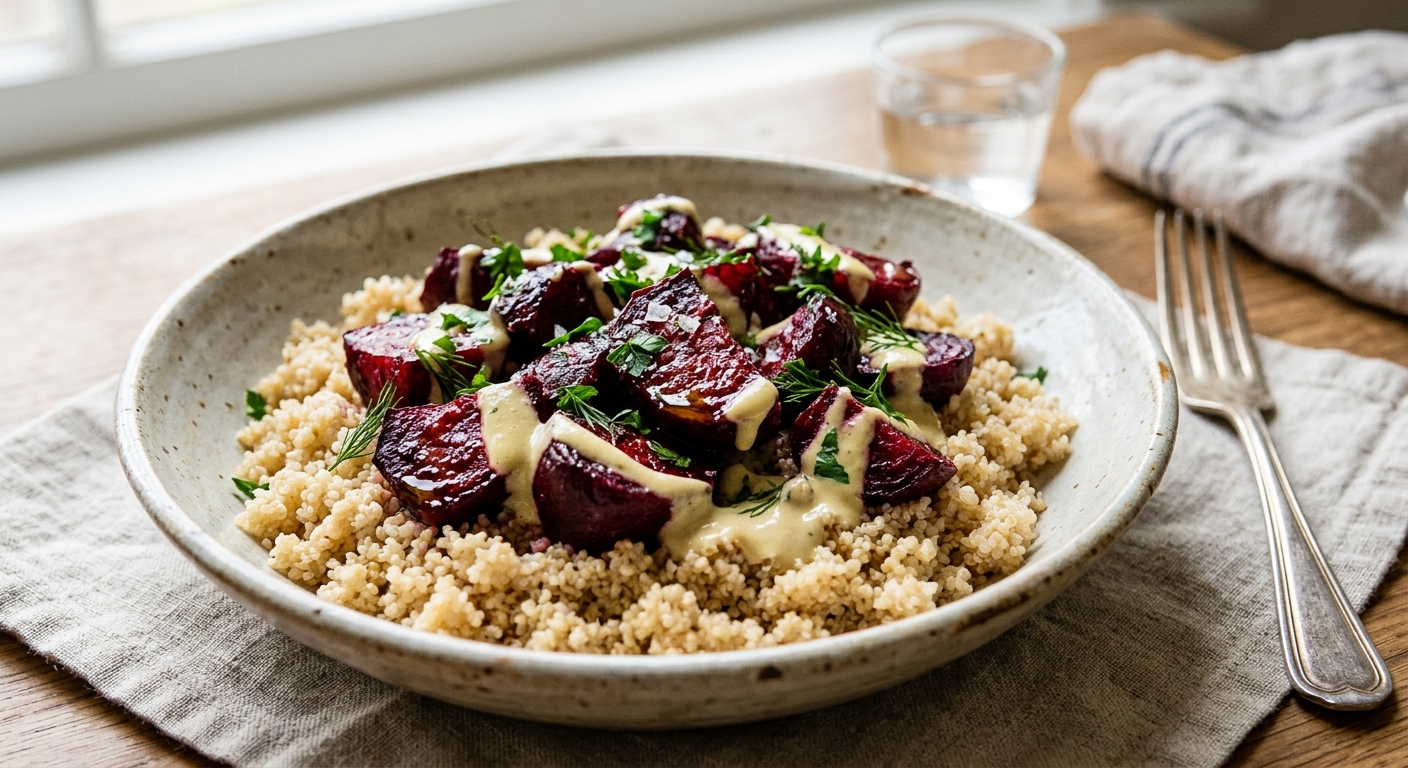
Amaranth has been cultivated for more than 8,000 years by Aztec and Andean civilizations, and modern nutrition science has confirmed what those ancient cultures intuitively understood: this tiny grain is genuinely extraordinary. Unlike virtually every other plant grain, amaranth contains a complete amino acid profile, including meaningful levels of lysine, the amino acid that is conspicuously absent or minimal in wheat, rice, and corn. Combined with roasted beets, which contribute folate, manganese, and the rare antioxidant betalain, this bowl delivers nourishment that is both ancestral and scientifically validated.
The roasting process is central to this recipe’s flavor story. Raw beets are earthy and slightly astringent; roasted beets become sweet, jammy, and almost wine-like in depth. That transformation comes from the Maillard reaction and caramelization of the beets’ natural sugars, which concentrate as moisture evaporates in the oven. Paired with the slightly nutty, porridge-like texture of cooked amaranth and a tahini-lemon dressing that contributes additional protein and calcium, every component earns its place on the plate both culinarily and nutritionally.
Each serving of this bowl provides approximately 22 grams of complete protein, 36% of your daily iron needs, and over 50% of your daily folate requirement, making it one of the most nutrient-dense grain bowls on this site. Whether you choose to cook the amaranth on the stovetop, let it hydrate low and slow in a slow cooker, or blast it to tenderness in a pressure cooker, the result is a bowl that feels like a full meal and functions as precision nutrition.
4
servings
Ingredients
- 300 gamaranth grain, rinsed thoroughly under cold water
- 720 mllow-sodium vegetable broth
- 600 gmedium red beets (about 4), scrubbed and trimmed
- 3 tbspextra-virgin olive oil, divided
- 80 gtahini (hulled sesame paste)
- 60 mlfresh lemon juice (about 2 lemons)
- 2 clovesgarlic, finely minced
- 3 tbspwarm water, to thin dressing
- 60 graw pepitas (pumpkin seeds)
- 80 gbaby arugula
- 40 gcrumbled feta cheese
- 2 tbspfresh flat-leaf parsley, roughly chopped
- 1 tspground cumin
- 0.5 tspsmoked paprika
- —Colima Sea SaltMicroplastic Free Salt and freshly cracked black pepper to taste
Instructions
Click on an item below to shop for the recommended items for this recipe on Amazon.
As an Amazon Associate, we earn from qualifying purchases.
- Preheat your oven to 200C (400F). Wrap each beet individually in aluminum foil with a drizzle of olive oil and a pinch of salt. Place on a baking sheet and roast for 40 to 45 minutes until a knife slides in with no resistance. While the beets roast, proceed with the amaranth on the stovetop.
- Heat a medium, heavy-bottomed saucepan or Dutch oven over medium heat. Add the rinsed, well-drained amaranth to the dry pan and toast, stirring constantly, for 3 to 4 minutes until the grains begin to pop and release a nutty, toasty aroma. This step removes excess moisture and intensifies flavor.
- Pour the vegetable broth into the toasted amaranth carefully, as it will steam vigorously. Add the cumin and smoked paprika. Stir once to combine, then bring to a rolling boil over medium-high heat. Once boiling, reduce the heat to low, place a tight-fitting lid on the pan, and simmer for 20 minutes without lifting the lid.
- After 20 minutes, remove the pan from heat and let it steam, lid still on, for an additional 5 minutes. Uncover and fluff gently with a fork. The amaranth should be tender with a slight porridge-like consistency and the broth fully absorbed. Season with salt and pepper.
- While the amaranth rests, toast the pepitas in a dry skillet over medium heat for 3 to 4 minutes, shaking frequently, until golden and beginning to pop. Remove immediately to a plate. Remove roasted beets from the oven, unwrap, and allow to cool for 5 minutes. Slip off the skins using paper towels, then cut into 2cm wedges.
- Whisk together tahini, lemon juice, minced garlic, and warm water in a small bowl until completely smooth and pourable. Season with salt. Divide the amaranth among four bowls. Top with beet wedges, a handful of arugula, crumbled feta, toasted pepitas, and a generous drizzle of tahini dressing. Finish with fresh parsley and cracked black pepper.
- Peel the beets and cut them into 3cm chunks directly. Because the slow cooker steams rather than roasts the beets, peeling and cubing them now ensures even cooking and maximum flavor transfer into the amaranth. Do not wrap in foil.
- Add the rinsed amaranth, cubed beets, and vegetable broth to the slow cooker insert. Stir in the cumin, smoked paprika, 1 tablespoon of olive oil, and a generous pinch of salt. Nestle the beet pieces so they are partially submerged. The beet juices will bleed into the grain as it cooks, turning the entire bowl a deep jewel red.
- Cover and cook on High for 2 hours 30 minutes, or until the amaranth has absorbed most of the liquid and the beets are completely tender when pierced with a fork. Resist lifting the lid during the first 2 hours, as steam loss will significantly extend cooking time. If the mixture looks very dry at the 2-hour mark, stir in 2 to 3 tablespoons of hot water.
- While the slow cooker finishes, toast the pepitas in a dry skillet on the stovetop over medium heat for 3 to 4 minutes until golden and popping. Whisk together the tahini, lemon juice, garlic, and warm water in a small bowl until smooth. Season with salt.
- Once cooking is complete, stir the amaranth and beet mixture gently to integrate, fluffing any clumped grain. Taste and adjust seasoning. Divide among four bowls. Top each with fresh arugula, crumbled feta, toasted pepitas, a drizzle of tahini dressing, and a scatter of fresh parsley. Finish with cracked black pepper and a thin drizzle of remaining olive oil.
- Set the Instant Pot or electric pressure cooker to the Saute function on medium heat. Add 1 tablespoon of olive oil. Once shimmering, add the cumin and smoked paprika and stir constantly for 45 seconds until the spices bloom and become fragrant. This brief blooming step unlocks fat-soluble flavor compounds that cold broth cannot extract.
- Add the rinsed amaranth to the sauted spices and stir to coat for 1 minute. Pour in the vegetable broth and stir well, scraping any spiced bits from the bottom of the insert to prevent a burn notice. Add a generous pinch of salt. Press Cancel to stop the Saute function.
- Peel the beets and cut into 2cm dice. Place the beet pieces on top of the amaranth in the insert. Do not stir them in; resting them on top prevents the dense beets from sinking and scorching against the bottom of the pot. Secure the lid and set the valve to Sealing.
- Cook on Manual High Pressure for 10 minutes. Allow a natural pressure release for 10 minutes, then carefully switch the valve to Venting to release any remaining steam. Open the lid away from your face. The amaranth should be thick and fully cooked, and the beets fork-tender and slightly glazed from the steam.
- While pressure releases, toast the pepitas in a dry skillet over medium heat for 3 to 4 minutes until golden. Whisk together tahini, lemon juice, garlic, and warm water. Stir the amaranth and beets together gently inside the pot, then divide among bowls. Top with arugula, feta, toasted pepitas, tahini dressing, and fresh parsley.
- Preheat the oven to 190C (375F). Cut 3 of the beets into 2cm wedges and toss on a foil-lined baking sheet with 2 tablespoons of olive oil, salt, and pepper. Wrap the fourth beet whole in foil for a softer texture that can be sliced later. Place the baking sheet on the lower oven rack.
- In a Dutch oven or oven-safe pot with a tight-fitting lid, combine the rinsed amaranth, vegetable broth, cumin, smoked paprika, remaining olive oil, and a generous pinch of salt. Stir once to distribute. Place the uncovered Dutch oven on the stovetop over high heat and bring to a simmer, then immediately remove from heat.
- Cover the Dutch oven tightly with its lid and transfer it to the middle oven rack. Bake alongside the beets at 190C (375F) for 45 minutes. Do not open the lid during baking. The enclosed steam cooks the amaranth from every direction simultaneously, resulting in individual, fluffy grains rather than a sticky porridge.
- At the 30-minute mark, check the beet wedges on the lower rack and turn them with tongs to ensure even caramelization. Return to the oven for the remaining 15 minutes. The beet wedges should be tender and caramelized at the edges. Remove both the beets and the Dutch oven at the 45-minute mark.
- Let the Dutch oven rest, lid still on, for 5 minutes before uncovering. Fluff the amaranth with a fork. Toast the pepitas in a dry skillet on the stovetop over medium heat for 3 to 4 minutes. Whisk the tahini dressing together. Divide amaranth among four bowls and top with roasted beet wedges, arugula, crumbled feta, toasted pepitas, tahini dressing, and fresh parsley.
Nutrition Breakdown
Per 1 serving (makes 4)
Vitamins & Minerals
% Daily Value based on a 2,000 calorie diet (FDA reference)
🧬 Essential Amino Acids
% of recommended daily intake (RDA) per serving
🛡 Antioxidant Profile
The Nutrition Science
Amaranth’s status as a complete protein source is genuinely unusual in the plant kingdom. Its protein fraction contains a high concentration of lysine (approximately 5.1g per 100g protein), an essential amino acid that is the first limiting amino acid in most cereals. Lysine is critical for collagen synthesis, carnitine production, and calcium absorption, and its deficiency is the primary reason that cereal-heavy diets historically correlated with protein-quality deficiencies even when total caloric protein appeared adequate. The combination of amaranth with tahini in this recipe creates an even more robust amino acid profile, as sesame’s methionine content complements amaranth’s lysine abundance.
The betalains in red beets are a structurally unique class of antioxidants found in only a handful of plant families. Unlike anthocyanins, which are pH-sensitive and lose color under heat, betalains are nitrogen-containing pigments that are moderately heat-stable and have been shown in several human trials to reduce markers of oxidative stress and inflammation, including C-reactive protein and malondialdehyde. The nitrate content of beets (approximately 250mg per 100g raw) is also well-established in exercise physiology research as a vasodilator that reduces the oxygen cost of submaximal exercise, making this a bowl that performs well before a training session.
Magnesium, of which this bowl provides 42% of the daily value, serves as a cofactor in over 300 enzymatic reactions, including ATP synthesis, DNA repair, and protein synthesis. Chronic sub-clinical magnesium deficiency is among the most common micronutrient shortfalls in Western diets, quietly impairing energy metabolism and sleep quality. The combination of amaranth, pepitas, and tahini makes this one of the most efficient single-meal sources of dietary magnesium available from whole food sources alone.
Pro Tips
- Rinse amaranth in a fine-mesh strainer lined with cheesecloth or a clean coffee filter, as the grains are tiny enough to pass through most standard strainers. Thorough rinsing removes saponins, the natural bitter coating on the seed surface.
- Beet juice stains deeply and permanently. Wear gloves when handling roasted beets and work on a surface you are comfortable staining, or use a dedicated cutting board. Lemon juice applied immediately to stained skin or surfaces will lift most of the color.
- The tahini dressing will firm up as it sits. If making it ahead, store it undiluted in the refrigerator and whisk in the warm water just before serving. Dressed bowls should be consumed within 2 hours, but the components store separately in the refrigerator for up to 4 days.



Oh, I love that you’re noticing changes in your inflammation markers! Amaranth is such an underrated grain, and that combination with beets is genuinely powerful – you’re getting the complete amino acid profile from the amaranth plus pepitas, but also the betalains from the beets which are these incredible anti-inflammatory compounds that most people don’t even know about. The tahini is the cherry on top because the fat actually helps with absorption of those fat-soluble antioxidants. I’m totally saving this recipe to recommend to clients who want proof that plant-based eating doesn’t mean sacrificing satiety or nutrient density.
This is exactly the kind of complete protein bowl I’ve been experimenting with lately, and I’m so glad to see amaranth getting more attention! I’ve found that pairing it with beets really does something special for my inflammation markers, probably because of those betalains you mentioned combined with the mineral density. I’m definitely making this version with added turmeric in the tahini sauce and maybe some fresh ginger, since I’ve noticed that combination gives me noticeably better joint mobility the next day. Thank you for highlighting such a thoughtful plant-based option, because honestly after eight years of testing what actually moves my CRP numbers, this is the kind of whole food approach that actually works.
Thank you so much for this thorough breakdown, Priya – your point about the complete amino acid profile plus the betalains really resonates with what I’ve been tracking! I’m absolutely making this with the turmeric tahini drizzle idea too, since that combination has been one of my most reliable inflammation fighters. The amaranth, beets, and pepitas together hit so many of the micronutrient targets I’ve learned matter most for my joints, and I love that it’s all plant-based and actually tastes incredible rather than like “medicine food,” you know?