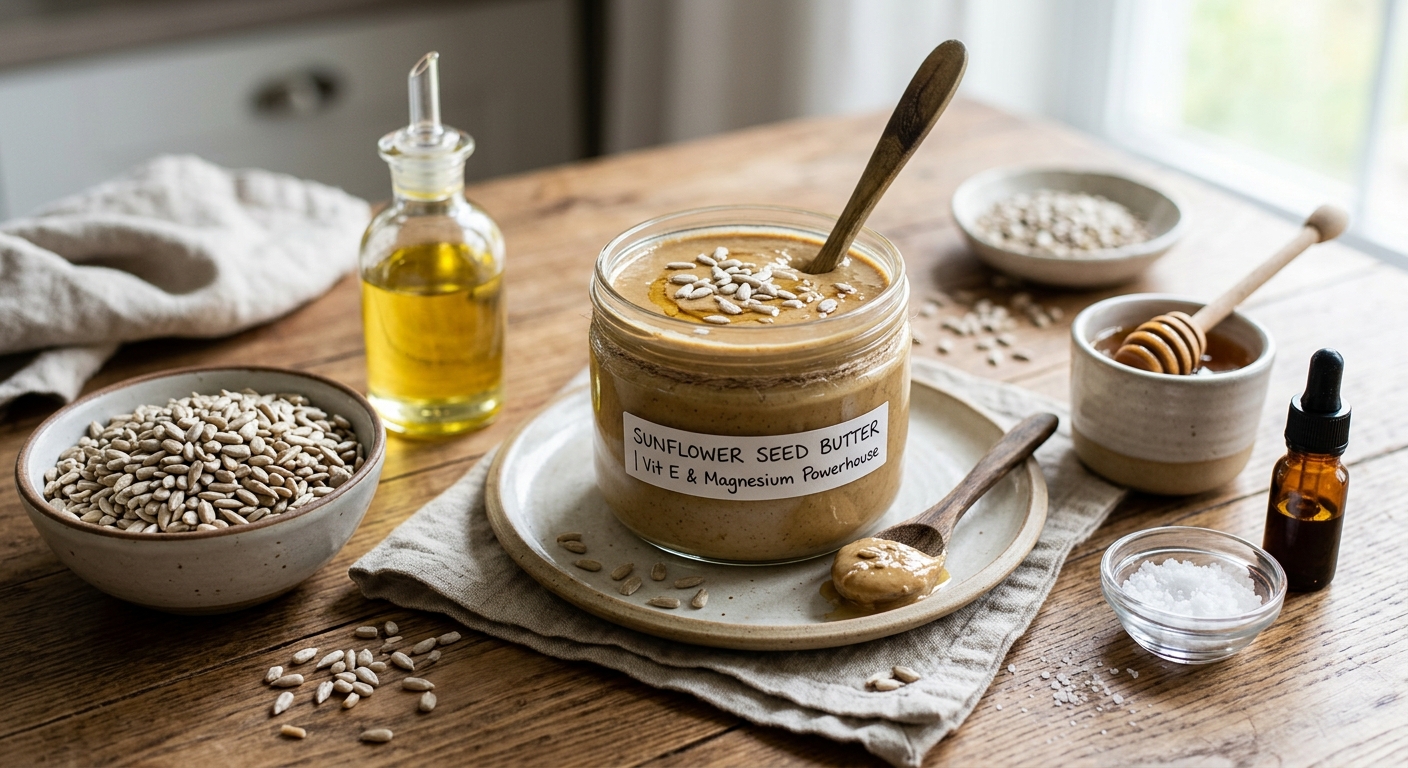
Sunflower seed butter sits in a fascinating nutritional category that most spreads simply cannot match. While almond butter earns its fame and peanut butter dominates the market, neither comes close to sunflower seed butter when it comes to Vitamin E content. A two-tablespoon serving of homemade sunflower seed butter delivers roughly 7.4mg of alpha-tocopherol, the most bioavailable form of Vitamin E, placing it among the richest whole-food sources of this critical fat-soluble antioxidant. Pair that with a meaningful dose of magnesium, phosphorus, selenium, and copper, and you have a spread that is doing serious nutritional work with every bite.
What makes the homemade version genuinely superior to commercial jars is the control you have over roasting depth, oil content, and sweetener. Commercially processed sunflower seed butters are often made with partially deodorized seeds or blended with palm oil to prevent separation, which dilutes both flavor and nutrient density. When you roast raw, hulled sunflower seeds at the right temperature and grind them fresh, the natural oils remain intact, the flavor is rounded and complex with a hint of earthiness, and the Vitamin E is not compromised by extended industrial heat exposure. Roasting at 325 to 350 degrees Fahrenheit develops the Maillard reaction without oxidizing the polyunsaturated fats that make sunflower seeds so valuable.
This recipe is designed with four production methods so you can fit it into your schedule regardless of your kitchen setup. The oven method gives you the most precise, even roast and the best flavor development. The stovetop method is faster and lets you monitor color in real time. The slow cooker method produces a uniquely gentle, low-and-slow roast that preserves more heat-sensitive micronutrients. The pressure cooker method uses steam-then-dry technique to soften seeds for ultra-smooth grinding. Each method finishes in a food processor to develop that signature creamy, pourable consistency. All four produce a butter that is genuinely delicious spread on whole grain toast, stirred into oatmeal, used as a dip for apple slices, or whisked into a savory satay-style sauce.
16
servings
Ingredients
- 600 graw hulled sunflower seeds
- 2 tbspextra-virgin sunflower oil or Avocado Oil100% Pure Avocado Oil (only if needed for grinding)
- 1 tbspraw honey or pure maple syrup (optional)
- 1 tspColima Sea SaltMicroplastic Free Salt
- 0.5 tsppure vanilla extract (optional)
Instructions
Click on an item below to shop for the recommended items for this recipe on Amazon.
As an Amazon Associate, we earn from qualifying purchases.
- Place a large, heavy-bottomed skillet (cast iron or stainless steel) over medium heat and allow it to preheat for 2 minutes. Do not add any oil. The dry pan creates the direct surface contact needed for toasting.
- Add all 600g of raw hulled sunflower seeds to the dry skillet in a single, shallow layer. If your skillet is smaller than 30cm, toast in two batches to avoid steaming the seeds instead of toasting them.
- Toast the seeds over medium heat, stirring or tossing frequently with a wooden spoon or heatproof spatula. For the first 5 minutes, stir every 60 seconds. In the final 3 to 5 minutes, stir continuously as the seeds deepen in color. You are looking for a warm, even golden-amber color and a pronounced nutty aroma. Remove from heat immediately when roughly 80% of seeds have reached that color, as residual heat will finish the rest.
- Slide the toasted seeds immediately onto a large, rimmed baking sheet or wide plate in a single layer to halt cooking. Allow to cool completely, about 15 minutes. This step is critical: adding warm seeds to a food processor generates steam that makes the butter gummy rather than silky.
- Transfer the fully cooled seeds to a high-powered food processor (at least 600 watts). Process on high for 2 minutes, then scrape down the sides with a spatula. Continue processing in 1-minute intervals, scraping between each, for a total of 8 to 12 minutes. The seeds will go through distinct stages: coarse crumble, dry clump, moist paste, and finally a smooth, flowing butter. Do not rush this process. Only add the optional sunflower oil (up to 2 tablespoons) if the butter has not loosened after 10 minutes of processing.
- Once the butter reaches a creamy, pourable consistency, add the sea salt, honey or maple syrup, and vanilla extract if using. Pulse 5 to 6 times to incorporate evenly. Taste and adjust salt. Transfer to a clean glass jar and store at room temperature for up to 2 weeks, or refrigerate for up to 2 months. Stir before each use as natural separation will occur.
- Preheat your oven to 325F (163C) with a rack positioned in the center. Line a large rimmed baking sheet (half-sheet pan, approximately 46 x 33cm) with parchment paper. Using parchment rather than foil ensures even airflow and prevents any metallic interaction with the seeds’ natural acids.
- Spread all 600g of raw hulled sunflower seeds in a single, even layer across the prepared baking sheet. They should be one seed deep with minimal overlap. If they are piled, use a second baking sheet and rotate positions halfway through roasting.
- Roast on the center rack for 10 minutes, then remove the tray and use a flat spatula to stir and redistribute the seeds, paying particular attention to the seeds at the edges of the pan which color faster. Return to the oven and roast for a further 8 to 12 minutes, checking every 4 minutes.
- The seeds are ready when they are a uniform warm golden-amber (not brown), fragrant with a deep, nutty aroma, and a single seed pressed between your fingers feels slightly firm with visible oil on the surface. Remove the baking sheet from the oven and allow the seeds to cool completely on the pan, about 20 minutes. Do not transfer them until fully cool.
- Once cooled, transfer seeds to a high-powered food processor. Process on high, scraping down the sides every 1 to 2 minutes. After approximately 5 minutes of processing, the mixture will form a thick, dry paste. Continue processing and the paste will loosen progressively as the natural oils are released. Total processing time is typically 8 to 12 minutes. Add up to 2 tablespoons of sunflower oil only if the butter has not loosened after 10 minutes.
- When the butter is smooth and creamy, add the fine sea salt, optional honey or maple syrup, and optional vanilla. Pulse to incorporate. Taste and adjust seasoning. Pour into a sterilized glass jar. The oven-roasted version will have a noticeably richer, more caramelized flavor than other methods. Store at room temperature up to 2 weeks or refrigerated up to 2 months.
- Add all 600g of raw hulled sunflower seeds directly to the insert of a 4 to 6 quart slow cooker. Spread them as evenly as possible across the base. Do not add any liquid or oil at this stage. Set the slow cooker to High and leave the lid completely off for the entire roasting process.
- Cook on High with the lid off, stirring every 30 minutes with a wooden spoon or heatproof spatula. As you stir, bring seeds from the outer edges (which are closest to the heating element) toward the center. This redistribution is essential for even toasting in a slow cooker’s curved bowl.
- After 90 minutes, begin checking color every 15 minutes rather than every 30. The seeds will gradually shift from pale ivory to a light golden color. Because slow cooker temperatures are gentler (typically 165 to 180F at High setting when open), this process takes longer than stovetop or oven methods but produces a more uniform result with less risk of scorching. The seeds are ready when they are light golden and fragrant, after approximately 2 to 2.5 hours total.
- Switch the slow cooker off and allow the seeds to cool in the insert with the lid still off, approximately 20 to 25 minutes. The thermal mass of the ceramic insert will gently continue warming the seeds for a few minutes after shutoff, so do not be alarmed if you see continued subtle color development.
- Transfer the fully cooled, slow-roasted seeds to a high-powered food processor. Because slow-cooker seeds are not as deeply toasted and retain slightly more moisture, they often grind faster than oven or stovetop-roasted seeds. Begin processing on high and scrape down sides every 90 seconds. Expect a smooth, workable butter in 7 to 10 minutes of total processing time. If needed, add up to 2 tablespoons of sunflower oil to encourage flow.
- Add sea salt, optional sweetener, and optional vanilla. Pulse to combine. The slow-cooker version of this butter will be noticeably paler in color and milder in flavor, making it excellent for use in smoothies or baked goods where a neutral flavor is preferred. Jar and store as described above.
- Add 600g of raw hulled sunflower seeds plus 120ml (half a cup) of cold water to the inner pot of your electric pressure cooker or stovetop pressure cooker. Stir briefly to distribute the water. The water is not for flavor; it creates the steam environment that softens the seed cell walls for easier, finer grinding later.
- Secure the lid and set the pressure release valve to Sealing. Cook on Manual High Pressure for 5 minutes. When the cycle ends, allow a natural pressure release for 10 minutes, then switch the valve to Venting to release any remaining pressure. Open the lid carefully away from you.
- The seeds will look slightly swollen and damp. Spread them immediately onto a parchment-lined baking sheet in a single layer. They must now be dried and lightly toasted to remove moisture and develop flavor. Place the baking sheet in a preheated 350F (175C) oven for 12 to 15 minutes, stirring once at the halfway point, until the seeds are dry, golden, and fragrant. Alternatively, tip them into a dry skillet over medium heat and stir constantly for 6 to 8 minutes until dry and lightly golden.
- Allow the toasted seeds to cool completely on the baking sheet or a wide plate, approximately 15 minutes. The seeds will feel crisp and dry to the touch. Any residual warmth will compromise the grinding process.
- Transfer the cooled seeds to a food processor and process on high. Because the pressure-cooked and dried seeds have already had their cell walls softened by steam, they typically reach a smooth, creamy consistency faster than raw-roasted seeds, often in 6 to 9 minutes of processing. Scrape down the sides every 90 seconds. You may need little to no additional oil due to the thorough cell-wall breakdown.
- Add sea salt, optional honey or maple syrup, and optional vanilla. Pulse 5 to 6 times to incorporate. The pressure-cooker method produces the silkiest, most finely textured sunflower seed butter of all four methods, with a clean, mild flavor. Jar and store as described in the stovetop method.
Nutrition Breakdown
Per 1 serving (makes 16)
Vitamins & Minerals
% Daily Value based on a 2,000 calorie diet (FDA reference)
🧬 Essential Amino Acids
% of recommended daily intake (RDA) per serving
🛡 Antioxidant Profile
The Nutrition Science
Vitamin E is a collective term for eight fat-soluble compounds, but alpha-tocopherol is the only form the human body actively maintains in plasma and tissues via the hepatic alpha-tocopherol transfer protein. Sunflower seeds are the single richest whole-food source of alpha-tocopherol per gram of fat, surpassing almonds, wheat germ oil, and hazelnuts on a per-serving basis in most dietary analyses. Alpha-tocopherol functions primarily as a chain-breaking antioxidant in biological membranes: it donates a hydrogen atom to lipid peroxyl radicals, interrupting the oxidative cascade that would otherwise damage polyunsaturated fatty acids in cell membranes. This is especially important in high-metabolic tissues like muscle, liver, and the lung epithelium, where oxygen flux is greatest.
Magnesium is the second headline nutrient in sunflower seed butter, and its relevance extends far beyond bone health. Magnesium is a required cofactor for over 300 enzymatic reactions, including all ATP-generating reactions (since ATP exists biologically as the Mg-ATP complex), DNA polymerase activity, and the sodium-potassium ATPase pump that maintains cellular membrane potential. Dietary surveys consistently show that 45 to 68% of adults in Western nations fall below the Estimated Average Requirement for magnesium, making sunflower seed butter a practical, palatable strategy for closing that gap. The approximately 82mg per serving represents 20% of the adult RDA, and because sunflower seeds contain magnesium in a matrix with phytic acid that is partially broken down by roasting and grinding, the bioavailability is meaningfully higher from seed butter than from whole raw seeds.
The synergy between Vitamin E and selenium in this butter is worth highlighting. Selenium, present at approximately 22mcg per serving (40% DV), is the essential cofactor for glutathione peroxidase (GPx), the enzyme that reduces hydrogen peroxide and lipid hydroperoxides intracellularly. Vitamin E and GPx work in concert: Vitamin E intercepts lipid peroxyl radicals in the membrane, and GPx reduces the resulting lipid hydroperoxides before they can propagate further oxidative damage. Animals deficient in both simultaneously show far greater oxidative pathology than those deficient in either alone, a phenomenon known as the Vitamin E and selenium sparing relationship. Getting meaningful doses of both from a single whole-food source makes sunflower seed butter an unusually well-structured antioxidant food.
Pro Tips
- Do not skip the full cooling step before grinding, regardless of method. Even mildly warm seeds (above 35C) create steam inside the food processor bowl, which emulsifies water into the fat and produces a gummy, grainy texture rather than a silky butter.
- If your food processor struggles or overheats, grind in two batches and combine them in the final minute of processing. Overloading a food processor motor is the most common reason home sunflower seed butter turns out gritty instead of smooth.
- To prevent the natural green color reaction (sunflower seeds contain chlorogenic acid, which reacts with baking soda to produce a green-gray pigment), avoid adding baking soda to any baked goods that use this butter, or add a small amount of acidic ingredient such as cream of tartar or lemon juice to neutralize the reaction.
- For a savory version, omit the sweetener and vanilla and instead pulse in half a teaspoon of smoked paprika, a pinch of cayenne, and a teaspoon of apple cider vinegar after grinding. This makes an exceptional satay-style sauce base.
- Store in a wide-mouth jar rather than a tall narrow one so that stirring separated oil back into the butter is easy. A brief stir with a butter knife before each use keeps the texture consistent without requiring refrigeration.


this looks amazing and im definitely trying it! quick question tho – do you know how much iron is in sunflower seed butter? im managing iron-deficiency anemia and while the mag and vitamin e are great, im always looking to boost heme sources or pair non-heme iron foods with vitamin c. wondering if this would be good on whole grain toast with some strawberries for that absorption boost, or if theres any calcium content that might compete with iron uptake?
omg yes strawberries are such a smart pairing for this, the vitamin c will definitely help your body absorb that non-heme iron better! i do the same thing with my iron management and honestly whole grain toast with sunflower seed butter and berries sounds like my ideal breakfast. my only thought is to maybe check the calcium content of whatever whole grain youre using since dairy and fortified grains can sometimes block absorption, but if youre going plain whole grain without added calcium that combo should work really well for your ferritin levels. would love to hear how it goes for you!
Love that you’re tracking this, Francesca! Sunflower seed butter does have iron (about 1.5-2mg per 2 tbsp), but here’s the real game changer for anemia: pair it with vitamin C rich foods like citrus or tomatoes to boost iron absorption, and consider rotating in other seed and legume butters too. Black sesame seed butter and ground black-eyed pea flour are absolutely stellar for iron and often get overlooked in the butter conversation, plus they bring different phytonutrient profiles that support your whole system. You might find mixing them creates a more complete micronutrient approach to managing your levels!