
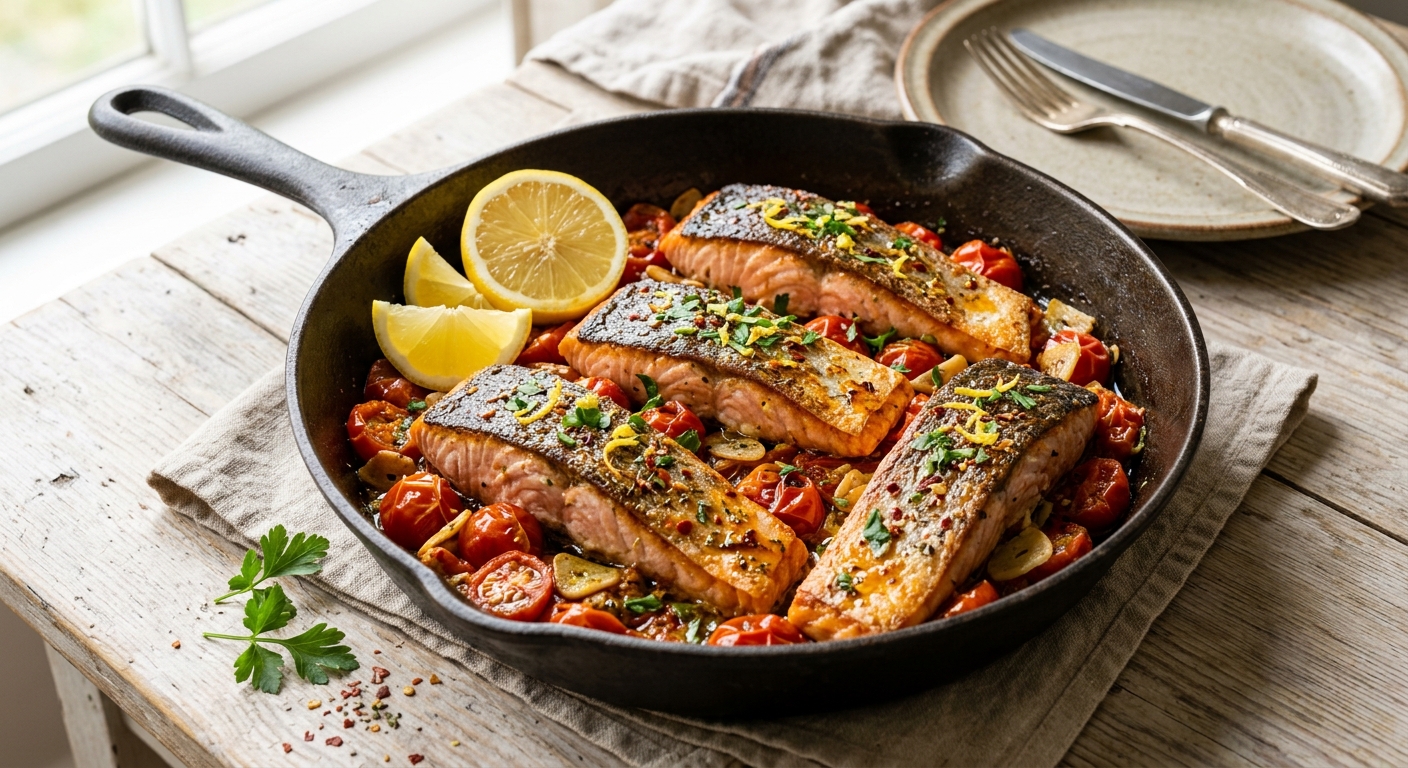
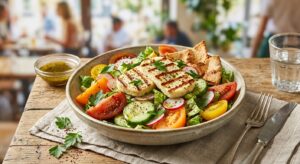
Few single-ingredient combinations in the nutritional world are as synergistic as salmon and tomatoes. Salmon is one of the rare natural food sources of vitamin D, a nutrient that nearly 40% of adults are deficient in, and it simultaneously delivers a full day’s supply of vitamin B12, the essential cobalamin that drives nerve function, red blood cell formation, and DNA synthesis. Roasted tomatoes are no passive bystander here either: their lycopene content actually increases with heat exposure, and their vitamin C content aids non-heme iron absorption from the accompanying ingredients.
This recipe was engineered from the ground up to hit specific micronutrient targets without leaning on supplements or fortified foods. A 170g salmon fillet provides approximately 570 IU of vitamin D (over 70% DV) and 4.5 micrograms of B12 (188% DV). Paired with cherry tomatoes, extra-virgin olive oil, and a scatter of fresh flat-leaf parsley, this single plate also contributes meaningful amounts of selenium, potassium, vitamin C, and omega-3 fatty acids. Every element earns its place on the plate.
Whether you have twenty-five minutes and a hot skillet or prefer a low-and-slow hands-off approach, we have calibrated each cooking method to preserve these nutrients as faithfully as possible. Vitamin D is relatively heat-stable, while B12 can degrade above 300 degrees Fahrenheit with prolonged exposure, so oven and pressure cooker timings have been specifically tuned to protect both. The result is a weeknight dinner that functions as nutritional insurance without asking you to sacrifice a single degree of flavour.
4
servings
Ingredients
- 680 gskin-on salmon fillets (4 x 170g portions), pin-boned
- 400 gcherry tomatoes, halved
- 4 clovesgarlic, thinly sliced
- 3 tbspextra-virgin olive oil, divided
- 1 mediumlemon, zested and cut into wedges for serving
- 1 tspsweet smoked paprika
- 0.5 tspdried oregano
- 0.5 tspred pepper flakes
- 120 mldry white wine (or low-sodium chicken broth)
- 20 gfresh flat-leaf parsley, roughly chopped
- 15 gfresh basil leaves, torn
- 2 tbspcapers, drained and rinsed
- —Colima Sea SaltMicroplastic Free Salt and freshly cracked black pepper to taste
Instructions
Click on an item below to shop for the recommended items for this recipe on Amazon.
As an Amazon Associate, we earn from qualifying purchases.
- Remove the salmon fillets from the refrigerator 10 minutes before cooking to take the chill off. Pat each fillet completely dry with paper towels, pressing firmly on both sides. Season generously with fine sea salt, black pepper, smoked paprika, and dried oregano, pressing the spices gently into the flesh.
- Heat 2 tablespoons of the olive oil in a large (30cm) stainless steel or cast-iron skillet over medium-high heat until the oil begins to shimmer and a faint wisp of smoke appears, about 2 minutes. Carefully lay the salmon fillets skin-side down in the pan. Press each fillet lightly with a spatula for the first 30 seconds to prevent curling. Cook undisturbed for 5 to 6 minutes until the skin is deeply golden and releases naturally from the pan.
- Flip the salmon fillets carefully using a thin fish spatula. Cook flesh-side down for 2 minutes, then transfer the fillets temporarily to a clean plate. They will be about 70% cooked at this stage, which is intentional.
- Reduce the heat to medium. Add the remaining 1 tablespoon of olive oil to the same skillet. Add the sliced garlic and red pepper flakes and cook, stirring frequently, for 60 seconds until fragrant and just beginning to turn golden at the edges. Add the halved cherry tomatoes and the lemon zest. Season with a pinch of salt. Cook for 4 to 5 minutes, stirring occasionally, until the tomatoes blister and begin to collapse, releasing their juices into the pan.
- Pour in the white wine (or broth) and stir to deglaze the pan, scraping up any browned bits from the bottom. Let the liquid reduce by half, about 2 minutes. Nestle the salmon fillets skin-side up back into the tomato mixture. Scatter the capers over the top.
- Reduce the heat to medium-low, cover the skillet loosely with a lid or foil, and cook for a final 3 to 4 minutes until the salmon reaches an internal temperature of 52 to 55 degrees Celsius (125 to 130 degrees Fahrenheit) for medium, or 60 degrees Celsius (140 degrees Fahrenheit) for fully cooked. Remove from heat, scatter the parsley and torn basil over the top, and serve immediately with lemon wedges.
- In a medium bowl, combine the halved cherry tomatoes, sliced garlic, red pepper flakes, lemon zest, smoked paprika, dried oregano, capers, white wine (or broth), and 2 tablespoons of the olive oil. Season with salt and pepper and stir well. Pour this mixture into the base of a 5 to 6 litre slow cooker and spread into an even layer.
- Pat the salmon fillets dry with paper towels. Season both sides with salt, pepper, and a light dusting of smoked paprika. Drizzle the remaining tablespoon of olive oil over the fillets. Lay the salmon skin-side down directly on top of the tomato mixture, spacing the fillets so they are not overlapping. The tomato mixture should come partway up the sides of the fillets.
- Place the lid on the slow cooker and cook on Low for 1 hour 30 minutes. At the 1 hour 15 minute mark, gently lift the lid and check the salmon by pressing the thickest part with your finger or inserting an instant-read thermometer. You are looking for 52 degrees Celsius (125 degrees Fahrenheit) for medium doneness. The flesh should flake easily when pressed but still hold its shape.
- Once the salmon reaches your desired temperature, carefully lift the fillets from the slow cooker using a wide spatula, as they will be delicate. The skin may stick to the base; use a second spatula underneath to support the fish fully. Arrange the fillets on a serving platter or individual plates.
- Spoon the collapsed tomato and pan-juice mixture generously over each fillet. The long, low cooking will have concentrated the tomato flavours and infused the wine and garlic into a loose, fragrant sauce. Scatter fresh parsley and torn basil over the top and serve with lemon wedges alongside. The texture of the salmon will be silkier and more tender than the stovetop version, closer to a poached or confit preparation.
- Set your Instant Pot or electric pressure cooker to the Saute function on Normal (medium) heat. Add 2 tablespoons of olive oil and heat until shimmering. Add the sliced garlic and red pepper flakes and saute for 60 seconds. Add the cherry tomatoes, lemon zest, smoked paprika, dried oregano, capers, and white wine. Stir to combine and cook for 2 minutes until the wine is slightly reduced. Press Cancel to turn off the Saute function.
- Pour the tomato mixture and any accumulated juices into the bottom of the pot. Add 60ml of water to ensure adequate liquid for pressurisation. Place the metal trivet that came with your cooker into the pot, resting it above the tomato base.
- Pat the salmon fillets dry and season both sides generously with salt, pepper, and smoked paprika. Drizzle the remaining tablespoon of olive oil over the fillets. Arrange the salmon on the trivet skin-side down. If they do not all fit flat, you can rest two at a slight angle, but avoid fully stacking them.
- Secure the lid and set the steam release valve to Sealing. Cook on Manual High Pressure for 3 minutes. As soon as the cook time is complete, immediately perform a Quick Release by carefully turning the steam release valve to Venting. Stand back from the steam. The cooking process must stop the moment the pressure drops.
- Open the lid away from you. The salmon should be just cooked through and opaque, with an internal temperature of approximately 55 to 60 degrees Celsius. Carefully lift the trivet and salmon out of the pot. Plate the fillets, then spoon the intensely flavoured tomato sauce from the bottom of the pot over each piece. Garnish with fresh parsley, torn basil, and lemon wedges. The pressure-cooked tomatoes will have broken down into a richer, more concentrated sauce than the stovetop version.
- Position an oven rack in the upper-middle position and preheat the oven to 220 degrees Celsius (425 degrees Fahrenheit) with convection if available, or 230 degrees Celsius (450 degrees Fahrenheit) conventional. Place a large rimmed baking sheet in the oven while it preheats; a hot pan will help the tomatoes blister immediately on contact.
- In a large bowl, toss the halved cherry tomatoes with 2 tablespoons of olive oil, sliced garlic, red pepper flakes, dried oregano, smoked paprika, lemon zest, capers, and a generous pinch of salt and pepper. Pour the white wine directly onto the mixture and toss again.
- Carefully remove the preheated baking sheet from the oven using oven mitts. Pour the tomato mixture onto the hot pan and spread it into a single layer. Roast for 10 minutes until the tomatoes are beginning to collapse and caramelise at the edges.
- While the tomatoes roast, pat the salmon fillets completely dry. Season both sides with salt, pepper, and the remaining pinch of smoked paprika. Drizzle the remaining tablespoon of olive oil over the skin side.
- Remove the baking sheet from the oven. Nestle the salmon fillets skin-side down directly into the collapsed tomato mixture, spacing them evenly. Return the pan to the oven and roast for 10 to 12 minutes, until the salmon is just opaque throughout and registers 55 to 60 degrees Celsius (130 to 140 degrees Fahrenheit) on an instant-read thermometer inserted at the thickest point. The surface of the salmon will develop a very light, golden crust from the dry oven heat, which is difficult to achieve with any other method.
- Remove from the oven and rest for 2 minutes. Scatter the fresh parsley and torn basil generously over the pan, squeeze one of the lemon wedges over the entire dish, and serve directly from the baking sheet for a dramatic presentation, or plate individually with the tomato pan juices spooned over each fillet.
Nutrition Breakdown
Per 1 serving (makes 4)
Vitamins & Minerals
% Daily Value based on a 2,000 calorie diet (FDA reference)
🧬 Essential Amino Acids
% of recommended daily intake (RDA) per serving
🛡 Antioxidant Profile
The Nutrition Science
Vitamin D and vitamin B12 share a fascinating functional relationship: both are required for healthy neurological function, yet the Western diet consistently falls short of both simultaneously. Vitamin D (as cholecalciferol, D3) in salmon exists naturally as a fat-soluble compound stored in the fish’s flesh and skin. A 170g Atlantic salmon fillet provides approximately 447 to 600 IU of D3 depending on whether the fish is farmed or wild-caught, with wild sockeye averaging the highest concentrations. Critically, the olive oil in this recipe is not just flavour: fat is required for the intestinal absorption of all fat-soluble vitamins including D3, and studies show that consuming vitamin D with a fat-containing meal increases absorption by up to 32% compared to a fat-free preparation.
Vitamin B12 in salmon exists in its most bioavailable form, methylcobalamin, bound to proteins in the muscle tissue. Unlike plant-based B12 analogues (which can actually compete with and block true B12 absorption), methylcobalamin from fish is recognised immediately by intrinsic factor in the stomach and absorbed with near-complete efficiency in the ileum. The 4.5 micrograms per serving here represents 188% of the 2.4 microgram daily requirement, providing a meaningful buffer for individuals with mildly reduced gastric acid production, a condition that affects absorption and becomes increasingly common after age 50.
The roasted tomatoes contribute more than flavour chemistry: the thermal breakdown of tomato cell walls during roasting releases lycopene from the chromoplast structures where it is otherwise tightly bound, increasing its bioaccessibility by 2.5 to 3.5 times compared to raw tomatoes. The lycopene is then absorbed most efficiently in the presence of fat, creating a second reason why extra-virgin olive oil is a deliberate and calibrated ingredient in this recipe, not an afterthought. Together, the salmon’s astaxanthin and the tomatoes’ lycopene create a complementary antioxidant shield acting across both aqueous and lipid compartments of human cells.
Pro Tips
- For maximum vitamin D content, choose wild-caught sockeye salmon over farmed Atlantic salmon: wild sockeye can contain up to 988 IU of vitamin D per 170g serving, nearly double that of most farmed varieties.
- Do not discard the salmon skin: it contains a concentrated layer of fat rich in omega-3s and astaxanthin, and when cooked correctly (skin-side down first with dry heat) it becomes a delicious, crispy element that adds textural contrast.
- Cherry tomatoes on the vine roast more evenly than pre-packed loose tomatoes because their sugar content tends to be higher and more uniform. Halving them exposes the cut surface to direct heat, which accelerates lycopene liberation and creates better caramelisation.
This is such a smart spotlight on nutrient density! I love that you’re showing how whole foods naturally align with our micronutrient targets instead of requiring a supplement strategy. One thing I always point out to my plant-based clients is how this same “hit multiple targets in one meal” approach works beautifully with things like nutritional yeast on roasted veggies or fortified plant milks with leafy greens, but honestly salmon does it effortlessly, which is why I recommend it so often for the flexitarians I work with. The lycopene in those blistered tomatoes will absorb even better with the salmon’s fat content too, which is the kind of practical pairing detail that
This is exactly the kind of meal planning I wish more patients would embrace! The salmon and tomato combo is particularly clever since the vitamin C from those blistered tomatoes actually enhances the absorption of the non-heme iron you’d get from any leafy greens on the side, which I see people miss all the time. One small note for anyone taking blood thinners like warfarin: the vitamin K in fresh herbs is totally fine, just keep your intake consistent rather than suddenly loading up on them, so your INR stays stable. Love how this post sidesteps the “eat more salmon” oversimplification by actually showing the synergistic nutrients working together.
omg YES the vitamin D and B12 combo is exactly what ive been trying to get my family to eat more of, especially my oldest who’s so picky about fish! salmon used to be such a hard sell but when i frame it as “the stuff that actually gives you energy” he’s way more into it. also totally agree with what veronika said about that vitamin C boost from the tomatoes – do you think roasting them like this makes a difference compared to eating them raw, or is it more about just getting it all on one plate so people actually eat it together?