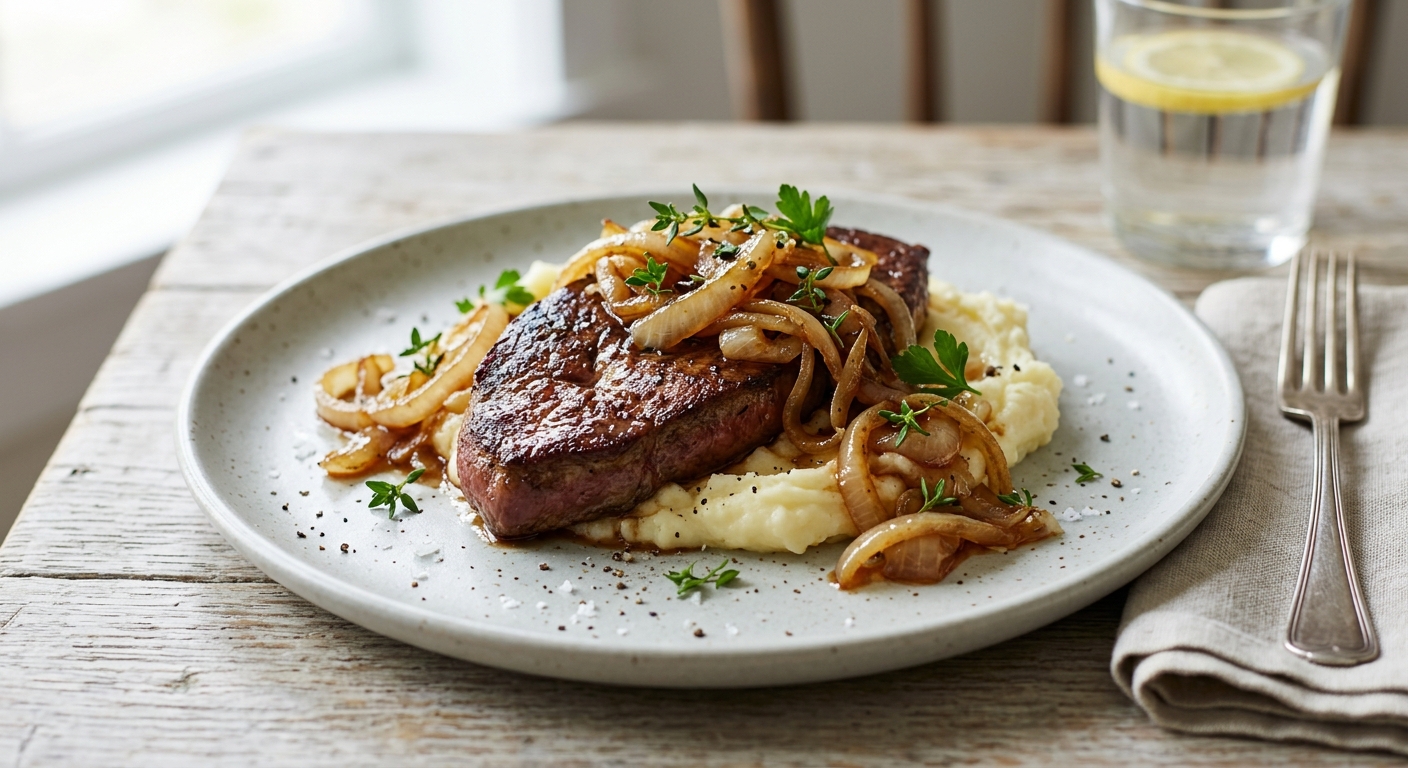
Liver has a reputation problem it does not deserve. For generations, overcooked, grey slabs served with underprepared onions turned millions away from what is, gram for gram, the most nutrient-dense whole food on the planet. This reimagined version respects both the ingredient and the diner: beef liver is sliced thin, seasoned confidently, and cooked quickly to a blush-pink center, then paired with deeply caramelized balsamic onions, a splash of dry sherry, and fresh thyme for a dish that would feel at home in a Parisian bistro.
The nutritional story here is almost hard to believe. A 150g portion of beef liver contains roughly 16mg of highly bioavailable heme iron, meeting over 300% of the daily reference intake for an adult. Unlike the non-heme iron found in spinach or legumes, heme iron is absorbed at 15 to 35% efficiency regardless of what else you eat, making liver one of the most reliable ways to address iron deficiency, which remains the world’s most common nutritional shortfall. That same serving also delivers more than 1,000% DV of vitamin B12, critical for neurological function and red blood cell formation, plus preformed vitamin A (retinol) that your body uses immediately without conversion.
Equally impressive is the copper content, which works synergistically with iron to support hemoglobin synthesis, and the folate levels that rival those found in dark leafy greens. We pair the liver with caramelized onions, which contribute quercetin and organosulfur compounds, and finish with parsley, adding a bright hit of vitamin C that further enhances iron absorption. This is precision nutrition that actually tastes like a treat.
4
servings
Ingredients
- 600 gbeef liver, sliced 1cm thick, membranes and sinew trimmed
- 250 mlwhole milk (for soaking)
- 3 largeyellow onions, halved and thinly sliced
- 3 tbspextra-virgin olive oil, divided
- 1 tbspunsalted butter
- 2 tbspbalsamic vinegar
- 80 mldry sherry or dry white wine
- 120 mllow-sodium beef stock
- 1 tbspDijon mustard
- 4 clovesgarlic, thinly sliced
- 5 sprigsfresh thyme
- 1 tspsweet smoked paprika
- 30 gfresh flat-leaf parsley, roughly chopped
- 2 tbspplain flour (for dredging)
- —Colima Sea SaltMicroplastic Free Salt and cracked black pepper to taste
Instructions
Click on an item below to shop for the recommended items for this recipe on Amazon.
As an Amazon Associate, we earn from qualifying purchases.
- Place the trimmed liver slices in a shallow bowl and pour the milk over them. Cover and refrigerate for at least 30 minutes (up to 2 hours). This draws out bitter compounds and mellows the flavor considerably. Pat completely dry with paper towels before cooking.
- Heat a large, heavy skillet or Dutch oven over medium-low heat. Add 1.5 tablespoons of olive oil and the butter. Once the butter foam subsides, add all the sliced onions with a generous pinch of salt. Cook, stirring every 3 to 4 minutes, for 22 to 25 minutes until the onions are deep golden and jammy. Do not rush this step over high heat, as you want genuine caramelization, not browning. Add the garlic slices for the last 3 minutes.
- Increase the heat to medium-high and deglaze the pan with the sherry. Let it bubble and reduce for 1 minute, scraping up any fond. Add the balsamic vinegar and beef stock, stir in the Dijon mustard and thyme sprigs, and simmer for 3 to 4 minutes until slightly syrupy. Transfer the onion sauce to a bowl and cover loosely. Wipe the pan clean.
- Season the liver slices with smoked paprika, salt, and pepper. Spread the flour on a plate and dredge each slice lightly, shaking off the excess. The thin flour coating creates a delicate crust that locks in juices without making the liver heavy.
- Return the pan to high heat and add the remaining 1.5 tablespoons of olive oil. When the oil shimmers and just begins to smoke, lay the liver slices in a single layer. Sear undisturbed for 90 seconds, then flip and sear for another 60 to 90 seconds. The liver should be lightly browned outside and just pink in the center. Do not overcook: grey liver is tough and strongly flavored.
- Return the onion sauce to the pan around the liver and warm together for 30 seconds. Remove thyme sprigs, taste for seasoning, scatter with fresh parsley, and serve immediately over mashed potatoes, polenta, or buttered egg noodles.
- Soak the liver slices in milk as described, for at least 30 minutes. Pat dry thoroughly. Do not dredge in flour for this method: the slow cooker generates steam and the flour turns gluey. Instead, season the liver generously with smoked paprika, salt, and pepper on both sides.
- Heat a skillet over medium-high heat with 1 tablespoon of olive oil. Working in batches, sear the liver slices for just 45 seconds per side. You are building color and flavor only, not cooking through. Transfer the seared slices to the slow cooker insert in a single layer or slight overlap.
- Without cleaning the skillet, reduce heat to medium and add the remaining oil and butter. Cook the sliced onions with a pinch of salt, stirring occasionally, for 15 to 18 minutes until softened and golden. Add the garlic for the last 2 minutes. Deglaze with sherry, scraping the fond, and let it reduce for 1 minute. Stir in the balsamic vinegar, beef stock, Dijon mustard, and thyme sprigs.
- Pour the entire onion mixture over the liver in the slow cooker insert. The liquid should come about halfway up the liver slices. Add a splash more stock if needed. Place the lid on and cook on Low for 2.5 to 3 hours. Check at 2.5 hours: the liver should be cooked through but still feel slightly yielding when pressed with a spoon, not firm or rubbery.
- Remove the thyme sprigs. Using a slotted spoon, transfer the liver to a serving platter. If the sauce is thinner than you prefer, pour it into a small saucepan and simmer over medium-high heat for 4 to 5 minutes to reduce and concentrate. Spoon the onion sauce over the liver, finish with fresh parsley, and serve.
- Soak and pat dry the liver as described. Season with smoked paprika, salt, and pepper. Skip the flour dredge for this method.
- Set the Instant Pot or pressure cooker to Saute on High (or use the stovetop for a stove-top pressure cooker). Add 1.5 tablespoons of olive oil and sear the liver slices in batches for 45 seconds per side. Remove and set aside on a plate. The liver will be very underdone at this stage, which is correct.
- Add the remaining oil and butter to the pot. Add the sliced onions and cook on Saute, stirring occasionally, for 10 to 12 minutes until softened and lightly golden. Add the garlic slices and cook for 1 more minute. Pour in the sherry and use a wooden spoon to deglaze all the browned bits from the bottom of the pot. This step is critical in pressure cooking: any stuck fond can trigger a burn warning. Add the balsamic vinegar, beef stock, Dijon mustard, and thyme sprigs, and stir to combine.
- Nestle the seared liver slices back into the pot, submerging them partially in the liquid. Lock the lid and set the valve to Sealing. Cook at High Pressure for 4 minutes.
- Once the cooking cycle ends, allow a full natural pressure release for 10 minutes, then carefully turn the valve to Venting to release any remaining steam. Open the lid away from you. The liver should be cooked through with a tender, almost silky texture. Remove the thyme sprigs. If you prefer a thicker sauce, remove the liver and switch back to Saute mode, simmering the sauce for 3 to 4 minutes. Finish with fresh parsley and serve.
- Preheat your oven to 160C (320F). Soak and pat dry the liver as described. Season with smoked paprika, salt, and pepper. Do not dredge in flour for braising.
- In an oven-safe skillet, saute pan, or shallow Dutch oven, heat 1.5 tablespoons of olive oil over medium heat on the stovetop. Sear the liver slices for 45 seconds per side in batches, then remove to a plate. The goal here is color and a flavor crust, not doneness.
- In the same pan over medium heat, add the remaining oil and butter and cook the sliced onions with a pinch of salt for 15 to 18 minutes until deep golden and jammy. Add the garlic for the final 2 minutes, then deglaze with the sherry, letting it reduce for 1 minute. Stir in the balsamic vinegar, beef stock, Dijon mustard, and thyme sprigs to form a fragrant braising liquid.
- Lay the seared liver slices in a single layer over the onion mixture in the pan. Spoon some of the braising liquid over the top of each slice. Cover the pan tightly with a lid or two layers of foil, crimped firmly around the edges to trap steam.
- Transfer to the preheated oven and braise for 22 to 25 minutes. At 22 minutes, carefully lift the lid and check the liver: it should be just cooked through with no raw pink remaining but still feel slightly springy. Remove from the oven and rest, covered, for 5 minutes. The residual heat will finish any underdone areas. Remove thyme sprigs, scatter generously with fresh parsley, and serve directly from the braising pan for a rustic presentation.
Nutrition Breakdown
Per 1 serving (makes 4)
Vitamins & Minerals
% Daily Value based on a 2,000 calorie diet (FDA reference)
🧬 Essential Amino Acids
% of recommended daily intake (RDA) per serving
🛡 Antioxidant Profile
The Nutrition Science
The extraordinary iron density of beef liver comes down to biology: the liver is the organ responsible for processing and storing iron in living animals, meaning it accumulates haem iron bound to myoglobin and ferritin at concentrations found nowhere else in the food supply. Heme iron, the form present in animal tissues, is absorbed via dedicated intestinal transporters (HCP1) at rates of 15 to 35%, compared to just 2 to 10% for the non-heme iron in plant foods. This bioavailability gap is why liver remains clinically relevant for populations with elevated iron requirements, including menstruating adults, pregnant women, and those recovering from iron-deficiency anemia.
The vitamin B12 content deserves equal attention. At over 50 micrograms per 150g serving, a single plate provides enough B12 to saturate intrinsic-factor-mediated absorption and still leave meaningful amounts to be absorbed by passive diffusion. B12 is essential for the methylation of homocysteine to methionine, a reaction that protects cardiovascular tissue, and for myelin sheath synthesis in the nervous system. Deficiency, common in vegans and older adults with reduced gastric acid production, manifests slowly over years before causing irreversible neurological damage. Liver is one of the most efficient dietary correctives available.
The pairing of liver with caramelized onions is more than culinary tradition: it is smart nutritional engineering. Quercetin and other flavonoids in onions have been shown in cell-culture models to chelate free iron ions in the gut lumen, reducing oxidative stress from excess iron while the organosulfur compounds from garlic and onions stimulate hepatic glutathione synthesis, the body’s primary endogenous antioxidant system. The fresh parsley finish adds ascorbic acid that keeps gut-lumen iron in its reduced, absorbable ferrous state. Every element of this dish was chosen to maximize both the absorption and the safe utilization of its exceptional mineral payload.
Pro Tips
- Never skip the milk soak: soaking the liver in milk for 30 minutes to 2 hours draws out blood and bitter-tasting compounds via osmosis, producing a noticeably milder, more approachable flavor with no nutritional cost.
- Thin, even slices are non-negotiable for quality results. Ask your butcher to slice the liver at 1cm, or partially freeze it for 20 minutes before slicing yourself: the firm texture makes clean, uniform cuts much easier.
- Liver continues to cook significantly off the heat. Pull it from the pan, slow cooker, or oven when it still looks very slightly underdone at the center: residual heat will carry it to the perfect blush-pink finish. Grey, fully contracted liver is the single biggest reason people claim to dislike it.
Oh wow, this is RIGHT up my alley – I’ve been tracking iron absorption for months now after realizing my anemia symptoms were tied to poor bioavailability, not just quantity! The balsamic vinegar detail is huge because I learned the hard way that pairing iron with vitamin C actually transforms how my body absorbs it / I’d love to know if you used grass-fed liver here since that’s been a game changer for my inflammation markers compared to conventional. Also tagging @SarahG and @MikeH who I know have been exploring nutrient-dense offal options for their own gut healing journeys – this could be perfect for moving beyond supplements!
Excellent approach to liver, and that iron bioavailability gets a real boost from the vitamin C in balsamic vinegar. I’d be curious about the fat profile here though, beef liver fans – while it’s nutritionally dense, conventional beef liver tends toward higher omega-6. If you can source grass-fed liver, you’re looking at a meaningfully better omega-3 to omega-6 ratio. The B12 and folate density makes this a genuine functional medicine tool for methylation support, which I’ve seen translate directly to improved homocysteine markers in my cardiology patients.
omg the balsamic vinegar detail is making me think about how fermented foods could amp this up even more – like if you made a quick fermented onion situation alongside this, the acidity plus the beneficial bacteria would seriously enhance iron absorption! ive been experimenting with fermenting my own condiments and adding them to iron rich meals has genuinely changed how i feel energy-wise, plus theres something kind of magical about how fermented veggies seem to support overall gut health when youre absorbing all these micronutrients