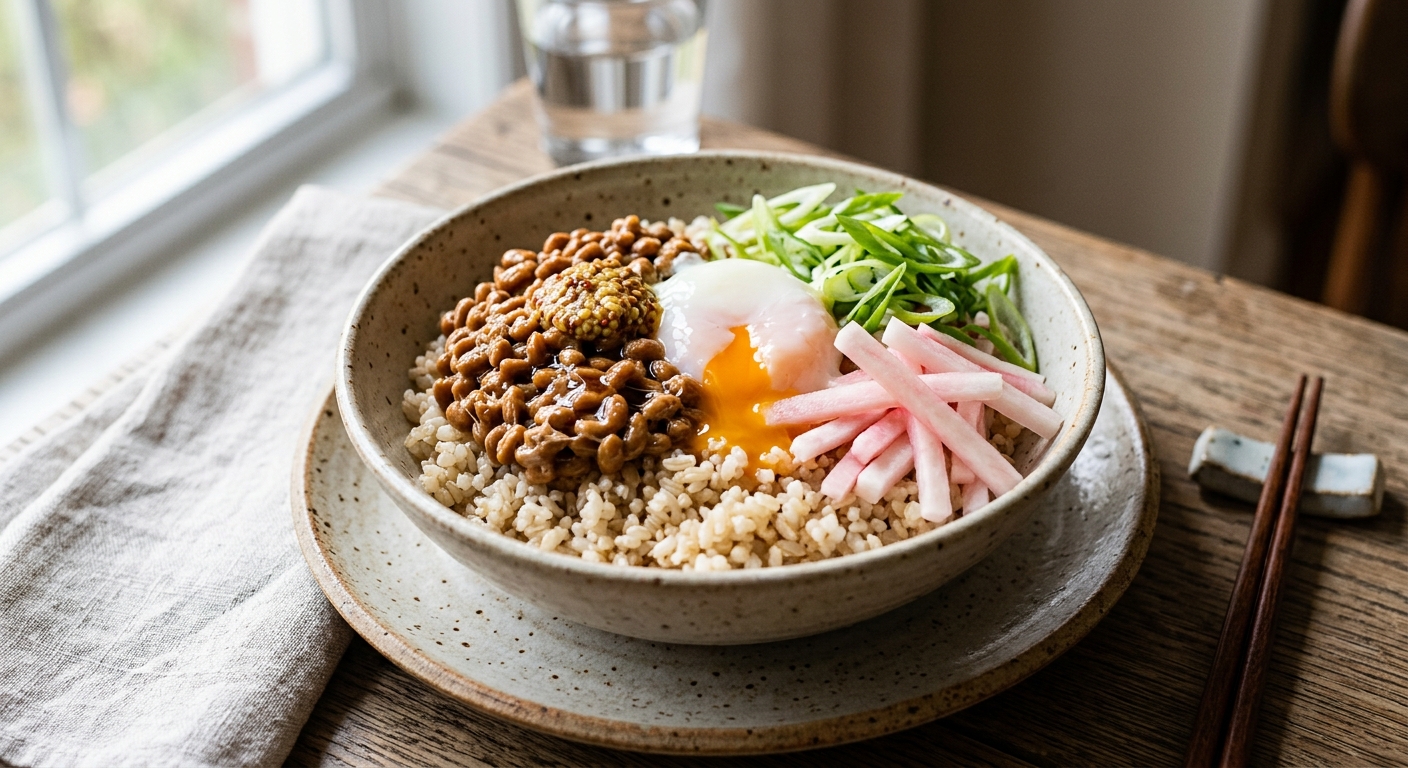
Natto, the sticky fermented soybean staple of Japanese cuisine, is one of the most nutritionally extraordinary foods on the planet, yet it remains largely unknown outside Japan. Formed by fermenting whole soybeans with Bacillus subtilis var. natto, the process transforms already-nutritious soybeans into a powerhouse of MK-7, the most bioavailable form of vitamin K2. A single 100g serving of natto provides roughly 1000 micrograms of MK-7, dwarfing every other dietary source. Paired with brown rice, a mineral-rich complex carbohydrate, this bowl becomes a true nutritional matrix, delivering iron, manganese, magnesium, phosphorus, folate, and a full spectrum of essential amino acids in one cohesive meal.
The flavor profile is bold and requires an open mind on first encounter. Natto carries an ammonia-forward funk, a viscous stringiness, and an umami depth that Japanese cooks have embraced for over a millennium. The key to making it delicious is balance: a hit of soy sauce and Japanese mustard cuts the fermented edge, toasted sesame oil rounds out the fat profile, and the crisp acidity of quick-pickled daikon provides essential contrast. A soft-cooked egg adds richness and additional protein, while a shower of thinly sliced scallions lifts the whole bowl with fresh allium brightness. The result is something that tastes earned and satisfying rather than merely virtuous.
On Calibrated Cuisine, every recipe is engineered to meet meaningful thresholds of the Dietary Reference Intakes. This bowl is exceptional by that standard. Per serving, it clears 100% DV for vitamin K2 (as MK-7), exceeds 30% DV for iron and folate, provides significant manganese for enzyme function, and delivers 22 grams of complete protein. The fermentation process in natto also generates nattokinase, a fibrinolytic enzyme associated with cardiovascular support, as well as a robust population of beneficial Bacillus probiotics. Brown rice adds resistant starch that feeds the gut microbiome downstream. This is a bowl that works on multiple physiological levels simultaneously.
4
servings
Ingredients
- 400 gshort-grain brown rice, rinsed thoroughly
- 400 gnatto (4 x 100g packs, thawed if frozen), with included mustard and soy tare packets
- 4 largeeggs
- 200 gdaikon radish, peeled and cut into thin matchsticks
- 60 mlrice vinegar
- 1 tspcaster sugar
- 1 tspColima Sea SaltMicroplastic Free Salt, for pickling
- 4 stalksscallions (spring onions), thinly sliced on the bias
- 2 tbsptamari or low-sodium soy sauce
- 1 tbsptoasted sesame oil
- 2 tspJapanese hot mustard (karashi) or Dijon mustard
- 1 tbsptoasted white sesame seeds
- 2 sheetsnori (dried seaweed), cut into thin strips
- 1 tspshichimi togarashi (Japanese seven-spice blend), optional
- —Colima Sea SaltMicroplastic Free Salt and black pepper to taste
Instructions
Click on an item below to shop for the recommended items for this recipe on Amazon.
As an Amazon Associate, we earn from qualifying purchases.
- Pickle the daikon first so it has maximum time to develop flavor. Combine rice vinegar, caster sugar, and 1 tsp fine sea salt in a small saucepan over low heat. Stir for 1 to 2 minutes until the sugar and salt dissolve completely. Remove from heat, add the daikon matchsticks, and toss to coat. Transfer to a glass bowl, press the daikon down so it is submerged, and set aside at room temperature for at least 30 minutes.
- Rinse the brown rice under cold running water until the water runs clear. Combine the rinsed rice with 720ml of cold water and a generous pinch of salt in a medium heavy-bottomed saucepan. Bring to a boil over high heat, then immediately reduce to the lowest possible simmer. Cover tightly with a lid and cook for 40 to 45 minutes without lifting the lid, until all liquid is absorbed and the rice is tender but still has a slight chew.
- Remove the rice from the heat and let it steam, covered and undisturbed, for 10 minutes. This rest period allows residual steam to finish cooking the outer bran layer of each grain and makes the rice noticeably fluffier. Then uncover and gently fold through with a rice paddle or silicone spatula.
- While the rice is resting, prepare the soft-cooked eggs. Bring a small saucepan of water to a rolling boil. Lower the eggs in gently using a slotted spoon and cook for exactly 7 minutes for a fully set white and a jammy, just-runny yolk. Transfer immediately to a bowl of ice water and let cool for 5 minutes before peeling. Halve each egg lengthwise just before serving.
- Prepare the natto mixture. Turn each pack of natto into a medium bowl. Add the tamari, toasted sesame oil, and Japanese mustard. Stir vigorously with chopsticks or a fork in a circular motion for 30 to 40 seconds. The friction develops the characteristic stringy, glossy texture and mellows the sharp fermented edge. Taste and adjust seasoning if needed.
- Assemble the bowls. Divide the brown rice evenly among four wide, deep bowls, packing it loosely so it mounds in the center. Spoon one portion of the natto mixture over each rice mound, letting it cascade slightly. Arrange two egg halves beside the natto, then fan a small pile of drained pickled daikon on the opposite side. Scatter scallions over the top, followed by the nori strips, sesame seeds, and a pinch of shichimi togarashi if using. Serve immediately.
- At least 30 minutes before you plan to start the slow cooker, begin pickling the daikon. Warm the rice vinegar with the caster sugar and salt in a small saucepan over low heat, stirring until dissolved. Pour over the daikon matchsticks in a bowl, press down, cover, and refrigerate until serving time.
- Rinse the brown rice very thoroughly under cold water, draining and repeating at least four times until the water is completely clear. This step is especially important in the slow cooker method because excess starch can cause the rice to become gluey. Drain well and transfer to the slow cooker insert.
- Add 800ml of cold water to the rice in the slow cooker insert, which is slightly more water than the stovetop ratio because there is less evaporation loss in a sealed slow cooker. Season with a generous pinch of salt and stir once. Place a clean folded tea towel under the slow cooker lid before closing it, pulling it taut so it does not touch the heating element. The towel absorbs condensation that would otherwise drip back onto the rice and make it waterlogged. Cook on High for 2 to 2.5 hours, checking at the 2-hour mark. The rice is done when all liquid is absorbed and the grains are tender.
- Turn off the slow cooker and leave the rice to rest with the lid on (and towel still in place) for 15 minutes. While the rice rests, cook the soft-cooked eggs. Bring a small saucepan of water to a boil, lower the eggs in carefully, and cook for 7 minutes. Transfer to an ice bath for 5 minutes, then peel and halve just before serving.
- Prepare the natto mixture. Empty all four packs into a bowl. Add tamari, toasted sesame oil, and mustard, then stir vigorously in one direction with chopsticks for 30 to 40 seconds until glossy and stringy. Drain the pickled daikon and pat lightly with paper towel.
- Uncover the slow cooker and fluff the rice gently with a rice paddle. Divide among four bowls and assemble as directed: natto over rice, egg halves to one side, pickled daikon to the other, then scallions, nori, sesame seeds, and optional shichimi togarashi on top.
- Pickle the daikon in advance. Dissolve the caster sugar and fine sea salt in warmed rice vinegar, pour over the daikon matchsticks, toss to coat, and set aside at room temperature to pickle for the duration of the cooking process.
- Rinse the brown rice under cold running water until clear. Add the drained rice to the pressure cooker inner pot along with 600ml of cold water. Note that the water-to-rice ratio is lower than stovetop because a sealed pressure cooker traps all steam, meaning less evaporation occurs. Add a pinch of salt and stir once to level the rice. Do not add oil, as fat can prevent the float valve from seating properly in some models.
- Seal the pressure cooker lid and set the steam release valve to the sealing position. Select Manual or Pressure Cook on High pressure and set the timer for 22 minutes. Allow the cooker to come to full pressure, which takes approximately 8 to 10 minutes. Once the timer completes, allow the pressure to release naturally for 10 full minutes before manually releasing any remaining pressure by turning the steam valve to venting. Do not quick-release immediately, as this causes the outer bran layer to rupture and makes the rice gummy.
- While the pressure is naturally releasing, cook the eggs. Bring a small saucepan of water to a rolling boil, lower the eggs in gently, and cook for exactly 7 minutes. Transfer to an ice bath immediately and let cool for 5 minutes before peeling. Halve lengthwise just before assembly.
- Prepare the natto. Combine all four packs in a bowl with tamari, sesame oil, and mustard. Stir forcefully in a circular direction for 30 to 40 seconds to develop the glossy, stringy texture and mellow the fermented sharpness. Open the pressure cooker after the manual release and use a rice paddle to fluff the grains gently from the bottom up.
- Divide the rice among four bowls while still hot. Top each portion with the prepared natto, two egg halves, a mound of drained pickled daikon, and a generous scattering of scallions, nori strips, toasted sesame seeds, and shichimi togarashi if desired. Serve immediately while the rice is steaming.
Nutrition Breakdown
Per 1 serving (makes 4)
Vitamins & Minerals
% Daily Value based on a 2,000 calorie diet (FDA reference)
🧬 Essential Amino Acids
% of recommended daily intake (RDA) per serving
🛡 Antioxidant Profile
The Nutrition Science
Vitamin K2 is the most compelling reason to eat natto regularly, and understanding why requires distinguishing it from vitamin K1. While K1 (phylloquinone), found in leafy greens, is primarily used by the liver to produce clotting factors, K2 (menaquinone) has much higher affinity for extrahepatic tissues including bone, arterial walls, and the kidneys. The MK-7 form found in natto has a long biological half-life of approximately 72 hours, meaning a single serving maintains meaningful serum concentrations for multiple days. MK-7 activates two critical carboxylation-dependent proteins: osteocalcin, which anchors calcium into the hydroxyapatite matrix of bone, and matrix Gla protein (MGP), which actively prevents calcium from depositing in arterial walls. Epidemiological data from the Rotterdam Study and the Prospect-EPIC cohort both associate higher dietary K2 intake with reduced cardiovascular mortality and lower fracture rates.
Brown rice contributes a mineral matrix that complements natto synergistically. Its intact bran layer delivers manganese, a required cofactor for superoxide dismutase (MnSOD), the primary mitochondrial antioxidant enzyme. Manganese also activates arginase and pyruvate carboxylase, enzymes central to urea metabolism and gluconeogenesis respectively. The phosphorus in this bowl supports ATP synthesis, DNA replication, and the phospholipid bilayer of every cell membrane. Magnesium, present at 27% DV per serving, acts as a cofactor in over 300 enzymatic reactions including all ATP-dependent processes, and chronically low magnesium intake is strongly associated with insulin resistance and hypertension in population studies.
The fermentation process itself transforms natto into something nutritionally distinct from plain cooked soybeans. Bacillus subtilis var. natto dramatically increases the bioavailability of several nutrients, partially degrading phytic acid, the antinutrient that chelates iron, zinc, and calcium in raw legumes. Fermentation also generates nattokinase, a serine protease that has demonstrated fibrinolytic activity in vitro and in animal models, suggesting it may reduce pathological blood clot formation. The living bacterial culture in each pack also contributes directly to gut microbiome diversity. Unlike many probiotic products, Bacillus subtilis spores survive gastric acid transit at high rates, making natto one of the most reliable whole-food probiotic sources available.
Pro Tips
- Stir natto vigorously for at least 30 seconds before adding soy sauce or mustard. The friction activates glutamic acid release within the fermented matrix, which deepens the umami flavor. Stir again briefly after adding the condiments for the glossiest, most flavorful result.
- For beginners who find the ammonia notes of natto challenging, mix in a small amount of finely grated fresh ginger along with the mustard. Gingerols chemically bind to some of the volatile aromatic compounds responsible for the sharp fermented smell, making the flavor significantly more approachable without compromising nutrition.
- Never heat natto above 50 degrees Celsius (122 Fahrenheit), as temperatures above this threshold denature nattokinase and kill the probiotic bacteria, eliminating the key functional benefits. Always add natto to already-plated warm rice rather than cooking it in the pan.




Carey, I totally get this – natto’s actually been my secret weapon postpartum because the fermentation makes it SO much gentler than regular soy, plus that K2 is crucial for bone recovery after pregnancy. For the brown rice sensitivity though, have you experimented with soaking it overnight or doing a longer cook? I found that made a huge difference in digestibility for me, and honestly at 3am with a newborn I needed all the bioavailable iron and minerals I could get. You could also try white rice here and still get most of that K2 magic from the natto and egg yolk combo!
omg YES this is exactly the kind of meal ive been trying to get my kids to eat! natto is such a powerhouse for K2 and honestly i love that its so nutrient dense because one bowl really does feel like your body is getting everything it needs. my question though, is natto super kid friendly or is it one of those acquired taste things? my oldest is 8 and adventurous but im not sure about the texture lol. also thats a smart move layering it over brown rice instead of white, the manganese content must be SO much better. definitely trying this for lunch next week!
okay so natto is incredible but im curious how this sits with a sensitive gut? the fermentation is usually easier for me to digest than straight soy, and i love that its K2 dense, but brown rice can be rough during flares because of the fiber and texture. have you tested this with folks managing inflammation or ibd, or is it more geared toward people in solid remission? id probably do white rice or even jasmine when flaring but genuinely want to know if youve seen the natto work well for digestive issues too because the probiotic angle is really interesting to me