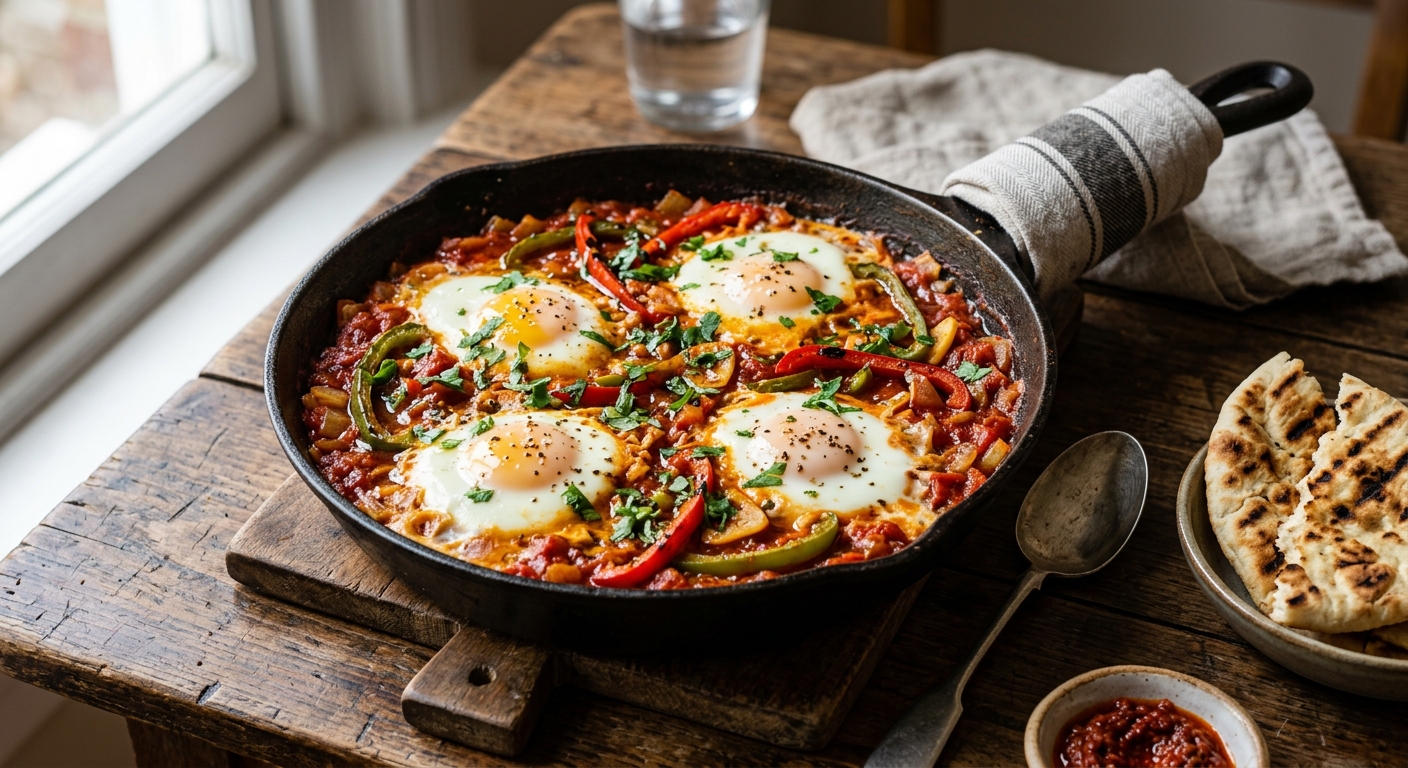
Shakshuka is one of those rare dishes where pleasure and nutrition align so perfectly it almost feels like a trick. Originating in the Maghreb region of North Africa and particularly beloved in Tunisia, this dish of eggs poached directly in a spiced tomato and pepper sauce has fed generations of families who understood intuitively what nutrition science now confirms: combining iron-rich ingredients with vitamin C sources in the same pan dramatically increases how much of that iron your body actually absorbs. The Tunisian version distinguishes itself from its Israeli and Middle Eastern cousins through the bold, complex heat of harissa, a chili paste built on roasted red peppers, caraway, and cumin that contributes not just fire but an entire additional layer of antioxidant compounds.
What makes this recipe exceptional from a nutritional engineering standpoint is the deliberate stacking of non-heme iron sources alongside heme-adjacent and vitamin C-rich ingredients. The chickpeas and spinach anchor the iron content while the red bell peppers, tomatoes, and harissa supply over 180mg of vitamin C per serving, well over twice the RDI. This matters because the ascorbic acid in vitamin C actively reduces ferric iron (Fe3+) to ferrous iron (Fe2+), the form your intestinal cells can actually transport across the gut wall. Without this conversion, as much as 85% of plant-based iron passes through unabsorbed. This dish is essentially a delivery mechanism engineered by centuries of culinary tradition before the biochemistry had a name.
We offer four cooking methods here because shakshuka is genuinely versatile. The stovetop in a cast iron skillet gives you the most control over egg doneness and the best caramelisation on the sauce. The slow cooker method builds a richer, deeper base over hours before you finish the eggs at the end, a technique that rewards a lazy Sunday morning. The pressure cooker collapses the sauce development into minutes using the Maillard reaction from the saute function before pressure-building the stew base. The oven method, beloved by restaurant cooks, surrounds the eggs with even radiant heat for perfectly set whites and runny yolks every single time. Choose your adventure.
4
servings
Ingredients
- 2 tbspextra-virgin olive oil
- 1 largeyellow onion, finely diced
- 2 largered bell peppers, cored and cut into 1cm strips
- 1 largegreen bell pepper, cored and cut into 1cm strips
- 6 clovesgarlic, thinly sliced
- 3 tbspharissa paste (store-bought or homemade)
- 1 tspground cumin
- 1 tspsweet smoked paprika
- 0.5 tspground caraway seeds
- 0.25 tspground turmeric
- 800 gcanned whole peeled tomatoes (two 400g cans), crushed by hand
- 240 gcanned chickpeas, drained and rinsed
- 100 gbaby spinach, loosely packed
- 8 largeeggs
- 80 gfeta cheese, crumbled
- 1 tsphoney
- 30 gfresh flat-leaf parsley, roughly chopped
- 20 gfresh coriander, roughly chopped
- 1 tbsplemon juice, freshly squeezed
- —Colima Sea SaltMicroplastic Free Salt and freshly ground black pepper to taste
Instructions
Click on an item below to shop for the recommended items for this recipe on Amazon.
As an Amazon Associate, we earn from qualifying purchases.
- Heat the olive oil in a large (30cm) cast iron skillet or heavy-bottomed pan over medium heat. Add the diced onion and a generous pinch of salt. Cook, stirring occasionally, for 8 to 10 minutes until the onion is soft, translucent, and beginning to turn golden at the edges. Do not rush this step; the caramelised sugars in the onion build the flavour foundation of the sauce.
- Add the red and green bell pepper strips to the pan. Increase heat to medium-high and cook for 6 to 7 minutes, stirring every 2 minutes, until the peppers have softened and developed some charred edges. Add the sliced garlic and cook for 90 seconds until fragrant, stirring constantly so the garlic does not burn.
- Push the vegetables to the edge of the pan and add the harissa paste to the empty centre. Let it sizzle and toast in the oil for 60 seconds before stirring it through the vegetables. Add the cumin, smoked paprika, caraway, and turmeric. Stir to coat everything, then cook for another 30 seconds until the spices are deeply aromatic.
- Pour in the hand-crushed tomatoes with all their juices. Add the honey, then stir and scrape up any browned bits from the bottom of the pan. Bring to a vigorous simmer, then reduce heat to medium-low. Cook uncovered for 12 to 15 minutes, stirring occasionally, until the sauce has thickened and the oil has started to separate and pool at the surface, a sign the flavour has fully concentrated. Stir in the chickpeas and baby spinach, cooking for 2 minutes until the spinach is just wilted. Taste and adjust salt, pepper, and lemon juice.
- Using a large spoon, create 8 evenly spaced wells in the sauce. Crack one egg into a small bowl, check for shell fragments, then slide it into a well. Repeat for all 8 eggs. Reduce heat to low, cover the pan with a lid or foil, and cook for 7 to 9 minutes, checking at 7 minutes, until the egg whites are fully set but the yolks remain glossy and slightly wobbly. The residual heat will continue cooking them off the stove, so pull them at the edge of set.
- Remove from heat. Squeeze the lemon juice over the entire pan. Scatter the crumbled feta, chopped parsley, and coriander over the top. Serve immediately, directly from the pan, with crusty bread or flatbread for scooping.
- Before loading the slow cooker, build the flavour base on the stovetop. Heat the olive oil in a skillet over medium-high heat and saute the onion for 5 minutes until softened. Add the bell peppers and cook for 4 minutes. Add the garlic, harissa, and all the dried spices, stir vigorously for 60 seconds until fragrant. This quick saute is essential because the slow cooker cannot caramelise vegetables or bloom spices effectively.
- Transfer the sauteed vegetable mixture to the slow cooker insert. Add the hand-crushed tomatoes, chickpeas, and honey. Stir everything together, then season lightly with salt and pepper (you will adjust again at the end). Do not add the spinach, eggs, or fresh herbs yet.
- Place the lid on the slow cooker and cook on Low for 5 to 6 hours. The sauce will thicken and deepen considerably. During the last 30 minutes, remove the lid slightly ajar to allow steam to escape and the sauce to concentrate further. At the 5-hour mark, stir the baby spinach into the sauce, replace the lid, and let it wilt for 10 minutes.
- Increase the slow cooker to the High setting. Using a spoon, make 8 wells in the sauce. Crack each egg individually into a small bowl before transferring to its well, this protects against broken yolks ruining a well. Replace the lid and cook on High for 20 to 25 minutes. Begin checking at 18 minutes. The whites should be fully opaque and set while the yolks remain soft. If your slow cooker runs hot, start checking at 15 minutes.
- Once the eggs are set to your liking, squeeze lemon juice over the entire dish. Stir to taste for salt and pepper. Scatter feta, parsley, and coriander directly over the surface in the cooker insert and serve immediately at the table. Leftovers without eggs keep in the fridge for 3 days.
- Set your Instant Pot or electric pressure cooker to Saute on the High or More setting. Add the olive oil and heat until shimmering. Add the onion with a pinch of salt and saute for 5 to 6 minutes, stirring frequently, until softened and lightly golden. Add the bell peppers and cook for 3 minutes until slightly softened.
- Add the sliced garlic, harissa paste, cumin, smoked paprika, caraway, and turmeric. Stir constantly for 60 to 90 seconds, allowing the spices to toast directly in the residual oil against the hot insert. This develops a rounded, deep spice note that pressure alone cannot achieve. Pour in a splash (about 60ml) of the canned tomato liquid and scrape the bottom of the insert thoroughly to deglaze any stuck bits, as these will trigger a burn warning during pressurisation.
- Add the remaining crushed tomatoes, chickpeas, and honey. Stir to combine. Cancel the Saute function. Secure the lid, set the pressure release valve to Sealing, and select Manual or Pressure Cook on High Pressure for 8 minutes. The pot will take approximately 8 to 10 minutes to come to pressure.
- When the cook time ends, perform a quick pressure release by carefully moving the valve to Venting. Once fully depressurised, remove the lid. The sauce will likely appear quite liquid. Select Saute on the Normal or Medium setting and simmer uncovered for 5 to 7 minutes, stirring regularly, until the sauce thickens to a scoopable consistency. Stir in the baby spinach and cook for 90 seconds until wilted. Taste and adjust seasoning and lemon juice now.
- Cancel the Saute function. The residual heat in the insert is sufficient to cook the eggs. Create 8 wells in the sauce with a spoon and crack the eggs in one at a time. Place the glass lid (not the pressure lid) or a large plate loosely over the top of the insert to trap heat. Allow the eggs to cook in the retained heat for 7 to 9 minutes, checking at 7 minutes. Finish with feta, parsley, coriander, and lemon juice. Serve promptly directly from the insert.
- Preheat your oven to 190 degrees Celsius (375 degrees Fahrenheit) with a rack positioned in the middle of the oven. Place an oven-safe cast iron skillet, enamelled braiser, or shallow ovenproof baking dish in the oven while it preheats. Starting with a hot vessel gives the sauce an immediate sear when it hits the pan.
- Build the sauce entirely on the stovetop in a separate large saucepan. Heat the olive oil over medium-high heat. Saute the onion for 8 minutes, then add the bell peppers and cook for 6 minutes. Add the garlic, harissa, and all dried spices, toast for 60 seconds. Pour in the crushed tomatoes and honey, scraping up any browned bits. Simmer over medium heat for 12 to 15 minutes, stirring regularly, until thickened and the oil separates to the surface. Stir in the chickpeas and spinach, cook 2 minutes, then add lemon juice and adjust seasoning. The sauce should be slightly thicker than you want it, as the oven will thin it slightly from the egg whites.
- Using oven mitts, carefully remove the preheated vessel from the oven. Pour and scrape the hot sauce into it immediately; you should hear a satisfying sizzle. Quickly create 8 evenly spaced wells in the sauce using a large spoon, working fast before the sauce sets against the hot surface.
- Crack each egg individually into a small bowl before carefully sliding them one by one into each prepared well. Work quickly so the eggs begin cooking at roughly the same time. Season each egg yolk with a tiny pinch of salt and a grind of black pepper.
- Carefully transfer the skillet to the middle rack of the preheated oven. Bake uncovered for 10 to 12 minutes. Check at 10 minutes: the whites should be fully opaque and just set at the edges of the yolk, while the yolks remain visibly glossy and domed. For firmer yolks, bake an additional 2 minutes. The oven method allows the egg whites to set from all sides simultaneously, producing cleaner whites than stovetop methods.
- Remove from the oven and allow to rest for 2 minutes, the eggs will continue to set slightly from the hot sauce beneath them. Scatter feta, parsley, and coriander over the top and serve the skillet at the table on a wooden board or trivet. Warn guests that the vessel is extremely hot.
Nutrition Breakdown
Per 1 serving (makes 4)
Vitamins & Minerals
% Daily Value based on a 2,000 calorie diet (FDA reference)
🧬 Essential Amino Acids
% of recommended daily intake (RDA) per serving
🛡 Antioxidant Profile
The Nutrition Science
The iron story in this dish is best understood through the lens of absorption chemistry. Shakshuka contains predominantly non-heme iron, the trivalent ferric form (Fe3+) found in plant foods and eggs, which your intestinal brush border cannot directly absorb. It must first be reduced to the divalent ferrous form (Fe2+) by an enzyme called duodenal cytochrome B, and this reduction is powerfully accelerated by ascorbic acid. At a ratio of roughly 2:1 vitamin C to iron by milligrams, absorption of non-heme iron can increase by three to six times compared to eating iron-rich plants without a vitamin C source. This dish provides approximately 182mg of vitamin C alongside 6.8mg of iron per serving, a ratio of about 27:1, which is nutritionally exceptional and ensures you are absorbing a meaningful fraction of the available iron rather than excreting most of it.
The fat from olive oil and egg yolks in this recipe plays a second and equally important role: it dramatically increases the bioavailability of the fat-soluble antioxidants and provitamins in the dish, specifically beta-carotene, lycopene, lutein, and zeaxanthin. These carotenoids are incorporated into mixed micelles in the small intestine, a process that requires dietary fat to occur. Research published in the American Journal of Clinical Nutrition demonstrated that consuming tomatoes cooked in oil increased lycopene absorption by over 400% compared to eating raw tomatoes without fat. Lycopene bioavailability is further enhanced by heat, which isomerises trans-lycopene (the dominant form in raw tomatoes) into cis-lycopene isomers that are more readily incorporated into micelles and transported to tissues. Every element of how this dish is cooked, the saute in oil, the long simmer of the tomatoes, the whole egg yolks, is working in service of your body’s ability to extract these compounds.
The chickpeas contribute more than bulk and texture. As a legume, they supply a meaningful amount of resistant starch and soluble fibre, both of which act as prebiotics in the colon, selectively feeding Bifidobacterium and Lactobacillus species. The short-chain fatty acids these bacteria produce, particularly butyrate, serve as the primary energy source for colonocytes (colon wall cells) and have been shown to downregulate the inflammatory transcription factor NF-kB. This anti-inflammatory effect is complemented at the molecular level by the quercetin from onions and the capsaicinoids from harissa, creating a dish that addresses inflammation through multiple simultaneous pathways. The combination of egg yolk choline (approximately 310mg per serving, over 56% of the Adequate Intake) further supports hepatic lipid metabolism and the synthesis of the neurotransmitter acetylcholine, making this a meal that genuinely supports both gut and brain health.
Pro Tips
- Do not skip the egg pre-cracking step: crack each egg into a small bowl before sliding it into the sauce well. This lets you check for shell fragments, catch a broken yolk before it ruins a well, and ensures all eggs hit the sauce at nearly the same moment for uniform doneness.
- To maximise iron absorption even further, avoid brewing tea or coffee within one hour of eating this meal. Tannins and polyphenols in both beverages form insoluble complexes with non-heme iron in the gut, directly competing with the vitamin C absorption enhancement you have carefully engineered into this dish.
- Harissa pastes vary enormously in heat and salt levels between brands. Taste yours before using and adjust the quantity accordingly. Rose harissa (a Tunisian variety made with rose petals) gives a more floral, complex heat and works beautifully here. For a deeper, smokier flavour, blend equal parts harissa with a teaspoon of tomato paste and a pinch of extra smoked paprika before adding.
This is smart work on the bioavailability angle, and I appreciate you highlighting it. I’m curious though about the protein distribution here, especially for those of us older folks trying to preserve muscle. Two eggs in a skillet sounds delicious and hits the iron story, but are we looking at maybe 12-14g protein per serving? I’ve been learning that hitting around 25-30g protein per meal matters more than I thought for muscle protein synthesis, so I’m wondering if you’d consider a version with Greek yogurt dolloped on top or maybe some crumbled feta mixed in to bump the leucine threshold. The iron bioavailability is gold, just want to make sure we’re not leaving gains
yo this is EXACTLY the kind of meal ive been prepping lately, the whole bioavailability angle changes everything. honestly used to just throw spinach at everything thinking iron was iron, but pairing it with that much vitamin c like you’re doing here is actually genius from a chemistry standpoint. the harissa paste homemade too? thats where the flavor complexity comes in because youre not dealing with oxidized spice blends, youre getting fresh heat and depth that makes the whole thing hit different. been meal prepping a version with za’atar eggs and wondering if you ever layer in some brined lemon or preserve the acidity intentionally to push that absorption even further
Oh I love this approach to bioavailability! Brixton, you’re touching on something so many of my clients realize once we dig into it, iron absorption is such a game changer when you pair it right. With shakshuka specifically, the eggs add choline and selenium to the mix, plus that lycopene in cooked tomatoes becomes even more available with the fat from the yolks. I’m definitely adding this to my rotation for clients who need a quick, complete iron meal that doesn’t feel like a chore to eat.