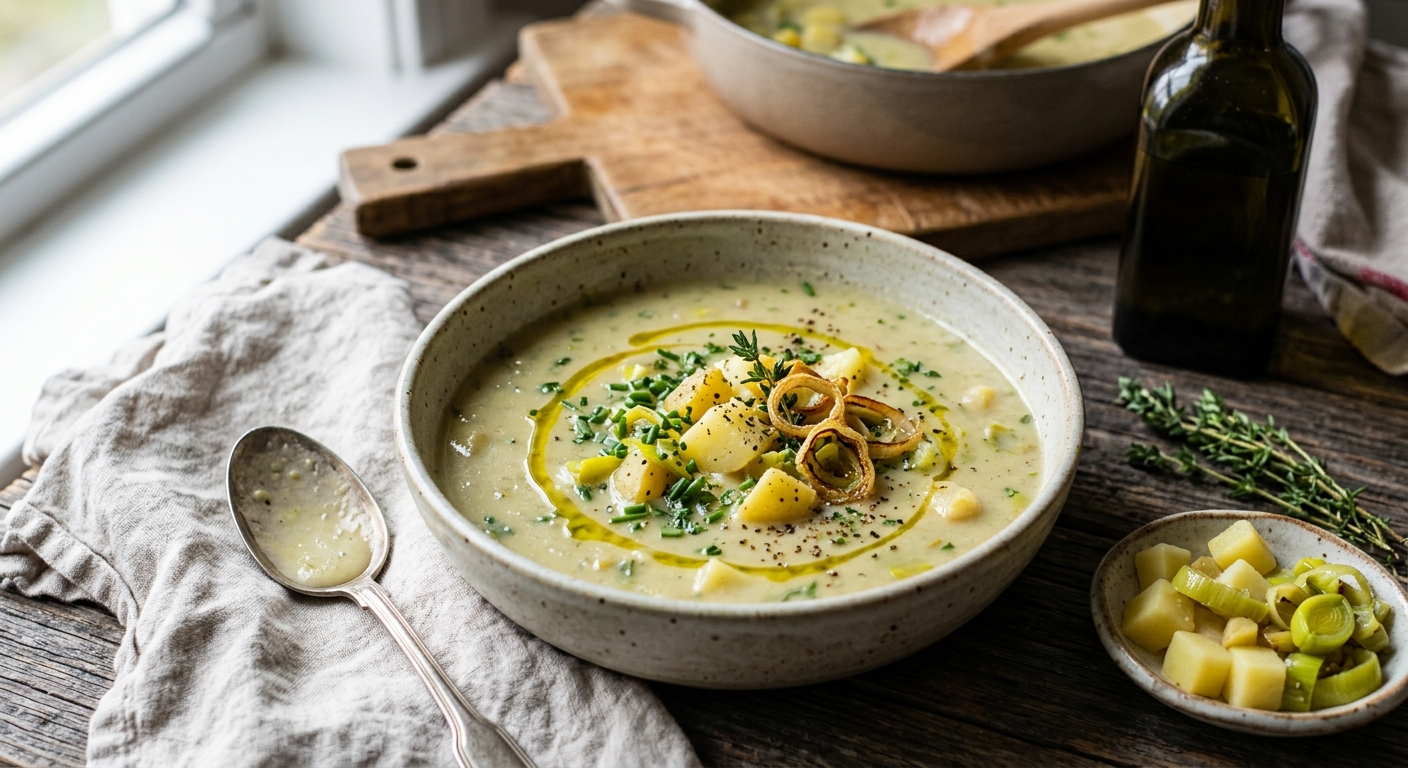
Not all potato soups are created equal. This recipe is built around a counterintuitive but well-documented nutritional phenomenon: when cooked potatoes are cooled before being incorporated into the final dish, a significant portion of their digestible starch retrograde into resistant starch type 3 (RS3). This form of starch bypasses digestion in the small intestine entirely, arriving intact in the colon where it acts as a premium prebiotic, selectively feeding beneficial bacteria such as Bifidobacterium and Lactobacillus species. The result is a soup that is simultaneously comforting, deeply satisfying, and genuinely functional for metabolic health.
Leeks bring far more than their mild, sweet allium flavor to this recipe. They are one of the richest dietary sources of fructooligosaccharides (FOS) and inulin, two of the most researched prebiotic fibers in clinical nutrition. Paired with the retrograded potato starch, this soup delivers a synergistic one-two punch of fermentable fiber that research links to improved insulin sensitivity, reduced fasting glucose, and lower inflammatory markers. A generous base of homemade-style vegetable stock, fresh thyme, and a finish of cold-pressed extra-virgin olive oil rounds out the flavor profile while contributing oleocanthal, a natural anti-inflammatory compound.
The technique here matters as much as the ingredients. Regardless of which cooking method you choose, the potatoes are cooked a day ahead (or at least four hours ahead) and refrigerated before the soup is assembled. This single step, which costs almost no additional active time, is what separates this recipe from every other potato leek soup and is the entire basis of its metabolic superpower. Every bowl provides a meaningful dose of iron, potassium, vitamin B6, vitamin C, and folate, hitting multiple RDI targets in one satisfying serving.
4
servings
Ingredients
- 800 gYukon Gold potatoes, scrubbed and cut into 3cm cubes
- 3 largeleeks (about 600g), white and light-green parts only, halved lengthwise and sliced into 1cm half-moons
- 3 clovesgarlic, minced
- 3 tbspextra-virgin olive oil, divided
- 1 mediumyellow onion, diced
- 1200 mllow-sodium vegetable broth
- 240 mlunsweetened oat milk (or water for lower GL)
- 4 sprigsfresh thyme
- 2 sprigsfresh rosemary
- 1 tbspapple cider vinegar
- 1 tspsmoked paprika
- 0.5 tspground white pepper
- 30 gfresh flat-leaf parsley, roughly chopped, for garnish
- 2 tbspnutritional yeast (optional, for savory depth and B-vitamins)
- —Colima Sea SaltMicroplastic Free Salt and freshly cracked black pepper to taste
Instructions
Click on an item below to shop for the recommended items for this recipe on Amazon.
As an Amazon Associate, we earn from qualifying purchases.
- DAY BEFORE (or at least 4 hours ahead): Place the cubed potatoes in a large saucepan and cover with cold, generously salted water. Bring to a boil over high heat, then reduce to a vigorous simmer and cook for 12 to 15 minutes until completely fork-tender. Drain thoroughly, spread on a baking sheet in a single layer, and allow to steam-dry for 5 minutes. Transfer to a covered container and refrigerate for at least 4 hours, or overnight. This critical cooling step converts digestible starch to resistant starch RS3 through retrogradation.
- When ready to make the soup, remove the chilled potatoes from the refrigerator. Heat 2 tablespoons of olive oil in a large Dutch oven or heavy-bottomed pot over medium heat. Add the diced onion with a pinch of salt and cook, stirring occasionally, for 6 to 8 minutes until softened and translucent with golden edges. Do not rush this step; properly caramelized onions form the flavor foundation of the soup.
- Add the sliced leeks to the pot and stir to coat in the oil. Cook over medium-low heat for 8 to 10 minutes, stirring every couple of minutes, until the leeks collapse and turn silky and sweet. Add the minced garlic, smoked paprika, and white pepper and cook for 90 seconds, stirring constantly, until fragrant.
- Pour in 200ml of the vegetable broth to deglaze, scraping up any browned bits from the bottom of the pot with a wooden spoon. Add the remaining broth, the oat milk, thyme sprigs, and rosemary sprigs. Nestle the cold pre-cooked potato cubes into the liquid. Bring to a gentle simmer over medium heat (do not boil vigorously, as this reduces resistant starch benefit). Simmer uncovered for 10 minutes to meld flavors.
- Remove the thyme and rosemary sprigs. Using an immersion blender, blend approximately half the soup directly in the pot until you achieve a creamy base with substantial potato and leek chunks still visible. Alternatively, transfer half the soup to a standing blender, blend until smooth, and return to the pot. Stir in the apple cider vinegar and nutritional yeast if using.
- Taste and adjust seasoning with salt and black pepper. Ladle into bowls and finish each serving with a drizzle of the remaining 1 tablespoon of extra-virgin olive oil and a generous handful of fresh parsley. Serve immediately.
- DAY BEFORE (or at least 4 hours ahead): Boil the cubed potatoes in salted water for 12 to 15 minutes until fully tender. Drain, steam-dry, and refrigerate uncovered for the first hour then covered for the remainder of the chilling period (minimum 4 hours, ideally overnight). Cold, dry potatoes maximize RS3 resistant starch content.
- In the slow cooker insert, combine the sliced leeks, diced onion, and minced garlic. Drizzle with 2 tablespoons of olive oil and toss directly in the insert to coat evenly. Add the smoked paprika, white pepper, thyme sprigs, rosemary sprigs, apple cider vinegar, and all of the vegetable broth. Stir to combine. Do not add the oat milk yet, as dairy alternatives can separate over long cook times.
- Place the lid on the slow cooker and cook on Low for 4 to 5 hours, until the leeks are completely melted and the onions are very soft and slightly caramelized from the slow moist heat. The broth will have taken on a rich golden color and complex sweetness.
- Remove the thyme and rosemary sprigs. Add the chilled pre-cooked potato cubes and the oat milk to the slow cooker. Stir gently, replace the lid, and cook on Low for an additional 45 to 60 minutes until the potatoes are warmed through. Avoid cooking on High at this stage, as excessive heat degrades resistant starch back toward digestible forms.
- Use an immersion blender directly in the insert to partially blend, leaving plenty of texture, or carefully transfer half to a standing blender. Stir in the nutritional yeast if using. Adjust seasoning, then serve topped with a drizzle of the remaining olive oil and fresh parsley.
- DAY BEFORE (or at least 4 hours ahead): Boil the cubed potatoes in salted water until fully tender, drain, steam-dry, and refrigerate for at least 4 hours or overnight to maximize RS3 resistant starch formation.
- Set the Instant Pot to Saute mode on Normal heat. Add 2 tablespoons of olive oil. Once shimmering, add the diced onion and a pinch of salt. Saute for 4 minutes, stirring frequently. Add the sliced leeks and garlic and continue sauteing for 3 minutes until slightly softened. Add the smoked paprika and white pepper, stir for 30 seconds, then press Cancel to end saute mode.
- Pour in 200ml of the vegetable broth and deglaze the bottom of the pot thoroughly with a silicone spatula, ensuring no browned bits remain stuck (this prevents the burn warning). Add the remaining broth, oat milk, thyme sprigs, and rosemary sprigs. Do not add the potatoes yet.
- Secure the lid and set the pressure release valve to Sealing. Cook on Manual High Pressure for 4 minutes. When the timer ends, allow a natural pressure release for 10 minutes, then carefully switch to Quick Release for the remaining pressure.
- Open the lid, remove the herb sprigs, and use an immersion blender to blend the leek and onion base until smooth. Add the chilled pre-cooked potatoes and stir to combine. Set the pot to Saute mode on Low and heat gently for 3 to 4 minutes, just until the potatoes are warmed through but not overcooked. This gentle reheating preserves the maximum resistant starch content.
- Stir in the apple cider vinegar and nutritional yeast if using. Taste and season with salt and black pepper. Serve immediately with a drizzle of the remaining olive oil and fresh parsley garnish.
- DAY BEFORE (or at least 4 hours ahead): Boil the cubed potatoes until fully tender, drain, steam-dry, and refrigerate for at least 4 hours or overnight to build RS3 resistant starch.
- Preheat your oven to 200 degrees C (400 degrees F). On a large rimmed baking sheet, spread the sliced leeks, diced onion, and whole unpeeled garlic cloves in a single layer. Drizzle with 2 tablespoons of olive oil, season with salt and white pepper, and toss to coat. Tuck the thyme and rosemary sprigs among the vegetables.
- Roast in the preheated oven for 28 to 32 minutes, tossing once halfway through, until the leeks are tender, deeply golden at the edges, and fragrant, and the onion is caramelized. The garlic cloves should be very soft inside their skins. Remove from the oven and allow to cool for 5 minutes.
- Squeeze the roasted garlic cloves out of their skins directly into a large Dutch oven or heavy saucepan. Discard the herb sprigs. Transfer all the roasted leeks and onion to the pot. Add the smoked paprika and stir briefly over medium heat for 30 seconds. Pour in all of the vegetable broth and the oat milk. Bring to a gentle simmer.
- Simmer the roasted vegetable and broth mixture for 10 minutes to fully integrate the flavors. Use an immersion blender to blend completely smooth, creating a rich, caramelized base. Taste and adjust salt and pepper.
- Add the chilled pre-cooked potatoes to the blended base. Stir in the apple cider vinegar and nutritional yeast if using. Simmer very gently over low heat for 5 to 8 minutes until the potatoes are just warmed through. Serve in wide bowls with a drizzle of the remaining olive oil, a sprinkle of smoked paprika, and fresh parsley.
Nutrition Breakdown
Per 1 serving (makes 4)
Vitamins & Minerals
% Daily Value based on a 2,000 calorie diet (FDA reference)
🧬 Essential Amino Acids
% of recommended daily intake (RDA) per serving
🛡 Antioxidant Profile
The Nutrition Science
The cornerstone of this recipe’s metabolic benefit is the retrogradation of starch, specifically the formation of resistant starch type 3 (RS3). When potato starch granules are heated in water, they gelatinize and become fully digestible. However, upon cooling to refrigerator temperatures (2 to 4 degrees C), the amylose chains in the cooked starch reassemble into tight, ordered crystalline structures that amylase enzymes in the small intestine cannot break down. Studies published in the European Journal of Clinical Nutrition show this process increases resistant starch content in cooked and cooled potatoes by 200 to 300% compared to freshly cooked potatoes, and critically, a 2020 study in Nutrients confirmed that gentle reheating below 100 degrees C preserves the majority of this RS3 structure.
Once RS3 reaches the colon, it undergoes fermentation by the resident microbiota, primarily Bifidobacterium longum, Faecalibacterium prausnitzii, and butyrate-producing Roseburia species. This fermentation generates short-chain fatty acids (SCFAs), principally butyrate, propionate, and acetate. Butyrate is the preferred energy substrate of colonocytes (colon lining cells) and plays a central role in maintaining intestinal barrier integrity, reducing intestinal permeability (sometimes called leaky gut), and suppressing pro-inflammatory gene expression via histone deacetylase inhibition. Propionate travels to the liver where it inhibits cholesterol synthesis, and acetate enters systemic circulation where it signals satiety via the gut-brain axis through free fatty acid receptors FFAR2 and FFAR3.
Leeks contribute inulin-type fructans, specifically inulin and fructooligosaccharides (FOS), at a concentration of approximately 3 to 10% of fresh weight. These are among the most evidence-backed prebiotics in nutritional science, with meta-analyses consistently linking their regular consumption to increased Bifidobacterium counts, improved glycemic control, and modest reductions in LDL cholesterol. The apple cider vinegar addition is not merely culinary: its acetic acid content has been shown in randomized trials to reduce postprandial blood glucose by up to 20% when consumed with a starchy meal, a mechanism attributable to alpha-amylase inhibition and delayed gastric emptying.
Pro Tips
- For maximum resistant starch, cook and cool the potatoes a full 24 hours ahead rather than just 4 hours. Studies show RS3 content continues to increase for up to 24 hours of refrigeration as more amylose chains complete their crystalline retrogradation.
- Do not blend the soup at full power for too long after adding the cold potatoes. Over-processing mechanically disrupts the retrograded starch granule structure, partially converting RS3 back into a more digestible form. A few short pulses for partial blending is optimal.
- Leek prep tip: after slicing, submerge the leek rounds in a bowl of cold water and agitate gently. Grit sinks to the bottom. Lift the leeks out with your hands rather than pouring through a colander, leaving the sand behind.
This is such a smart approach to making gut health accessible for families! I love how you’re sneaking in those prebiotic benefits without the “health food” rigidity that can backfire with kids. I’ve seen the same thing with black-eyed peas and other legumes, honestly, which also have that resistant starch component but bring even more fiber and minerals to the table. Have you experimented with mixing cooled potatoes into other dishes like grain bowls or even mashed with other starches? I’m curious if your kids might go for it if there’s textural variety, since sometimes the temperature shift alone can make something feel new and exciting to them.
omg yes to this! ive been doing the same thing with cooled potatoes and my kids actually dont mind eating them cold mixed into their lunch bowls, which is huge because getting them to eat resistant starch without it feeling like a “health thing” is always my struggle. but heres my question – do you know if soaking or sprouting potatoes would affect the resistant starch content at all? ive been sprouting everything lately to reduce antinutrients and im wondering if that would work backwards on the RS benefits. also curious if you tested this with any legumes mixed in, because i made a cooled potato and sprouted lentil combo last week and my 7 year old actually said
oh this is SO up my alley, ive been experimenting with cold potato salads on my long run days because the resistant starch digests slower and keeps my energy more stable than regular carbs, but i never thought about turning it into soup! does the cooling and reheating method work if youre batch prepping for the week or does it break down after a few days in the fridge? also curious whether this would hit different as a post-race recovery meal versus a training day fuel since the slower digestion could either be perfect for reducing inflammation or not ideal if i need quick glycogen replenishment, definitely making this soon either way