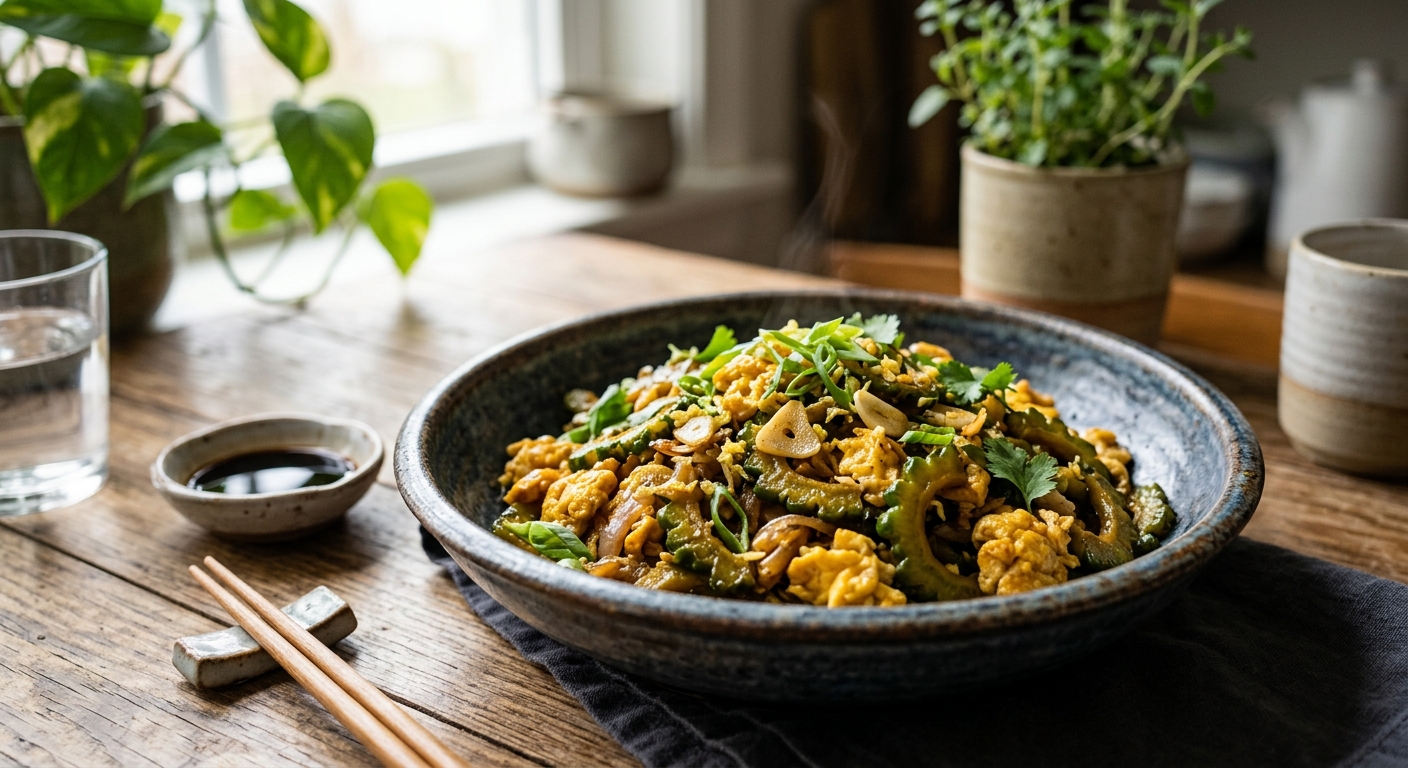
Bitter melon (Momordica charantia) has been used in Ayurvedic and Traditional Chinese Medicine for centuries, but modern nutritional science is catching up fast. The fruit contains at least three distinct compounds, charantin, polypeptide-p, and vicine, that work synergistically to support healthy blood glucose metabolism through mechanisms remarkably similar to berberine, the celebrated alkaloid found in barberry and goldenseal. Paired with eggs as a complete protein anchor, this stir-fry transforms a challenging ingredient into a genuinely craveable weeknight meal.
The technique here matters as much as the ingredients. Salting and pressing the bitter melon before cooking draws out excess moisture and reduces the most aggressive bitterness, leaving behind a pleasant, clean bitterness reminiscent of good radicchio or dark chocolate. The eggs are added off the most intense heat, folded in gently so they cook in large, custard-soft curds that cling to every ridge of the melon. A finishing drizzle of toasted sesame oil ties it all together with nutty depth.
From a calibrated nutrition standpoint, this dish punches far above its calorie count. A single serving delivers meaningful amounts of vitamin C, folate, zinc, and iron alongside a rare dietary source of conjugated linolenic acid from the melon seeds. The glycemic load stays firmly in the low range thanks to the melon’s high water content and significant soluble fiber, making it an ideal centerpiece for anyone managing insulin sensitivity, metabolic syndrome, or simply trying to eat more intentionally.
4
servings
Ingredients
- 600 gbitter melon (approximately 2 medium), halved lengthwise, seeds and pith removed, sliced into 4mm half-moons
- 1 tspColima Sea SaltMicroplastic Free Salt, for pre-salting the melon
- 5 largeeggs, beaten with 1 tbsp water
- 3 tbspAvocado Oil100% Pure Avocado Oil (avocado or light sesame), divided
- 4 clovesgarlic, thinly sliced
- 1 tbspfresh ginger, finely grated
- 2 mediumshallots, thinly sliced
- 1 tbsplow-sodium soy sauce (tamari for gluten-free)
- 1 tsptoasted sesame oil
- 0.5 tspground white pepper
- 0.5 tspcoconut sugar or raw sugar
- 2 stalksscallions, sliced, for garnish
- 1 tsptoasted sesame seeds, for garnish
- —Colima Sea SaltMicroplastic Free Salt and black pepper to taste
Instructions
Click on an item below to shop for the recommended items for this recipe on Amazon.
As an Amazon Associate, we earn from qualifying purchases.
- Toss the sliced bitter melon with 1 tsp fine sea salt in a colander, toss well, and let drain over the sink or a bowl for 15 minutes. Rinse thoroughly under cold water, then press firmly between two clean kitchen towels to remove as much moisture as possible. This step is non-negotiable for proper caramelization and mellow bitterness.
- Beat the eggs with 1 tbsp water, a pinch of salt, and the white pepper in a bowl. Set aside.
- Heat a wok or large skillet over high heat until smoking. Add 1.5 tbsp neutral oil and swirl to coat. Add the pressed bitter melon in a single layer, pressing it against the hot surface. Let it sit undisturbed for 90 seconds to develop golden-brown edges, then stir-fry actively for another 2 to 3 minutes until the slices are tender with lightly charred spots. Transfer to a plate.
- Reduce the heat to medium-high. Add the remaining 1.5 tbsp oil to the same wok. Add the shallots and cook for 2 minutes until softened and beginning to color. Add the garlic and ginger and stir-fry for 45 seconds until fragrant.
- Return the bitter melon to the wok. Add the soy sauce and coconut sugar, tossing everything together for 30 seconds so the melon absorbs the seasoning.
- Push the contents to the side of the wok and reduce the heat to medium. Pour the egg mixture into the cleared space. Let the eggs begin to set on the bottom for about 20 seconds, then use a spatula to gently fold them in large curds, incorporating the melon mixture as you go. Remove from heat when the eggs are just barely set and still look slightly glossy (residual heat will finish them).
- Drizzle with toasted sesame oil, taste and adjust salt, then transfer to a serving plate. Garnish with sliced scallions and toasted sesame seeds. Serve immediately over steamed jasmine or brown rice.
- Salt and drain the bitter melon as described: toss with 1 tsp salt, rest 15 minutes, rinse thoroughly, and squeeze dry with kitchen towels. This is especially important for the slow cooker method since there is nowhere for excess water to escape.
- In a small bowl, whisk together the soy sauce, coconut sugar, white pepper, half the grated ginger, and 2 tbsp water to form a braising sauce.
- Layer the shallots on the bottom of the slow cooker insert, followed by the garlic and remaining ginger. Arrange the pressed bitter melon slices on top. Pour the braising sauce evenly over the melon. Drizzle with 2 tbsp of the neutral oil. Do NOT add the eggs at this stage.
- Cover and cook on Low for 3 hours. The melon will become tender and lightly translucent, absorbing the aromatics and sauce. The bitterness will mellow considerably into a savory-umami depth quite different from the stir-fry version.
- Beat the eggs with 1 tbsp water and a pinch of salt. Switch the slow cooker to High and remove the lid for 5 minutes to allow some surface steam to escape. Pour the beaten eggs directly over the hot melon mixture. Replace the lid and cook on High for 8 to 10 minutes, just until the eggs are barely set in soft, custardy pockets throughout. They will look underdone when you lift the lid but will firm up quickly.
- Drizzle with toasted sesame oil and scatter the scallions and sesame seeds over the top. Serve directly from the insert over steamed brown rice for the most complete nutritional profile.
- Salt the bitter melon slices with 1 tsp sea salt, let rest 15 minutes, rinse, and pat as dry as possible. The pressure cooker tolerates slightly more moisture than a wok, but drying the melon still intensifies flavor.
- Set the Instant Pot to Saute mode on High. Add 2 tbsp neutral oil. When the oil shimmers, add the shallots and cook for 2 minutes, stirring frequently. Add the garlic and ginger and saute for 30 seconds more until fragrant. Press Cancel.
- Add the pressed bitter melon to the pot along with the soy sauce, coconut sugar, white pepper, and 3 tbsp water (this small amount of liquid is necessary to reach pressure). Stir briefly to combine everything.
- Seal the lid and set the steam release valve to Sealing. Select Pressure Cook (Manual) on High pressure for 2 minutes. The pot will take approximately 8 minutes to come to pressure.
- As soon as the cook time ends, perform a Quick Release by carefully switching the valve to Venting. Open the lid once the float pin drops. The melon should be just tender with a slight bite remaining.
- Switch back to Saute mode on Low. Beat the eggs with 1 tbsp water, salt, and white pepper. Push the melon to the sides of the pot, creating a clearing in the center. Pour the eggs into the center and let them begin to set for 20 seconds, then fold them gently through the melon in large soft curds. Press Cancel as soon as the eggs are just set and still look glossy.
- Finish with toasted sesame oil, taste for seasoning, and garnish with scallions and sesame seeds before serving.
- Preheat the oven to 220C (425F) with a large rimmed baking sheet inside on the center rack. Preheating the pan is critical: it mimics the wok’s searing heat and prevents the melon from steaming.
- Salt the bitter melon, rest 15 minutes, rinse, and dry very thoroughly with kitchen towels. Toss the dried melon slices in a large bowl with 2 tbsp neutral oil, the garlic, shallots, ginger, soy sauce, coconut sugar, and white pepper until every slice is well coated.
- Carefully remove the blazing-hot baking sheet from the oven using thick oven mitts. Quickly spread the melon mixture in a single, uncrowded layer on the hot pan (it should sizzle immediately on contact). Return to the oven and roast for 15 minutes, flipping the slices once at the halfway mark, until golden-brown and lightly crisped at the edges.
- While the melon roasts, beat the eggs with 1 tbsp water, a pinch of salt, and the white pepper. After the 15-minute roast, remove the pan and use a spatula to consolidate the melon slices toward the center of the pan, leaving a small border around the edges.
- Pour the beaten eggs evenly over the melon. Return the pan to the oven and bake for 8 to 10 minutes until the eggs are fully set with no visible liquid wobble. The edges will puff slightly and take on a light golden color similar to a thin frittata.
- Remove from the oven and immediately drizzle with toasted sesame oil. Scatter scallions and sesame seeds over the surface. Slice into portions directly on the pan and serve. This method works beautifully as a high-protein breakfast or as a meal-prep option since it holds its shape for easy portioning.
Nutrition Breakdown
Per 1 serving (makes 4)
Vitamins & Minerals
% Daily Value based on a 2,000 calorie diet (FDA reference)
🧬 Essential Amino Acids
% of recommended daily intake (RDA) per serving
🛡 Antioxidant Profile
The Nutrition Science
Bitter melon’s most studied bioactive, charantin, is a mixture of steroidal saponins that activates AMP-activated protein kinase (AMPK), the same cellular energy-sensing enzyme targeted by berberine and, importantly, metformin. AMPK activation suppresses hepatic glucose output, enhances glucose transporter type 4 (GLUT4) translocation to muscle cell membranes, and improves fatty acid oxidation. In practical terms, this means the meal actively supports the cellular machinery that moves glucose out of the bloodstream and into muscle tissue where it can be burned for energy rather than stored as fat.
The egg component contributes more than just protein. Egg yolk phosphatidylcholine is the primary dietary source of choline, a nutrient that roughly 90% of adults under-consume. Choline is the rate-limiting precursor for acetylcholine (neurotransmission) and is required for hepatic VLDL assembly, meaning adequate intake is essential for preventing non-alcoholic fatty liver disease, a condition tightly linked to insulin resistance. The two large eggs per serving in this recipe provide approximately 32% of the adequate intake for choline, making this dish a meaningful contributor to a nutrient most people miss entirely.
Sesame oil’s contribution goes beyond flavor. Toasted sesame oil is rich in sesamol and sesaminol, lignin-derived antioxidants that have demonstrated inhibition of lipid peroxidation and modulation of cytochrome P450 enzymes in peer-reviewed research. When consumed alongside the fat-soluble carotenoids in bitter melon, the sesame and avocado oils in this recipe also serve as critical absorption vehicles: beta-carotene bioavailability from plant foods increases by as much as three to fivefold when consumed with dietary fat, meaning the oil is nutritionally indispensable, not merely cosmetic.
Pro Tips
- Do not skip the salting and pressing step. Thirty minutes of patience here is the difference between bitter melon that tastes medicinal and harsh versus one that is pleasantly bittersweet and properly caramelized. For an even milder result, blanch the salted, rinsed slices in boiling water for 60 seconds before drying and cooking.
- The seeds and spongy white pith are the most intensely bitter parts of the melon and should be fully removed with a spoon before slicing. However, if you are specifically cooking for metabolic support, note that the seeds contain conjugated linolenic acid (CLnA), a fatty acid with emerging evidence for anti-obesity effects. You can dry-toast the cleaned seeds separately in a dry pan and sprinkle them over the finished dish as a garnish.
- Fresh bitter melon loses its bioactive compounds relatively quickly after cutting due to enzyme activity. Buy it whole, refrigerate unwashed, and prepare it within 2 to 3 days of purchase for maximum charantin and vitamin C content. The skin should be firm and bright green with no yellowing, which indicates over-ripeness and a significant reduction in polyphenol content.


omg this is RIGHT up my alley – bitter melon is such a game changer for flattening my post meal glucose! the pairing with eggs and healthy fats is *chef’s kiss* because the fat slows absorption and keeps the glycemic load super manageable. i’m curious about the serving size you recommend and whether you’ve tested this with a CGM, because i find bitter melon portions really matter for my individual response. definitely saving this one!
Oh wow, this is such a compelling application of phytonutrient pharmacology! I’m actually writing my thesis on charantin and momordicin bioavailability, so seeing this paired with egg fat is *chef’s kiss* from a nutritional synergy perspective – the lipid solubility of fat-soluble compounds in those bitter melon alkaloids really does enhance absorption. Plus I’m fascinated by the glucose flattening you both are tracking because I’ve been wondering if the magnesium content in bitter melon plays an underrated role alongside the berberine-mimetics, especially for insulin signaling? Has anyone noticed a difference in their response when they pair it with magnesium
This is SO exciting – bitter melon has been a game changer for my IBS and blood sugar stability too! I’ve been tracking my postprandial glucose responses for about 3 months and bitter melon consistently shows the best results, especially when paired with eggs like this / the fat and protein combo really does slow everything down and reduce my inflammatory markers the next day – I actually tag my meals in my food diary when I include bitter melon because the difference is that noticeable. Definitely trying this version with the ginger and sesame oil since ginger has been my secret weapon for reducing digestive bloating!