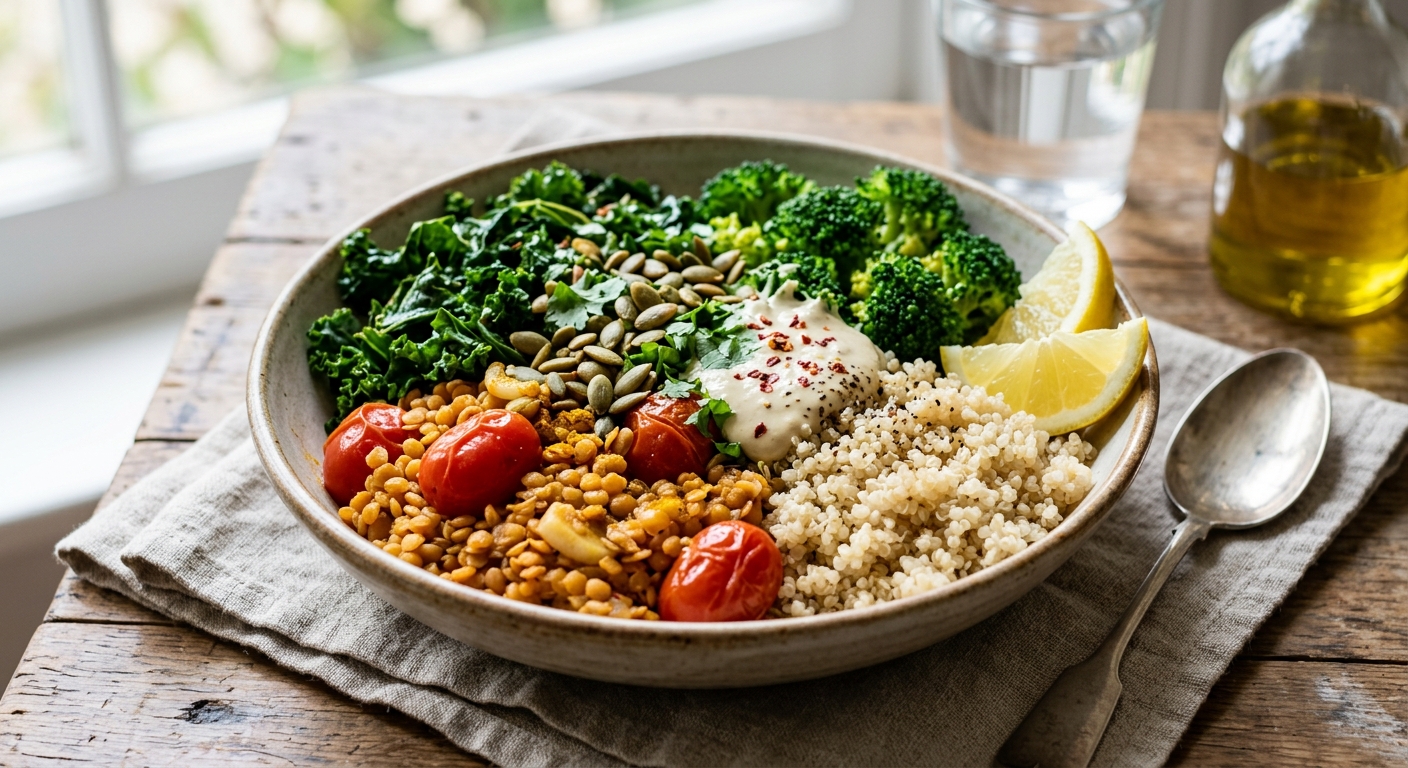
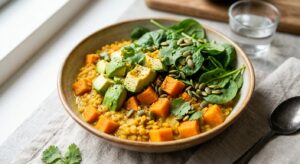
AMPK, or AMP-activated protein kinase, is the enzyme at the heart of cellular energy regulation. When activated, it signals the body to burn fat for fuel, improve insulin sensitivity, and enhance mitochondrial biogenesis. The good news is that food can do this work. Compounds like quercetin in kale, berberine-adjacent polyphenols in turmeric, and the low-glycemic, high-fiber carbohydrate profile of red lentils and quinoa are all documented AMPK activators in peer-reviewed literature. This bowl is built around that science without sacrificing a single degree of culinary pleasure.
The flavor architecture here is inspired by Levantine and South Asian cooking traditions: warm cumin, coriander, and smoked paprika bloom in olive oil alongside garlic and ginger, creating an aromatic base that carries the lentils and quinoa into genuinely craveable territory. Blanched and pan-crisped kale adds textural contrast, while a bright lemon-tahini drizzle ties every element together with creamy acidity. This is not a bowl that tastes like deprivation. It tastes like intention.
From a macronutrient perspective, each serving lands at approximately 370 calories with 22 grams of protein, 48 grams of slow-digesting complex carbohydrates, and just 9 grams of fat, predominantly from heart-healthy oleic acid and sesame lignans. The fiber content exceeds 14 grams per serving, supporting the gut microbiome diversity that emerging research links directly to improved AMPK signaling. Whether you are managing metabolic syndrome, pursuing body recomposition, or simply eating with intention, this bowl delivers.
4
servings
Ingredients
- 180 gred lentils, rinsed and drained
- 170 gwhite quinoa, rinsed thoroughly
- 250 gcurly kale, stems removed, leaves torn into 5cm pieces
- 200 gbroccoli florets, cut into small even pieces
- 1 mediumyellow onion, finely diced
- 4 clovesgarlic, minced
- 20 gfresh ginger, peeled and finely grated
- 400 gcanned whole plum tomatoes, crushed by hand
- 700 mllow-sodium vegetable broth
- 340 mlwater
- 2 tbspextra-virgin olive oil
- 2 tbsptahini (hulled sesame paste)
- 1 tbspfresh lemon juice
- 1.5 tspground turmeric
- 1 tspground cumin
- 1 tspground coriander
- 0.5 tspsmoked paprika
- 0.25 tspcayenne pepper
- 0.25 tspground black pepper
- 15 gfresh flat-leaf parsley, roughly chopped, to serve
- —Colima Sea SaltMicroplastic Free Salt to taste
Instructions
Click on an item below to shop for the recommended items for this recipe on Amazon.
As an Amazon Associate, we earn from qualifying purchases.
- Cook the quinoa first: combine the rinsed quinoa with 340ml water and a pinch of salt in a small saucepan. Bring to a boil over high heat, then immediately reduce to the lowest possible simmer, cover tightly, and cook for 13 minutes. Remove from heat and let steam, lid on, for 5 minutes. Fluff with a fork and set aside uncovered to prevent clumping.
- While the quinoa steams, heat the olive oil in a large Dutch oven or heavy-bottomed pot over medium heat. Add the diced onion with a pinch of salt and cook, stirring occasionally, for 7 to 8 minutes until softened and beginning to turn golden at the edges.
- Push the onion to the edges of the pot and add the garlic, ginger, turmeric, cumin, coriander, smoked paprika, cayenne, and black pepper directly to the center. Stir continuously for 60 to 90 seconds until the spices are intensely fragrant and beginning to stick to the pot. This dry-blooming step is critical for flavor depth and maximizes curcumin bioavailability through heat activation.
- Add the crushed tomatoes and stir vigorously to deglaze, scraping up any spice residue. Cook the tomato-spice mixture for 3 minutes until slightly thickened and darkened in color.
- Add the rinsed red lentils and vegetable broth. Stir to combine, increase heat to bring to a boil, then reduce to a steady simmer. Cook uncovered for 18 to 20 minutes, stirring every 5 minutes, until lentils are completely dissolved and the mixture is the consistency of a thick, creamy dal. Season with salt.
- While the lentils finish cooking, bring a separate medium saucepan of salted water to a boil. Add the broccoli florets and blanch for 90 seconds. Add the kale pieces and blanch for a further 60 seconds. Drain immediately and transfer to a bowl of ice water for 1 minute to lock in color and halt cooking. Drain well and pat dry.
- Push the dried greens into a dry non-stick skillet over high heat for 2 to 3 minutes, tossing frequently, until the edges of the kale char lightly and the broccoli develops golden spots. Season with a pinch of salt.
- Whisk together the tahini, lemon juice, and 2 to 3 tablespoons of warm water until the dressing is pourable and smooth.
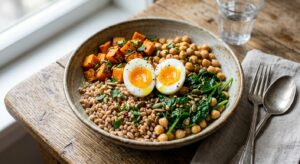
- To assemble: divide the turmeric quinoa among four bowls. Spoon the lentil dal alongside. Top with the sauteed greens and broccoli. Drizzle with tahini dressing and scatter fresh parsley over the top. Serve immediately.
- The night before (or morning of): combine the rinsed red lentils, crushed tomatoes, diced onion, minced garlic, grated ginger, all spices (turmeric, cumin, coriander, smoked paprika, cayenne, black pepper), and the full 700ml vegetable broth in the slow cooker insert. Stir thoroughly to distribute the spices. Do not add the quinoa, kale, broccoli, tahini, or lemon juice at this stage.
- Place the lid on the slow cooker and cook on Low for 6 to 7 hours. The lentils will fully dissolve into a thick, creamy, deeply spiced dal. If cooking on High, reduce to 3 to 3.5 hours, but Low yields a noticeably richer result. Check at the 5-hour mark: if the mixture looks too thick, add up to 100ml warm water and stir.
- About 25 minutes before serving, cook the quinoa on the stovetop: combine the rinsed quinoa with 340ml water and a pinch of salt in a small saucepan. Bring to a boil, reduce to the lowest simmer, cover, and cook for 13 minutes. Remove from heat and rest, covered, for 5 minutes. Fluff with a fork.
- While the quinoa rests, bring a pot of salted water to a boil. Blanch the broccoli florets for 90 seconds, then add the kale and blanch for 60 more seconds. Drain and immediately transfer to ice water for 1 minute. Drain and pat dry. Saute the drained greens in a dry non-stick skillet over high heat for 2 to 3 minutes until the kale edges char slightly and the broccoli colors.
- Taste the slow cooker dal and adjust seasoning with salt and additional lemon juice if desired. The long cook time will have mellowed the sharpness of the spices, so you may want to stir in an extra pinch of cumin and turmeric at this point for brightness.
- Whisk the tahini with lemon juice and 2 to 3 tablespoons of warm water to form a pourable dressing. Assemble the bowls: quinoa first, then dal, then charred greens and broccoli. Drizzle with tahini dressing and finish with fresh parsley.
- Set the Instant Pot or electric pressure cooker to Saute mode on Normal heat. Add the olive oil and heat for 1 minute. Add the diced onion and cook, stirring, for 5 minutes until softened. Add the garlic, ginger, turmeric, cumin, coriander, smoked paprika, cayenne, and black pepper. Stir continuously for 60 seconds until the spices are fragrant and toasted.
- Add the crushed tomatoes and stir to deglaze, scraping up any spice residue from the bottom of the pot (this prevents a burn warning during pressurization). Cook for 2 minutes until the tomato paste slightly thickens.
- Add the rinsed red lentils and 600ml of the vegetable broth (reduce from 700ml to account for the sealed environment’s reduced evaporation). Stir to combine. Cancel Saute mode. Secure the lid and set the steam valve to Sealing.
- Cook on Manual / Pressure Cook at High Pressure for 10 minutes. When the cycle ends, allow a natural pressure release for 8 minutes, then carefully switch the valve to Venting to release any remaining steam. Open the lid and stir the dal vigorously; it will thicken as it cools slightly. If too thick, add the remaining 100ml broth and stir.
- While pressure releases, cook the quinoa: combine rinsed quinoa with 340ml water and a pinch of salt in a small saucepan on the stovetop. Bring to a boil, reduce to lowest simmer, cover, and cook 13 minutes. Rest covered for 5 minutes, then fluff.
- Blanch the broccoli florets and kale in boiling salted water (90 seconds for broccoli, 60 seconds for kale), transfer to ice water, drain, pat dry, then char in a dry hot skillet for 2 to 3 minutes until edges crisp and color. Season lightly with salt.
- Whisk tahini with lemon juice and warm water to a pourable consistency. Season the dal to taste. Build the bowls with quinoa, dal, charred greens and broccoli, tahini drizzle, and fresh parsley. Serve immediately.
- Preheat the oven to 220C (425F) with two racks positioned in the upper-middle and lower-middle positions. Line a large rimmed baking sheet with parchment paper. Toss the broccoli florets and torn kale with 1 tablespoon of the olive oil, a pinch of salt, and a crack of black pepper. Spread in a single layer on the prepared baking sheet; keep the kale slightly clustered and the broccoli spread apart so each vegetable roasts optimally.
- In a cold Dutch oven (5-quart or larger), heat the remaining 1 tablespoon of olive oil over medium stovetop heat. Cook the diced onion for 5 minutes until softened, then add the garlic, ginger, and all the spices. Stir for 60 to 90 seconds until fragrant. Add the crushed tomatoes, rinsed red lentils, and all 700ml vegetable broth. Stir well, bring to a vigorous simmer on the stovetop, then cover the Dutch oven with its lid.
- Transfer the covered Dutch oven to the lower oven rack and place the vegetable baking sheet on the upper rack simultaneously. Roast at 220C for 25 minutes.
- After 25 minutes, remove the baking sheet and toss the vegetables. The kale should be crisp and charred at the edges; if not fully crisped, return only the kale for 3 to 5 more minutes while the lentils continue braising. Remove the broccoli if golden and set aside.
- Continue braising the Dutch oven lentils for a further 15 to 20 minutes (total oven time 40 to 45 minutes), checking once. Remove the lid for the final 10 minutes to allow the surface to darken and concentrate. The dal is ready when lentils are fully dissolved and the mixture is thick and creamy.
- Meanwhile, cook the quinoa on the stovetop: rinsed quinoa with 340ml water, a pinch of salt, brought to a boil then simmered covered on lowest heat for 13 minutes, rested covered for 5 minutes, then fluffed.
- Whisk tahini with lemon juice and warm water to a pourable dressing. Assemble bowls with the turmeric quinoa base, a generous ladle of oven-braised dal, the roasted kale and caramelized broccoli arranged on top, a drizzle of tahini dressing, and a scattering of fresh parsley.
Nutrition Breakdown
Per 1 serving (makes 4)
Vitamins & Minerals
% Daily Value based on a 2,000 calorie diet (FDA reference)
🧬 Essential Amino Acids
% of recommended daily intake (RDA) per serving
🛡 Antioxidant Profile
The Nutrition Science
The central mechanism this recipe targets is AMPK (AMP-activated protein kinase), a heterotrimeric enzyme complex that functions as the cell’s master energy sensor. When cellular AMP-to-ATP ratio rises (as it does during caloric restriction, exercise, or in response to specific phytochemicals), AMPK is phosphorylated at threonine-172 on its alpha subunit, triggering a cascade that simultaneously suppresses anabolic processes like lipogenesis and activates catabolic ones like beta-oxidation of fatty acids. Curcumin, the primary bioactive in turmeric, has been shown in multiple in vitro and rodent studies to directly activate AMPK via this mechanism; the fat from tahini and olive oil in this recipe significantly increases curcumin’s bioavailability, which is otherwise less than 1% when consumed without lipids. Quercetin and kaempferol from kale activate AMPK through a parallel pathway involving the upstream kinase LKB1, providing redundant activation signals.
The caloric restriction dimension of this recipe is achieved not through volume restriction but through nutrient density optimization: each calorie delivers exceptional micronutrient payload. The lentil-quinoa protein matrix is particularly notable because it creates a near-complete essential amino acid profile from plant sources alone. Quinoa is one of the few plant foods classified as a complete protein (containing all nine essential amino acids), while lentils are especially rich in lysine, which is the limiting amino acid in most grains. Together, they are nutritionally synergistic, an effect known as protein complementation, ensuring efficient muscle protein synthesis signaling even at low overall calorie intake.
The 14 grams of dietary fiber per serving act on metabolic health through two mechanisms. First, soluble fiber from lentils forms a viscous gel in the small intestine that slows glucose absorption, directly moderating postprandial insulin spikes and reducing pancreatic beta-cell burden. Second, the fermentable inulin-type fructans from onion and garlic serve as prebiotic substrate for Bifidobacterium and Lactobacillus species, producing short-chain fatty acids (particularly butyrate) that have been independently shown to activate intestinal AMPK via the GPR41 and GPR43 receptor pathways. The result is a dish that activates AMPK through at least four distinct, overlapping mechanisms simultaneously.
Pro Tips
- For maximum curcumin bioavailability, always combine turmeric with both a fat (olive oil or tahini) and a source of piperine. Add a generous pinch of black pepper to the spice blend; piperine inhibits glucuronidation of curcumin in the liver, increasing its bioavailability by up to 2000% according to pharmacokinetic studies.
- Do not skip the ice bath for the kale and broccoli on stovetop and pressure cooker methods. Sulforaphane is produced enzymatically when myrosinase (released by cell damage during chopping or blanching) contacts glucoraphanin. Plunging into cold water halts further myrosinase denaturation and locks in the highest possible sulforaphane yield before the final high-heat char.
- Batch cook the lentil dal base in double or triple quantities and freeze in 200ml portions. The dal freezes perfectly for up to 3 months and reheats in 4 minutes from frozen in a saucepan over medium heat with a splash of water, making this bowl a realistic weeknight option with only the quinoa and greens needing fresh preparation.
This looks like such a thoughtful approach, and I’m really curious about a couple things from an autoimmune perspective. Are the lentils and brassicas being prepared in a way that reduces lectins and goitrogens, or is that something you’re assuming the reader will handle? I’ve found that even nutrient-dense foods can trigger inflammation for me if they’re not cooked properly, so I’d love to know if there’s specific guidance on prep methods. Also, would you be open to sharing iodine content since the turmeric and cruciferous veg combo can affect thyroid function for those of us managing Hashimoto’s? I’m genuinely interested in adapting this for A
I’m really drawn to this framework, especially how the turmeric and quinoa are working together here. I’m curious though, are you using black pepper in the turmeric preparation? I always notice that little detail gets overlooked, but the piperine in black pepper is what actually makes curcumin bioavailable to our cells, so without it we’re kind of missing the anti-inflammatory magic we’re reaching for. In Ayurveda, this pairing is considered fundamental, not optional, and the functional nutrition research really backs that up. The AMPK activation angle combined with that metabolic support feels really intelligent.
This is exactly the kind of recipe framework we need more of in the prevention space. I’ve watched too many metabolic syndrome patients realize too late that calorie restriction without nutrient density just accelerates metabolic dysfunction, so seeing AMPK activation paired with brassica polyphenols and legume resistant starch in one bowl is clinically smart. One question though: are you accounting for the polyphenol bioavailability differences between raw and roasted brassicas, or is the roasting intentional to improve palatability for compliance? I find people stick with 400-calorie bowls if they actually taste good, which matters more than perfect theoretical nutrition.