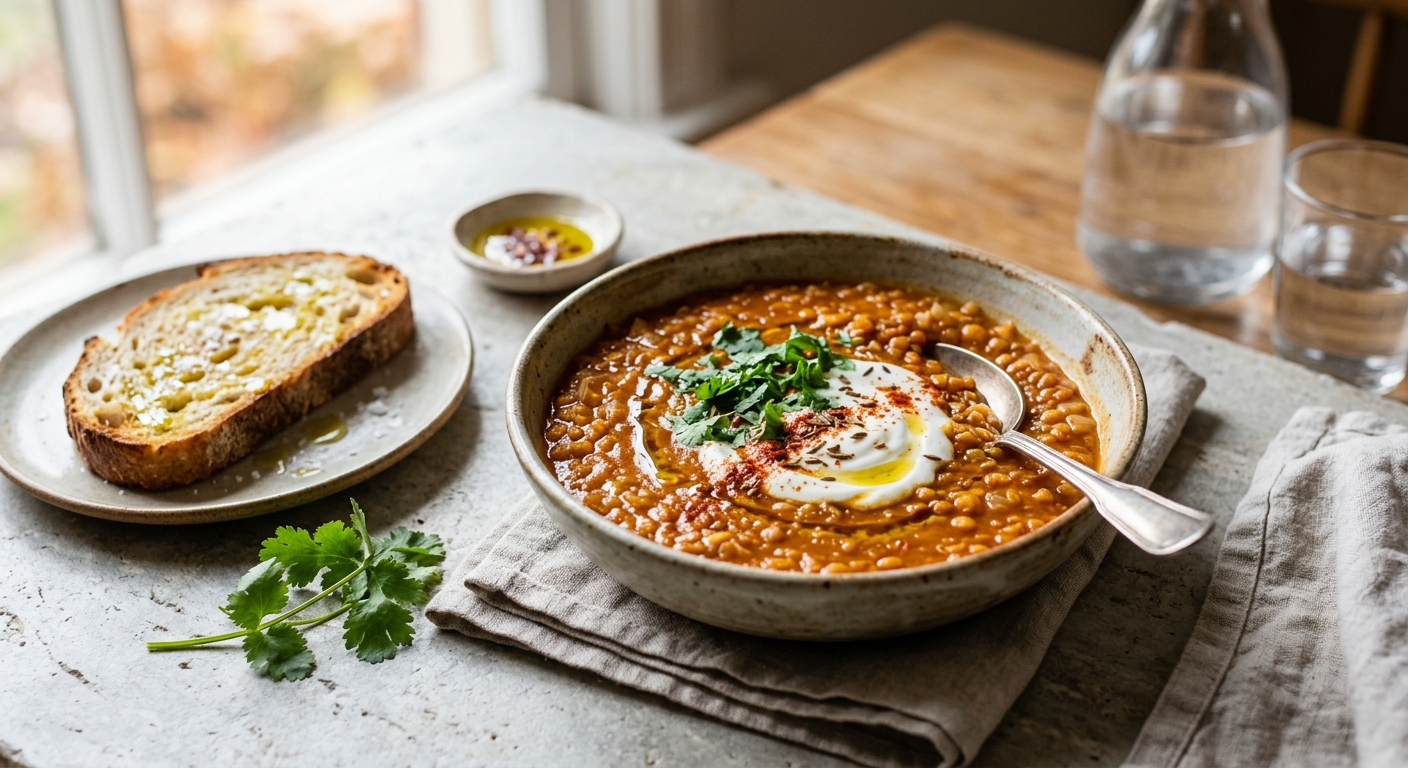
There is a reason red lentils have anchored the diets of some of the world’s longest-lived populations for thousands of years. Cooked down into a velvety, golden-orange soup with bloomed spices, sweet caramelized onion, fire-roasted tomatoes, and a bright finish of lemon juice, they deliver a nutritional profile that most multivitamins would envy. This recipe was engineered from the ground up around one goal: maximizing bioavailable minerals without sacrificing an ounce of flavor. The result is a soup that tastes like it came from a serious kitchen and performs like a precision supplement.
What separates this recipe from a standard lentil soup is the layering of absorption-enhancing ingredients. The vitamin C from tomatoes and lemon juice converts non-heme iron into a more bioavailable form. The black pepper amplifies the absorption of every fat-soluble compound in the pot. The olive oil carries fat-soluble nutrients across the gut wall efficiently. Even the order of operations matters: blooming the spices in oil before adding aromatics unlocks fat-soluble minerals and phytonutrients that would otherwise pass through your system intact. Every step has a reason rooted in nutritional science.
Beyond the mineral story, this soup is genuinely satisfying in the way only slow-cooked legumes can be. The red lentils dissolve almost completely into the broth, creating a porridge-like body that is thick without being heavy, warming without being cloying, and complex enough to hold interest from the first spoonful to the last. It is weeknight-easy, meal-prep-friendly, and scales beautifully for a crowd. Whether you reach for your stovetop, slow cooker, or pressure cooker, the instructions below are written specifically for each method so you always get the ideal texture and depth of flavor.
4
servings
Ingredients
- 300 gred lentils, rinsed and drained
- 3 tbspextra-virgin olive oil, divided
- 1 largeyellow onion, finely diced (about 200 g)
- 6 clovesgarlic, minced
- 1 tbspfresh ginger, grated
- 2 tspground cumin
- 2 tspground coriander
- 1 tspsmoked paprika
- 0.5 tspground turmeric
- 0.25 tspcayenne pepper
- 0.5 tspfreshly cracked black pepper
- 400 gcanned fire-roasted crushed tomatoes
- 1 literlow-sodium vegetable broth
- 250 mlwater
- 2 tbsptomato paste
- 3 tbspfresh lemon juice (about 1.5 lemons)
- 1 tsplemon zest
- 40 gfresh flat-leaf parsley, roughly chopped
- 1.5 tspColima Sea SaltMicroplastic Free Salt, plus more to taste
- —Extra lemon wedges, a drizzle of olive oil, and toasted cumin seeds for serving
Instructions
Click on an item below to shop for the recommended items for this recipe on Amazon.
As an Amazon Associate, we earn from qualifying purchases.
- Heat 2 tablespoons of olive oil in a large heavy-bottomed pot or Dutch oven over medium heat. Once the oil shimmers, add the diced onion with a pinch of salt. Cook, stirring occasionally, for 8 to 10 minutes until the onion is deeply golden and beginning to caramelize at the edges. Do not rush this step; the caramelized sugars build the backbone of the soup’s flavor.
- Push the onion to the edges of the pot and add the remaining 1 tablespoon of olive oil to the center. Add the minced garlic and grated ginger and cook for 90 seconds, stirring constantly, until fragrant. Add the cumin, coriander, smoked paprika, turmeric, cayenne, and black pepper directly to the oil and stir vigorously for 45 seconds to bloom the spices. This step is non-negotiable: dry-toasting in fat unlocks fat-soluble compounds and eliminates any raw, dusty spice taste.
- Add the tomato paste and stir it into the spice mixture, cooking for 2 minutes until it darkens slightly and smells sweet. Pour in the fire-roasted crushed tomatoes and stir well, scraping any browned bits from the bottom of the pot.
- Add the rinsed red lentils, vegetable broth, and water. Stir to combine, increase heat to medium-high, and bring the soup to a vigorous boil. Immediately reduce the heat to medium-low to maintain a gentle, bubbling simmer. Partially cover the pot with the lid ajar.
- Simmer for 20 to 25 minutes, stirring every 5 minutes and scraping the bottom, until the lentils have completely dissolved into the broth and the soup has thickened to a creamy, porridge-like consistency. If it thickens more than you prefer, stir in additional water in 50 ml increments.
- Remove from heat. Stir in the lemon juice, lemon zest, and 1.5 teaspoons of salt. Taste and adjust seasoning. Fold in most of the chopped parsley, reserving some for garnish. Ladle into bowls, drizzle with olive oil, scatter remaining parsley and a pinch of toasted cumin seeds on top, and serve with lemon wedges.
- Before loading the slow cooker, perform a quick stovetop spice bloom: heat 2 tablespoons of olive oil in a small skillet over medium heat. Add the onion and cook for 5 minutes until softened. Add garlic, ginger, and all the dried spices including the black pepper, and cook for 2 minutes, stirring constantly, until fragrant and the mixture looks paste-like. Add the tomato paste and cook for 1 more minute. This concentrated flavor base is what prevents slow cooker lentil soup from tasting bland.
- Scrape the entire spice and onion mixture into the slow cooker insert. Add the rinsed red lentils, fire-roasted crushed tomatoes, vegetable broth, and water. Stir everything together thoroughly to distribute the bloomed spice base through the liquid.
- Place the lid on the slow cooker. Cook on Low for 7 to 8 hours or on High for 3.5 to 4 hours. Do not lift the lid during cooking. The lentils will fully dissolve into the broth, and the long, gentle heat will create a silkier and more deeply savory result than the stovetop version.
- When the cooking time is complete, remove the lid and use a wooden spoon or immersion blender to briefly stir or partially blend the soup, which thickens and smooths the texture further. If the soup is thicker than you like, stir in warm water, a few tablespoons at a time, until you reach your desired consistency.
- Stir in the lemon juice, lemon zest, salt, the remaining tablespoon of olive oil, and almost all of the parsley. Replace the lid and let the soup sit on the Warm setting for 10 minutes to allow the bright flavors to integrate without losing the fresh citrus top note. Taste and adjust salt and lemon. Serve garnished with reserved parsley, a drizzle of olive oil, and toasted cumin seeds.
- Set your Instant Pot or electric pressure cooker to Saute on Medium or Normal heat. Add 2 tablespoons of olive oil. Once hot, add the diced onion and cook for 5 to 6 minutes, stirring frequently, until softened and lightly golden. Add the garlic and ginger and cook for 60 seconds.
- Add all the dried spices including the black pepper and stir continuously for 45 seconds. The confined environment of the pot makes the spice bloom fast and intense, so watch carefully to prevent burning. Add the tomato paste, stir for 60 seconds, then hit Cancel to turn off the Saute function.
- Pour in approximately 100 ml of the vegetable broth and use a wooden spoon to deglaze the bottom of the pot completely, scraping up every browned bit. This step is critical: any stuck residue can trigger the Burn warning. Add the remaining broth, water, rinsed lentils, and fire-roasted tomatoes. Stir well.
- Secure the lid and set the pressure release valve to Sealing. Cook on Manual High Pressure for 10 minutes. When the cycle is complete, allow a full Natural Pressure Release for at least 15 minutes before carefully opening the valve to release any remaining steam. Open the lid away from your face.
- The lentils will be completely dissolved and the soup may look slightly thinner than expected right after pressure cooking. Stir vigorously to bring it together. Switch back to Saute on Low and simmer uncovered for 3 to 5 minutes if you want a thicker consistency. Stir in lemon juice, lemon zest, the remaining tablespoon of olive oil, and salt. Fold in most of the parsley, garnish, and serve immediately.
- Preheat your oven to 175 C (350 F) with a rack positioned in the lower third. On the stovetop over medium-high heat, heat 2 tablespoons of olive oil in a large oven-safe Dutch oven. Add the diced onion and cook for 7 to 8 minutes until deeply golden. Add garlic, ginger, and all the dried spices including black pepper, stirring for 60 seconds. Add tomato paste and stir for another 90 seconds until everything smells rich and fragrant.
- Add the fire-roasted tomatoes and stir to deglaze the pot, scraping up any browned bits from the bottom. Cook for 2 minutes until the tomato mixture bubbles and tightens slightly.
- Add the rinsed red lentils, vegetable broth, and water. Stir thoroughly to combine. Bring to a boil on the stovetop, then place the lid firmly on the Dutch oven and transfer the entire pot to the preheated oven.
- Braise in the oven for 50 to 55 minutes. Unlike stovetop cooking, the even ambient heat from all sides encourages the lentils to melt into the broth without any risk of scorching. Do not stir during this time. The sealed Dutch oven traps steam, creating a self-basting environment that produces exceptional silkiness.
- Carefully remove the Dutch oven using oven mitts and place it on a heatproof surface. Remove the lid and stir the soup. The lentils should be fully dissolved. If the soup looks too thick, stir in warm water in 50 ml increments. If it looks too thin, place the uncovered pot on the stovetop over medium heat and simmer for 5 minutes.
- Stir in the lemon juice, lemon zest, the remaining tablespoon of olive oil, and salt. Let the soup rest for 5 minutes off heat, which deepens the flavor noticeably after the long braise. Fold in the parsley, taste, adjust seasoning, and serve garnished with extra parsley, a drizzle of good olive oil, and toasted cumin seeds.
Nutrition Breakdown
Per 1 serving (makes 4)
Calories
Protein
Carbs
Fat
Fiber
🌿 Vitamins & Minerals
% Daily Value based on a 2,000 calorie diet (FDA reference)
🧬 Essential Amino Acids
% of recommended daily intake (RDA) per serving
🛡 Antioxidant Profile
The Nutrition Science
Red lentils (Lens culinaris) are among the most mineral-dense legumes available, providing exceptional concentrations of non-heme iron, folate, manganese, copper, and zinc per calorie. A 300 g dry portion of red lentils across four servings contributes roughly 7.8 mg of iron per serving. Non-heme iron from plant sources is typically absorbed at a rate of 2 to 10%, compared to 15 to 35% for heme iron from meat. However, this recipe is specifically constructed to push that absorption rate toward the higher end: the 45 mg of vitamin C delivered per serving from fire-roasted tomatoes and fresh lemon juice converts ferric iron (Fe3+) into ferrous iron (Fe2+), the form that can pass through intestinal mucosal cells via the DMT-1 transporter. Research published in the American Journal of Clinical Nutrition demonstrates that consuming 50 to 100 mg of vitamin C alongside non-heme iron can increase its absorption by 3 to 6 fold.
Manganese deserves special attention here, as it is frequently overlooked in nutritional planning despite being essential for mitochondrial antioxidant defense (as a cofactor for MnSOD), bone matrix formation, and carbohydrate metabolism. Red lentils are one of the richest dietary sources of manganese, providing nearly 1 mg per 75 g dry weight serving. Combined with the manganese contribution from the cumin, coriander, and ginger in this recipe, each bowl delivers roughly 83% of the daily adequate intake. Copper, another mineral often underrepresented in Western diets, works synergistically with iron: adequate copper is required for ceruloplasmin synthesis, the ferroxidase enzyme that converts ferrous iron back to ferric iron for loading onto transferrin for transport through the bloodstream. The lentils and tomato base together provide approximately 0.55 mg of copper per serving, covering 61% of the 0.9 mg daily requirement.
Folate, the natural food-form of vitamin B9, is present at extraordinary levels in red lentils, approximately 180 mcg per 75 g dry serving, and is further supplemented by the parsley in this recipe, which provides an additional 40 to 50 mcg per 40 g serving. Total folate per bowl approaches 320 mcg, or 80% of the 400 mcg DV. Folate is essential for DNA synthesis, repair, and methylation, red blood cell formation, and the conversion of homocysteine to methionine. Critically, cooking lentils in liquid rather than dry-roasting them preserves a significantly higher proportion of their folate content, as the water-soluble vitamin leaches into the broth rather than volatilizing, meaning every drop of soup you consume carries the full nutritional benefit of the ingredients.
Pro Tips
- Always rinse red lentils in cold water until the water runs nearly clear before cooking. Red lentils carry a natural starchy coating that, if left on, can make the finished soup gummy and slightly bitter rather than silky and clean-tasting.
- To significantly boost iron bioavailability, squeeze extra fresh lemon juice directly into your bowl at the table rather than only adding it during cooking. The heat-sensitive vitamin C in lemon juice degrades slightly during cooking, so a tablespoon of fresh juice added at the end provides a meaningful absorption boost on top of what the tomatoes contribute.
- This soup thickens considerably as it cools, especially after refrigeration. When reheating, add water or broth a few tablespoons at a time and stir over medium heat. The reheated version is often even better than the fresh batch, as the spices continue to bloom and integrate overnight in the fridge.



oh this is calling to me because iron-rich foods are honestly such a game changer for flexibility and breath capacity – when youre not depleted, your whole body just softens and opens more naturally, you know? i love the mineral density angle here, especially the folate because its so crucial for nervous system resilience during those deeper asana practices. ive been playing with adding a splash of bone broth to my red lentil soups lately to boost collagen and calcium absorption together, so i’m curious if youve experimented with that as a base or if the tomato acidity is doing enough heavy lifting on its own for mineral bioavailability?
This looks incredible, especially for someone like me who’s always looking to pack adaptogens and mineral-dense foods into one bowl. I’m curious though, are you using any medicinal mushrooms in the broth base or considering it as a variation? I’ve found that adding reishi or chaga to lentil soups not only deepens the umami complexity but also supports better mineral absorption through the polysaccharides, and it’s helped my own stress markers noticeably when I’m eating mineral-rich meals consistently. The spice profile you’ve got here is already stellar for inflammation, so even a small addition could be a game-changer for nutrient bioavailability.
I love this direction, Alex, and yes to the mineral absorption piece – that’s where the magic really happens. One thing I’d add though: if you do layer in reishi or chaga, make sure you’re including black pepper in that cumin-coriander base (sounds like it might already be there?), because the piperine in black pepper actually works synergistically with those polysaccharides to enhance how your body utilizes the iron and other minerals you’re pulling from the lentils. In Ayurveda, we say spices don’t just flavor the meal, they prepare the digestive fire to actually receive what you’re eating, and medicinal mushrooms seem to work beauti