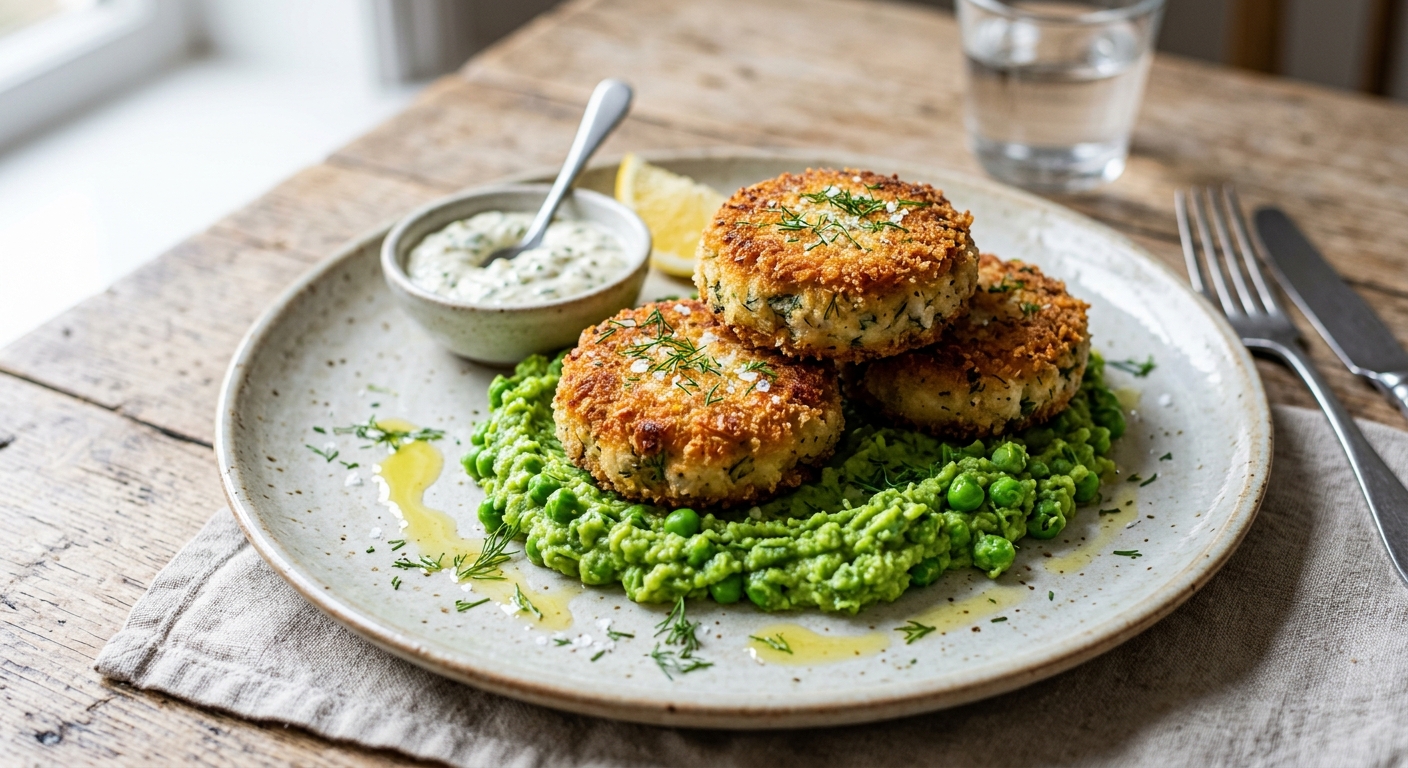
Mackerel is one of the most nutrient-dense, affordable, and underused fish in the home kitchen. A single 100g serving of Atlantic mackerel delivers roughly 2.6g of combined EPA and DHA omega-3 fatty acids, placing it firmly among the top five dietary sources on the planet. Paired with the humble green pea, which contributes plant-based protein, folate, and vitamin K, this dish crosses into genuinely complete nutrition territory. We have engineered every component of this recipe to hit maximum micronutrient density without sacrificing a single point of flavour.
The fish cakes themselves are bound with egg and a small amount of mashed potato, which keeps the glycemic load moderate while providing a crisp, golden crust that shatters satisfyingly on the fork. The pea mash is not an afterthought: it is a deliberate nutritional counterweight, rich in folate, manganese, and vitamin C that amplifies iron absorption from the mackerel. A squeeze of lemon and fresh dill finish the dish with brightness, and both ingredients carry their own phytonutrient credentials. This is the kind of meal that earns its place on the Calibrated Cuisine table.
We have developed four cooking methods for this recipe because different households have different equipment and schedules. The stovetop method gives you the crispiest crust. The oven method is more hands-off and excellent for batch cooking. The pressure cooker method is ideal for preparing the potato and poaching the mackerel simultaneously, then finishing the cakes under the grill. The slow cooker method takes a different approach entirely, turning the same ingredients into a deeply flavoured fish cake cassoulet-style dish that is soft, warming, and perfect for winter. Each method is genuinely distinct, and each one is worth making.
4
servings
Ingredients
- 480 gfresh mackerel fillets, skin removed and pin-boned
- 400 gfloury potatoes (such as Maris Piper or Russet), peeled and cubed
- 300 gfrozen peas
- 2 largeeggs, lightly beaten
- 3 tbspextra-virgin olive oil, divided
- 4 tbspplain flour (or rice flour for gluten-free)
- 60 gpanko breadcrumbs (or gluten-free breadcrumbs)
- 3 tbspfresh dill, finely chopped
- 2 tbspcapers, roughly chopped
- 1 tbspDijon mustard
- 1 largelemon, zest and juice divided
- 3 clovesgarlic, minced
- 30 gunsalted butter
- 2 tbspwhole milk
- 4 spring onionsfinely sliced
- —Colima Sea SaltMicroplastic Free Salt and freshly ground black pepper to taste
Instructions
Click on an item below to shop for the recommended items for this recipe on Amazon.
As an Amazon Associate, we earn from qualifying purchases.
- Boil the cubed potatoes in a large saucepan of well-salted water over high heat for 12 to 14 minutes, until completely tender when pierced with a knife. Drain thoroughly and return to the hot, dry pan for 2 minutes to steam off excess moisture. This step is critical: wet potato makes the fish cakes fall apart.
- While the potatoes boil, poach the mackerel fillets in a wide skillet with 2cm of simmering salted water and a strip of lemon zest for 4 to 5 minutes, until the flesh flakes easily and is fully opaque. Lift out with a slotted spatula, discard the poaching liquid, and allow the fish to cool for 5 minutes before flaking into a large bowl, removing any remaining bones.
- Mash the drained potatoes until completely smooth. Add the mustard, capers, spring onions, dill, lemon zest (from half the lemon), half the beaten egg, salt, and pepper. Fold in the flaked mackerel gently, preserving some texture. Do not overmix. Divide into 8 equal portions and shape into rounds approximately 2cm thick. Refrigerate for 10 minutes to firm up.
- Set up a breading station with three shallow dishes: flour seasoned with salt and pepper in the first, the remaining beaten egg in the second, and panko breadcrumbs in the third. Dust each fish cake in flour, dip in egg, then press firmly into the breadcrumbs on both sides.
- Heat 2 tablespoons of olive oil in a large non-stick or cast iron skillet over medium-high heat until shimmering. Cook the fish cakes in batches of 4, without moving them, for 3 to 4 minutes per side until deep golden brown and heated through. Transfer to a warm plate lined with paper towel.
- For the pea mash, bring a small saucepan of salted water to the boil and cook the peas for 3 minutes. Drain, then return to the pan. Add the butter, milk, garlic, remaining lemon juice, and a pinch of salt. Use a potato masher or hand blender to mash to a semi-smooth texture, leaving some peas whole for contrast. Taste and adjust seasoning. Serve 2 fish cakes per person on a generous bed of pea mash, garnished with extra dill and lemon wedges.
- Preheat your oven to 220 degrees C (200 degrees C fan, 425 degrees F). Line a large baking sheet with foil and set a wire rack on top. Lightly spray or brush the rack with olive oil.
- Boil the cubed potatoes in a large saucepan of well-salted water for 12 to 14 minutes until tender. Drain, steam-dry in the pan for 2 minutes, then mash until smooth.
- Place the mackerel fillets on a second small baking sheet lined with foil. Drizzle with 1 teaspoon of olive oil, season lightly, and roast in the preheated oven for 8 to 10 minutes until just cooked through and flaking. Remove and allow to cool slightly, then flake into the mashed potato. This simultaneous oven-roasting of the fish builds more flavour than poaching and is unique to the oven method.
- Combine the flaked mackerel and potato with the mustard, capers, spring onions, dill, lemon zest (from half the lemon), half the beaten egg, salt, and pepper. Mix gently, shape into 8 rounds roughly 2cm thick, and refrigerate for 10 minutes.
- Bread each fish cake: dust in seasoned flour, dip in remaining beaten egg, then press into panko breadcrumbs. Arrange on the prepared wire rack and drizzle or spray lightly with the remaining olive oil. Bake at 220 degrees C for 20 to 22 minutes, flipping once at the 12-minute mark, until the crust is deep golden and crisp on both sides.
- While the fish cakes bake, cook the peas in boiling salted water for 3 minutes, drain, and mash with butter, milk, garlic, remaining lemon juice, salt, and pepper to a semi-smooth consistency. Serve 2 fish cakes per person over the pea mash with fresh dill and lemon wedges.
- This method takes a fundamentally different approach. Instead of shaped and breaded cakes, you will build a layered slow cooker fish dish. Grease the ceramic insert of a 4 to 6 litre slow cooker with 1 tablespoon of olive oil. Spread the raw potato cubes in an even layer across the base, seasoning generously with salt and pepper.
- In a small bowl, mix together the garlic, Dijon mustard, lemon zest, lemon juice, remaining olive oil, dill, capers, spring onions, and a pinch of salt to form a flavour paste. Coat the mackerel fillets evenly in this paste.
- Lay the coated mackerel fillets directly on top of the potato layer in the slow cooker. Scatter the frozen peas over and around the fish. Pour in 100ml of water around the edges of the insert (not over the fish) to create steam and prevent the potatoes from catching.
- Place the lid on, set to High, and cook for 2.5 to 3 hours, until the potatoes are completely tender and the mackerel flakes easily with a fork. Do not lift the lid during the first 2 hours.
- Once cooked, use a fork to roughly break up the mackerel and fold it through the potato and peas, creating a rustic textured mixture. Stir in the butter and milk at this point. Taste and adjust seasoning. If you prefer a golden top, transfer the mixture into an oven-safe dish and place under a hot grill for 3 to 4 minutes. Serve in deep bowls with crusty bread and extra dill.
- Pour 250ml of water into the inner pot of your pressure cooker or Instant Pot. Place the cubed potatoes in the pot below the trivet. Season the mackerel fillets, lay them on a piece of foil folded into a sling, drizzle with 1 teaspoon of olive oil, and set the foil packet on the trivet above the potatoes. This two-level setup cooks both components simultaneously without mixing flavours.
- Secure the lid, set the pressure release valve to Sealing, and cook on High Pressure for 5 minutes. Once the cycle completes, perform a Quick Release by carefully switching the valve to Venting. Open the lid when the pin drops.
- Remove the mackerel packet first and allow to cool for 3 minutes before flaking. Drain any residual liquid from the potatoes and use the Saute function on Low (or transfer to a bowl) to steam-dry them for 1 to 2 minutes. Mash the potatoes until smooth.
- Combine the mashed potato with the flaked mackerel, mustard, capers, spring onions, dill, lemon zest (from half the lemon), half the beaten egg, salt, and pepper. Mix gently and shape into 8 rounds, about 2cm thick. Refrigerate for 10 minutes to firm.
- Bread each cake through the flour, egg, and panko station. For the final cook, you have two options: (a) Use the Saute function on High in the pressure cooker pot with 2 tablespoons of olive oil and pan-fry 4 minutes per side, cooking in batches, or (b) place the cakes on a foil-lined baking sheet and grill under a hot grill for 4 minutes per side. Meanwhile, cook the peas on the stovetop for 3 minutes, drain, and mash with butter, milk, garlic, lemon juice, and seasoning. Serve 2 cakes per person over the pea mash.
Nutrition Breakdown
Per 1 serving (makes 4)
Vitamins & Minerals
% Daily Value based on a 2,000 calorie diet (FDA reference)
🧬 Essential Amino Acids
% of recommended daily intake (RDA) per serving
🛡 Antioxidant Profile
The Nutrition Science
The omega-3 fatty acids EPA (eicosapentaenoic acid) and DHA (docosahexaenoic acid) in mackerel are long-chain polyunsaturated fats that cannot be efficiently synthesised by the human body and must be obtained from the diet. Each serving of this dish delivers approximately 2.6g of combined EPA and DHA, exceeding the American Heart Association’s recommendation of at least 1g per day for individuals with cardiovascular disease and meeting the upper range of general population guidelines. These fatty acids directly reduce circulating triglycerides, improve arterial elasticity, and modulate inflammatory gene expression via the NF-kB pathway, offering measurable cardioprotective effects with consistent dietary intake.
The extraordinary vitamin B12 content of mackerel (over 400% DV per serving) is clinically significant because B12 deficiency is one of the most common nutrient deficiencies globally, particularly in older adults and those who limit animal products. B12 is essential for myelin sheath synthesis, red blood cell formation, and the methylation cycle that regulates homocysteine levels. Elevated homocysteine is an independent risk factor for coronary artery disease and cognitive decline. A single serving of this dish provides enough B12 to protect against deficiency for several days.
The pea mash serves as a deliberate nutritional synergist. The vitamin C content from both the peas and the lemon juice significantly enhances the absorption of non-haem iron present in the peas themselves, a mechanism mediated by ascorbic acid reducing ferric iron (Fe3+) to the more bioavailable ferrous form (Fe2+). Peas also provide resistant starch and soluble fibre that feeds Lactobacillus and Bifidobacterium species in the gut microbiome, contributing to short-chain fatty acid production. The combined protein from mackerel and peas delivers all nine essential amino acids in quantities that meet or exceed RDA benchmarks for a 70kg adult, making this a genuinely complete protein meal.
Pro Tips
- Always steam-dry your mashed potato before mixing in the fish. Even a small amount of excess water weakens the binding and causes the cakes to crumble in the pan. Return drained potatoes to the hot pan over low heat for 2 full minutes, stirring, before mashing.
- Fresh mackerel fillets give the best flavour and the highest omega-3 content, but high-quality canned mackerel in spring water (drained very well) is an excellent budget alternative and reduces prep time by 10 minutes. Avoid mackerel canned in sunflower oil as it dilutes the omega-3 to omega-6 ratio.
- Chilling the shaped fish cakes in the refrigerator for at least 10 minutes before breading and cooking is not optional. This resting time firms the structure and dramatically reduces the risk of cakes breaking apart during the cooking process, regardless of which method you use.

The amino acid profile here is pretty stellar, Paul – you’re getting lysine and methionine from the mackerel hitting those sulfur amino acids, plus the peas round it out nicely with leucine for muscle synthesis. My only note is the cooking temp matters a lot for those omega-3s: I shallow pan-sear at medium rather than high heat to minimize oxidation of the PUFA chains, which honestly changes the micronutrient bioavailability more than most people realize.
Love the mackerel focus here, especially for athletes looking to optimize their omega-3 to omega-6 ratio without going all-in on fish oil supplements. One thing I’d be curious about: what’s the amino acid profile looking like when you combine the mackerel with the pea mash? Mackerel brings all nine essentials with solid leucine content, but peas actually complement that really well since they’re higher in lysine where fish can lag a bit. That synergy is gold for post-workout muscle protein synthesis, and honestly it’s one reason this pairing beats a standard fish and rice combo for my athletes.
oh this is exactly what ive been looking for post-WOD! mackerel is such an underrated protein source and the omega-3 density here plus complete amino acid profile from the fish and pea combo is chef’s kiss for reducing inflammation after heavy lifting sessions. curious though, what’s the macronutrient ratio looking like – is this more of a balanced recovery meal or are you leaning heavier on protein for that muscle repair window?