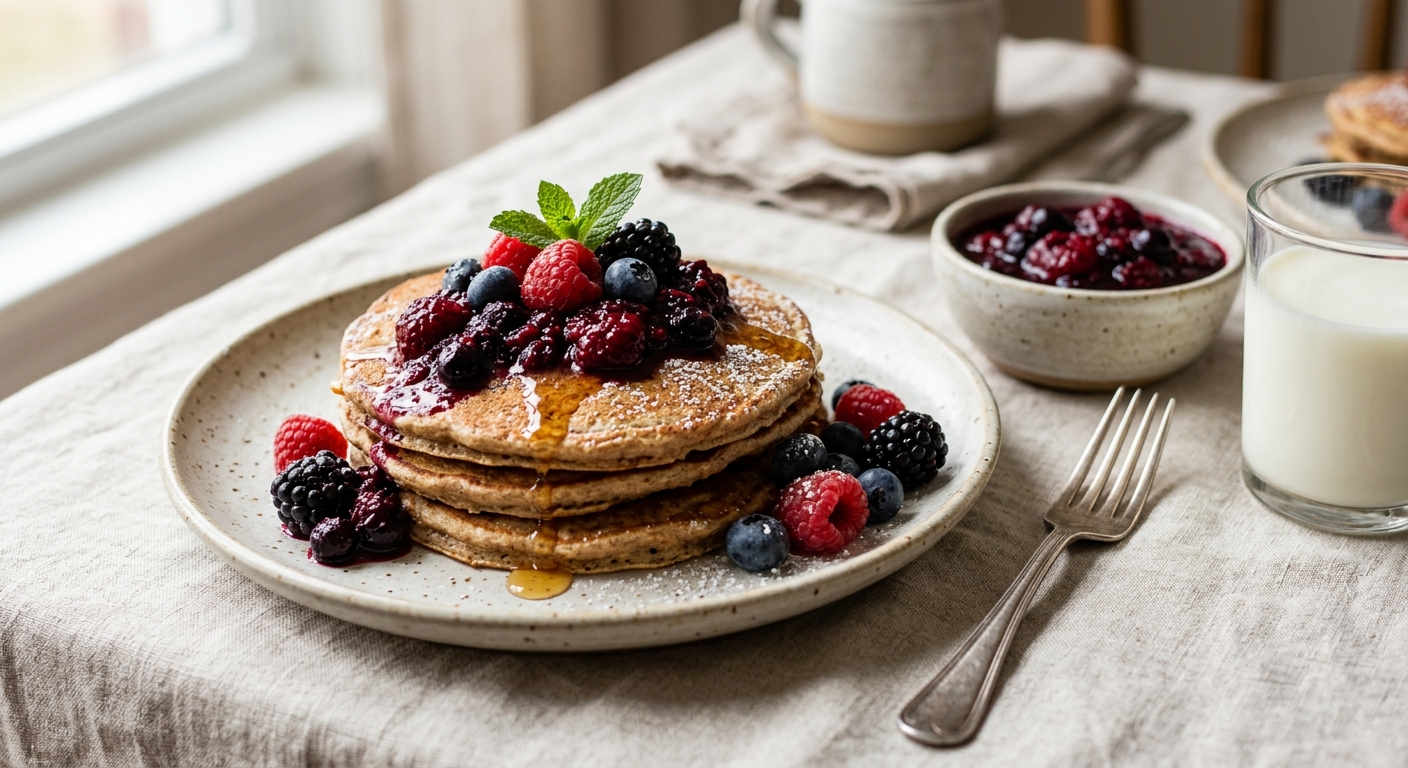
Most breakfast pancakes are a nutritional afterthought, built on refined flour and topped with sugar. These kefir pancakes flip that script entirely. Kefir, a fermented milk drink teeming with Lactobacillus and Bifidobacterium strains, reacts with baking soda to produce the most extraordinarily tender, cloud-like crumb you have ever pulled off a griddle. The acidity that makes it such a powerful probiotic food is also the secret to its culinary magic, tenderising gluten strands and creating a batter that puffs dramatically on contact with heat.
The berry compote is not an afterthought. A slow-simmered blend of blueberries, raspberries, and blackberries releases a concentrated cascade of anthocyanins, ellagic acid, and pterostilbene, three of the most studied anti-inflammatory compounds in the plant kingdom. Paired with a whisper of raw honey and fresh lemon zest, it becomes a deeply flavourful sauce that contributes meaningful amounts of vitamin C, manganese, and folate to every serving. Together, the pancakes and compote cover over 30% of your daily needs for calcium, B12, riboflavin, and phosphorus in a single breakfast sitting.
At Calibrated Cuisine, we built this recipe around a half-and-half blend of whole wheat pastry flour and all-purpose flour. That ratio preserves the light texture that makes pancakes irresistible while delivering enough fibre and micronutrients to genuinely differentiate this breakfast from its white-flour counterparts. The result is a glycaemic load carefully moderated by fibre, protein from kefir and eggs, and the natural fructose matrix of whole fruit. This is a breakfast engineered for sustained energy, reduced systemic inflammation, and genuine morning delight.
4
servings
Ingredients
- 240 gwhole wheat pastry flour
- 120 gall-purpose flour
- 480 mlplain whole-milk kefir, at room temperature
- 2 largeeggs, at room temperature
- 30 mlraw honey
- 30 mlextra-virgin coconut oil, melted and cooled, plus more for the pan
- 1 tsppure vanilla extract
- 1.5 tspbaking powder
- 0.75 tspbaking soda
- 0.5 tspColima Sea SaltMicroplastic Free Salt
- 200 gfresh or frozen blueberries
- 150 gfresh or frozen raspberries
- 150 gfresh or frozen blackberries
- 30 mlraw honey or pure maple syrup (for compote)
- 1 tspfresh lemon zest
- 15 mlfresh lemon juice
- 1 tsparrowroot starch (optional, for thickening compote)
- —Colima Sea SaltMicroplastic Free Salt to taste
Instructions
Click on an item below to shop for the recommended items for this recipe on Amazon.
As an Amazon Associate, we earn from qualifying purchases.
- Make the compote first: combine the blueberries, raspberries, blackberries, 30ml honey, lemon zest, and lemon juice in a small saucepan over medium heat. Stir gently and bring to a simmer. Cook for 8 to 10 minutes, stirring occasionally, until the berries burst and the liquid reduces by about one third. If you want a thicker consistency, whisk the arrowroot starch with 1 tablespoon of cold water and stir it into the compote during the last 2 minutes. Remove from heat and set aside; it will continue to thicken as it cools.
- While the compote simmers, make the pancake batter. In a large bowl, whisk together the whole wheat pastry flour, all-purpose flour, baking powder, baking soda, and fine sea salt until evenly combined.
- In a separate medium bowl, whisk the kefir, eggs, honey, melted coconut oil, and vanilla extract until smooth. Pour the wet ingredients into the dry ingredients and fold gently with a rubber spatula until just combined. A few small lumps are not only acceptable but desirable. Do not overmix or the gluten will develop and toughen the pancakes. Let the batter rest for 5 minutes so the kefir acid fully activates the baking soda.
- Heat a large cast iron skillet or non-stick griddle over medium-low heat. Brush lightly with coconut oil. The surface is ready when a few drops of water flicked onto it skitter and evaporate in about 2 seconds. Pour approximately 80ml (one third cup) of batter per pancake onto the surface, spacing them at least 3cm apart.
- Cook undisturbed until bubbles form across the entire surface of the pancake and the edges look set and matte rather than glossy, about 2 to 3 minutes. Flip once with a thin spatula and cook for a further 1 to 2 minutes until the underside is golden brown and the pancake feels springy when gently pressed. Adjust heat as needed between batches; the pan will get hotter as you go. Serve immediately topped with the warm berry compote.
- Line the insert of a 4 to 6 quart slow cooker with a single sheet of parchment paper, pressing it into the base and up the sides. Lightly brush the parchment and any exposed insert walls with melted coconut oil. This prevents sticking and allows you to lift the finished pancake out cleanly.
- Prepare the batter as directed: whisk the dry ingredients (both flours, baking powder, baking soda, salt) together in a large bowl. In a separate bowl, whisk the kefir, eggs, honey, melted coconut oil, and vanilla. Fold wet into dry until just combined with a few lumps remaining. Let the batter rest for 5 minutes, then pour the entire batch into the prepared slow cooker insert and spread evenly with a spatula.
- Place a double layer of paper towels across the top of the slow cooker insert before fitting the lid. The paper towels absorb condensation that would otherwise drip back onto the surface of the pancake and create soggy patches. This is the single most important technique for slow-cooker baked goods.
- Cook on High for 2 to 2.5 hours. Begin checking at the 2-hour mark by inserting a toothpick or thin skewer into the centre. It should come out with just a few moist crumbs attached, not wet batter. The edges will pull away slightly from the parchment when done. Avoid lifting the lid before the 2-hour mark, as each peek adds approximately 15 to 20 minutes to the cook time.
- While the pancake bakes, make the berry compote on the stovetop: combine berries, honey, lemon zest, and lemon juice in a small saucepan over medium heat and simmer 8 to 10 minutes until jammy. Add arrowroot slurry if desired. Set aside to cool slightly.
- Once cooked, turn off the slow cooker and remove the lid. Lift the parchment to transfer the whole pancake to a cutting board. Slice into generous wedges or squares and serve topped with the warm berry compote.
- Grease a 7-inch (18cm) round springform pan or a 1.5-litre oven-safe glass bowl generously with coconut oil. Line the base with a circle of parchment paper and grease the parchment as well. Pour 240ml (1 cup) of water into the Instant Pot insert and place the trivet (steam rack) in the bottom.
- Prepare the batter: whisk the dry ingredients together in a large bowl. Whisk the kefir, eggs, honey, melted coconut oil, and vanilla together in a separate bowl. Fold wet into dry until just combined, rest for 5 minutes, then pour the batter into the prepared pan. Tap the pan gently on the counter twice to release any large air pockets.
- Tear a large piece of aluminium foil and tent it loosely over the top of the pan, crimping it around the edges. This prevents condensation from dripping directly onto the surface but still allows steam to circulate. Lower the pan into the Instant Pot using a foil sling (fold a long piece of foil into thirds lengthwise and use it as a handle to lower and raise the pan).
- Seal the lid and set the vent to Sealing. Cook on Manual High Pressure for 20 minutes. When the cycle completes, allow the pressure to release naturally for 10 minutes, then carefully switch the vent to Venting to release any remaining steam. Do not perform an immediate quick release, as the sudden pressure change can cause the interior to collapse.
- While the pressure releases, make the berry compote on the stovetop: combine berries, honey, lemon zest, and lemon juice in a small saucepan over medium heat. Simmer for 8 to 10 minutes until the berries are broken down and the sauce is glossy. Stir in the arrowroot slurry if you prefer a thicker consistency. Remove from heat.
- Use the foil sling to lift the pan from the Instant Pot. Remove the foil tent, run a thin knife around the edge, and release the springform clasp or invert the bowl onto a plate. The pancake cake will be golden-edged and beautifully domed. Slice into wedges and spoon the warm compote generously over each serving.
- Preheat the oven to 200°C (400°F / Gas Mark 6). Line a large rimmed baking sheet (approximately 33x46cm / 13×18 inch half-sheet pan) with parchment paper. Brush the parchment generously with melted coconut oil, making sure to coat the edges and corners where the batter is most likely to stick.
- Prepare the batter: whisk the two flours, baking powder, baking soda, and salt in a large bowl. In a separate bowl, whisk together the kefir, eggs, honey, melted coconut oil, and vanilla extract until smooth. Pour the wet mixture into the dry and fold with a rubber spatula until just combined. Rest the batter for 5 minutes to allow full leavener activation.
- Pour the rested batter onto the prepared baking sheet and spread it into an even layer using an offset spatula or the back of a large spoon. Aim for a thickness of about 1 to 1.5cm across the entire surface. If the batter pools towards the centre, tilt the pan gently to distribute it.
- Bake in the preheated oven for 18 to 22 minutes. The sheet pancake is done when the surface is golden, the centre springs back when lightly pressed with a fingertip, and the edges have pulled away slightly from the parchment. A toothpick inserted in the thickest part should come out clean.
- While the sheet pancake bakes, make the compote: combine the berries, honey, lemon zest, and lemon juice in a small saucepan over medium heat. Simmer for 8 to 10 minutes, stirring occasionally, until reduced and jammy. Stir in the arrowroot slurry for the last 2 minutes if a thicker sauce is desired. Remove from heat and keep warm.
- Remove the baking sheet from the oven and allow the pancake to cool for 3 minutes before slicing into 12 squares or cutting into generous portions. Lift squares off the parchment with a spatula, plate them, and spoon the warm berry compote over the top. This method also reheats exceptionally well: store leftover squares in an airtight container and reheat in a 180°C oven for 5 to 7 minutes.
Nutrition Breakdown
Per 1 serving (makes 4)
Vitamins & Minerals
% Daily Value based on a 2,000 calorie diet (FDA reference)
🧬 Essential Amino Acids
% of recommended daily intake (RDA) per serving
🛡 Antioxidant Profile
The Nutrition Science
The anti-inflammatory power of this dish operates on two distinct but complementary fronts. Kefir’s live microbial cultures, typically including Lactobacillus acidophilus, L. kefiri, and multiple Bifidobacterium species, survive gastric transit in meaningful numbers and colonise the lower intestinal tract. A healthier, more diverse gut microbiome is now strongly associated with reduced circulating levels of C-reactive protein and interleukin-6, two of the most widely used biomarkers of chronic systemic inflammation. The fermentation process also partially breaks down lactose and phytic acid in the batter, improving the bioavailability of calcium, magnesium, and zinc compared to unfermented dairy and whole grain combinations.
The berry compote contributes a structurally diverse array of polyphenols that act through several anti-inflammatory mechanisms simultaneously. Anthocyanins from blueberries and blackberries have been shown in randomised controlled trials to reduce nuclear factor kappa B (NF-kB) activation, the master switch for inflammatory gene expression. Ellagic acid from raspberries undergoes gut microbial transformation into urolithins, metabolites with even greater anti-inflammatory potency than the parent compound. Pterostilbene, a methylated analogue of resveratrol found almost exclusively in blueberries, crosses the blood-brain barrier more readily and has demonstrated neuroprotective effects in animal and early human studies.
The whole wheat pastry flour contributes ferulic acid, a hydroxycinnamic acid bound to the bran matrix that is released during digestion. Ferulic acid has measurable free-radical scavenging capacity and has been specifically linked to reduced LDL oxidation, a key early step in atherogenesis. The fibre content, 8 grams per serving, feeds Bifidobacterium and Faecalibacterium prausnitzii populations in the colon, which produce short-chain fatty acids including butyrate. Butyrate is the primary energy source for colonocytes and is a potent inhibitor of histone deacetylases, enzymes that, when overactive, up-regulate pro-inflammatory gene expression. In short, this breakfast nourishes the anti-inflammatory machinery of the gut from multiple angles at once.
Pro Tips
- Do not overmix the batter under any circumstances. Overworking the gluten creates tough, rubbery pancakes. Stop folding as soon as the dry streaks disappear, even if the batter looks a little lumpy.
- Full-fat whole milk kefir produces the most tender pancakes due to its higher fat content buffering the strong acidity. Low-fat kefir works but may yield a slightly denser crumb. Avoid non-dairy kefir substitutes as their lower protein content changes the batter structure significantly.
- The berry compote can be made up to 4 days in advance and stored in an airtight jar in the refrigerator. It actually intensifies in flavour overnight as the polyphenols continue to leach from the fruit skins. Reheat gently in a small saucepan over low heat, adding a splash of water if it has thickened too much.
I absolutely love this approach, though I’m curious if you incorporate any warming spices into the batter itself? In my yoga kitchen, I’ve been adding a touch of turmeric and ginger to kefir pancakes, and the combination of those live cultures plus the anti-inflammatory compounds in the spices feels like a real synergy for gut health. The berries are gorgeous, but I always finish mine with a sprinkle of black pepper over the compote, honestly more out of habit than anything else, though it does help with turmeric absorption if you ever want to play with that variation.
This looks amazing, and I’m so curious about the kefir choice here – are you using dairy or coconut kefir? I’ve been experimenting with both since my Hashimoto’s diagnosis, and I’ve found coconut kefir sits better with my system, though I know the probiotic profile differs. Also, quick question on AIP compatibility, since I follow a modified protocol: are the berries used in the compote nightshade-free? I’m assuming yes given the “triple-berry” mention, but I want to make sure before I adapt this for my restricted diet. The anti-inflammatory angle with the warming spices Tiara mentioned sounds perfect for what my body needs right
ooh tiara you’re onto something with the warming spices, ive been experimenting with ginger in my post-run breakfast pancakes too and the anti-inflammatory combo is legit. my question for the author tho is whether the kefir batter holds up well as a portable race-day fuel, or does the tangy flavor get weird sitting in a container for a couple hours? thinking about testing these for my next ultra training block since i need something that wont cause stomach issues mid-run but still packs actual nutrition instead of just refined carbs.