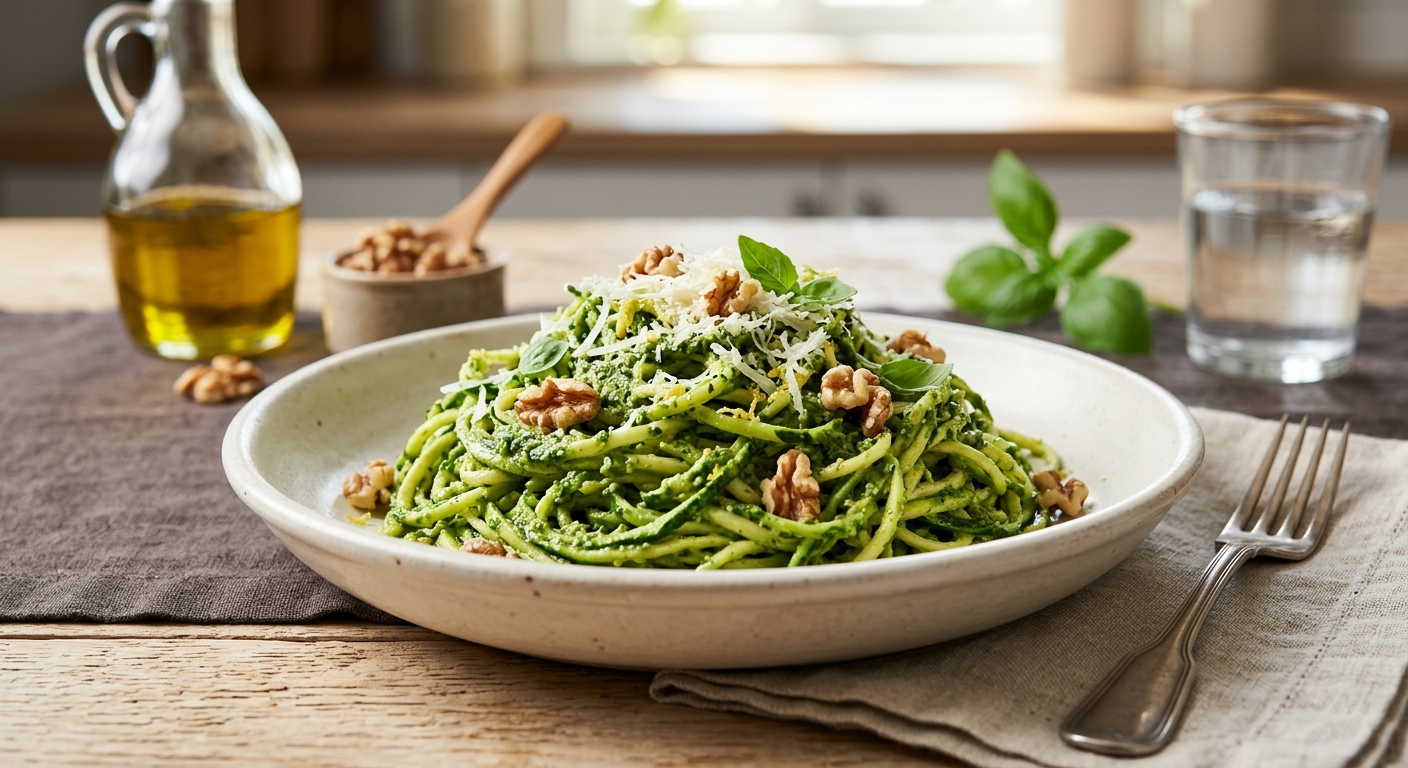
Zucchini noodles with walnut pesto sits at the intersection of culinary elegance and nutritional precision. Unlike traditional pasta pesto, which relies on starchy wheat for its bulk, this dish builds its satisfying texture entirely from spiralized zucchini and a thick, herb-forward sauce where toasted walnuts provide both body and a remarkable concentration of alpha-linolenic acid (ALA), the plant-based omega-3 fatty acid linked to reduced inflammatory markers. The result is a meal that feels indulgent but works hard for your long-term health.
Walnuts are one of the very few nuts with a genuinely meaningful omega-3 content: a 30-gram handful delivers roughly 2.5 grams of ALA, covering well over 100% of the adequate intake for most adults. Paired with fresh basil rich in the flavonoid apigenin, garlic loaded with allicin, and extra-virgin olive oil supplying oleocanthal, a natural COX-inhibitor functionally similar to ibuprofen, this pesto is essentially a cold-pressed anti-inflammatory supplement that happens to taste extraordinary. The Parmesan adds a sharp umami backbone while contributing calcium, and the lemon zest brightens every component with a clean citrus note.
This recipe has been calibrated so that a single serving delivers at least 35% of your daily value for vitamin C, meaningful amounts of manganese and magnesium from the walnuts, and a respectable hit of vitamin K from the basil and zucchini combined. The three cooking methods below, stovetop sauté, a slow-cooker warm-through technique, and a pressure-cooker steam-and-toss approach, each produce a slightly different texture profile, from crisp-tender to silky-soft, so you can match the dish to your mood and schedule without sacrificing any of its nutritional integrity.
4
servings
Ingredients
- 900 gmedium zucchini (about 4 large), spiralized into noodles
- 100 graw walnut halves
- 60 gfresh basil leaves, packed
- 40 gParmesan cheese, finely grated, plus extra to serve
- 80 mlextra-virgin olive oil, plus extra to finish
- 3 clovesgarlic, peeled
- 30 mlfresh lemon juice (about 1 lemon)
- 1 tsplemon zest
- 15 gnutritional yeast (optional, for extra umami depth)
- 2 tbsptoasted pine nuts, to garnish
- 0.5 tspred chilli flakes, to garnish
- —Colima Sea SaltMicroplastic Free Salt and cracked black pepper to taste
Instructions
Click on an item below to shop for the recommended items for this recipe on Amazon.
As an Amazon Associate, we earn from qualifying purchases.
- Toast the walnuts in a dry skillet over medium heat for 3 to 4 minutes, stirring frequently, until fragrant and lightly golden. Watch carefully as they burn quickly. Transfer immediately to a plate to cool for 5 minutes.
- While the walnuts cool, combine them in a food processor with the basil, garlic, lemon juice, lemon zest, Parmesan, and nutritional yeast if using. Pulse 6 to 8 times until a coarse crumble forms. With the motor running, stream in the olive oil in a slow, steady pour until you reach a thick, spoonable consistency. Season generously with salt and pepper. If the pesto is too thick, add water one tablespoon at a time. Set aside.
- Place the spiralized zucchini in a colander, toss with 0.5 tsp fine sea salt, and let it sit for 5 minutes. Pat thoroughly dry with clean kitchen towels or paper towels. Removing this moisture is critical to prevent a watery sauce.
- Heat a large (30 cm) skillet or sauté pan over medium-high heat. Add 1 tablespoon of olive oil and swirl to coat. Add the zucchini noodles in a single layer and toss with tongs for 2 to 3 minutes only, until just tender but still bright green and slightly firm. Do not cover the pan.
- Remove the pan from the heat and immediately add 3 to 4 tablespoons of the walnut pesto. Toss vigorously, adding the pesto off the heat so the basil stays vibrant and the olive oil does not overheat and lose its polyphenols. Add a splash of cold water or a squeeze of lemon juice to loosen if needed.
- Divide among four warm bowls. Top with extra Parmesan, toasted pine nuts, a pinch of chilli flakes, and a drizzle of your best extra-virgin olive oil. Serve immediately.
- Toast the walnuts in a dry skillet over medium heat for 3 to 4 minutes until fragrant. Transfer to a plate and cool completely. Make the walnut pesto as described: process walnuts, basil, garlic, lemon juice, lemon zest, Parmesan, and nutritional yeast to a coarse crumble, then stream in olive oil to form a thick sauce. Season well. This entire step is done on the stovetop before any slow cooker use.
- Salt the spiralized zucchini noodles and let them drain in a colander for 10 minutes. Pat aggressively dry. Excess water in the slow cooker will dilute the pesto and create a pooled liquid at the bottom.
- Lightly oil the insert of your slow cooker with 1 teaspoon of olive oil. Add the dried zucchini noodles and dollop half the pesto over the top. Toss gently inside the insert using tongs. Do not add any additional liquid as the zucchini will release enough moisture during cooking.
- Place the lid on and cook on Low for 1.5 to 2 hours. Check at the 1.5 hour mark: the noodles should be tender and glossy, having absorbed the pesto. If there is pooled liquid at the bottom, remove the lid and let the cooker run for a further 15 minutes uncovered.
- Switch off the slow cooker and add the remaining pesto. Toss gently to coat, tasting and adjusting seasoning with salt, pepper, and a squeeze of fresh lemon juice to re-brighten the flavors after the long cook. Serve directly from the insert topped with Parmesan, pine nuts, chilli flakes, and a finish of raw extra-virgin olive oil.
- Prepare the walnut pesto first: toast walnuts in a dry pan for 3 to 4 minutes, then process with basil, garlic, lemon juice, lemon zest, Parmesan, nutritional yeast, and olive oil until a thick sauce forms. Season with salt and pepper. Set aside at room temperature.
- Salt the spiralized zucchini and drain in a colander for 5 minutes, then pat thoroughly dry. Add 240 ml (1 cup) of cold water to the pressure cooker insert. Place the trivet (steam rack) inside. Arrange the zucchini noodles loosely on top of the trivet, piling them high as they will compress significantly.
- Seal the lid and set the valve to Sealing. Select Manual (or Pressure Cook) on High Pressure and set the timer to 0 minutes. The cooker will take 4 to 6 minutes to build pressure; once it reaches full pressure the timer counts down instantly and the unit beeps.
- Immediately perform a Quick Release by switching the valve to Venting. Stand clear of the steam. Open the lid once the float valve drops, which takes about 1 minute.
- Using tongs, lift the zucchini noodles off the trivet and transfer them to a large mixing bowl. Discard the steaming water. The noodles should be tender and slightly translucent. Immediately add 3 to 4 tablespoons of pesto and toss to coat while the noodles are still hot so the sauce clings. Add remaining pesto to taste, adjusting with a squeeze of lemon juice to re-sharpen the flavors.
- Portion into bowls and finish with extra Parmesan, toasted pine nuts, chilli flakes, and a generous drizzle of raw extra-virgin olive oil. Serve at once.
- Preheat your oven to 200°C (400°F) with convection fan if available. Line two large rimmed baking sheets with parchment paper. While the oven heats, toast the walnuts on one of the dry baking sheets for 6 to 8 minutes until golden and fragrant. Watch closely after the 5-minute mark. Remove and cool completely before making the pesto.
- Make the walnut pesto in a food processor: combine cooled walnuts, basil, garlic, lemon juice, lemon zest, Parmesan, and nutritional yeast. Pulse to a rough crumble, then stream in olive oil to form a thick sauce. Season with salt and pepper. Refrigerate the pesto until needed to keep the basil vivid.
- Salt the spiralized zucchini and drain in a colander for 10 minutes. Pat extremely dry with towels. Divide the noodles between the two parchment-lined baking sheets in a single, spread-out layer. Overcrowding will cause steaming instead of roasting. Drizzle each sheet with 1 teaspoon of olive oil and season lightly.
- Roast at 200°C for 18 to 22 minutes, rotating the pans halfway through, until the noodles are lightly golden at the edges and any surface moisture has evaporated. The noodles will look slightly wilted and concentrated. Do not stir them during roasting as disruption releases steam and prevents caramelization.
- Transfer the roasted noodles immediately to a large bowl while hot. Remove the pesto from the refrigerator and add 3 to 4 tablespoons, tossing to coat. The residual heat from the noodles will gently warm the pesto without cooking it, preserving its nutritional integrity and bright green color. Adjust seasoning with lemon juice, salt, and pepper.
- Plate and top with shaved Parmesan, toasted pine nuts, red chilli flakes, and a final drizzle of raw extra-virgin olive oil for maximum polyphenol delivery. Serve warm.
Nutrition Breakdown
Per 1 serving (makes 4)
Vitamins & Minerals
% Daily Value based on a 2,000 calorie diet (FDA reference)
🧬 Essential Amino Acids
% of recommended daily intake (RDA) per serving
🛡 Antioxidant Profile
The Nutrition Science
The anti-inflammatory credentials of this dish rest on a convergence of three distinct molecular mechanisms. First, the alpha-linolenic acid (ALA) from walnuts serves as a precursor to the longer-chain omega-3 fatty acids EPA and DHA. While conversion efficiency in humans is modest (approximately 5 to 15% to EPA), even ALA itself has been shown in controlled trials to reduce plasma concentrations of interleukin-6 (IL-6) and tumor necrosis factor-alpha (TNF-a), two cytokines central to chronic low-grade inflammation associated with metabolic syndrome, cardiovascular disease, and neurodegeneration.
Second, extra-virgin olive oil in this recipe functions as a delivery vehicle for oleocanthal, a secoiridoid phenolic compound whose anti-inflammatory mechanism was formally described by researchers at the Monell Chemical Senses Center. Oleocanthal inhibits cyclooxygenase-1 and COX-2 enzymes in a dose-dependent manner structurally analogous to ibuprofen, which is why high-quality EVOO causes a characteristic peppery sting at the back of the throat: the same sensory receptor (TRPA1) activated by the NSAID detects the oleocanthal. The roughly 2 tablespoons of EVOO per serving in this recipe delivers an estimated 200 to 400 micrograms of oleocanthal, an amount shown in mechanistic studies to exert measurable COX inhibition.
Third, the walnut matrix provides ellagitannins that are biotransformed by gut microbiota into urolithin A and urolithin B. These metabolites have attracted significant research attention for their ability to activate mitophagy (selective clearance of dysfunctional mitochondria) and inhibit NF-kB signaling at the transcriptional level. Clinical studies published in Nature Metabolism demonstrated that urolithin A supplementation improved mitochondrial efficiency in older adults, and regular walnut consumption is associated with measurably higher urolithin plasma levels in individuals with diverse gut microbiome profiles. Together, these mechanisms make walnut pesto on zucchini noodles far more than a fashionable low-carb substitute: it is a genuinely functional anti-inflammatory meal.
Pro Tips
- Dry the zucchini noodles aggressively before cooking. Zucchini is approximately 95% water and will flood the pan if not properly salted and patted dry first, turning your pesto into a thin soup.
- Never heat the pesto directly in the pan. Add it off the heat or after the cooking step to protect the omega-3 fatty acids in the walnut oil and the delicate polyphenols in the basil and olive oil from oxidation at high temperatures.
- Use the freshest, highest-polyphenol extra-virgin olive oil you can source for the pesto itself. Look for harvest-date labeling and choose oils less than 18 months from pressing. The anti-inflammatory oleocanthal content degrades significantly in older or improperly stored oils.
Love this recipe and the omega-3 focus, but I’ve got to ask from my late-life nutrition learning curve: what’s the total protein per serving here? I’m obsessed with hitting about 30g protein per meal to trigger muscle protein synthesis, and zucchini noodles plus pesto might land light on that front for us older folks trying to preserve muscle mass. Maybe a poached egg on top or some hemp seeds to push the leucine threshold? The anti-inflammatory angle is solid, but I’ve learned the hard way that inflammation control doesn’t mean much if we’re losing muscle tissue at 62 and beyond.
This is such a smart observation, Steve, and honestly I’ve had to think about this same balance myself because managing inflammation doesn’t help if you’re not maintaining strength. I haven’t run the exact macros on this particular recipe, but I’ve found adding a poached egg or some wild-caught salmon on the side works beautifully with walnut pesto without overwhelming my joints, plus the extra omega-3s from fish give me measurably lower CRP levels compared to walnuts alone. Hemp seeds are a great call too if you want to stay lighter, though I personally do the egg route because after eight years of tracking what actually moves my inflammation markers, I’ve learned my body responds best to that complete amino acid
this is so real and i love that youre tracking what actually moves your markers instead of just following the theory, because honestly thats where the magic happens. my abuela always paired her fermented foods with eggs or fish and i dismissed it for years until i started learning about how the bioavailability piece matters so much – like the vitamin d in that egg yolk literally helps your gut absorb the omega-3s better, its not just about stacking nutrients its about the symphony. i do something similar with my fermentation workshops now, teaching people that a spoonful of my kimchi or miso alongside good protein hits different than either one alone, and the amino acid angle youre hitting on is exactly why my grandmother
This is exactly the kind of recipe I’ve been looking for, honestly. I’ve been experimenting with how different carb sources affect my neuroinflammation markers, and the combination of walnuts for ALA omega-3s plus the polyphenols from quality olive oil is something I actually track. My neurologist was skeptical at first about dietary intervention, but this kind of meal feels like something concrete I can do between appointments. Do you have thoughts on the ratio of walnuts to olive oil for maximizing the anti-inflammatory effect, or does it mostly come down to total volume consumed?
nadia this is such a thoughtful question and honestly it makes me emotional that your neurologist is coming around because mine were the same way after my event. tbh i think the ratio matters less than consistency and weather you’re actually absorbing whats in there, so pairing it with some fat soluble vit like the basil gives you better bioavailability than optimizing the exact math. ive been doing walnut heavy pestos in my slow cooker broths for a year now and my inflammation markers dropped way more when i started eating them daily rather than obsessing over ratios, so maybe focus on making it something delicious you’ll actually stick with long term? would love to hear how your neuroinfl
oh this sounds amazing, especially the walnut angle – ive been leaning into walnuts too for the ala content but honest question, does anyone worry about the phytic acid in nuts blocking mineral absorption? im always calculating iron paired with my meals since im managing iron deficiency anemia, and walnuts are one of those foods i love but wonder if theyre competing with my ferritin uptake. nadia, are you noticing any markers shift with the walnut pesto specifically or is it more the overall anti inflammatory pattern?