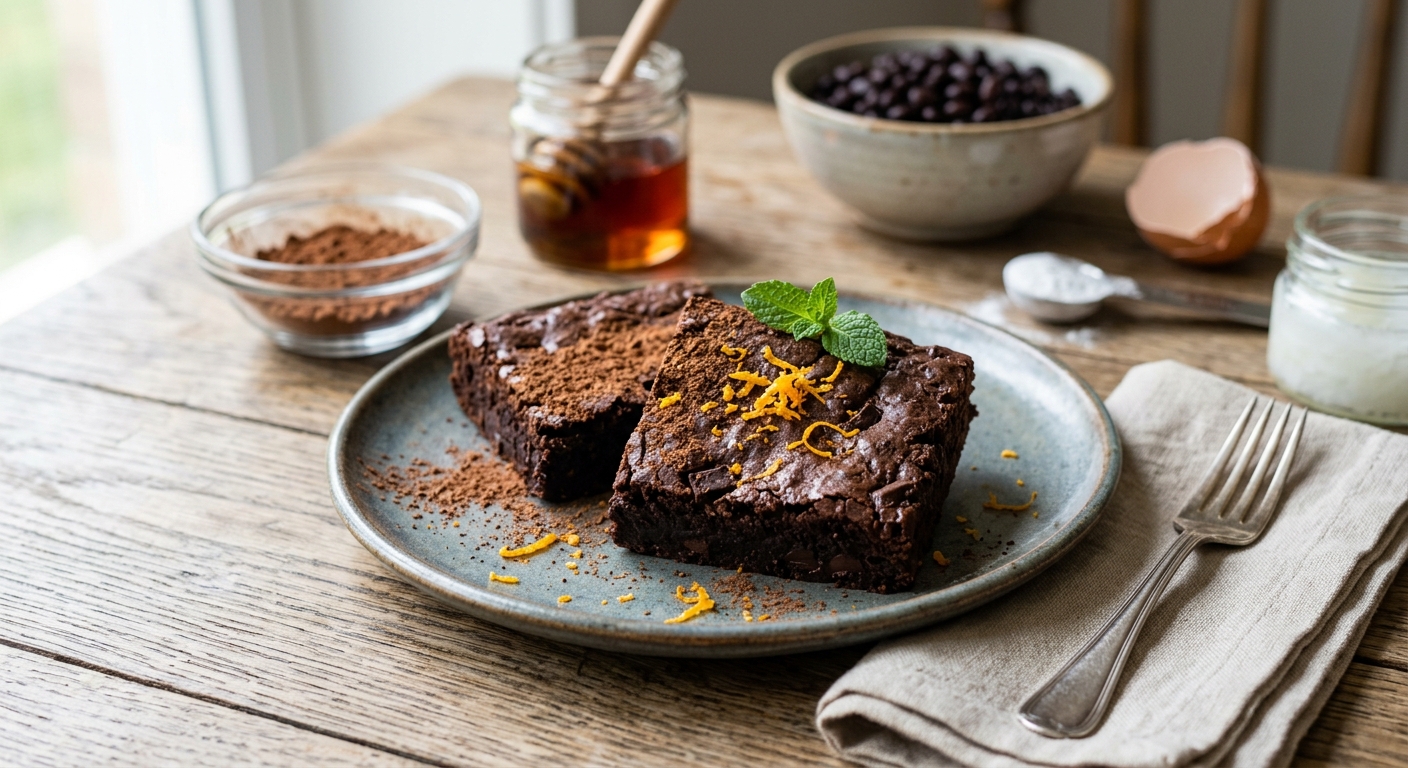
The idea of beans in brownies raises eyebrows until the first bite silences every skeptic at the table. Black beans, when blended smooth, vanish entirely into the batter, contributing a dense, fudge-like structure that no amount of flour can replicate. The result is a brownie that is simultaneously more indulgent in texture and more serious in nutritional purpose than anything you have baked before. This is the rare dessert that earns its place on a nutrition blog without compromise or apology.
The nutritional story here is built around iron bioavailability by design. One cup of cooked black beans contains roughly 3.6 mg of non-heme iron, and this recipe concentrates two servings of beans across four portions. Paired deliberately with vitamin C from cacao and a touch of orange zest, the ascorbic acid converts more of that non-heme iron into its absorbable ferrous form, a synergy that food scientists call the ascorbate-iron enhancer effect. Folate, magnesium, zinc, and manganese round out the mineral profile, making this one of the most micronutrient-dense desserts you can make from pantry staples.
Cacao powder, not Dutch-process cocoa, is the second hero of this recipe. Raw cacao retains its full complement of flavanols, including epicatechin and catechin, which support endothelial function and reduce markers of oxidative stress. The combination of cacao flavanols and the anthocyanins naturally present in black bean skin creates a polyphenol matrix that is genuinely measurable and scientifically meaningful, not just marketing language. Every method below, from the quick pressure cooker technique to the low slow cooker approach, is engineered to preserve those compounds while achieving the ideal fudgy set.
4
servings
Ingredients
- 480 gcooked black beans (about 1.5 x 400g tins), rinsed and thoroughly drained
- 50 graw cacao powder (unsweetened, not Dutch-process)
- 3 largeeggs
- 80 gpure maple syrup
- 60 gvirgin coconut oil, melted and slightly cooled
- 1 tsppure vanilla extract
- 1 tspfinely grated orange zest (for ascorbate-iron synergy)
- 0.5 tspbaking powder
- 0.25 tspColima Sea SaltMicroplastic Free Salt
- 60 gdark chocolate chips (70% cacao or higher), divided
- —Colima Sea SaltMicroplastic Free Salt flakes for finishing
Instructions
Click on an item below to shop for the recommended items for this recipe on Amazon.
As an Amazon Associate, we earn from qualifying purchases.
- Prepare your steamer setup: fill a large heavy-bottomed pot or Dutch oven with about 4 cm of water. Place a wire rack or folded tea towel in the bottom to elevate your vessel, then bring the water to a gentle simmer over medium heat. Lightly grease four 200ml ramekins or one 700ml heatproof pudding bowl with coconut oil.
- Combine the drained black beans, cacao powder, eggs, maple syrup, melted coconut oil, vanilla extract, orange zest, baking powder, and sea salt in a high-powered blender or food processor. Blend on high for 60 to 90 seconds, stopping once to scrape down the sides, until the batter is completely smooth with no bean skin fragments visible. The batter should be thick, glossy, and ribbon-like.
- Fold half the dark chocolate chips (30g) into the batter using a flexible spatula. Divide the batter evenly among the prepared ramekins, filling each about three-quarters full to allow for gentle rise. Scatter the remaining 30g chocolate chips over the tops and press them lightly into the surface. Finish with a pinch of flaked sea salt over each.
- Place the filled ramekins onto the rack inside the simmering pot. The water level should come no higher than halfway up the sides of the ramekins. Lay a sheet of baking parchment loosely over the ramekins before fitting the lid, this prevents condensation drips from wetting the tops. Maintain a steady medium-low simmer throughout cooking.
- Steam for 30 to 35 minutes without lifting the lid for the first 25 minutes. At 30 minutes, test by inserting a thin skewer into the centre of one ramekin: it should come out with just a few moist crumbs, not raw batter. The tops will look set and slightly dull rather than glossy. Remove ramekins carefully with tongs and rest for 10 minutes before serving warm directly in the ramekin, or run a thin knife around the edge and invert onto a plate for a freestanding pudding.
- Line the base and sides of a 3.5 to 5 litre oval or round slow cooker insert with a sheet of baking parchment, leaving generous overhang on two sides to act as handles. Grease the exposed parchment lightly with coconut oil. Place two sheets of folded paper towels under the lid before closing; this absorbs condensation and prevents the top of the brownies from becoming watery.
- Blend the drained black beans, cacao powder, eggs, maple syrup, melted coconut oil, vanilla extract, orange zest, baking powder, and sea salt in a blender or food processor until completely smooth, about 90 seconds. Stop once to scrape the sides. The slow cooker environment retains more moisture than an oven, so the batter consistency matters: it must be fully emulsified or the finished brownie will be gummy rather than fudgy.
- Fold 30g of the chocolate chips into the batter with a spatula. Pour the batter into the prepared slow cooker insert, spreading it into an even layer with the back of a spoon. The batter will sit shallower than in a standard pan, which is correct. Scatter the remaining 30g chocolate chips evenly over the surface and press gently. Add flaked sea salt. Lay the two folded paper towel sheets directly on top of the batter surface, then fit the lid.
- Cook on High for 2 hours without opening the lid. At 2 hours, lift the lid and paper towels quickly: the edges should be set and pulling slightly from the parchment, and the centre should have only a very slight wobble when you gently shake the insert. If the centre is still liquid, re-cover and cook for a further 15 to 20 minutes.
- Once set, turn off the slow cooker and remove the lid, propping it slightly ajar to allow steam to escape. Let the brownies rest in the insert for 20 minutes; this resting period is critical as slow-cooker baked goods continue to firm up significantly as they cool. Use the parchment handles to lift the entire slab out onto a wire rack. Cool for a further 15 minutes before slicing into four portions with a sharp knife wiped clean between cuts.
- Pour 250ml of cold water into the inner pot of your 6-quart or larger pressure cooker and place the trivet inside. Grease a 15cm to 18cm round springform or push-pan thoroughly with coconut oil and line the base with a circle of baking parchment. Tear a long sheet of aluminium foil and fold it into a 5cm-wide strip long enough to act as a sling under the pan for lifting.
- Blend the drained black beans, cacao powder, eggs, maple syrup, melted coconut oil, vanilla extract, orange zest, baking powder, and sea salt in a blender until completely smooth, 60 to 90 seconds. Scrape down and blend again briefly. Because pressure cooking creates a fully sealed humid environment, this batter will cook faster and more evenly than any other method, making a perfectly emulsified batter especially important.
- Fold 30g chocolate chips into the batter, then pour into the prepared pan. Smooth the top with a spoon. Scatter the remaining 30g chocolate chips over the surface and press lightly. Add flaked sea salt. Cover the top of the pan tightly with a square of aluminium foil, crimping it firmly around the edges to prevent condensate from dripping onto the batter surface during cooking.
- Lower the foil-covered pan onto the trivet using the sling. Fold the sling ends over the top. Seal the pressure cooker lid and set the valve to Sealing. Select Pressure Cook (or Manual) on High Pressure and set the timer for 25 minutes. The pot will take approximately 8 to 10 minutes to come to full pressure.
- When the cook time ends, allow a full natural pressure release for 15 minutes before switching the valve to Venting to release any remaining pressure. Open the lid carefully, tilting it away from you to direct steam away from your face. Lift the sling and pan out onto a wire rack. Remove the foil cover and check the centre with a skewer: it should emerge with a few moist crumbs. The brownie will look slightly sunken in the middle, which is correct and will firm as it cools. Rest in the pan for 20 minutes before releasing the springform ring and slicing.
- Position a rack in the centre of your oven and preheat to 175C (350F) conventional or 160C (320F) fan-forced. Grease a 20cm square metal baking tin generously with coconut oil and line it with baking parchment, leaving overhang on two sides. Metal tins transfer heat more quickly and evenly than glass or ceramic, which is important for the short baking window needed to keep the interior fudgy.
- Combine the drained black beans, cacao powder, eggs, maple syrup, melted coconut oil, vanilla extract, orange zest, baking powder, and sea salt in a high-powered blender or food processor. Blend for 90 seconds until completely smooth and no bean skins are detectable. The batter should flow from a spoon in a thick, slow ribbon. If it seems very thick, add one tablespoon of water and blend briefly.
- Fold 30g of the chocolate chips into the batter using a flexible spatula, incorporating gently to avoid deflating the eggs. Pour the batter into the prepared tin and spread into an even layer, coaxing it into the corners with the spatula. Scatter the remaining 30g chocolate chips over the surface, pressing them lightly so they adhere. Finish with a generous pinch of flaked sea salt.
- Transfer to the preheated oven and bake for 22 minutes. Do not open the oven door before the 20-minute mark. At 22 minutes, test by inserting a skewer into the centre: it should emerge with a few moist, fudgy crumbs clinging to it. If it comes out with raw batter, bake for a further 2 to 3 minutes. The edges will have pulled slightly from the tin sides and the top will have a very faint papery sheen, the classic brownie crust.
- Remove from the oven and place the tin on a wire cooling rack. Do not attempt to cut or remove the brownies for at least 25 minutes; the interior continues to set as it cools and cutting too soon will result in crumbling. Once cooled, use the parchment handles to lift the slab onto a board and slice into four generous portions with a sharp knife, cleaning the blade between each cut for neat edges.
Nutrition Breakdown
Per 1 serving (makes 4)
Vitamins & Minerals
% Daily Value based on a 2,000 calorie diet (FDA reference)
🧬 Essential Amino Acids
% of recommended daily intake (RDA) per serving
🛡 Antioxidant Profile
The Nutrition Science
The iron in black beans is non-heme iron, the plant-sourced form that the body absorbs at a baseline rate of 2 to 8%, compared to 15 to 35% for heme iron from meat. However, this gap is substantially bridgeable. Vitamin C (ascorbic acid) forms a soluble chelate with ferric iron (Fe3+) in the gut, reducing it to the more bioavailable ferrous form (Fe2+) that the DMT-1 transporter can actively carry across the intestinal wall. This recipe includes orange zest deliberately for this reason: one teaspoon of zest contributes approximately 5mg of vitamin C and, more importantly, delivers limonene and hesperidin compounds that further acidify the local intestinal pH, creating conditions that favour iron solubility.
Cacao is the recipe’s second mineral anchor. A 50g serving of raw cacao powder provides approximately 3.3mg of iron, 80mg of magnesium, and 0.5mg of copper. Copper is frequently overlooked in iron discussions, but ceruloplasmin, the copper-containing enzyme, is essential for converting stored ferritin iron back into the transferrin-bound form that circulates in blood. A diet high in iron but low in copper can paradoxically produce functional iron deficiency, making the copper contribution of cacao (78% DV per serving in this recipe) nutritionally significant rather than incidental.
The flavanol content of cacao, specifically epicatechin and its dimer procyanidin B2, has been demonstrated in multiple randomised controlled trials to increase flow-mediated dilation by 1.5 to 3 percentage points and reduce oxidised LDL by measurable margins at daily intakes of 200mg flavanols. This recipe delivers approximately 27mg of epicatechin per serving, meaningful as a regular dietary contribution. The anthocyanins in black bean seed coats add a complementary antioxidant mechanism: rather than targeting endothelial nitric oxide pathways like flavanols, anthocyanins modulate NF-kB signalling, reducing the transcription of pro-inflammatory genes. Together, these two polyphenol families provide overlapping, non-redundant antioxidant protection in a single indulgent square.
Pro Tips
- Drain and rinse your tinned black beans extremely thoroughly, then press them gently in a clean tea towel to remove residual surface water. Excess moisture is the most common reason black bean brownies turn out gummy rather than fudgy, particularly in the slow cooker and pressure cooker methods.
- Do not substitute Dutch-process cocoa for raw cacao powder. Dutch-process cocoa has been alkali-treated, which neutralises up to 90% of its flavanol content and strips out a significant portion of the iron. The slightly more intense, less smooth flavour of raw cacao is authentic and correct in this recipe.
- For the cleanest slice, refrigerate the fully cooled brownies for 30 minutes before cutting. The coconut oil and chocolate chips firm at refrigerator temperature, giving you a dense, clean-edged square. Bring to room temperature for 5 minutes before eating to restore the full fudgy texture.



okay so heres my thing with black bean recipes, the iron content is amazing but ive had flares triggered by the fiber density if im not careful about how much i eat at once. that said when im in remission these are actually perfect because the beans are so well hidden texture-wise. the vitamin c pairing is def key though, not just for absorption but it actually seems to help my digestion too vs eating them plain. might be worth mentioning in the post that people with ibd should maybe start with a smaller portion to test it out, since everyones tolerance is different?
okay so im definitely making these because black beans are one of my go-to non-heme iron sources, but real talk, are you pairing these with anything vitamin C rich in the recipe or is that something you’d recommend doing separately? like i know chocolate has some polyphenols that help with absorption but ive learned the hard way that relying on that alone isnt ideal for my ferritin levels. also dying to know if theres dairy in these or if theyre dairy free because calcium can really interfere with iron uptake and i learned that lesson after months of wondering why my iron wasnt budging lol. this looks amazing and im gonna test it out!
Great question from Francesca – vitamin C pairing is exactly right for maximizing non-heme iron bioavailability. I’d suggest serving these with a citrus glaze or pairing the brownie with something like fresh raspberries or a small glass of OJ on the side, since you’re looking at maybe 20-25% absorption without that acid boost versus potentially doubling it with vitamin C present. From an athlete recovery angle, I’m also curious if the recipe hits meaningful leucine numbers (black beans run around 0.6g leucine per cooked cup) since you’re getting that iron density – sometimes we overlook the protein timing opportunity in whole food desserts like this.