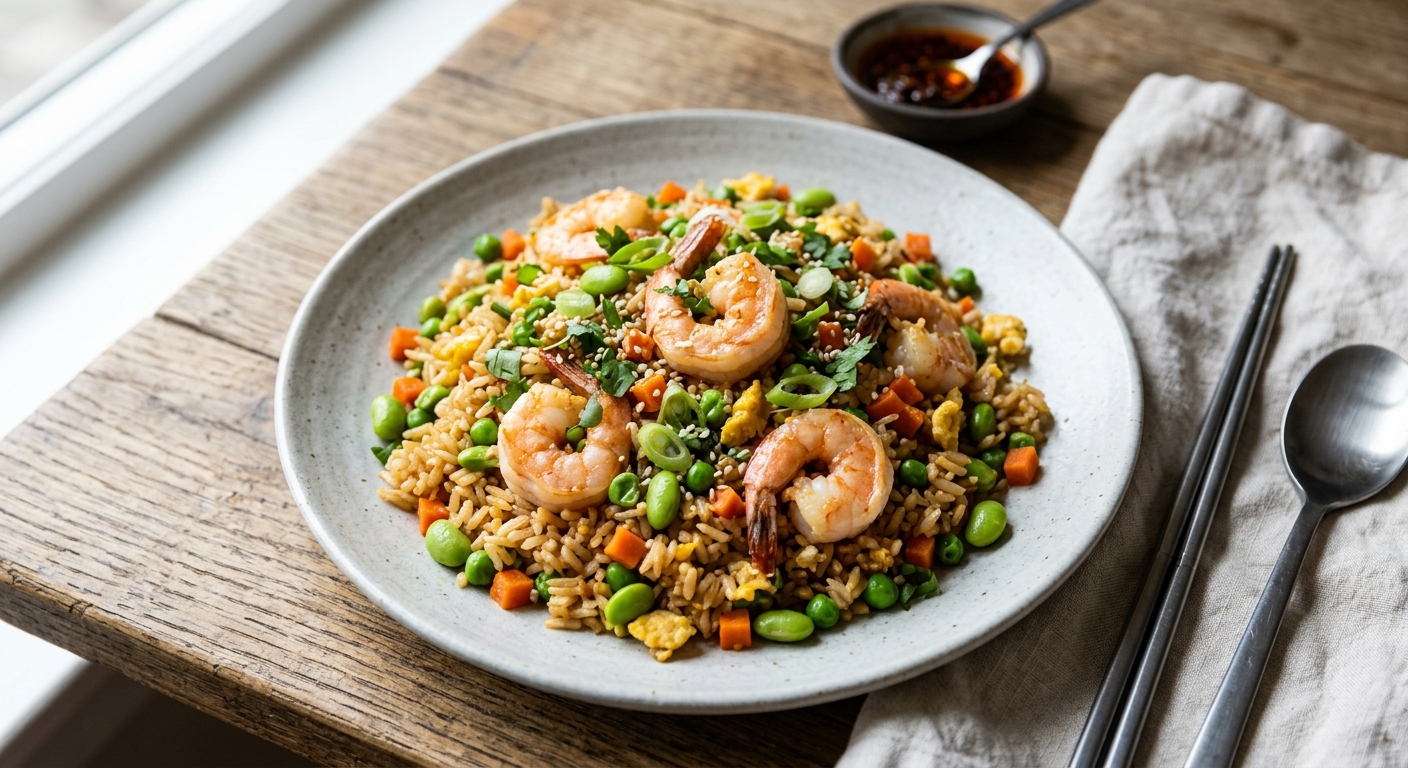
Choline is one of the most overlooked nutrients in modern diets, yet it is absolutely essential for memory formation, nerve signaling, and liver function. Most people get less than half the adequate intake recommended by the Institute of Medicine, and the consequences are real: cognitive fog, impaired lipid metabolism, and reduced acetylcholine synthesis. This Egg and Shrimp Fried Rice was engineered from the ground up to close that gap deliciously, pairing two of nature’s most concentrated choline sources, whole eggs and shrimp, with fragrant jasmine rice, sesame oil, and a colorful cascade of vegetables.
What makes this dish extraordinary from a culinary standpoint is the technique of dry-frying day-old rice over high heat, a method used in every serious Chinese kitchen to achieve that elusive wok hei, the smoky, slightly charred aroma that separates restaurant-quality fried rice from the soggy, steamed-rice version most home cooks settle for. The proteins are added in careful sequence to preserve their texture: shrimp first for a quick sear, eggs scrambled separately to stay custardy and distinct, and the rice last to absorb the rendered fat and savory seasoning.
Beyond choline, this plate punches well above its weight nutritionally. The shrimp supply a near-complete amino acid profile, including exceptional amounts of lysine and leucine. The eggs contribute vitamin B12, riboflavin, and selenium. The edamame and scallions add folate and vitamin K. Together, these ingredients build a dish that clocks in at roughly 480 calories per serving while delivering a macro balance, 38 grams of protein, 52 grams of complex carbohydrate, and 12 grams of fat, that sustains energy without spiking blood sugar to problematic levels.
4
servings
Ingredients
- 320 gday-old cooked jasmine rice (about 160g dry), chilled overnight
- 400 graw medium shrimp, peeled and deveined
- 4 largewhole eggs, beaten
- 120 gfrozen shelled edamame, thawed
- 100 gfrozen peas, thawed
- 80 gcarrots, finely diced
- 4 clovesgarlic, minced
- 2 tspfresh ginger, grated
- 5 stalksscallions (green onions), thinly sliced, whites and greens separated
- 3 tbsplow-sodium soy sauce
- 1 tbspoyster sauce
- 1 tsptoasted sesame oil
- 2 tbspAvocado Oil100% Pure Avocado Oil, divided
- 1 tsprice vinegar
- 0.5 tspwhite pepper
- —Colima Sea SaltMicroplastic Free Salt to taste
- —Optional: 1 tsp chili garlic sauce for heat
Instructions
Click on an item below to shop for the recommended items for this recipe on Amazon.
As an Amazon Associate, we earn from qualifying purchases.
- Remove the chilled rice from the refrigerator and use your fingers to break apart any clumps into individual loose grains. Season the shrimp lightly with a pinch of salt and white pepper. Beat the eggs in a small bowl with a pinch of salt and set aside.
- Heat a wok or large cast-iron skillet over the highest flame your stovetop allows for 2 full minutes until it begins to smoke. Add 1 tablespoon of avocado oil and swirl to coat the surface. Add the shrimp in a single layer and sear undisturbed for 60 seconds until pink and curled on the bottom. Flip each shrimp and cook 30 seconds more. The shrimp should be just cooked through with golden edges. Transfer to a plate immediately and set aside.
- Return the wok to high heat. Add the remaining 1 tablespoon of oil. Add the scallion whites, garlic, and ginger all at once and stir-fry vigorously for 30 seconds, moving constantly to prevent burning. Add the diced carrots and stir-fry for 2 minutes until they begin to soften at the edges.
- Push the aromatics to one side of the wok, creating a clear space. Pour the beaten eggs into the empty space and let them sit untouched for 10 seconds until the edges begin to set. Use a spatula to scramble them gently into large, soft curds, stopping while they are still slightly underdone. Immediately fold the aromatics through the eggs to combine.
- Add all of the chilled rice to the wok in one addition. Press it firmly against the hot surface with the back of your spatula and let it sit undisturbed for 45 seconds to develop a light crust on the bottom. Then toss everything vigorously. Repeat this press-and-toss cycle two more times over about 3 minutes until the rice is heated through and you can smell a light toasty aroma.
- Add the edamame and peas and toss to combine. Pour the soy sauce, oyster sauce, and rice vinegar around the edge of the wok (not directly onto the rice) so they hit the hot metal and caramelize slightly before coating the rice. Toss everything together for 1 minute. Return the cooked shrimp to the wok and fold through gently.
- Remove from heat. Drizzle the toasted sesame oil over the rice and toss once more. Taste and adjust seasoning with salt. Plate and finish with scallion greens scattered over the top. Serve immediately.
- This method starts with dry uncooked jasmine rice, not pre-cooked rice. Rinse 160g dry jasmine rice under cold water until the water runs clear, then drain thoroughly. Grease the slow cooker insert lightly with a small amount of avocado oil.
- In a skillet over medium-high heat, warm 1 tablespoon of avocado oil. Add the scallion whites, garlic, ginger, and diced carrots and saute for 3 to 4 minutes until the carrots are slightly softened and the garlic is fragrant. This brief pre-cook step removes raw sharpness from the aromatics and builds a flavor base that the slow cooker cannot develop on its own. Transfer the mixture to the slow cooker insert.
- Add the rinsed rice, edamame, peas, soy sauce, oyster sauce, rice vinegar, white pepper, and 480ml (2 cups) of low-sodium chicken or vegetable broth to the slow cooker. Stir to combine. Cover and cook on High for 1 hour and 30 minutes, or until the rice has absorbed the liquid and is just cooked through.
- While the rice finishes, whisk the eggs with a pinch of salt. In the same skillet used for the aromatics, heat a tiny drizzle of oil over medium heat and pour in the eggs. Scramble gently into soft, barely-set curds and remove from heat immediately while still glossy. In the same pan, quickly sear the seasoned shrimp over medium-high heat for 90 seconds per side until just pink. Set both aside.
- When the rice is cooked, open the slow cooker and fold the scrambled eggs and seared shrimp gently into the rice using a silicone spatula, being careful not to break the eggs or shrimp apart. Replace the lid and cook on High for a further 10 minutes to let the proteins warm through and integrate into the rice. Drizzle with sesame oil, top with scallion greens, and serve directly from the insert.
- Rinse 160g dry jasmine rice until the water runs clear and drain well. Add it to the Instant Pot insert along with 240ml (1 cup) of low-sodium chicken broth, the diced carrots, edamame, peas, soy sauce, oyster sauce, rice vinegar, white pepper, and 1 tablespoon of avocado oil. Stir briefly to distribute everything evenly.
- Seal the lid, set the valve to Sealing, and cook on Manual High Pressure for 3 minutes. Once the cycle completes, allow a natural pressure release for 10 minutes, then carefully switch the valve to Venting to release any remaining steam. Open the lid and fluff the rice gently with a fork. The rice should have absorbed all the liquid and each grain should be distinct.
- Switch the Instant Pot to Saute mode on High. Add the remaining 1 tablespoon of avocado oil along with the scallion whites, garlic, and ginger. Stir-fry directly in the pot for 90 seconds until fragrant, scraping the bottom to prevent sticking.
- Push the rice to the sides of the pot, creating a well in the center. Add the shrimp to the center in a single layer and cook, stirring occasionally, for about 2 minutes until they are pink and opaque. Add the beaten eggs directly over the shrimp and stir constantly to scramble them into small curds that distribute throughout the rice as they cook.
- Once the eggs are just set, fold everything together thoroughly. Turn off the Saute function. Drizzle the toasted sesame oil over the top, taste and adjust salt, and finish with the scallion greens. Serve immediately directly from the pot.
- Preheat your oven to 200C (400F) with a rack in the upper-middle position. Rinse 160g dry jasmine rice until the water runs clear. In a 9×13 inch (23x33cm) oven-safe baking dish or a 30cm cast-iron skillet, combine the dry rinsed rice, diced carrots, edamame, peas, scallion whites, garlic, ginger, soy sauce, oyster sauce, rice vinegar, white pepper, 1 tablespoon of avocado oil, and 480ml (2 cups) of hot low-sodium chicken or vegetable broth. Stir everything together until combined.
- Cover the baking dish tightly with two layers of aluminum foil, pressing the edges firmly to seal in steam. Bake on the upper-middle rack for 25 minutes. The rice will absorb the liquid and steam-cook within the foil seal.
- While the rice bakes, season the shrimp lightly with salt and white pepper. Toss them with a small drizzle of avocado oil. Beat the eggs with a pinch of salt.
- After 25 minutes, carefully remove the baking dish from the oven and peel back the foil, taking care to avoid the burst of steam. Fluff the rice gently with a fork. Scatter the seasoned shrimp evenly over the surface of the rice in a single layer. Pour the beaten eggs in thin streams across the top of the entire dish.
- Return the dish to the oven uncovered and bake for a further 8 to 10 minutes until the shrimp are pink and opaque and the eggs are just set across the surface. The edges of the rice should be lightly golden and beginning to crisp. Remove from the oven, drizzle with toasted sesame oil, scatter the scallion greens over the top, and serve by scooping portions from the dish, making sure each serving gets some of the crispy edge.
Nutrition Breakdown
Per 1 serving (makes 4)
Vitamins & Minerals
% Daily Value based on a 2,000 calorie diet (FDA reference)
🧬 Essential Amino Acids
% of recommended daily intake (RDA) per serving
🛡 Antioxidant Profile
The Nutrition Science
Choline is classified as an essential nutrient by the Institute of Medicine, yet surveys consistently show that over 90% of Americans fall short of the Adequate Intake of 550mg per day for men and 425mg for women. The biochemical consequences are not trivial. Choline is the direct precursor to acetylcholine, the principal neurotransmitter involved in memory encoding, attention, and skeletal muscle contraction. It is also required for synthesizing phosphatidylcholine, the dominant phospholipid in every cell membrane in the human body. Without adequate dietary choline, the liver cannot package triglycerides into VLDL particles for export, leading to hepatic fat accumulation. Eggs are the most choline-dense whole food available, delivering approximately 147mg per large egg predominantly from the yolk in the form of phosphatidylcholine. Shrimp contribute an additional 80 to 100mg per 100g serving as free choline and sphingomyelin.
Shrimp also provide astaxanthin, a xanthophyll carotenoid that sets them apart from most protein sources. Unlike beta-carotene, astaxanthin is not converted to vitamin A; instead it functions as a potent antioxidant in its own right, with a free radical quenching capacity estimated at 6,000 times that of vitamin C and 550 times that of vitamin E in certain assay systems. Critically, astaxanthin is lipophilic and crosses both the blood-brain barrier and the blood-retinal barrier, concentrating in neural tissue where it suppresses oxidative stress and neuroinflammation. Cooking shrimp at high temperature does not degrade astaxanthin; in fact the pink-red color that develops during searing reflects the liberation of astaxanthin from its protein-bound form, making it more bioavailable to the digestive system.
The selenium content of this dish is particularly noteworthy. Both eggs and shrimp are among the richest dietary sources of selenium, a trace mineral that serves as the catalytic center of the glutathione peroxidase enzyme family, the body’s primary intracellular hydrogen peroxide defense system. Adequate selenium status also supports the conversion of inactive thyroid hormone T4 to active T3 via the selenoenzyme iodothyronine deiodinase, and the iodine contributed by the shrimp in this dish directly feeds that thyroid hormone synthesis pathway. The co-presence of selenium and iodine in a single meal is a genuinely rare nutritional synergy that this recipe delivers naturally.
Pro Tips
- The single most impactful technique upgrade for the stovetop method is using a carbon steel wok over a gas burner and preheating it for at least 2 full minutes before adding oil. A properly seasoned, screaming-hot surface is what creates wok hei; an electric cooktop with a flat-bottom wok can approximate this if you resist the urge to move the rice constantly.
- Do not overcook the shrimp. Shrimp go from raw to perfectly cooked to rubbery in a window of about 90 seconds per side over high heat. Pull them from the heat the moment they form a ‘C’ shape and turn opaque; a tightly curled ‘O’ shape means they are overcooked and the texture will suffer noticeably.
- To maximize choline bioavailability, do not discard or reduce the yolks. Phosphatidylcholine in egg yolk is more efficiently absorbed than choline supplements because it is packaged within a lipid matrix that facilitates micelle formation in the small intestine. The fat in the yolk is a feature, not a bug, for choline absorption.
This is such a smart observation about the gut-brain connection, Greta. Choline is a precursor for acetylcholine (critical for focus and memory), but it also supports phosphatidylcholine in gut barrier integrity, which reduces systemic inflammation that clouds cognition. I’ve noticed the same pattern with clients who prioritize choline: they get the obvious mental clarity wins, but then report improved digestion and better sleep quality within weeks. The shrimp and eggs combo here is particularly elegant because you’re also hitting omega-3s and quality protein simultaneously, which synergizes beautifully with choline for sustained BDNF production.
This is exactly the kind of nutrient synergy breakdown I geek out over. Have you noticed any difference in your CGM data when you’re consistently hitting higher choline intake, or is it mainly a subjective cognition/digestion thing? I’ve been tracking this too and I’m curious if the acetylcholine pathway actually smooths out glucose stability or if that’s just the secondary benefit of better gut barrier function reducing inflammatory spikes. The BDNF angle with the omega-3 and choline combo is fascinating, would love to know if you’ve seen any clients track this correlation with specific biomarkers.
OMG yes – I’ve been tracking choline intake for about 3 months now and noticed such a difference in my brain fog and actually, my gut motility too! This recipe is calling my name because I’ve had amazing results with egg-based meals, and shrimp is one of my safe proteins that doesn’t trigger inflammation flare-ups. Quick question: are you using fish sauce in the aromatics, or sticking to tamari/coconut aminos? I’m curious because I’ve noticed certain fermented ingredients vs others can really shift my IBS symptoms – and if this has good prebiotic veggies mixed in that would be the ultimate win for my microbiome and cognition combo!