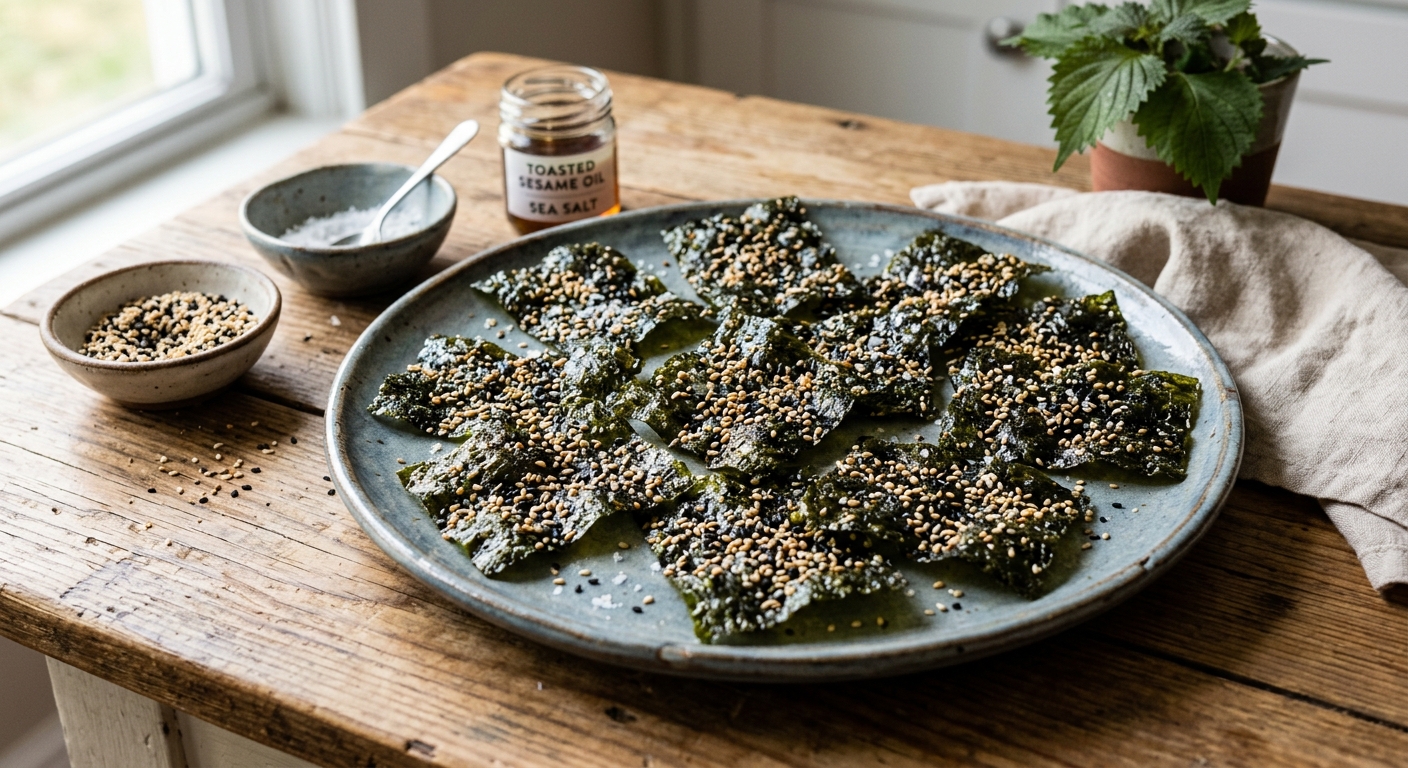
Seaweed snacks have earned their place in the global pantry, and for good reason that goes far beyond trend. Nori, the dried red algae pressed into thin sheets and best known as the wrapper for sushi rolls, is one of the most concentrated natural sources of iodine on the planet. A single gram of nori can contain anywhere from 16 to 43 micrograms of iodine, meaning even a modest serving of four sheets puts you comfortably above the recommended daily intake of 150 micrograms. Pair that with toasted sesame seeds and a whisper of sesame oil, and you have a snack that is simultaneously mineral-dense, rich in healthy fats, and genuinely craveable.
What makes this recipe stand apart from commercially packaged seaweed snacks is the control you have over the process. Store-bought versions are often seasoned with excessive sodium or coated in palm oil, and they lose their satisfying snap sitting in bulk packaging. When you toast nori at home, whether in a dry skillet, a low oven, or with the brief blast of an air fryer, you activate the Maillard reaction on its surface compounds, deepening that characteristic ocean-mineral umami flavor while driving off residual moisture for a shatter-crisp texture. A light brush of cold-pressed sesame oil before toasting adds fat-soluble flavor compounds that bloom under heat, and toasted sesame seeds provide a secondary crunch with their own payload of zinc, copper, and manganese.
For the Calibrated Cuisine approach, this recipe is also a study in how tiny ingredients can punch far above their weight class nutritionally. The selenium naturally present in nori partners with iodine at the enzymatic level: selenoprotein deiodinases are the enzymes that convert the relatively inactive thyroid hormone T4 into its metabolically active form T3, and without adequate selenium those enzymes stall. Sesame seeds supply the selenium complement, making this pairing genuinely synergistic rather than merely delicious. Whether you are looking for a mid-afternoon energy reset, a pre-workout mineral top-up, or just the most satisfying two-minute snack you have made all week, these roasted nori sheets deliver every time.
4
servings
Ingredients
- 16 sheetsdried nori sheets (full sushi-grade sheets, approximately 19cm x 21cm each)
- 2 tbspcold-pressed toasted sesame oil
- 3 tbspwhite sesame seeds
- 1 tbspblack sesame seeds
- 0.5 tspColima Sea SaltMicroplastic Free Salt (such as Maldon)
- 0.25 tspColima Sea SaltMicroplastic Free Salt (for stovetop method seasoning control)
- 1 tsptamari or coconut aminos (optional, for umami depth)
- —Light Avocado Oil100% Pure Avocado Oil spray (for oven and air fryer methods, optional)
Instructions
Click on an item below to shop for the recommended items for this recipe on Amazon.
As an Amazon Associate, we earn from qualifying purchases.
- Mix the sesame oil and tamari (if using) together in a small bowl. Using a pastry brush or your fingertips, very lightly coat one side of each nori sheet with the sesame oil mixture. You want the thinnest possible film, roughly 0.25 tsp of oil per two sheets. Over-oiling causes steaming rather than crisping in a dry pan.
- Place a large stainless steel or cast iron skillet over medium-high heat. Do not add any oil to the pan. Allow the pan to heat for 90 seconds until it is genuinely hot. Reduce heat to medium once it is fully preheated.
- Place one nori sheet, oiled side down, flat in the hot skillet. Press it gently with a flat spatula to ensure full contact with the pan surface. Toast for 45 to 60 seconds. You will see the color shift from dark purple-black to a bright olive green and the sheet will begin to curl at the edges. This color change is your key visual cue for doneness.
- Flip the sheet and toast the dry side for 20 to 30 seconds only. Immediately transfer to a wire cooling rack. While still warm, scatter a pinch of white and black sesame seeds over the oiled side and press them lightly so they adhere. Add a few flakes of sea salt.
- Repeat with the remaining sheets, working in single-sheet batches. Allow the pan to return to temperature between batches if it cools. Stack finished sheets loosely on the wire rack so air circulates and they crisp as they cool. Serve within 30 minutes for maximum crunch, or store in an airtight container with a silica gel packet.
- Preheat your oven to 160 degrees Celsius (325 degrees Fahrenheit), or 150 degrees Celsius on convection or fan-forced setting. Line two large rimmed baking sheets with parchment paper. Do not use silicone mats, as they trap steam beneath the sheets and prevent crisping.
- Whisk together the sesame oil and tamari (if using) in a small bowl. Working on a clean flat surface, brush one side of each nori sheet with the lightest possible coat of the sesame oil mixture, using a silicone pastry brush. Immediately sprinkle the white and black sesame seeds evenly across the oiled surface of each sheet while the oil is still wet so the seeds bond to the surface during baking.
- Arrange the seasoned nori sheets in a single layer on the prepared baking sheets, oiled side up, leaving at least 1cm between sheets. Do not overlap. You will likely fit 4 sheets per standard baking sheet; use two racks and two pans simultaneously.
- Place both baking sheets in the oven. Bake for 5 minutes, then rotate the pans front to back and swap their rack positions. Continue baking for a further 3 to 5 minutes, watching closely. The sheets are done when they have turned from dark purple to bright olive green throughout and feel stiff and papery when you lift a corner with tongs. They will still feel very slightly pliable when hot but will crisp fully as they cool.
- Remove from the oven and immediately season with flaky sea salt while still warm. Transfer sheets to a wire rack in a single layer, do not stack, and allow to cool for 5 minutes before serving. Cooling on the rack rather than leaving them on the hot pan is essential to prevent residual steam from softening the bottoms.
- Set your slow cooker to the Low setting and prop the lid open by placing a wooden chopstick or the handle of a wooden spoon across the rim with the lid resting on it at an angle. This gap is critical: it allows steam to escape continuously, which is the whole mechanism of this method. Without the gap, moisture trapped inside the cooker will cause the nori to become chewy rather than crisp.
- Mix the sesame oil and tamari (if using) together. Brush each nori sheet on one side with the thinnest possible coat of the mixture, then scatter the white and black sesame seeds over the oiled surface immediately so they adhere.
- Cut each full nori sheet into quarters using kitchen scissors, giving you 64 snack-sized pieces from 16 sheets. This smaller size is important for the slow cooker method: smaller pieces can be suspended vertically or layered with airflow between them more easily than full sheets, which would be too large for most slow cooker inserts.
- Place a wire rack or a small oven-safe cooling rack inside the slow cooker insert if it fits. Alternatively, crumple two sheets of parchment paper loosely and place them in the bottom to create an elevated uneven surface, then lay the nori quarters across this surface so they are not lying completely flat. Arrange in a loose single layer. Depending on the size of your slow cooker, you may need to do this in two batches.
- Dehydrate with the lid propped for 3 to 4 hours on Low. Check at the 2.5-hour mark by removing one piece and allowing it to cool for 1 minute. It should snap cleanly and feel completely dry. If it is still pliable, continue for another 30 to 60 minutes. Once done, season with flaky sea salt and cool on a wire rack. These dehydrated pieces store exceptionally well in an airtight container for up to one week.
- Remove the lid from your electric pressure cooker (Instant Pot or equivalent) entirely and set it aside. Select the Saute function and set it to High. Allow the inner pot to preheat for 3 to 4 minutes. The pot is ready when a few drops of water flicked onto the surface evaporate immediately with a loud sizzle.
- Prepare your nori by brushing each sheet on one side with the sesame oil and tamari mixture using a very light hand. Have your sesame seeds in a small bowl and flaky salt ready at the station before you begin, as the toasting process moves quickly and you need to season immediately after each sheet comes out.
- Reduce Saute to the Medium setting once preheated. Place one nori sheet flat into the dry pot, oiled side down. Press it flat with a silicone spatula, holding it in contact with the pot surface. Toast for 30 to 40 seconds. Watch for the green color shift across the surface. The stainless steel pot concentrates heat more intensely than a skillet, so sheets toast faster and more evenly.
- Flip the sheet and toast the second side for 15 to 20 seconds only, then immediately lift it out using tongs and place it on a wire cooling rack. While still warm, press sesame seeds onto the oiled side and add a pinch of flaky sea salt. The seeds will adhere well due to the residual oil and heat.
- Continue with remaining sheets one at a time. If the pot begins to smoke or the nori browns too quickly, press Cancel and allow the pot to cool for 60 seconds before resuming on Medium Saute. Serve within 20 minutes for optimal crunch, as the stainless steel surface gives these sheets a particularly intense toast that peaks fresh.
Nutrition Breakdown
Per 1 serving (makes 4)
Vitamins & Minerals
% Daily Value based on a 2,000 calorie diet (FDA reference)
🧬 Essential Amino Acids
% of recommended daily intake (RDA) per serving
🛡 Antioxidant Profile
The Nutrition Science
Iodine occupies a uniquely critical position in human metabolism because it is the literal building block of thyroid hormones. The thyroid gland incorporates iodine atoms into tyrosine residues to synthesize thyroxine (T4, containing four iodine atoms) and triiodothyronine (T3, containing three). T3 is the metabolically active form, binding to nuclear receptors in virtually every cell in the body and regulating basal metabolic rate, thermogenesis, protein synthesis, and cardiac output. Chronic iodine insufficiency is the world’s leading preventable cause of intellectual disability and also drives hypothyroidism, a condition characterized by fatigue, weight gain, and cold intolerance. Nori provides bioavailable iodine in a food matrix that includes companion minerals such as selenium, which is required for the deiodinase enzymes that convert T4 to active T3.
The sesame component of this recipe is far more than a textural garnish. Sesame seeds are among the richest plant sources of the lignans sesamin and sesamolin, which are transformed by gut microbiota into the enterolignans enterodiol and enterolactone. These compounds have demonstrated weak phytoestrogenic activity and meaningful antioxidant capacity in multiple in vitro and animal studies. More practically, sesame seeds provide a significant dose of copper, which is an essential cofactor for the mitochondrial enzyme cytochrome c oxidase, the final step in the electron transport chain where ATP is synthesized. Adequate copper therefore has a direct bearing on cellular energy production, complementing the metabolic-boost theme of this snack in a biochemically precise way.
Fucoxanthin, the carotenoid responsible for the brown-orange pigment in many algae and present in measurable amounts in nori, is one of the most exciting compounds in nutritional science. Unlike beta-carotene, fucoxanthin cannot be converted to vitamin A, but it exerts its own powerful effects. Multiple rodent studies have shown it activates uncoupling protein 1 (UCP1) in white adipose tissue, a protein normally found only in brown fat, effectively causing white fat cells to dissipate energy as heat rather than storing it. While human trials are still limited, a 2010 randomized controlled trial by Abidov et al. demonstrated statistically significant reductions in body fat mass in obese women supplementing with fucoxanthin, supporting a genuine thermogenic mechanism. Eating nori regularly as part of a balanced diet represents one of the most practical dietary delivery routes for this compound.
Pro Tips
- Store untoasted nori sheets in a sealed bag with a food-grade silica gel desiccant packet. Even brief exposure to humidity causes them to absorb moisture and lose the ability to crisp properly during toasting.
- If your toasted nori sheets lose their crunch after storage, spread them on a baking sheet and place in a 150 degrees Celsius oven for 3 minutes to drive off reabsorbed moisture and restore their snap completely.
- Vary the seasoning profile while keeping the iodine payload intact: try a Korean-inspired version with gochugaru and a drop of gochujang thinned with sesame oil, or a Japanese furikake style with a pinch of MSG, dried bonito powder, and shiso flakes brushed on before toasting.






This is a great snack, and I love that you’re highlighting iodine since it really is foundational for thyroid function, but I’d gently pump the brakes on calling it “the ultimate metabolic snack” or claiming it directly “fuels” metabolic rate in a major way. The iodine content is legit (nori typically has 16-2600 mcg per gram depending on source water), but thyroid hormone synthesis is just one piece of a complex metabolic puzzle, and getting adequate iodine doesn’t meaningfully boost metabolism in people who aren’t deficient. That said, the umami from nori plus the polyphenols and sesamin from sesame oil
Love this one, especially for iodine support without needing to overthink it. I’ve been curious though, have you experimented with layering in some dried seaweed powders like kelp or dulse that were sourced specifically for their mineral density? I’ve found that combining nori’s umami with an adaptogenic herb like rhodiola can create this really grounding snack that also helps stabilize cortisol, which indirectly supports thyroid function when stress isn’t constantly suppressing TSH. The sesame oil pairing is perfect since the lignans seem to enhance mineral absorption too.
nori’s legit here, but honestly the real win is pairing it with the sesame for that magnesium and B6 combo that actually supports mineral absorption and hormone synthesis. ive seen clients nail their iodine intake but still feel flat until we dialed in the supporting minerals, so dont sleep on the synergy aspect. curious what your sourcing looks like on the nori though, some brands are way more consistent on mineral density than others.