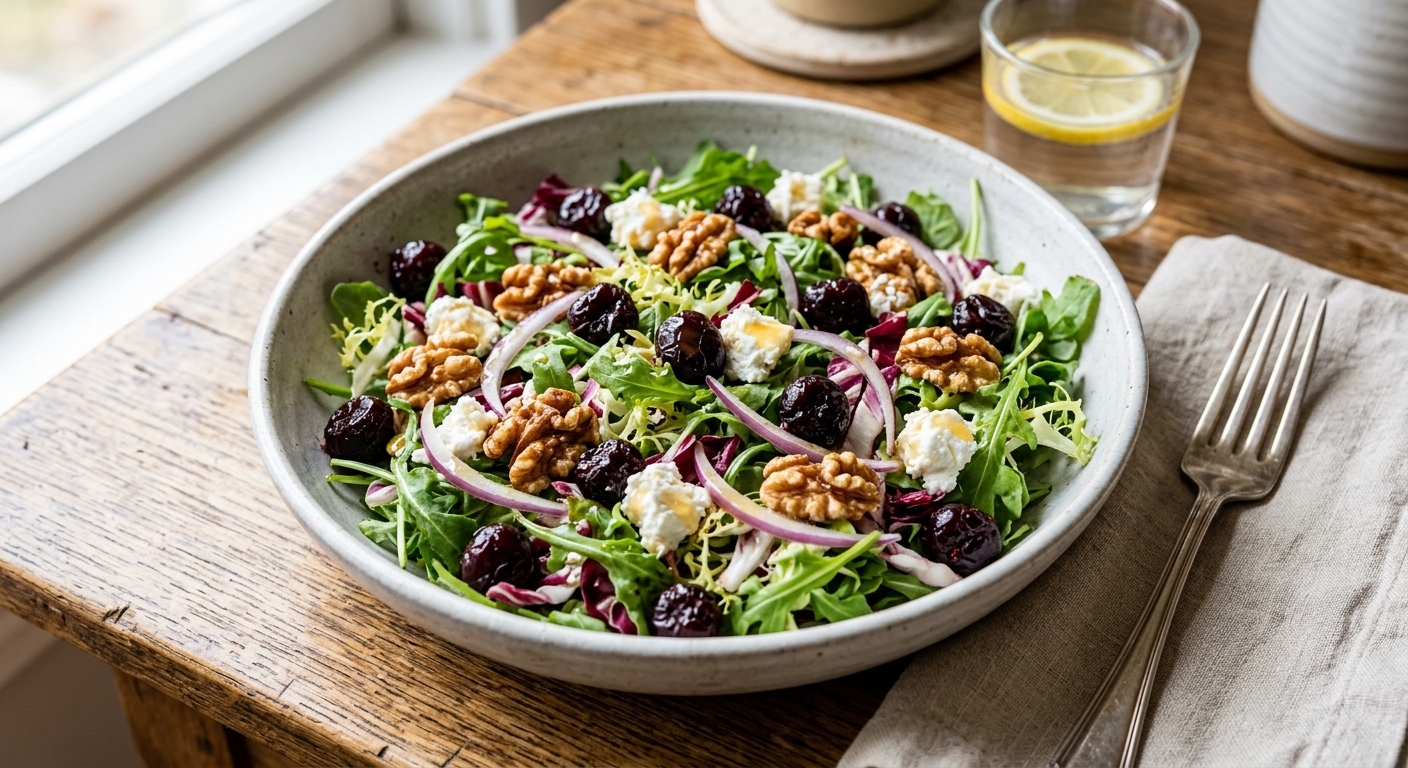
Some salads are merely vehicles for dressing. This one is a precision-engineered anti-inflammatory protocol disguised as the most satisfying lunch you will eat this week. Tart cherries, specifically Montmorency varieties, contain some of the highest measured concentrations of anthocyanins in any whole food, compounds that directly inhibit COX-1 and COX-2 enzymes, the same pathways targeted by ibuprofen. Paired with walnuts, which are uniquely rich in alpha-linolenic acid (ALA) among tree nuts, and you have a synergistic combination that addresses inflammatory cascades from multiple biochemical angles simultaneously.
Goat cheese brings far more than creamy contrast to this bowl. Its shorter-chain fatty acids, particularly capric and caprylic acid, are more readily absorbed and metabolized than bovine dairy fats, making it easier on the digestive system while contributing calcium, phosphorus, and a meaningful dose of vitamin A. The honey-balsamic vinaigrette is not an afterthought either: raw honey contributes flavonoids and inhibits the growth of inflammatory gut pathogens, while good balsamic vinegar provides resveratrol and acetic acid, both of which support insulin sensitivity and reduce postprandial blood glucose spikes.
Now, you might wonder why a salad recipe needs stovetop, slow cooker, pressure cooker, and oven methods. The answer is that this recipe goes well beyond tossing leaves. The walnut-preparation method, the cherry-infusion technique, and the vinaigrette-building process each benefit from different approaches depending on what you have available and how much depth of flavor you want to develop. The slow cooker and pressure cooker methods produce a warm, wilted grain-and-greens version with plumped cherries and deeply toasted walnuts, while the oven method produces a spectacular roasted component plate. Each version is a genuinely different, nutritionally complete dish built from the same core ingredients.
4
servings
Ingredients
- 120 gdried tart (Montmorency) cherries, unsweetened
- 100 gwalnut halves
- 120 gsoft goat cheese (chevre), crumbled
- 160 gbaby arugula, washed and dried
- 80 gradicchio, thinly sliced
- 60 gfrisee or curly endive, torn
- 1 mediumred onion, thinly sliced into half-moons
- 2 tbspraw honey
- 60 mlaged balsamic vinegar
- 60 mlextra-virgin olive oil
- 1 tbspDijon mustard
- 1 clovegarlic, finely minced
- 1 tbspfresh thyme leaves
- 120 gcooked farro or spelt berries (for warm versions)
- 30 mlapple cider vinegar
- 1 tspsmoked paprika
- —Colima Sea SaltMicroplastic Free Salt and freshly cracked black pepper to taste
- —Colima Sea SaltMicroplastic Free Salt for finishing
Instructions
Click on an item below to shop for the recommended items for this recipe on Amazon.
As an Amazon Associate, we earn from qualifying purchases.
- Place the dried tart cherries in a small saucepan with the apple cider vinegar and 60ml of water. Bring to a gentle simmer over medium-low heat and cook for 5 to 6 minutes, stirring occasionally, until the cherries are plump and have absorbed most of the liquid. Remove from heat and set aside to cool slightly. Reserve any remaining liquid for the vinaigrette.
- Place the walnut halves in a dry skillet over medium heat. Toast, shaking the pan frequently, for 4 to 5 minutes until the walnuts are fragrant and lightly golden on the flat sides. Watch carefully as they can burn quickly. Transfer immediately to a cutting board and roughly chop. Season lightly with flaky salt while still warm.
- In the same skillet, add the red onion half-moons with 1 tablespoon of the olive oil over medium-low heat. Cook gently for 3 to 4 minutes until softened and just beginning to caramelize at the edges. Add the minced garlic and thyme leaves and cook for 30 seconds more. Remove from heat.
- Build the warm honey-balsamic vinaigrette directly in the skillet off the heat: add the aged balsamic vinegar, Dijon mustard, raw honey, smoked paprika, and any reserved cherry soaking liquid. Whisk vigorously while drizzling in the remaining olive oil to emulsify. Season with salt and pepper. The residual pan warmth will keep the vinaigrette fluid and help the flavors meld.
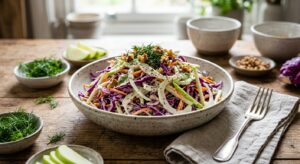
- Arrange the arugula, radicchio, and frisee on a large serving platter or in individual wide bowls. Scatter the plumped cherries and caramelized onions evenly over the greens. Distribute the warm chopped walnuts across the top, then crumble the goat cheese generously over everything. Pour the warm vinaigrette over the salad tableside just before serving, finishing with flaky sea salt and cracked pepper.
- Combine the dried tart cherries, cooked farro, sliced red onion, smoked paprika, thyme leaves, apple cider vinegar, balsamic vinegar, Dijon mustard, raw honey, and 180ml of water in the slow cooker insert. Stir well to distribute everything evenly. Drizzle 1 tablespoon of olive oil over the surface. Season generously with salt and pepper.
- Place the walnut halves in a single layer on a piece of aluminum foil and nestle the foil parcel loosely on top of the cherry-farro mixture inside the slow cooker. This allows the walnuts to gently warm and toast in the steam environment without becoming soggy, picking up subtle cherry and thyme aromatics.
- Place the lid on and cook on Low for 3 hours. After 2.5 hours, check the mixture: the farro should be tender and creamy, the cherries fully plump and giving, and the liquid reduced to a thick, glossy sauce clinging to the grains. If the mixture looks too wet, remove the lid for the final 30 minutes.
- Remove the walnut parcel from the slow cooker and roughly chop the walnuts on a cutting board. Whisk the remaining tablespoon of olive oil and the minced garlic into the warm farro mixture directly in the insert. Taste and adjust seasoning. The residual heat will mellow the raw garlic perfectly.
- To serve, place a generous handful of arugula and frisee in each wide bowl. Spoon the warm cherry-farro mixture over the greens, allowing the heat to gently wilt the arugula slightly. Top each bowl with chopped walnuts and crumbled goat cheese. The contrast of warm grains and cool, crisp greens is intentional. Finish with flaky salt and a crack of black pepper.
- Select the Saute function on your Instant Pot or electric pressure cooker and heat 1 tablespoon of olive oil over medium-high heat. Add the sliced red onion and cook, stirring occasionally, for 3 to 4 minutes until softened and lightly golden. Add the garlic, smoked paprika, and thyme and stir for 30 seconds until fragrant. Press Cancel to stop the saute function.
- Add the dried tart cherries, cooked farro, balsamic vinegar, apple cider vinegar, Dijon mustard, raw honey, and 120ml of water to the pot. Stir to combine thoroughly, scraping up any browned bits from the bottom of the insert to prevent a burn warning. Season with salt and pepper.
- Secure the lid and set the pressure release valve to Sealing. Cook on High Pressure for 8 minutes. When the cycle is complete, perform a quick pressure release by carefully turning the valve to Venting. Once all steam has escaped, open the lid.
- Select the Saute function again on the lowest setting. Stir the mixture: the cherries should be completely plump and the farro very tender. If excess liquid remains, simmer uncovered for 2 to 3 minutes, stirring frequently, until the sauce has reduced to a glossy, coating consistency. Stir in the remaining tablespoon of olive oil and taste for seasoning.
- While the mixture finishes, toast the walnut halves in a separate dry skillet on the stovetop over medium heat for 3 to 4 minutes until fragrant. Chop roughly. To plate, create a bed of arugula, radicchio, and frisee in each bowl, spoon the hot cherry-farro mixture over the greens, top with toasted walnuts and crumbled goat cheese, and finish with flaky salt.
- Preheat the oven to 200 degrees Celsius (400 degrees Fahrenheit). Line two rimmed baking sheets with parchment paper. On the first baking sheet, toss the red onion half-moons with 1 tablespoon of olive oil, a pinch of salt, and the smoked paprika. Spread in a single layer on one half of the sheet. Place the dried tart cherries on the other half, drizzle with 1 tablespoon of the balsamic vinegar, and toss gently.
- On the second baking sheet, toss the walnut halves with 1 teaspoon of olive oil, 1 teaspoon of the raw honey, the thyme leaves, and a pinch of flaky salt. Spread in a single layer. Place both baking sheets in the preheated oven. The walnuts will take 8 to 10 minutes and the onion-cherry sheet will take 18 to 22 minutes, so stagger their start times by 10 minutes, putting the onion and cherry pan in first.
- After 10 minutes, add the walnut pan to the oven. At the 18 to 20 minute mark, check the onions: they should be deeply golden and caramelized at the edges, and the cherries should be blistered and sticky. The walnuts should be fragrant, glossy from the honey, and lightly candied. Remove both pans and allow to cool for 5 minutes.
- Make the cold vinaigrette while the components cool: whisk together the remaining balsamic vinegar, Dijon mustard, remaining raw honey, minced garlic, apple cider vinegar, and a pinch of salt in a small bowl. Slowly drizzle in the remaining olive oil while whisking constantly until the dressing is emulsified, smooth, and glossy. Taste and adjust seasoning.
- Arrange the arugula, radicchio, and frisee across a large flat serving platter. Scatter the warm roasted onions and blistered cherries over the greens. Break up any large clusters of candied walnuts and distribute across the top. Crumble the goat cheese in generous mounds throughout. Drizzle the cold vinaigrette over everything just before serving, letting it pool slightly in the wells of the leaves. Finish with flaky salt and cracked pepper.
Nutrition Breakdown
Per 1 serving (makes 4)
Vitamins & Minerals
% Daily Value based on a 2,000 calorie diet (FDA reference)
🧬 Essential Amino Acids
% of recommended daily intake (RDA) per serving
🛡 Antioxidant Profile
The Nutrition Science
The anti-inflammatory synergy in this dish operates through at least three distinct biological pathways. Tart cherries provide among the densest natural sources of anthocyanins, particularly cyanidin-3-glucoside and cyanidin-3-rutinoside, which have been demonstrated in randomized controlled trials to reduce serum uric acid, lower C-reactive protein, and decrease urinary markers of oxidative stress. A landmark 2012 study in the Journal of Nutrition found that consuming two servings of Montmorency cherries reduced circulating CRP by 25% within 12 hours, a magnitude of effect comparable to low-dose aspirin therapy.
Walnuts contribute the highest concentration of alpha-linolenic acid (ALA) of any tree nut at approximately 2.5g per 28g serving, providing the precursor substrate for EPA and DHA synthesis, though conversion efficiency in humans is limited to roughly 5 to 15%. More immediately relevant is walnuts’ gamma-tocopherol content, a form of vitamin E not found in olive oil, which has demonstrated specific inhibitory activity against peroxynitrite-induced inflammation in endothelial tissues. Goat cheese’s medium-chain triglycerides, primarily capric acid (C10) and caprylic acid (C8), bypass the standard chylomicron transport pathway and are transported directly to the liver via the portal vein, providing rapid energy without stimulating significant inflammatory lipid signaling.
The vinaigrette itself is a clinically relevant anti-inflammatory vehicle. Balsamic vinegar’s acetic acid reduces postprandial insulin secretion by approximately 20% when consumed alongside a moderate-glycemic-load meal, according to a 2005 European Journal of Clinical Nutrition trial. Raw honey’s methylglyoxal and hydrogen peroxide content, combined with its flavonoid fraction, inhibit the growth of inflammatory gut bacteria including H. pylori and several Staphylococcus species. Together, this dressing acts as both a flavor amplifier and a metabolic moderator, making it an integral part of the dish’s nutritional design rather than a finishing garnish.
Pro Tips
- For maximum anthocyanin density, seek out unsweetened Montmorency dried cherries rather than generic dried sweet cherries: Montmorency varieties contain up to 5 times more cyanidin-3-glucoside than Bing or Rainier cherries and the absence of added sugar keeps the glycemic load in check.
- Toast walnuts immediately before serving and never more than 5 minutes before plating: walnut ALA oxidizes rapidly when the nut’s surface area is broken by heat, and freshly toasted walnuts deliver dramatically superior flavor and better lipid integrity than pre-toasted packaged varieties.
- If your goat cheese is very cold from the refrigerator, remove it 20 minutes before serving and crumble it by hand rather than with a knife: room-temperature chevre spreads into creamy ribbons rather than dense cold clumps, distributing flavor more evenly across every bite and improving mouthfeel significantly.
Okay this salad is honestly calling my name, especially for blood sugar stability! The walnuts and healthy fats from the goat cheese are going to slow down the anthocyanins’ glucose impact, which my PCOS body desperately needs. I’d maybe add some pumpkin seeds for extra magnesium and zinc too, since those minerals are huge for insulin sensitivity. Laurie, I love your DMA thinking – though I’ve found that adding a quality omega-3 supplement (algae based since I’m pescatarian) plus eating this kind of fat and fiber combo consistently has made way more difference for me than hunting for it all in one meal, if that helps!
This is such a smart combo, especially those walnuts for ALA omega-3s! I’m curious about the DHA angle though, since I’m always hunting for ways to boost my breast milk’s DHA content postpartum. Have you considered adding a sardine or salmon variation, or does the walnut ALA conversion typically feel sufficient for your readers? Also, the tart cherries are perfect for sleep recovery, which honestly feels like half the battle when you’re a new mom running on fumes. I’ve been rotating this type of salad into my meal prep and it’s become such a reliable postpartum nutrition hit, especially paired with a protein source.
You’re touching on something I’ve been thinking about a lot with my students lately, Laurie – that ALA to DHA conversion is where the epigenetics gets really interesting because it’s not just about the fatty acid itself, it’s about whether your methylation pathways have the cofactors (B vitamins, choline, folate) to actually upregulate those conversion enzymes efficiently. I started adding chopped sardines to my walnut salads specifically because postpartum, like you’re experiencing, your choline and folate demands spike and that methylation machinery gets taxed, so why make your body work harder to convert ALA when you could just get bioavailable DHA straight up? The