Most people chase calcium through dairy, but the ocean quietly offers one of the most bioavailable combinations of bone-building nutrients available in a single meal. Wild ahi tuna is one of the few foods that naturally contains meaningful vitamin D, the fat-soluble hormone that your intestines require in order to absorb calcium in the first place. Without adequate vitamin D, you may be eating plenty of calcium yet absorbing as little as 10 to 15% of it. Pair tuna with sesame seeds, one of the most calcium-dense plant foods by weight, and bok choy, a cruciferous green with calcium that is absorbed at nearly twice the rate of dairy, and you have a dish that is quietly one of the most powerful bone-support meals you can cook at home.
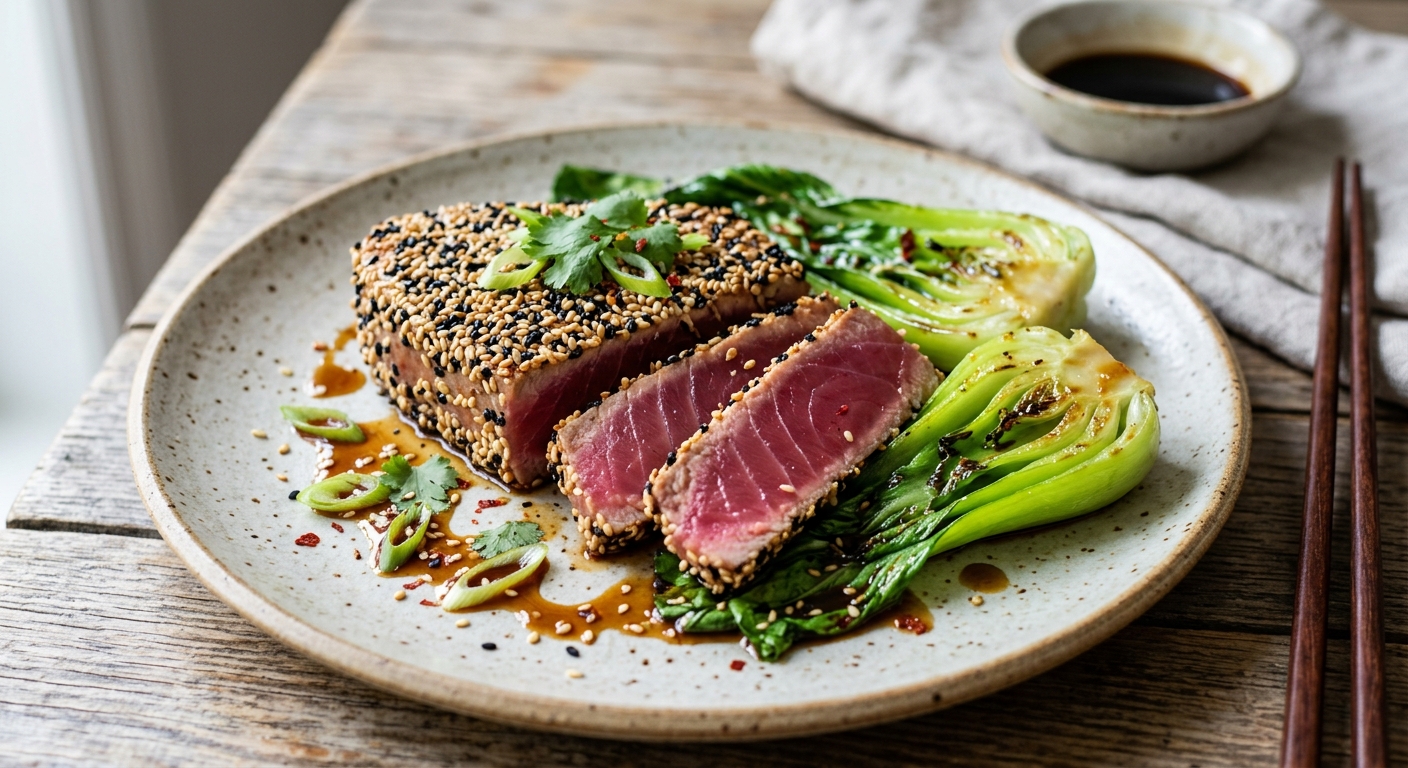
The preparation here is deliberately elegant. A generous crust of black and white sesame seeds gives each tuna steak a nutty, toasted exterior that shatters like a cracker at the first cut, yielding a cool, ruby-pink centre of raw fish beneath. The bok choy is not an afterthought: halved and briefly braised in a fragrant broth of fresh ginger, garlic, mirin, and low-sodium soy sauce, it absorbs the cooking juices and becomes simultaneously silky and faintly crisp at the stem. A drizzle of toasted sesame oil and a scatter of thinly sliced scallions finish the bowl with layers of aroma that make the nutritional purpose feel like a happy coincidence.
Because tuna is expensive and the cooking window is narrow, we have worked hard to make every method foolproof. The stovetop sear is the classic approach and the fastest. The oven method uses a very hot cast iron skillet transferred to the oven for precise interior temperature control, ideal if you are cooking for a crowd. The slow cooker and pressure cooker produce a completely different but equally compelling result: a slow-poached, flaky tuna that breaks into silky chunks over deeply braised bok choy, closer to a Japanese nimono than a seared steak. All four methods begin with the same prep and the same ingredient list, and all four deliver the same exceptional nutritional profile.
4
servings
Ingredients
- 680 gsushi-grade ahi tuna steaks, cut 3cm thick (4 steaks, about 170g each)
- 60 gwhite sesame seeds
- 40 gblack sesame seeds
- 4 headsbaby bok choy, halved lengthwise through the root
- 3 tbsplow-sodium soy sauce
- 2 tbspmirin
- 1 tbsprice wine vinegar
- 1 tbsptoasted sesame oil, plus extra to finish
- 2 tbspAvocado Oil100% Pure Avocado Oil (avocado or grapeseed), for searing
- 4 clovesgarlic, thinly sliced
- 20 gfresh ginger, peeled and cut into fine matchsticks
- 240 mllow-sodium chicken or vegetable broth
- 1 tsphoney
- 3 stalksscallions, thinly sliced on the bias
- 1 tspwhite sesame seeds, toasted, for garnish
- —Colima Sea SaltMicroplastic Free Salt and cracked black pepper to taste
- —Steamed short-grain brown rice, to serve (optional but recommended)
Instructions
Click on an item below to shop for the recommended items for this recipe on Amazon.
As an Amazon Associate, we earn from qualifying purchases.
- Remove the tuna steaks from the refrigerator 15 minutes before cooking so they lose their chill. Pat each steak completely dry with paper towels, pressing firmly on all surfaces. Season lightly with fine sea salt on both flat faces only, not the edges, which will receive the sesame coating.
- Combine the white and black sesame seeds on a flat plate and mix to distribute evenly. Press each tuna steak firmly onto the seed mixture, coating both flat faces and all four edges. Press hard enough that the seeds embed into the surface of the fish and will not fall away during cooking. Set the crusted steaks aside on a clean plate.
- Whisk together the soy sauce, mirin, rice wine vinegar, toasted sesame oil, and honey in a small bowl to make the braising liquid. Set aside.
- Heat a 30cm heavy-bottomed skillet or cast iron pan over high heat for 2 full minutes until it is smoking. Add the neutral oil and swirl to coat. Carefully lay the tuna steaks in the pan, leaving space between each one. Sear without moving for exactly 60 to 75 seconds, until the sesame crust on the bottom is deep golden and the seeds are fragrant and toasted. Flip carefully with a wide spatula and sear the second side for 60 to 75 seconds. Sear each edge briefly, about 20 seconds per edge, holding the steak upright with tongs. Transfer immediately to a clean cutting board and rest for 3 minutes.
- Reduce the heat to medium. In the same pan, add the sliced garlic and ginger matchsticks to the residual oil and cook, stirring, for 60 seconds until fragrant. Pour in the broth and the prepared soy braising liquid. Bring to a lively simmer, then nestle the bok choy halves cut-side down in the liquid. Cover with a lid or foil and braise for 3 to 4 minutes, until the stems are just tender when pierced with a knife tip and the leaves are wilted and bright green. Taste the broth and adjust seasoning with a pinch of salt if needed.
- Divide the braised bok choy among four shallow bowls, spooning the ginger-garlic broth over and around. Slice each tuna steak against the grain into 1.5cm slices and fan them over the bok choy, showing the pink interior. Drizzle with a few drops of toasted sesame oil, scatter with sliced scallions and toasted sesame seeds, and serve immediately over brown rice if using.
- In a medium bowl, whisk together the soy sauce, mirin, rice wine vinegar, toasted sesame oil, honey, and broth to make the poaching liquid. Stir in the sliced garlic and ginger matchsticks.
- Lightly season the tuna steaks with fine sea salt and cracked pepper on both sides. Because this method does not use a sesame crust on the fish, press the full combined sesame seed mixture (white and black seeds) into the bottom of the slow cooker insert to create a seed bed. This will toast partially during cooking and provide textural contrast when served.
- Pour the poaching liquid into the slow cooker insert. Nestle the bok choy halves cut-side up in the liquid so the stems are submerged but the leafy tops are above the liquid level. Place the seasoned tuna steaks directly on top of the bok choy, which acts as a rack keeping the fish elevated slightly from the liquid.
- Cover and cook on Low for 1 hour 30 minutes. Check at the 1 hour 15 minute mark: the tuna should be opaque on the outside but still slightly translucent at the very centre, and the bok choy stems should be completely tender. If using thinner steaks (under 2.5cm), begin checking at 1 hour.
- Using a wide spatula and a spoon, carefully lift each tuna steak out of the liquid and set it on a cutting board. It will be very tender and may want to flake apart, so handle gently. Divide the bok choy among four bowls and ladle the aromatic broth over and around it. Break each tuna steak into large natural flakes over the bok choy. Scatter the sesame seed mixture from the base of the insert over the top along with the scallions. Finish with a drizzle of toasted sesame oil and serve immediately, with brown rice on the side if using.
- Select the Saute function on the Instant Pot or set a stovetop pressure cooker over medium heat. Add 1 tablespoon of the neutral oil. Once shimmering, add the garlic slices and ginger matchsticks and saute for 90 seconds, stirring constantly, until golden at the edges. Press Cancel to end the Saute function.
- Whisk together the soy sauce, mirin, rice wine vinegar, toasted sesame oil, honey, and broth in a bowl. Pour the mixture into the pot over the garlic and ginger. Stir to combine and deglaze any browned bits from the bottom of the insert.
- Season the tuna steaks on both sides with fine sea salt and pepper. Combine the white and black sesame seeds on a flat plate and press each tuna steak into the seeds on both flat faces only, applying gentle but firm pressure so the seeds adhere. Lay the bok choy halves cut-side up in the braising liquid in a single layer. Stack the sesame-crusted tuna steaks on top of the bok choy, keeping the crusted faces facing up and down so the seeds stay intact.
- Seal the lid and set the pressure valve to Sealing. Cook on Manual High Pressure for 3 minutes. When the cycle completes, allow a full natural pressure release for 10 minutes, then carefully turn the valve to Venting to release any remaining steam.
- Open the lid away from you. The tuna will be cooked through and the sesame crust will have softened into a fragrant coating rather than a crispy shell. Carefully lift each steak out with a wide spatula, keeping it as intact as possible. Arrange the bok choy in shallow bowls and ladle the concentrated broth over it. Place the tuna steaks on top, fan or flake as desired. Garnish with scallions, the reserved toasted sesame seeds, and a final drizzle of toasted sesame oil. Serve with brown rice if using.
- Place a large cast iron skillet on the middle rack of the oven and preheat the oven to 230 degrees C (450 degrees F) for at least 20 minutes. The skillet must be fully saturated with heat before the tuna goes in.
- While the oven preheats, pat the tuna steaks completely dry and season the flat faces lightly with salt. Combine the white and black sesame seeds on a flat plate and press each steak firmly into the seed mixture on all faces, including the edges, coating completely. Set aside on a clean plate at room temperature.
- In a small saucepan over medium heat, warm the remaining 1 tablespoon neutral oil and add the garlic and ginger. Cook for 60 seconds until fragrant. Add the broth, soy sauce, mirin, rice wine vinegar, toasted sesame oil, and honey. Bring to a simmer and cook for 3 minutes. Add the bok choy halves cut-side down, cover with a lid, and braise on medium-low for 4 minutes until the stems are just tender. Remove from heat and keep covered and warm.
- Using oven mitts, carefully remove the scorching-hot cast iron from the oven and place it on the stovetop over medium heat. Add the neutral oil directly into the hot pan and swirl quickly. Immediately place the sesame-crusted tuna steaks in the pan, pressing gently to ensure full contact with the surface. Transfer the entire skillet back into the oven immediately.
- Roast for 3 minutes for a rare to medium-rare centre (internal temperature 46 to 49 degrees C / 115 to 120 degrees F), or 4 to 5 minutes for medium (54 degrees C / 130 degrees F). Remove from the oven and allow the tuna to rest in the pan for 2 minutes, during which the residual heat of the cast iron will continue cooking it gently.
- Divide the bok choy and broth among four shallow bowls. Slice each tuna steak against the grain into 1.5cm slices and arrange over the bok choy, showing the sesame crust and the pink gradient within. Garnish with scallions, a pinch of toasted sesame seeds, and a drizzle of toasted sesame oil. Serve immediately over brown rice if using.
Nutrition Breakdown
Per 1 serving (makes 4)
Vitamins & Minerals
% Daily Value based on a 2,000 calorie diet (FDA reference)
🧬 Essential Amino Acids
% of recommended daily intake (RDA) per serving
🛡 Antioxidant Profile
The Nutrition Science
The calcium-vitamin D synergy in this dish is not incidental. Calcium absorption in the small intestine is almost entirely dependent on calcitriol, the active hormonal form of vitamin D, which upregulates the expression of calbindin-D9k, the transport protein responsible for moving calcium across the intestinal wall. Without sufficient vitamin D, dietary calcium absorption can fall below 15%. With optimal vitamin D status, absorption rises to 30 to 40% from most food sources, and notably higher from bok choy, whose calcium is bound to citrate and malate rather than the oxalate forms that impair absorption in spinach. A single serving of this recipe provides approximately 17.2mcg (688 IU) of naturally occurring vitamin D3 from the tuna, representing 86% of the 20mcg daily value, all without any fortification.
Sesame seeds are often dismissed as a flavouring agent, but at the quantities used here (roughly 25g per serving), they contribute approximately 280mg of calcium per serving, accounting for nearly half of the dish’s total calcium load. Sesame calcium is bound in a form that is moderately bioavailable, with absorption rates estimated between 20 and 28%. Critically, sesame also provides meaningful magnesium (approximately 63mg per serving from seeds alone), which is required as a cofactor for the enzyme that converts vitamin D into its biologically active form in the kidney. Without adequate magnesium, supplemental or dietary vitamin D cannot be fully activated. The dish’s phosphorus content (620mg, 50% DV), delivered primarily from the tuna, completes the mineralogical triad required for hydroxyapatite crystal formation in bone.
Vitamin K2, the form directly involved in bone mineralisation, is not found in significant amounts in this dish, which provides vitamin K1 from bok choy instead. Vitamin K1 is partially converted to K2 by gut bacteria in individuals with healthy microbiomes, but for maximum bone benefit, the complete_day_tip above recommends fermented dairy, which naturally contains menaquinone-7 (MK-7), the most bioavailable dietary form of K2. This combination of K1 at dinner, K2 at lunch, vitamin D exceeding the daily value, and calcium approaching 60% of daily needs from two meals represents a genuinely comprehensive dietary bone health strategy backed by current osteoporosis prevention guidelines.
Pro Tips
- Buy the thickest tuna steaks available, ideally 3cm or more. Thin steaks cook through before the sesame crust has time to toast, which eliminates the textural contrast that makes this dish special.
- Toast the sesame seeds in a dry pan for 90 seconds before crusting if they are not already toasted. Pre-toasting intensifies the nutty flavour and increases the bioavailability of sesaminol lignans by breaking down the seed coat.
- If you cannot source sushi-grade ahi tuna, yellowfin tuna works well. Avoid canned tuna for the stovetop and oven methods, as it cannot be seared. Swordfish steaks are an excellent substitute with a comparable vitamin D profile.
- Do not overcrowd the pan when searing. If your pan is smaller than 30cm, sear the tuna in two batches and keep the first batch warm under foil. Crowding drops the pan temperature and causes steaming rather than searing, which prevents crust formation.
- Bok choy sizes vary enormously. If you can only find large heads rather than baby bok choy, cut them into quarters lengthwise. Large heads take 1 to 2 minutes longer to braise and need slightly more broth to fully steam the stems.

Fred, that calcium bioavailability piece is crucial, and honestly, I’ve watched too many patients optimize one nutrient in isolation and miss the forest for the trees. The vitamin D in this recipe is the real MVP here because it actually helps your gut absorb that bok choy calcium – you’re getting synergy instead of just stacking micronutrients. The omega-3s in the tuna are also doing anti-inflammatory heavy lifting alongside whatever else you’re doing, so this isn’t just bone support, it’s a pretty elegant cardiovascular play too. How are your vitamin D levels trending now, and are you getting any direct sunlight exposure still or relying mostly on diet/supplementation?
This is exactly the kind of recipe I’ve been looking for – my last round of labs showed I’m still working on getting my vitamin D and calcium bioavailability optimized, especially since I’ve been focusing on reducing inflammation through my protocol. I’m curious about the sesame seed ratio (black to white?) and whether you’re using raw or toasted seeds, since I’ve read that toasting can affect mineral absorption. Also, is the bok choy cooked in the broth or just served alongside, because I want to make sure the calcium isn’t getting bound up by oxalates during cooking?
This is exactly what I needed to see right now – I’ve been struggling to find tuna preparations that work within my MS protocol without feeling like I’m eating the same thing on repeat. The vitamin D and calcium combo is huge for me since neuroinflammation and bone health are so intertwined in my case, and honestly the fact that you’re emphasizing bioavailability over just hitting numbers makes all the difference. I’m really grateful for recipes that treat nutrition as systems rather than isolated nutrients, because that’s when I actually feel the impact on my fatigue and cognitive clarity.