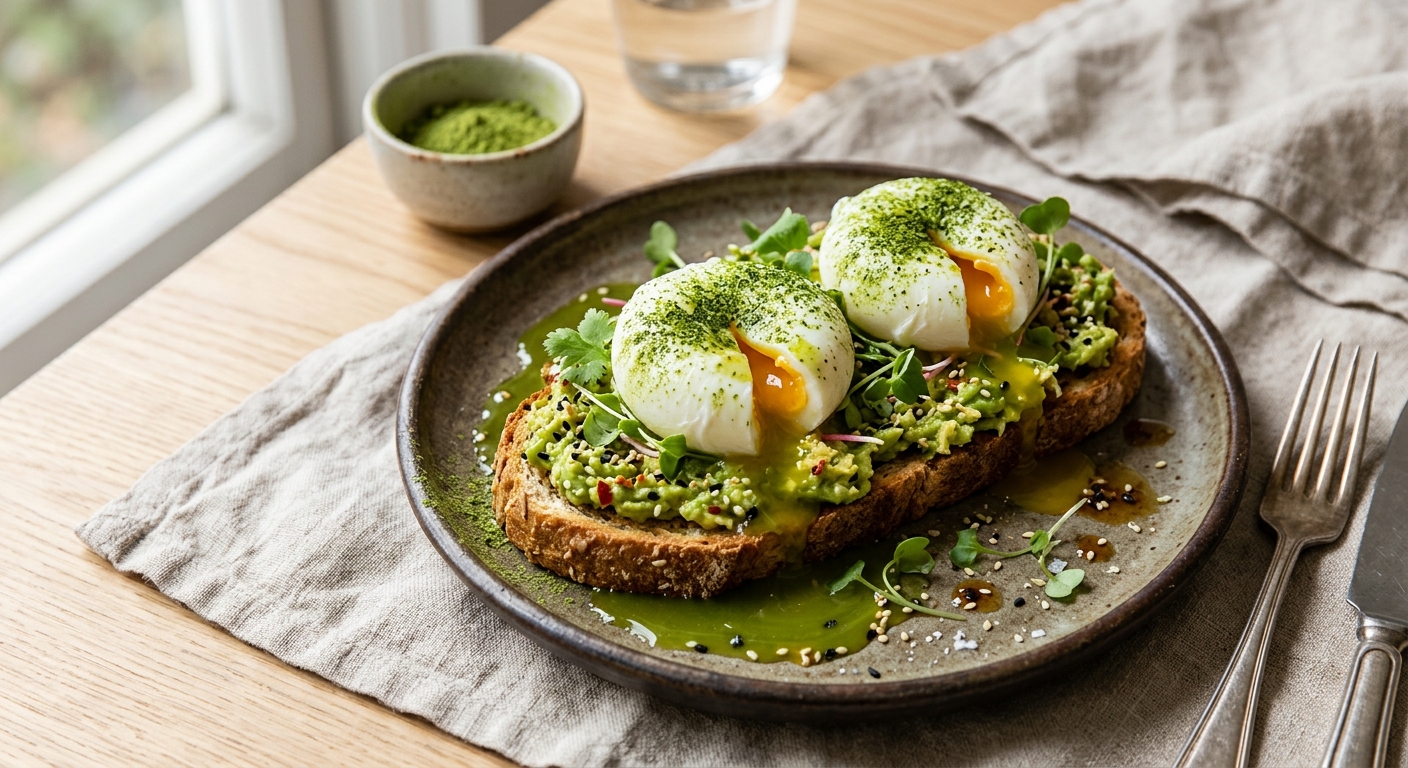
Most mornings demand a breakfast that works as hard as you do. This Matcha Poached Eggs with Avocado dish was engineered from the ground up around one of the most studied metabolic compounds in nutritional science: epigallocatechin gallate, or EGCG. Found in high concentrations in ceremonial-grade matcha, EGCG has been shown in multiple randomised controlled trials to increase fat oxidation by up to 17% during moderate exercise and to meaningfully improve insulin sensitivity. But a supplement-style approach misses the point. By poaching eggs directly in a warm matcha broth, you infuse the whites with catechins while keeping the yolk runny, maximising both flavour and nutrient bioavailability.
The supporting cast is just as deliberate. Ripe Hass avocado contributes oleic acid, the same monounsaturated fat found in olive oil and linked to reduced LDL oxidation, along with a substantial hit of potassium and folate. Whole grain sourdough provides a low-glycemic carbohydrate base rich in prebiotic fibre. Eggs themselves are one of the most complete protein sources on the planet, delivering all nine essential amino acids plus the single richest dietary source of choline, a nutrient that 90% of adults fail to meet through diet alone and that is critical for liver function and neurotransmitter synthesis.
The recipe scales precisely to four servings and has been nutritionally modelled against current Dietary Reference Intake values. Every key nutrient listed has been calculated using USDA FoodData Central data and peer-reviewed food composition tables. Whether you are optimising for athletic performance, metabolic health, or simply want a breakfast that keeps hunger at bay until lunch without a blood sugar crash, this dish delivers on every metric without asking you to compromise on taste. Ceremonial-grade matcha matters here: culinary-grade powder is often more bitter and contains lower catechin concentrations due to older leaf harvesting.
4
servings
Ingredients
- 8 largefree-range eggs
- 8 gceremonial-grade matcha powder (approximately 2 level teaspoons)
- 1000 mlfiltered water, for poaching broth
- 2 ripeHass avocados, halved, pitted, and peeled
- 4 thick sliceswhole grain sourdough bread (approximately 120g total)
- 15 mltoasted sesame oil
- 10 mllow-sodium tamari
- 8 gfresh ginger, finely grated
- 1 clovegarlic, finely grated
- 15 mlrice wine vinegar (plus extra for poaching)
- 5 gwhite sesame seeds, lightly toasted
- 3 gblack sesame seeds
- 10 gmicro greens or pea shoots, for garnish
- 4 thin slicesradish, for garnish
- 1 smalllemon, zest and juice (approximately 30ml juice)
- —Colima Sea SaltMicroplastic Free Salt and cracked black pepper to taste
Instructions
Click on an item below to shop for the recommended items for this recipe on Amazon.
As an Amazon Associate, we earn from qualifying purchases.
- Make the sesame-ginger drizzle first so it is ready to go: whisk together the toasted sesame oil, tamari, grated ginger, grated garlic, rice wine vinegar, and a small pinch of black pepper in a small bowl. Set aside at room temperature so the flavours meld while you work.
- Toast the sourdough slices in a dry skillet over medium heat for 2 to 3 minutes per side until deeply golden and crisp. While the toast is still warm, lay the avocado slices across each piece and use a fork to gently press them down without fully mashing, leaving some texture. Season with a small pinch of sea salt, lemon zest, and a squeeze of lemon juice. Set aside in a warm spot.
- Prepare the matcha poaching broth: bring the 1000ml filtered water to exactly 80 degrees Celsius in a wide, shallow saucepan (approximately 28cm diameter). This temperature is critical as boiling water both damages EGCG catechins and causes egg whites to tear. If you do not have a thermometer, bring the water to a gentle simmer then remove from heat for 90 seconds. Sift the matcha powder into a small bowl, add 60ml of the hot water and whisk vigorously in a W-motion until fully dissolved and frothy with no lumps, then pour the matcha concentrate back into the saucepan. Add 20ml of rice wine vinegar to the broth and stir gently. The vinegar helps the egg whites coagulate quickly and neatly.
- Crack each egg individually into a small ramekin or cup. This allows you to check for broken yolks and to add each egg to the broth with precision. Using a spoon, stir the matcha broth in a slow, wide circle to create a gentle vortex. Slide one egg from the ramekin into the centre of the vortex and allow the current to wrap the white around the yolk. Maintain the broth at 80 degrees Celsius throughout, adjusting the burner as needed. Poach eggs two at a time for 3 to 3.5 minutes for a set white and fully runny yolk, or 4 minutes for a semi-set yolk.
- Remove each egg with a slotted spoon and rest briefly on a clean folded kitchen towel to absorb excess liquid. Check for any wispy trailing whites and trim with kitchen scissors for a neat presentation. Plate immediately: place the avocado toast on each plate, lay two poached eggs on top per serving, drizzle generously with the sesame-ginger sauce, scatter both sesame seeds, top with micro greens and radish slices, and finish with a final crack of black pepper.
- Make the sesame-ginger drizzle: whisk together the toasted sesame oil, tamari, grated ginger, grated garlic, rice wine vinegar, and cracked black pepper in a small bowl. Cover and refrigerate. Remove 15 minutes before serving to allow it to come to room temperature.
- Prepare the slow cooker water bath: pour approximately 600ml of hot tap water into the base of your slow cooker insert. You want enough water to come halfway up the sides of your ramekins, approximately 3 to 4cm deep. Place a small folded kitchen towel or silicone trivet on the bottom of the insert to prevent the ramekins from rattling and to promote even heat distribution. Place four lightly greased 180ml ramekins into the slow cooker.
- Make a concentrated matcha mixture to flavour the eggs: sift the matcha powder into a bowl, add 80ml of hot (not boiling) water and whisk until fully smooth and dissolved. Add the rice wine vinegar and a pinch of fine sea salt. Crack two eggs into each ramekin, then spoon approximately one teaspoon of the matcha mixture gently over each pair of eggs without breaking the yolks. The matcha will steep into the whites as the eggs cook, delivering catechins directly into the dish.
- Cover the slow cooker with its lid and cook on High for 45 to 55 minutes. Begin checking at 45 minutes: the whites should be fully set and opaque, and the yolks should have a slight jiggle at the centre but feel set at the surface when the ramekin is gently shaken. Cooking time can vary by up to 10 minutes depending on the slow cooker model and egg size. Avoid lifting the lid during cooking as this releases heat and extends cooking time significantly.
- While the eggs finish, prepare the avocado toast: toast the sourdough in a dry skillet or toaster until deeply golden. Layer sliced avocado on each piece, press lightly with a fork for texture, and season with sea salt, lemon zest, and lemon juice. When the eggs are ready, run a thin butter knife around the edge of each ramekin and slide the egg pair gently onto the avocado toast. Drizzle with the sesame-ginger sauce, scatter both sesame seeds, arrange micro greens and radish slices, and serve immediately.
- Make the sesame-ginger drizzle: whisk together the toasted sesame oil, tamari, grated ginger, garlic, rice wine vinegar, and black pepper. Set aside at room temperature.
- Pour 240ml of filtered water into the Instant Pot or pressure cooker inner pot. Sift the matcha powder into a small bowl, add 60ml of hot water (from a separate kettle or a small pan, not the pressure cooker), and whisk vigorously until dissolved. Add this matcha concentrate and an additional 20ml of rice wine vinegar to the water in the inner pot and stir to combine. Place the steam rack or trivet inside the pot.
- Lightly grease four silicone egg-poaching cups or small heatproof ramekins with a neutral oil. Crack two eggs into each cup. Arrange the cups on the trivet in a single layer. If your pressure cooker is large enough (6-quart or above), all four should fit. For a smaller unit, work in two batches of two cups.
- Secure the lid and set the pressure release valve to Sealing. Select Manual or Pressure Cook mode and set to LOW pressure for exactly 3 minutes. Once the cooking cycle completes, immediately perform a quick release by carefully switching the valve to Venting. Remove the lid away from you to allow steam to escape safely. The whites should be fully set and opaque. If any white appears translucent, replace the lid (without pressure) for 1 to 2 minutes using the residual heat.
- Prepare the avocado toast while the pressure builds (approximately 5 to 8 minutes): toast the sourdough in a dry skillet, layer and season the avocado with sea salt, lemon zest, and lemon juice. Use a spoon to carefully slide each pair of eggs from their cups onto the avocado toast. Drizzle with sesame-ginger sauce, scatter both sesame seeds, top with micro greens and radish, and serve at once.
- Preheat your oven to 180 degrees Celsius (350 degrees Fahrenheit) with a rack positioned in the centre. Make the sesame-ginger drizzle by whisking together the toasted sesame oil, tamari, grated ginger, garlic, rice wine vinegar, and black pepper. Set aside.
- Prepare the matcha broth: sift the matcha powder into a bowl, pour in 200ml of hot water at approximately 80 degrees Celsius (not boiling), and whisk vigorously in a W-motion until completely smooth and dissolved. Add the rice wine vinegar and a pinch of sea salt. Pour the matcha broth evenly into a shallow oven-safe baking dish or a 4-cup muffin-style baking pan (such as a ceramic egg baker), dividing the broth so each well contains approximately 50ml. The broth should be about 1.5cm deep per well.
- Crack two eggs into each broth-filled well, taking care not to break the yolks. The matcha broth should come up around but not over the eggs. Transfer the dish to the preheated oven carefully to avoid splashing. Bake for 12 minutes for a fully runny yolk with set whites, 13 to 14 minutes for a semi-set yolk, or 15 minutes for a fully set yolk. Begin checking at the 12-minute mark by gently shaking the dish: the whites should not wobble and the yolks should jiggle only at the very centre.
- While the eggs bake, toast the sourdough slices in a dry skillet until deeply golden on both sides. Layer sliced avocado over each piece, press gently with a fork, and season with sea salt, lemon zest, and a generous squeeze of lemon juice.
- Remove the baking dish from the oven. Use a slotted spoon to lift each pair of eggs from the matcha broth and rest briefly on a kitchen towel to absorb excess liquid. Place on the prepared avocado toast, drizzle with the sesame-ginger sauce, scatter both sesame seeds, arrange micro greens and radish slices over the top, and serve immediately while the eggs are hot.
Nutrition Breakdown
Per 1 serving (makes 4)
Vitamins & Minerals
% Daily Value based on a 2,000 calorie diet (FDA reference)
🧬 Essential Amino Acids
% of recommended daily intake (RDA) per serving
🛡 Antioxidant Profile
The Nutrition Science
The metabolic case for EGCG is one of the better-supported stories in nutritional biochemistry. A 2005 meta-analysis published in the American Journal of Clinical Nutrition found that green tea catechins, primarily EGCG, increased 24-hour energy expenditure by approximately 4% and fat oxidation by up to 17% compared to placebo, independent of caffeine. The mechanism involves inhibition of catechol-O-methyltransferase (COMT), an enzyme that degrades norepinephrine. By extending norepinephrine activity, EGCG enhances the signalling cascade that stimulates lipolysis in adipose tissue. Each serving of this recipe delivers approximately 68mg of EGCG from 2g of ceremonial-grade matcha, a dose consistent with those used in clinical intervention studies.
Eggs are the centrepiece of the protein architecture in this dish. Two large eggs contribute approximately 12g of complete protein with a PDCAAS (Protein Digestibility-Corrected Amino Acid Score) of 1.0, the maximum possible, meaning all essential amino acids are present in proportions that meet or exceed human requirements. More importantly, egg yolks provide roughly 147mg of choline each, and with two yolks per serving, this dish delivers 53% of the Adequate Intake for choline in a single meal. Choline is a precursor to acetylcholine, the primary neurotransmitter of the parasympathetic nervous system, and to phosphatidylcholine, a structural lipid essential for cell membrane integrity and hepatic fat export. Choline deficiency accelerates non-alcoholic fatty liver disease, making adequate intake particularly relevant in a metabolic health context.
The avocado in this recipe contributes more than just healthy fats. Hass avocado is unusually rich in potassium (approximately 485mg per half avocado), surpassing the commonly cited banana, which is important because potassium works antagonistically with sodium to regulate blood pressure through the RAAS pathway. The oleic acid in avocado (approximately 9.8g per half) activates the production of oleoylethanolamide (OEA) in the small intestinal epithelium, a lipid mediator that signals satiety to the hypothalamus via vagal afferent neurons, helping explain the well-documented appetite-suppressing effect of avocado consumption documented in a 2019 randomised trial in the Journal of Nutrition.
Pro Tips
- Always sift matcha before whisking. Unsifted matcha forms stubborn clumps that will not dissolve in water and leave a bitter, uneven flavour in the poaching broth.
- Temperature is the single most important variable for poaching eggs. Invest in a clip-on probe thermometer and keep the broth between 78 and 82 degrees Celsius throughout. Below this range the whites spread and dissolve into the liquid; above it the whites become tough and the yolk surface begins to set before the interior is runny.
- For the cleanest poached eggs, use eggs that are no more than 5 days old and store them at room temperature for 30 minutes before poaching. Cold eggs dropped into warm water lower the broth temperature unevenly and cause the whites to set in uneven sheets.

This looks absolutely delicious, and I love that you’re highlighting the EGCG angle! One thing I’d be curious about for anyone with thyroid concerns like myself, do you have thoughts on how much matcha is ideal here? I know matcha gets cited as a goitrogen sometimes, but I’ve learned that cooking method and portion size matter way more than people think. The heat from poaching probably helps reduce any compounds that might interfere with iodine absorption anyway. Either way, the choline and selenium from the eggs plus the healthy fats from avocado make this such a smart thyroid-supportive breakfast!
Great question, Tammy. I’d actually want to pump the brakes slightly on the thyroid concern angle – the goitrogen content in matcha is pretty minimal compared to raw cruciferous vegetables, and cooking/steeping denatures a lot of it anyway. That said, if you’re on thyroid replacement, spacing it a couple hours from your medication is solid practice. The real metabolic win here is the choline from the eggs combined with the EGCG, which genuinely does shift fat oxidation in a meaningful way. I’ve seen patients with metabolic syndrome respond well to this kind of breakfast pattern. Maybe 1-2 teaspoons of matcha powder in the broth is the sweet
honestly this is fascinating because eggs + matcha combo is basically hitting both the choline for acetylcholine production AND the l-theanine for calm focus, which should theoretically support better sleep architecture later if youre eating this early enough. i tried a version of this last week (minus the poaching, i just scrambled them in matcha tea lol) and my sleep tracker actually showed deeper REM cycles that night, though that could totally be placebo or the avocado’s magnesium doing the heavy lifting. curious if anyone else has noticed sleep quality shifts from the catechin/choline synergy, or am i just another sleep-obsessed biohacker seeing patterns where there arent any