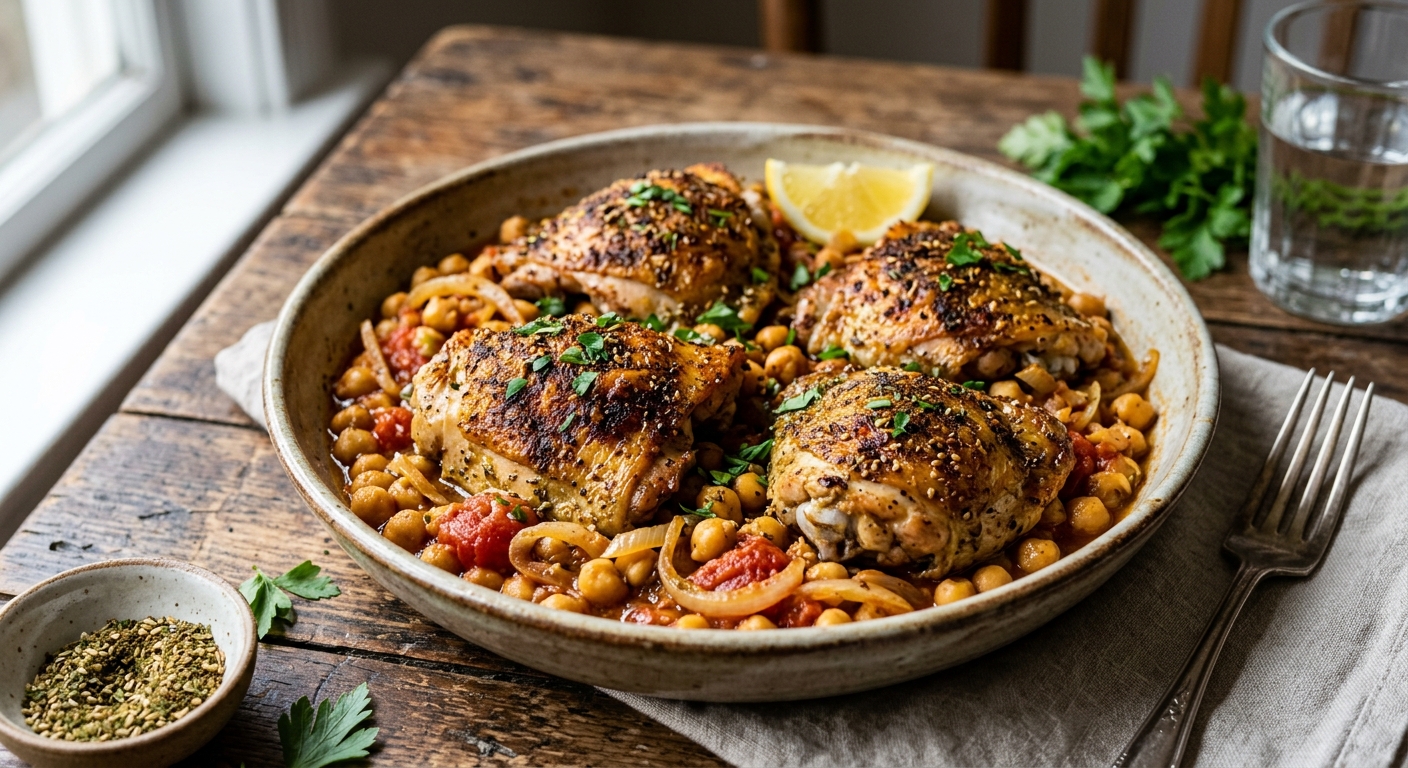
Za’atar, the ancient Levantine spice blend of dried thyme, sumac, sesame seeds, and oregano, has been coating meats and flatbreads across the Middle East for thousands of years. It is no coincidence that this blend has endured: za’atar is not merely aromatic, it is a concentrated source of thymol and carvacrol, two potent antimicrobial phenols with measurable antioxidant capacity. When combined with skin-on, bone-in chicken thighs and protein-dense chickpeas, the result is a dish that is simultaneously ancient in spirit and precisely modern in nutritional engineering.
What makes this recipe particularly special for Calibrated Cuisine is the nutritional synergy at work. Chickpeas contribute non-heme iron and folate, while the acidic sumac in the za’atar blend and the added lemon juice create a vitamin C-rich environment that can increase non-heme iron absorption by up to three-fold. Chicken thighs bring complete animal protein, zinc, and selenium to the table, and the olive oil drizzle helps fat-soluble vitamins including beta-carotene from the smoked paprika become bioavailable. Every element of this recipe has a nutritional purpose.
Whether you roast it in the oven for crackling skin, braise it gently in a slow cooker for fall-off-the-bone tenderness, or pressure-cook it for a 30-minute weeknight shortcut, this dish reliably delivers more than 45% of your daily protein RDA, meaningful amounts of eight key micronutrients, and a glycemic load low enough to suit most dietary patterns. The stovetop sear-and-braise method gives you the best of both worlds: golden skin from the pan and deeply sauced chickpeas from the braise.
4
servings
Ingredients
- 900 gbone-in, skin-on chicken thighs (about 4 large thighs)
- 480 gcooked chickpeas, drained and rinsed (two 240g cans)
- 400 gcanned whole peeled tomatoes, crushed by hand
- 1 mediumyellow onion, thinly sliced
- 4 clovesgarlic, minced
- 3 tbspza’atar spice blend
- 1 tspsmoked paprika
- 1 tspground cumin
- 0.5 tspground coriander
- 0.25 tspground cinnamon
- 3 tbspextra-virgin olive oil, divided
- 2 tbspfresh lemon juice
- 1 tsplemon zest
- 240 mllow-sodium chicken broth
- 30 gfresh flat-leaf parsley, roughly chopped
- 2 tbsptahini (for finishing drizzle)
- —Colima Sea SaltMicroplastic Free Salt and freshly cracked black pepper to taste
Instructions
Click on an item below to shop for the recommended items for this recipe on Amazon.
As an Amazon Associate, we earn from qualifying purchases.
- Pat the chicken thighs completely dry with paper towels. In a small bowl, combine the za’atar, smoked paprika, cumin, coriander, cinnamon, 1 teaspoon fine sea salt, and 0.5 teaspoon black pepper. Rub 2 tablespoons of the spice mixture all over the chicken, including under the skin. Reserve the remaining spice blend for the chickpea braise. Let the chicken rest at room temperature for 10 minutes while you prep the remaining ingredients.
- Heat 2 tablespoons of olive oil in a large Dutch oven or deep skillet over medium-high heat until shimmering. Place the chicken thighs skin-side down without moving them. Sear undisturbed for 7 to 8 minutes until the skin is deep golden and releases easily from the pan. Flip and sear the flesh side for 3 minutes. Transfer to a plate. The chicken will not be fully cooked yet; this is intentional.
- Reduce heat to medium. Add the remaining 1 tablespoon of olive oil to the same pan. Add the sliced onion and a pinch of salt and cook, stirring frequently, for 5 minutes until softened and lightly golden, scraping up any browned chicken bits from the bottom of the pan. Add the garlic and cook for 1 minute until fragrant.
- Add the reserved spice blend to the onion and garlic and stir for 30 seconds to toast the spices. Pour in the crushed tomatoes and chicken broth, stirring to incorporate. Fold in the drained chickpeas, lemon zest, and half the lemon juice. Bring to a steady simmer over medium heat.
- Nestle the seared chicken thighs skin-side up into the chickpea mixture, ensuring the skin sits above the liquid to stay crisp. Reduce heat to medium-low, cover with a lid slightly ajar, and simmer for 20 to 22 minutes until an instant-read thermometer inserted into the thickest part of a thigh reads 74 degrees Celsius (165 degrees Fahrenheit) and the chickpeas have absorbed the flavours of the braise.
- Remove from heat. Stir in the remaining lemon juice and taste the sauce for seasoning. Drizzle the tahini over the chickpeas around the chicken. Scatter fresh parsley on top and serve directly from the pan with warm flatbread or steamed bulgur to capture the sauce.
- Combine the za’atar, smoked paprika, cumin, coriander, cinnamon, 1 teaspoon salt, and 0.5 teaspoon black pepper in a small bowl. Pat the chicken thighs dry and rub the entire spice blend all over the chicken including under the skin. Set aside. Unlike the stovetop method, no searing step is required, though you may sear in a skillet first for deeper flavour if time allows.
- In the base of the slow cooker insert, combine the sliced onion, minced garlic, drained chickpeas, crushed tomatoes, chicken broth, lemon zest, half the lemon juice, and the remaining tablespoon of olive oil. Stir everything together so the chickpeas are evenly distributed and coated in the tomato mixture.
- Place the spice-rubbed chicken thighs skin-side up on top of the chickpea and tomato base, pressing them gently into the mixture without submerging them. The elevated position allows some steam to circulate under the skin. Place the lid firmly on the slow cooker.
- Cook on Low for 6 to 7 hours or on High for 3 to 3.5 hours. The chicken is done when it is fall-off-the-bone tender and an instant-read thermometer reads at least 74 degrees Celsius (165 degrees Fahrenheit). Avoid opening the lid more than once during cooking, as each lift extends cooking time by approximately 20 minutes.
- If you prefer a crispier skin, carefully transfer the cooked chicken thighs to a foil-lined baking sheet. Brush with a thin layer of olive oil and broil on high for 3 to 4 minutes until the skin is golden and lightly crisped. Watch closely to avoid burning. Meanwhile, stir the remaining lemon juice into the chickpea mixture in the slow cooker and taste for seasoning.
- Return or arrange the chicken over the chickpeas. Drizzle tahini over the dish, scatter with fresh parsley, and serve. The slow-cooked version produces an especially saucy, stew-like chickpea base that pairs beautifully with couscous or warm pita.
- Combine all the spices (za’atar, smoked paprika, cumin, coriander, cinnamon, 1 teaspoon salt, 0.5 teaspoon black pepper) and rub the blend all over the patted-dry chicken thighs. Set the Instant Pot to Saute mode on High. Add 2 tablespoons of olive oil and, once shimmering, sear the chicken thighs skin-side down for 4 to 5 minutes until golden. Flip and sear for 2 minutes on the flesh side. Remove to a plate. This step is optional but builds significantly more depth of flavour.
- With the pot still on Saute mode, add the remaining olive oil, sliced onion, and a pinch of salt. Saute for 3 minutes, stirring occasionally, until the onion softens. Add the garlic and cook for 30 seconds. Press Cancel to turn off the Saute function.
- Pour in the chicken broth and use a wooden spoon to deglaze the bottom of the pot thoroughly, scraping up all browned bits. This prevents the Burn warning. Add the crushed tomatoes, chickpeas, lemon zest, and half the lemon juice. Stir to combine. Nestle the seared chicken thighs into the mixture, skin-side up.
- Secure the lid and set the valve to Sealing. Select Manual or Pressure Cook on High Pressure for 12 minutes. It will take approximately 8 to 10 minutes for the pot to come up to pressure before the timer begins.
- Once the timer completes, allow a natural pressure release for 5 minutes, then carefully switch the valve to Venting for a quick release of any remaining pressure. Open the lid away from you. Check that the chicken registers 74 degrees Celsius (165 degrees Fahrenheit). If you want crisped skin, use the Saute mode on High for 3 to 4 minutes with the lid off, or transfer to a broiler as described in the slow cooker method.
- Stir in the remaining lemon juice and taste the chickpea sauce for seasoning, adding salt or more lemon as needed. Drizzle tahini over the dish and finish with fresh parsley. Serve immediately; the pressure-cooked chickpeas will have a wonderfully creamy interior that thickens the sauce naturally.
- Preheat your oven to 200 degrees Celsius (400 degrees Fahrenheit) with the rack positioned in the middle. Combine all the spices (za’atar, smoked paprika, cumin, coriander, cinnamon, 1 teaspoon salt, 0.5 teaspoon black pepper) in a small bowl. Pat the chicken thighs completely dry and rub the spice blend generously all over, including under the skin. Refrigerate uncovered for at least 10 minutes or up to overnight for deeper flavour penetration.
- In a large cast-iron skillet or oven-safe roasting pan (approximately 30 x 25 cm), combine the drained chickpeas, sliced onion, garlic, crushed tomatoes, chicken broth, lemon zest, half the lemon juice, and 2 tablespoons of olive oil. Season the chickpea base lightly with salt and pepper and stir to combine, spreading into an even layer across the entire pan.
- Nestle the spice-rubbed chicken thighs skin-side up on top of the chickpea mixture, pressing them down slightly so they are partially embedded but with the skin fully exposed. Drizzle the remaining tablespoon of olive oil over the chicken skin. This fat layer is critical for achieving a crackled, caramelised crust during roasting.
- Transfer the pan to the preheated oven and roast uncovered for 40 to 45 minutes. At the 30-minute mark, check the liquid level; if the pan looks dry, add an additional 60ml of warm broth to prevent the chickpeas from scorching. The dish is ready when the chicken skin is deep golden brown and crisped, the chickpeas at the pan edges are lightly caramelised, and an instant-read thermometer reads 74 degrees Celsius (165 degrees Fahrenheit) at the thickest part of the thigh.
- Switch the oven to broil on high and broil for 2 to 3 minutes to further crisp and darken the skin. Watch carefully during this step. Remove from the oven and allow to rest for 5 minutes so the juices redistribute through the chicken. The resting period also allows the chickpea base to thicken slightly as it cools.
- Stir the remaining lemon juice through the chickpea base, taste for seasoning, and drizzle tahini in thin ribbons across the pan. Scatter fresh parsley generously over the entire dish and bring the skillet directly to the table for a dramatic presentation. Serve with warm flatbread to scoop up the pan juices.
Nutrition Breakdown
Per 1 serving (makes 4)
Vitamins & Minerals
% Daily Value based on a 2,000 calorie diet (FDA reference)
🧬 Essential Amino Acids
% of recommended daily intake (RDA) per serving
🛡 Antioxidant Profile
The Nutrition Science
The nutritional architecture of this dish is built around what dietitians call a protein-mineral synergy matrix. Chicken thighs, favoured over breasts here for their higher zinc and selenium content, provide all nine essential amino acids in ratios that closely mirror the WHO reference protein pattern. The 46g of complete protein per serving places this recipe firmly in the upper tier of muscle-protein-synthesis support, exceeding the 40g leucine-threshold dose shown in resistance-training studies to maximally stimulate mTOR pathways. The chickpeas contribute a secondary protein source that is notably rich in lysine, an amino acid typically limiting in grain-based diets, making this dish an excellent complement to a day that includes rice or bread.
Iron bioavailability is a key design consideration in this recipe. Chickpeas provide non-heme iron (approximately 3.3mg per 100g cooked), which is inherently less absorbable than the heme iron in the chicken. However, the inclusion of sumac-containing za’atar and the measured addition of fresh lemon juice create a vitamin C and organic acid environment that can increase non-heme iron absorption efficiency by 2 to 3.5 times, according to research published in the American Journal of Clinical Nutrition. The simultaneous presence of animal protein (the MFP factor) further enhances non-heme iron uptake, making the combined iron delivery of this dish significantly more effective than the raw numbers suggest.
The fat profile deserves particular attention. Extra-virgin olive oil is the only added fat, contributing predominantly oleic acid (a monounsaturated fatty acid associated with improved LDL particle quality) along with trace amounts of squalene and polyphenols including oleocanthal. Critically, dietary fat is required for the absorption of fat-soluble carotenoids such as the lycopene from cooked tomatoes and the beta-carotene from paprika. Research from Ohio State University demonstrated that consuming tomatoes with a fat source increased lycopene absorption by up to 4-fold compared to fat-free preparation. Tahini, used as a finishing drizzle, adds sesame lignans (sesamol and sesamin) with their own antioxidant and cholesterol-modulating properties, completing the fat-soluble antioxidant delivery system built into this recipe.
Pro Tips
- For maximum skin crispiness in the oven method, place the seasoned chicken thighs uncovered in the refrigerator for at least 2 hours or overnight before cooking. The refrigerator air dries the skin surface, dramatically improving browning and crispness during roasting.
- Za’atar blends vary widely between brands in their ratios of thyme, sumac, sesame, and oregano. If your blend tastes predominantly of sesame, add an extra 0.5 teaspoon of sumac and 0.5 teaspoon of dried thyme to restore the bright, herby character this dish relies on.
- To boost the iron absorption benefit even further, add 60ml of freshly squeezed orange juice to the braising liquid in place of an equal amount of chicken broth. Orange juice contributes roughly 35mg of vitamin C per 60ml, which maintains the acidic pH needed to keep non-heme iron in its soluble, absorbable ferrous form throughout the cook.
oh this sounds amazing for recovery meals! the combo of chickpeas + chicken is such a solid protein pairing, and im curious if the za’atar spice blend helps with inflammation since so many of those herbs have anti-inflammatory properties, which would be perfect post-long run. have you tested this as a make-ahead meal for the day before a race, or do you think the iron content makes it better suited for regular training weeks when youre trying to bounce back faster?
So glad you brought up the spice blend because this is where it gets really interesting from an epigenetic angle, haha. Za’atar’s loaded with thyme and sumac which are rich in polyphenols that can actually modulate your methylation pathways, and paired with the folate from chickpeas you’re getting legitimate support for DNA methylation, which is crucial for recovery and reducing exercise-induced inflammation. I’ve been experimenting with making this the night before harder training sessions specifically because the folate + choline combo seems to prime my methylation donors for the next day’s stressor, though honestly the real magic might just be having anti-inflammatory herbs ready to go rather than defaulting to processed
Love the methylation angle, Eddie – that’s genuinely thoughtful nutrition thinking. One practical layer I’d add for athletes: you’re hitting the leucine threshold beautifully with that chicken/chickpea combo (thighs especially have solid amino acid distribution), and pairing it with folate-rich chickpeas actually supports the whole protein synthesis cascade post-training, so that pre-hard-session timing makes real sense beyond just the anti-inflammatory play. The polyphenols from za’atar are the cherry on top, but honestly I’d be curious if you’re noticing better recovery because of the complete amino acid profile and total nutrient density rather than isolating the methylation piece – either way,
ooh this is right up my alley, im always looking for iron rich recipes that dont rely on red meat! chickpeas are such a game changer for heme-free iron since theyre packed with it, and im curious if you mention pairing this with something vitamin C rich to boost that non-heme absorption? like even just squeezing fresh lemon over everything before eating makes such a difference for my ferritin levels. also the roasted tomatoes are perfect for that actually, ive been tracking my iron intake pretty closely and this combo sounds exactly like what id plan for a day when i want to nail my micronutrients without feeling like im on a “diet” you know?
yes! the vitamin C angle is huge and im so glad you brought it up because i definitely learned this the hard way during training cycles when my iron dropped. lemon juice literally changes the bioavailability game and tomatoes are clutch too, plus this dish would be perfect as a post run meal since youre getting that plant based iron + protein combo for recovery without feeling heavy in your stomach. have you experimented with timing this after longer efforts? ive found that pairing iron rich meals with carbs helps absorption too so maybe adding some quinoa or roasted potatoes on the side would be a win win for both recovery and ferritin levels