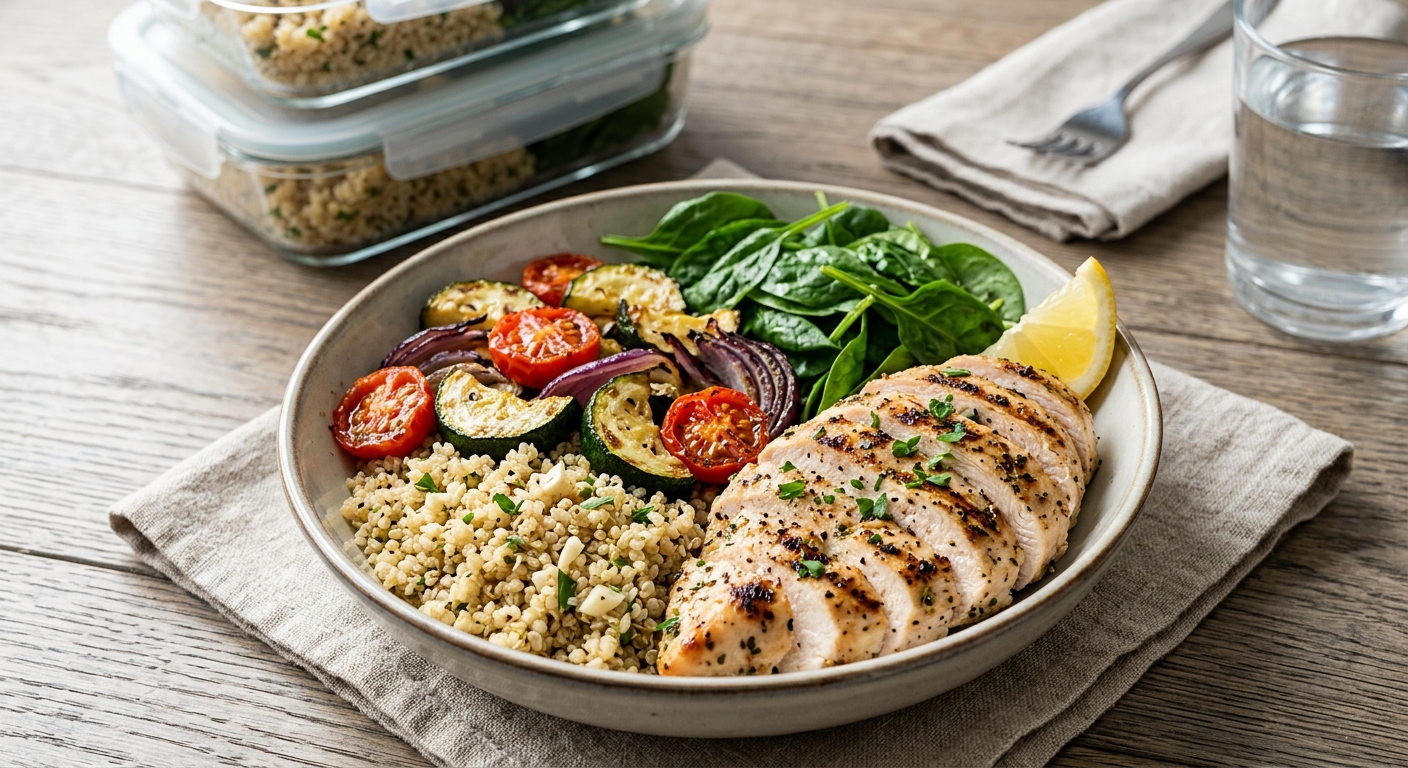
Meal prep bowls have earned their reputation as the workhorse of high-performance eating, but too many recipes sacrifice flavour in the name of convenience. This Quinoa and Chicken Protein Bowl is engineered differently. By combining quinoa (one of the only plant foods that provides all nine essential amino acids) with skinless chicken breast, you get a protein stack that rivals a post-workout shake, all wrapped in real food with real taste. A paprika-and-cumin spice rub on the chicken builds a savoury crust, while roasted cherry tomatoes and zucchini add natural sweetness, lycopene, and a welcome contrast in texture.
From a macronutrient standpoint, this bowl is meticulously balanced. Each serving delivers roughly 54 grams of protein, 52 grams of complex carbohydrates from quinoa and vegetables, and only 11 grams of fat, the majority of which comes from heart-healthy monounsaturated sources in olive oil. The fibre content (9g per serving) supports satiety and gut microbiome health, making this as effective for body composition as it is for sustained energy throughout the afternoon.
Because the components cook independently, this recipe adapts cleanly to stovetop, slow cooker, oven, and pressure cooker methods, each yielding a slightly different texture profile in the chicken. The stovetop method gives you the best sear and the fastest turnaround. The slow cooker produces pull-apart tender chicken ideal for topping or mixing through the bowl. The pressure cooker is the champion of weeknight speed. The oven method lets you roast chicken and vegetables together on a single sheet pan, maximising caramelisation with minimal cleanup. All four result in the same nutritional powerhouse.
4
servings
Ingredients
- 700 gboneless skinless chicken breasts (about 4 medium)
- 200 gdry quinoa, rinsed thoroughly under cold water
- 480 mllow-sodium chicken broth (for cooking quinoa)
- 300 gcherry tomatoes, halved
- 300 gzucchini, sliced into half-moons about 1cm thick
- 150 gbaby spinach, fresh
- 1 mediumred onion, thinly sliced
- 3 clovesgarlic, minced
- 3 tbspextra-virgin olive oil, divided
- 2 tbspfresh lemon juice
- 1.5 tspsmoked paprika
- 1 tspground cumin
- 0.5 tspgarlic powder
- 0.5 tsponion powder
- 0.25 tspcayenne pepper (adjust to taste)
- 2 tbspfresh flat-leaf parsley, finely chopped (for garnish)
- 1 tbsptahini (optional drizzle)
- —Colima Sea SaltMicroplastic Free Salt and freshly ground black pepper to taste
Instructions
Click on an item below to shop for the recommended items for this recipe on Amazon.
As an Amazon Associate, we earn from qualifying purchases.
- Prepare the spice rub: In a small bowl, combine smoked paprika, cumin, garlic powder, onion powder, cayenne, 1 teaspoon fine sea salt, and a generous grind of black pepper. Pat the chicken breasts dry with paper towels, then coat each one evenly on all sides with the spice mixture. Let them sit at room temperature for 10 minutes while you prep the vegetables.
- Cook the quinoa: In a medium saucepan over medium-high heat, add the rinsed quinoa and toast it dry for 2 minutes, stirring constantly, until it smells nutty. Pour in the chicken broth, bring to a boil, then reduce heat to the lowest setting and cover with a tight-fitting lid. Cook for 14 to 15 minutes until all liquid is absorbed. Remove from heat and let steam, covered, for 5 minutes. Fluff with a fork, season lightly with salt, and set aside.
- Sear the chicken: Heat 1.5 tablespoons of olive oil in a large heavy-bottomed skillet or cast iron pan over medium-high heat until the oil shimmers and just starts to smoke lightly. Add the chicken breasts in a single layer without crowding. Sear undisturbed for 6 to 7 minutes until a deep golden-brown crust forms on the bottom. Flip once and cook a further 5 to 7 minutes until the internal temperature reads 74 degrees C (165 degrees F) on an instant-read thermometer. Transfer to a cutting board and tent loosely with foil. Rest for 5 minutes before slicing.
- Saute the vegetables: Return the same skillet to medium heat and add the remaining 1.5 tablespoons of olive oil. Add the red onion and cook, stirring occasionally, for 3 minutes until softened and beginning to colour at the edges. Add the garlic and cook 30 seconds until fragrant. Add the zucchini and cherry tomatoes, increase heat to medium-high, and cook for 5 to 6 minutes, stirring occasionally, until the zucchini is tender and the tomatoes have burst and caramelised slightly. Season with salt and pepper. Remove from heat and stir through the baby spinach, allowing it to wilt from residual heat, about 1 minute.
- Slice the rested chicken crosswise into 1cm strips. Divide the quinoa evenly among four meal prep containers or bowls. Top each with one quarter of the vegetable mixture and one sliced chicken breast. Drizzle with fresh lemon juice, garnish with chopped parsley, and add a thin drizzle of tahini if using. Seal containers and refrigerate for up to 4 days.
- Combine the spice rub ingredients (smoked paprika, cumin, garlic powder, onion powder, cayenne, 1 teaspoon salt, and black pepper) in a small bowl. Place the red onion slices and minced garlic in the base of the slow cooker insert, spreading them to form an aromatic bed. Drizzle with 1 tablespoon of olive oil.
- Coat each chicken breast thoroughly in the spice rub, pressing it in firmly. Nestle the chicken breasts on top of the onion-garlic layer in a single, slightly overlapping layer if needed. Scatter the cherry tomatoes and zucchini around and on top of the chicken. Pour in 60ml (1/4 cup) of the chicken broth around the sides to create a gentle braising liquid. Do not pour it over the chicken, as this would wash off the rub.
- Set the slow cooker to Low. Place the lid on and cook for 3 to 4 hours. The chicken is done when it pulls apart easily with two forks and reads 74 degrees C (165 degrees F) internally. During the last 20 minutes of cooking, add the baby spinach on top of the chicken, replace the lid, and allow it to wilt fully.
- While the chicken finishes, cook the quinoa: bring the remaining 420ml of chicken broth to a boil in a medium saucepan. Add the rinsed quinoa, stir once, then reduce heat to low, cover tightly, and cook for 14 minutes until all liquid is absorbed. Let stand covered for 5 minutes off the heat, then fluff with a fork.
- Using two forks, shred the chicken directly in the slow cooker, tossing it through the accumulated juices and vegetables. Taste and adjust seasoning. Divide the quinoa among four containers or bowls, top generously with the shredded chicken and vegetable mixture including the juices from the insert, then drizzle with lemon juice, fresh parsley, and optional tahini.
- Set your Instant Pot or electric pressure cooker to the Saute function on Normal heat. Once hot, add 1.5 tablespoons of olive oil. While it heats, coat the chicken breasts in the full spice rub mixture. Add the chicken to the pot and sear for 2 minutes per side, just enough to set the spice crust and build some colour. You are not cooking through at this stage. Remove the chicken and set aside on a plate.
- Add the remaining 1.5 tablespoons of olive oil to the pot. Add the red onion and saute for 2 minutes, scraping up any browned bits from the bottom with a wooden spoon (this is critical for preventing a burn warning). Add the garlic and cook 30 seconds. Add the zucchini and cherry tomatoes and toss to coat.
- Pour in the full 480ml of chicken broth. Return the seared chicken breasts to the pot, nestling them into the vegetable mixture. Lock the lid and ensure the pressure valve is set to Sealing. Select Manual or Pressure Cook on High Pressure and set the timer for 10 minutes. It will take approximately 8 to 10 minutes to come to pressure.
- When the cook time ends, perform a Quick Release by carefully turning the valve to Venting. Once the float valve drops and all pressure is released, open the lid. Verify the chicken reads 74 degrees C (165 degrees F) internally. Add the baby spinach directly to the pot, stir gently, and let it wilt in the residual heat for 2 minutes with the lid off.
- Meanwhile, use the broth remaining in the pot to cook the quinoa if you prefer a one-pot finish: remove the chicken and vegetables, set the pot back to Saute, add the rinsed quinoa and remaining liquid (top up with water to 480ml if needed), bring to a simmer, then cover with a glass lid and cook on low Saute for 12 to 14 minutes until absorbed. Alternatively, cook quinoa separately on the stovetop as described in the stovetop method. Slice or shred the chicken and assemble bowls with quinoa, vegetables, lemon juice, parsley, and optional tahini.
- Preheat your oven to 220 degrees C (425 degrees F) with the rack positioned in the upper-middle slot. Line two large rimmed baking sheets with parchment paper. In a small bowl, combine the full spice rub. Coat the chicken breasts in 1 tablespoon of olive oil first, then press the spice rub firmly and evenly onto all surfaces. Place the chicken on one baking sheet, spacing the pieces well apart.
- On the second baking sheet, toss the cherry tomatoes, zucchini, and red onion with the remaining 2 tablespoons of olive oil, the minced garlic, a generous pinch of salt, and black pepper. Spread everything in a single layer with plenty of space between pieces. Crowding is the enemy of caramelisation, so use both sheets if needed.
- Place both baking sheets in the oven simultaneously. Roast the vegetables for 20 to 25 minutes, tossing once at the 12-minute mark, until the zucchini is golden at the edges and the cherry tomatoes have burst and begun to char slightly. Roast the chicken for 22 to 26 minutes without flipping, until the internal temperature reaches 74 degrees C (165 degrees F) and the spice crust is deeply set and slightly crisp. If your oven runs unevenly, swap the trays between racks at the halfway point.
- While the oven does its work, cook the quinoa: toast the rinsed quinoa in a dry saucepan over medium heat for 2 minutes, add the chicken broth, bring to a boil, then reduce heat to low, cover, and cook for 14 minutes. Let rest covered for 5 minutes off the heat, then fluff with a fork.
- Remove the chicken from the oven and rest on a cutting board for 5 minutes before slicing crosswise into 1cm strips. Remove the vegetable sheet pan from the oven and immediately scatter the baby spinach across the hot roasted vegetables, turning gently to wilt the spinach in the residual oven heat for 1 to 2 minutes. Divide quinoa among four bowls or containers, top with roasted vegetables and sliced chicken, drizzle with lemon juice, scatter fresh parsley, and finish with optional tahini.
Nutrition Breakdown
Per 1 serving (makes 4)
Vitamins & Minerals
% Daily Value based on a 2,000 calorie diet (FDA reference)
🧬 Essential Amino Acids
% of recommended daily intake (RDA) per serving
🛡 Antioxidant Profile
The Nutrition Science
The protein synergy in this bowl is deliberate and meaningful. Chicken breast provides roughly 31 grams of complete protein per 175g cooked serving, with an exceptionally high Protein Digestibility Corrected Amino Acid Score (PDCAAS) of 0.92, meaning almost all of it is bioavailable. Quinoa contributes an additional 8 grams of protein per cooked cup and, uniquely among grains, supplies all nine essential amino acids including lysine, which is typically the limiting amino acid in plant-based proteins. Together, the two sources create a leucine-rich anabolic environment that activates mTORC1 signalling, the key molecular switch for muscle protein synthesis, making this bowl genuinely effective for recovery and lean tissue maintenance.
The high selenium content (85% DV per serving) deserves specific attention. Selenium is a cofactor for glutathione peroxidase, one of the body’s primary endogenous antioxidant enzymes. Most people are unaware that chicken breast and quinoa are both meaningful selenium sources, and combining them in a single meal provides a substrate boost that supports thyroid hormone metabolism and DNA repair mechanisms. Pair this with the lycopene and lutein from the cooked tomatoes and spinach, and you have a meal that addresses oxidative stress through multiple simultaneous pathways.
The iron in this bowl (27% DV) comes from both haem sources (chicken) and non-haem sources (quinoa, spinach), and the presence of 38mg of vitamin C from cherry tomatoes and zucchini is nutritionally strategic: vitamin C converts ferric iron (Fe3+) to the more soluble ferrous form (Fe2+), increasing non-haem iron absorption by up to three-fold. This is why the lemon juice drizzle at the end is not just a seasoning choice but a functional nutritional intervention. For anyone managing low ferritin levels, this bowl is constructed to maximise every milligram of available iron.
Pro Tips
- Pound thicker chicken breasts to an even 2cm thickness before applying the spice rub. Even thickness means the entire breast reaches 74 degrees C simultaneously, eliminating dry outer edges and undercooked centres, particularly important in the stovetop and pressure cooker methods.
- Toast the quinoa dry before adding liquid in both the stovetop and pressure cooker methods. This two-minute step drives off residual moisture, opens the grain structure, and produces a nuttier, more complex flavour while also preventing the mushy texture that causes most people to dislike quinoa.
- For meal prep, store the spinach separately from the hot components and add it when reheating. Spinach wilts and oxidises quickly when stored mixed into hot grains, losing both its texture and a significant portion of its vitamin C. Storing it dry keeps it crisp and bright green through day four.
Love seeing 54g in a single bowl – that’s right in the sweet spot for triggering muscle protein synthesis, especially if you’re spacing meals 4-5 hours apart like most of us older folks need to. Quick question though: what’s the leucine content hitting? I’ve been obsessing over the research showing you need about 2.5-3g of leucine per meal to really maximize MPS, and while chicken’s solid, I’m curious if the quinoa pushes you over that threshold or if you’re relying mostly on the poultry. Been meal prepping something similar for the last two years and it’s honestly been a game changer for maintaining what I’ve built in the gym.
This is solid macro work, Steve, and I’m curious how you’re timing this relative to training – I’ve been tracking my FTP gains and noticed the quinoa base is interesting because it’s bringing both the protein AND roughly 60-65g carbs per cooked cup, so the timing window matters a lot depending on whether it’s a recovery day or a build phase. Are you hitting this post-workout when you need the glycemic response, or using it more as a general protein anchor throughout the day? The complete amino acid profile from quinoa plus chicken is definitely there, but I’d love to know if you’ve felt a difference between this and something like rice or pasta when it comes to satiety and energy in longer
The carb timing point is sharp, Carsten. I’d actually push back slightly on treating quinoa’s glycemic response as a major differentiator here, though, because the fiber content (8g per cooked cup) blunts the actual glucose hit pretty meaningfully compared to white rice. Where I see the real win is satiety and micronutrient density, which absolutely affects how you feel during longer training blocks. I’ve noticed clients stick with this formula way better than pasta-based bowls because the resistant starch from properly cooked quinoa plus the fiber keeps blood sugar steadier without the energy cliff at hour three. For post-workout specifically, if you want faster glucose delivery, you’d want to