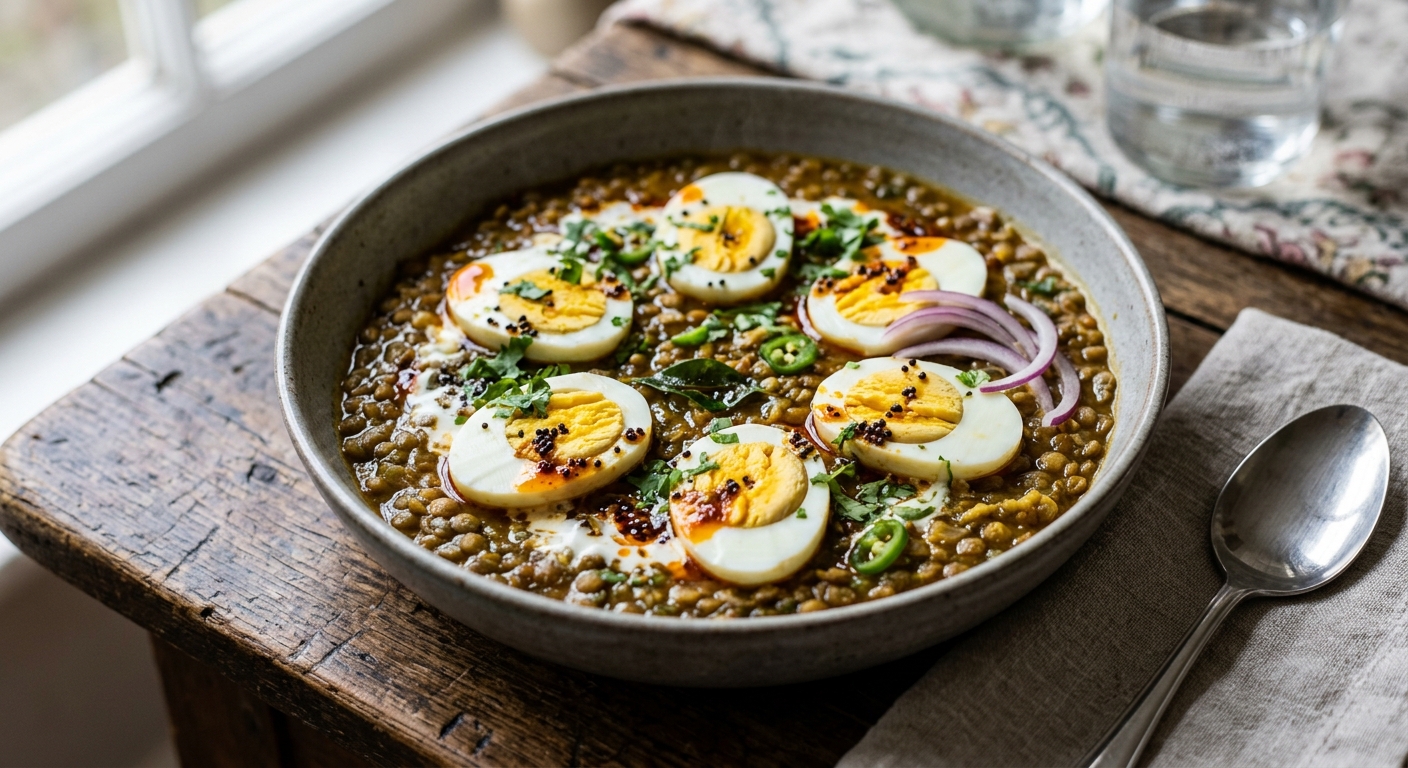
There is a reason this curry has earned a permanent spot in our weekly rotation: it is the rare dish that simultaneously satisfies deep comfort-food cravings and hits serious nutritional targets. Green lentils provide a slow-digesting base of plant protein, iron, and folate, while whole hard-boiled eggs layered into the gravy contribute complete protein with all nine essential amino acids, plus choline for cognitive function and fat-soluble vitamins D and B12 that lentils simply cannot supply. Together, a single bowl clears 36 grams of protein and surpasses the recommended daily intake for six key micronutrients.
The sauce is built on a classic South Asian tarka foundation: mustard seeds bloomed in oil, followed by onion cooked low and slow until deeply golden, then a paste of ginger, garlic, and green chilli. Tomatoes and coconut milk join next, creating a gravy with just enough richness to carry the spices without tipping into heaviness. Garam masala, turmeric, and ground cumin are added at two separate stages, a technique called double-spicing that ensures both raw depth and bright top-note aroma in the finished dish. The eggs are scored lightly so the sauce can penetrate the whites, turning each half into a spice-stained, protein-dense gem.
Because every cooking method behaves differently with lentils and eggs, we have written fully separate instructions for stovetop, slow cooker, pressure cooker, and oven. The stovetop gives you the most control over texture and colour. The slow cooker produces a darker, more melded gravy perfect for batch cooking. The pressure cooker is the weeknight workhorse, cutting active time to under 30 minutes. The oven version uses a covered Dutch oven for gentle, even braising that yields exceptionally creamy lentils. Choose your method based on your schedule, not just convenience.
4
servings
Ingredients
- 240 gdried green lentils (Puy or standard), rinsed and picked over
- 8 largeeggs
- 3 tbspAvocado Oil100% Pure Avocado Oil (such as sunflower or Avocado Oil100% Pure Avocado Oil)
- 1 tspblack mustard seeds
- 2 mediumyellow onions, finely diced
- 6 clovesgarlic, minced
- 30 gfresh ginger, peeled and grated
- 2 mediumgreen chillies, finely sliced (seeds optional)
- 400 gcanned crushed tomatoes
- 400 mlfull-fat coconut milk
- 480 mllow-sodium vegetable broth
- 2 tspground cumin
- 2 tspground coriander
- 1.5 tspground turmeric
- 1.5 tspgaram masala, divided
- 1 tspsmoked paprika
- 0.5 tspcayenne pepper, or to taste
- 2 tbsptomato paste
- 1 tbspfresh lemon juice
- 20 gfresh cilantro, roughly chopped, for garnish
- —Colima Sea SaltMicroplastic Free Salt and black pepper to taste
Instructions
Click on an item below to shop for the recommended items for this recipe on Amazon.
As an Amazon Associate, we earn from qualifying purchases.
- Hard-boil the eggs: place them in a saucepan, cover with cold water by at least 2.5 cm, and bring to a full rolling boil over high heat. Remove from heat, cover, and let stand for exactly 11 minutes. Transfer to an ice bath for 5 minutes, then peel. Using a sharp paring knife, score each egg with four shallow lengthwise cuts through the white, stopping just before the yolk. Set aside.
- Set a large heavy-bottomed pot or Dutch oven over medium-high heat. Add the oil and heat until shimmering. Add the mustard seeds and let them sizzle and pop for about 30 seconds, covering loosely if they jump. Add the diced onions with a pinch of salt and cook, stirring every 2 to 3 minutes, for 14 to 16 minutes until deeply golden and beginning to catch at the edges. Do not rush this step; the fond that forms is the backbone of the curry’s flavour.
- Reduce heat to medium. Add the garlic, ginger, and green chillies and cook, stirring constantly, for 2 minutes until fragrant. Add the tomato paste and stir vigorously for 90 seconds until it darkens by one shade. Add the ground cumin, ground coriander, turmeric, smoked paprika, cayenne, and 1 teaspoon of the garam masala. Stir for 1 minute, keeping everything moving so the spices bloom without burning.
- Pour in the crushed tomatoes and stir to deglaze any fond from the bottom of the pot. Cook for 5 minutes, stirring occasionally, until the tomatoes reduce slightly and the oil begins to separate at the edges, which indicates the rawness has cooked out. Add the rinsed lentils and stir to coat them thoroughly in the sauce.
- Pour in the vegetable broth and bring to a boil. Reduce heat to a steady simmer, partially cover the pot, and cook for 22 to 25 minutes, stirring every 5 minutes and adding a splash of water if the lentils absorb too much liquid. The lentils should be tender but still holding their shape with a thick, saucy consistency.
- Stir in the coconut milk and return to a gentle simmer for 5 minutes. Taste and adjust salt. Nestle the scored eggs into the curry, spooning sauce over them to coat. Simmer uncovered for 4 minutes so the eggs heat through and absorb the sauce through the score marks. Remove from heat, drizzle with lemon juice, and scatter over the remaining 0.5 teaspoon of garam masala. Garnish with cilantro and serve immediately.
- Make the tarka on the stovetop: heat the oil in a skillet over medium-high heat, bloom the mustard seeds for 30 seconds, then add the diced onions with a pinch of salt. Cook for 14 to 16 minutes until deeply golden. Add the garlic, ginger, and green chillies and cook for 2 minutes. Add the tomato paste and stir for 90 seconds until it darkens. Add all dry spices except the reserved 0.5 teaspoon of garam masala and stir for 1 minute. Pour in the crushed tomatoes, stir, and cook for 3 minutes. This stovetop tarka step cannot be skipped; a slow cooker will not develop the same depth of flavour from raw aromatics.
- Transfer the entire tarka mixture into the slow cooker insert. Add the rinsed lentils and pour in the vegetable broth. Stir thoroughly to combine. The liquid should just cover the lentils by about 1 cm; add up to 120 ml more broth if needed, as slow cooker lids trap steam and prevent evaporation.
- Cover and cook on Low for 6.5 to 7 hours or on High for 3 to 3.5 hours, until the lentils are completely tender and the sauce has thickened. The curry will look darker and more cohesive than the stovetop version because the flavours have had time to meld deeply.
- Hard-boil the eggs 30 minutes before the curry is due to finish. Place eggs in cold water, bring to a boil, cook for 11 minutes, ice-bath for 5 minutes, peel, and score each egg with four shallow cuts as described in the stovetop method. This timing keeps the yolks moist rather than chalky.
- Stir the coconut milk into the slow cooker and nestle the scored eggs into the curry. Re-cover and cook on High for a further 25 to 30 minutes until the coconut milk is fully incorporated, the sauce is creamy, and the eggs are heated through. Finish with lemon juice, the reserved 0.5 teaspoon of garam masala, salt to taste, and a generous handful of fresh cilantro before serving.
- Set the Instant Pot or electric pressure cooker to Saute mode on High. Add the oil and heat for 1 minute. Add the mustard seeds and cook for 20 to 30 seconds until popping. Add the diced onions and cook, stirring frequently, for 10 minutes until golden brown (Saute on High runs hotter than a stovetop, so watch carefully). Add the garlic, ginger, and green chillies and stir for 90 seconds.
- Add the tomato paste and stir for 60 seconds. Add the cumin, coriander, turmeric, smoked paprika, cayenne, and 1 teaspoon garam masala. Stir for 30 seconds. Pour in the crushed tomatoes and deglaze the bottom of the pot by scraping up any browned bits with a wooden spoon. This step is critical in a pressure cooker: any stuck fond can trigger the burn warning. Add the rinsed lentils and vegetable broth and stir well. Cancel Saute mode.
- Secure the lid and set the pressure valve to Sealing. Cook on High Pressure for 14 minutes. While the curry pressurises and cooks, hard-boil the eggs separately on the stovetop: bring a small saucepan of water to a boil, lower eggs in gently, cook for 11 minutes, ice-bath for 5 minutes, peel, and score with four lengthwise cuts.
- Allow the pressure to release naturally for 10 minutes, then carefully switch the valve to Venting to release remaining steam. Open the lid and stir the curry. The lentils should be completely tender and the sauce thick. If the curry is thinner than desired, use Saute mode on Medium for 3 to 4 minutes to reduce.
- Stir in the coconut milk on Saute mode (Medium) and bring to a gentle simmer for 3 minutes. Nestle the scored eggs into the curry and spoon sauce over them. Simmer for 3 to 4 minutes until the eggs are heated through. Turn off the pot, add lemon juice, the remaining 0.5 teaspoon garam masala, and salt to taste. Garnish with cilantro and serve directly from the insert.
- Preheat your oven to 170C (325F) with a rack positioned in the lower third. On the stovetop, heat the oil in a large oven-safe Dutch oven over medium-high heat. Bloom the mustard seeds for 30 seconds. Add the diced onions with a pinch of salt and cook for 14 to 16 minutes, stirring occasionally, until deep golden. The oven will continue to develop the fond during the bake, so a thorough stovetop browning here is essential.
- Reduce to medium heat and add the garlic, ginger, and green chillies. Cook for 2 minutes. Add the tomato paste, stir for 90 seconds until it darkens. Add the cumin, coriander, turmeric, smoked paprika, cayenne, and 1 teaspoon garam masala, stirring for 60 seconds. Pour in the crushed tomatoes and cook on the stovetop for 4 minutes, stirring often. Add the rinsed lentils and stir to coat.
- Pour in the vegetable broth and the full can of coconut milk together (unlike other methods, adding coconut milk at the start works in the oven because the temperature never reaches a rolling boil, preventing separation). Bring the liquid to a simmer on the stovetop, stir once, and taste for salt. Adjust seasoning before covering because it will be difficult to stir frequently once in the oven.
- Cover the Dutch oven tightly with its lid and transfer to the preheated oven. Bake for 45 minutes without opening the lid. Meanwhile, hard-boil the eggs: place in cold water, bring to a boil, cook for 11 minutes, ice-bath for 5 minutes, peel, and score with four shallow lengthwise cuts.
- After 45 minutes, remove the Dutch oven and carefully lift the lid away from you. Stir the lentils; they should be just tender. If they are still firm, cover and return to the oven for 10 more minutes. Once the lentils are done, nestle the scored eggs into the curry, spoon sauce generously over each one, and return the pot to the oven uncovered for 8 to 10 minutes to warm the eggs through and lightly set the top of the gravy. Remove, drizzle with lemon juice, dust with the remaining 0.5 teaspoon garam masala, and garnish with cilantro before serving.
Nutrition Breakdown
Per 1 serving (makes 4)
Vitamins & Minerals
% Daily Value based on a 2,000 calorie diet (FDA reference)
🧬 Essential Amino Acids
% of recommended daily intake (RDA) per serving
🛡 Antioxidant Profile
The Nutrition Science
The central nutritional story of this curry is protein complementarity made effortless. Green lentils are rich in lysine, one of the amino acids most commonly limiting in plant proteins, but relatively low in methionine and cysteine. Eggs are one of the highest-scoring complete proteins in food science, with a Digestible Indispensable Amino Acid Score (DIAAS) near 1.13, and they contribute the methionine that lentils lack. The result is a dish whose combined amino acid profile approaches that of animal muscle tissue, which is why the essential amino acid panel above shows every measured essential amino acid exceeding its RDA by at least 20 percent per single serving.
Turmeric deserves special attention beyond its vivid colour. The curcuminoids in turmeric are poorly absorbed in isolation, but the fat from coconut milk and egg yolks in this dish dramatically increases their bioavailability by enabling micellar transport through the intestinal wall. Studies show that consuming curcumin alongside fat increases plasma curcumin concentrations by up to 7.9 times compared to aqueous consumption. Pairing turmeric with black pepper, even in small amounts naturally present in garam masala, further enhances absorption by 20 percent via the piperine-mediated inhibition of hepatic first-pass metabolism.
The folate content deserves a note for anyone of reproductive age or managing homocysteine levels. At 310 mcg per serving, this curry provides 78 percent of the 400 mcg daily folate recommendation from whole food sources rather than synthetic folic acid. Food-form folate from lentils is in the naturally occurring 5-methyltetrahydrofolate form, which bypasses the MTHFR enzyme step that up to 40 percent of the population carries a variant for, making it accessible to virtually everyone regardless of genetic methylation capacity.
Pro Tips
- Score the peeled eggs with a paring knife rather than halving them; four shallow lengthwise cuts allow the curry sauce to soak into the whites while keeping the eggs visually impressive and structurally intact for serving.
- For maximum iron absorption, add the lemon juice at the very end of cooking rather than during it; heat degrades vitamin C rapidly, and the intact ascorbic acid converts non-haem iron from the lentils into the more absorbable ferrous form as it enters the digestive system.
- The curry base, meaning the tarka plus cooked lentils without the eggs and coconut milk, freezes exceptionally well for up to three months. Freeze in individual portions, then thaw, reheat, add freshly boiled coconut milk, and poach or add freshly boiled eggs to restore the dish to near-original quality on a busy weeknight.




Oh this is SO relevant to what I’ve been tracking – I’ve had the same experience with whole green lentils being so much gentler than split red ones! The intact hull on green lentils seems to feed my good bacteria without triggering inflammation the way the mushy red lentils do for me. Plus that complete protein with eggs is exactly what I’ve noticed keeps my energy stable and my IBS symptoms at bay for hours – I’m definitely making this and comparing it to my standard lentil dal to see how the coconut milk affects my inflammation markers versus my usual yogurt-based versions!
ok im really intrigued by this but need to ask about the lentil prep – are we talking split red lentils or whole green lentils here? because whole lentils have been way easier on my gut during remission but red lentils can be pretty rough texture wise even when theyre cooked down. also curious about the coconut milk ratio since higher fat content actually helps me absorb nutrients better without triggering inflammation, so id definitely be adding extra cream if thats an option. the protein combo is genius though, eggs have been my safest protein source so pairing them with something more substantial is making me want to try this asap
This lentil-egg combo is actually genius from an epigenetic standpoint, and I’m glad you two are noticing the gut difference with whole green lentils! The intact hull acts like a prebiotic, but here’s what really fascinates me: eggs are loaded with choline, which is a major methylation donor, and when you pair that with the folate and B vitamins in lentils, you’re essentially creating a meal that supports your MTHFR pathway and DNA methylation patterns. I started doing this exact combo last semester and noticed my energy stayed stable through afternoon classes instead of the usual crash, plus my students probably benefited from me being less hangry. Have either of